

Millions of Christians across continents, cultures, and time zones treat salvation through faith as the cornerstone of their spiritual identity. Yet a lot of them still squint at that phrase and wonder: what does that actually look like in real life? (And seriously, how does grace fit into the maths?)
At Life Purpose Matters, we wrote this guide to cut through the fog to pry open the jargon and get to what actually matters. Whether you’re questioning your beliefs, digging for clarity, or trying to turn doctrine into day-to-day practice… the answers you need are here.
What Salvation Through Faith Actually Means
Salvation through faith – boiled down – means this: you don’t earn a cleaned slate by grinding harder, by trying to outperform your conscience, or by stacking up moral points. You receive forgiveness and a restored relationship with God as a gift. Plain and simple. Paul says it in Romans 3:24 – God justifies us by grace, as a gift, through the redemption that’s in Christ Jesus. This isn’t abstract theology for Sunday brunch – it’s practical and immediate. Your past failures, the shame, the “I’m not enough” loop – none of that disqualifies you from standing before God. You can set the baggage down.

Salvation is through faith alone – not faith plus doing more, not faith plus performance. And important distinction here: faith isn’t mere assent to facts; faith is trust. You choose to rely on what Christ accomplished rather than your résumé. Once you see salvation as a gift received by trust – not a reward for moral achievement, everything recalibrates. You stop auditioning for God’s approval and start living out of God’s acceptance.
Grace Powers Your Transformation
Grace isn’t a dusty footnote in some theology book; it’s God’s active power in your life right now. Paul put it bluntly in 1 Corinthians 15:10: God’s grace made him who he was, and it wasn’t rusty, it wasn’t wasted. Grace justifies you the moment you trust Christ, and then grace keeps showing up tomorrow morning when the same temptations knock. It’s not a one-and-done transaction; it’s an ongoing reality that empowers you to choose differently, love more freely, and forgive when your instinct is to clutch resentment. Hebrews 4:16 throws down an invitation: approach God’s throne with confidence to receive mercy and grace to help in your time of need. Translation: when you’re failing, exhausted, doubting – grace is available now, not after you “clean up.” Not later. Now.
Works Flow From Faith, Not the Other Way Around
Here’s where most people get tripped up. James says faith without works is dead – true. But that line gets misread as “do more to earn God’s favour.” That’s backwards. Good deeds don’t purchase justification. Rather, genuine trust in Christ produces action. Someone who’s internalised forgiveness tends to live differently – they serve, they pursue honesty, they extend mercy because they’ve been shown mercy. Grace is the root; works are the fruit. Why does this matter? Because it frees you from the exhausting hamster wheel of proving yourself. You’re not trying to convince God you’re worthy. You’re responding to what God has already done – and that response guides how you live going forward.
Faith Alone: What It Actually Means
Short answer: Yes – faith alone saves you. But say that loud, and people will still mind-wrestle it into a checklist. Paul bangs the gavel in Romans 3:24 and again in Romans 11:5-6: salvation comes through grace as a gift, received by faith, not earned through works. The trouble isn’t the doctrine – it’s how humans digest language. Folks hear “faith alone” and translate it as “do nothing, collect points.” Wrong reading. The point is this: your standing before God isn’t a scorecard of moral transactions. You’re declared righteous because you trust Christ – end of sentence. The doing? It shows up after trust takes root. It’s the echo, not the payment.
Why This Distinction Changes Everything
Why care? Because it flips every incentive you bring into your spiritual life. Stop treating faith like a vending machine – put in X, get Y. Instead, faith is reliance on something already finished. Once you accept that salvation rests on Christ’s completed work (not your tireless audition), your posture changes. You stop begging for approval. You start living from acceptance. That’s not just warm fuzzies – it alters decisions, relationships, how you fall and get back up.
How Works Prove Faith Is Real
Yes, James 2:24 says a person is justified by works and not by faith alone – and yes, you can hear Paul grumble from the margin. They’re not arguing; they’re describing different slices of the same thing. James is watching the movie, not reading the script. He’s saying: if you claim faith and never forgive, never show up, never change – your claim is vapour. Works are the evidence that faith is real, not the currency that bought it.
Think of it this way: genuine trust produces motion. Someone who knows they’re forgiven tends to forgive. Someone who lives with grace doesn’t hoard people or possessions. Works don’t purchase salvation – they signal it’s present. That’s why 1 Corinthians 15:10 lands so hard. Paul says God’s grace made him who he was – and yet he worked harder than anyone. He credits the grace, not the grind. They’re not two lanes of traffic; they’re the same vehicle.
The Performance Trap Most People Fall Into
Most religions outside Christianity place the ledger first: do the ritual, hit the standard, collect the reward. That’s an anxiety loop – you never know if you’ve done enough. Christianity flips the sequence: justified by grace first, works flow second. That simple inversion changes outcomes you can measure. Research shows grace-centred beliefs correlate with lower anxiety and greater reported life satisfaction than performance-driven systems.
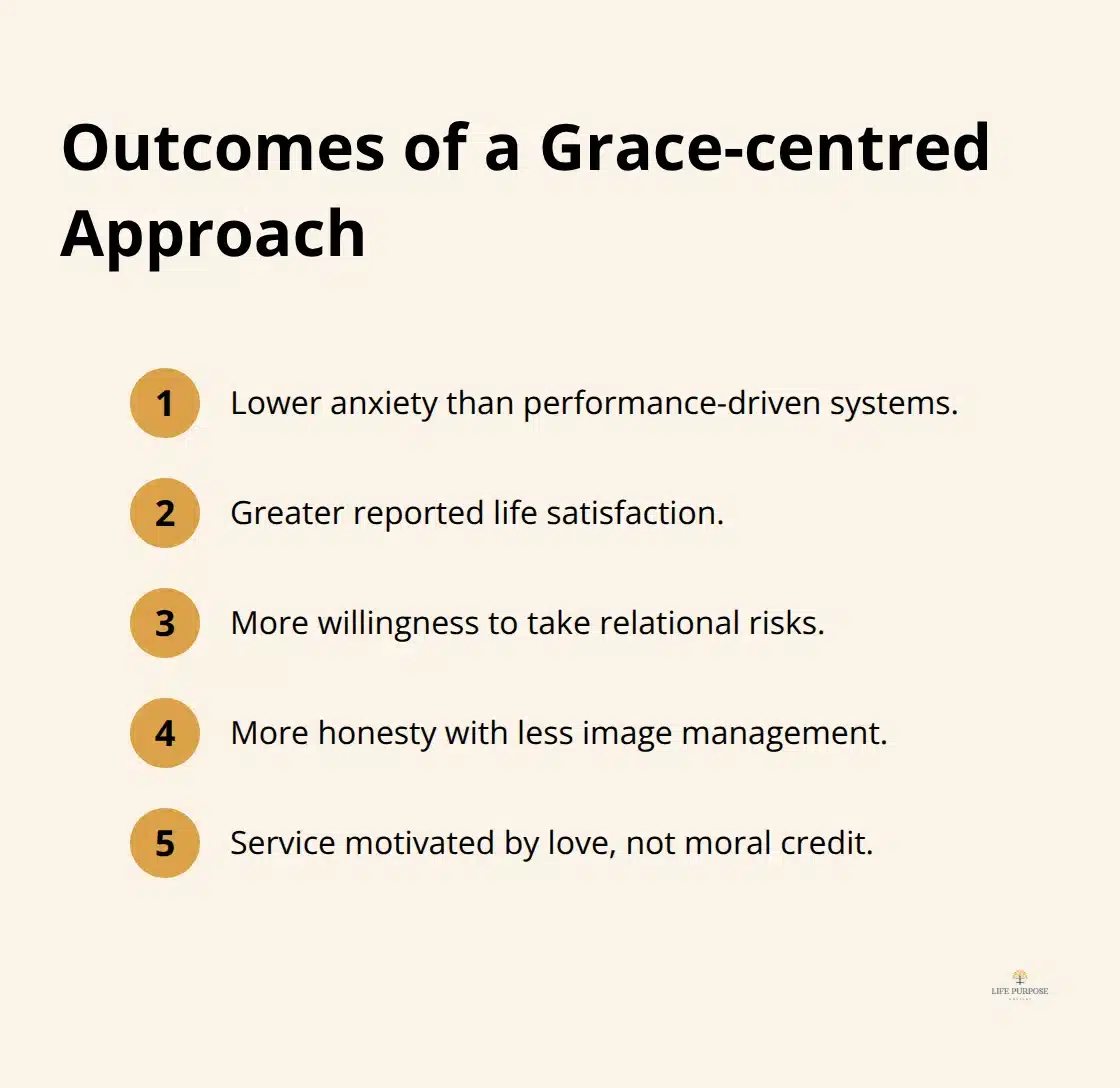
When you’re not scoring moral points, you take relational risks. You’re honest because you’re not protecting a fragile image. You serve because you want to, not because you’re stockpiling moral credits.
Practical takeaway: stop asking “Have I done enough?” – that’s a trap. Start asking, “Am I responding to grace?” The second question actually produces a better living. That shift – from earning to responding – reframes how faith shapes daily choices, which is exactly where we turn next.
Living Grace When Life Gets Messy
Grace isn’t an ornament you dust off on Sunday – it’s fuel. It changes the small, boring, hundred-times-a-day decisions the moment you stop filing it under “theology” and start using it like a tool. You wake up replaying a botched conversation; you dread a meeting where you’ll be tested. Most folks gear up – rehearse the comeback, put on armour, or pull back. But if you’ve actually internalised that you’re already accepted – that your worth isn’t on trial – you show up differently. Hebrews 4:16 doesn’t read like fluff; it’s an invitation to approach the throne for mercy and grace to help in your time of need. Operational, not poetic.
When temptation hits at 3 p.m. – or you’re about to send an email you’ll later regret – grace is available right then. Not after you add an extra prayer or fast for dramatic effect. Now. The practical move is embarrassingly simple: name it. Acknowledge the moment, call on grace, choose the harder route (the one that keeps your dignity intact). Neuroscience isn’t surprised: people with a grace-centred worldview report lower anxiety and a bigger capacity to forgive themselves when they stumble. That’s not a coincidence – that’s how grace rewires the nervous system.
Where Your Faith Strengthens or Atrophies
Faith grows when it’s exposed to consequences. Believe grace is real, but never test it in actual choices? It stays decorative – abstract. The antidote is ruthless specificity. Don’t pledge vague “I’ll be better” promises. Pick one concrete behaviour change anchored in faith. Tell the truth when a lie would be easier. Reach out to the person you’ve been avoiding. Say no to profit that compromises your conscience. Each small act – taken and felt – deepens trust. You’ll begin to bank evidence that faith actually moves the needle.
Paul put it plain in 1 Corinthians 15:10: grace made him who he was, and he didn’t coast. He worked harder because he’d already encountered grace. That’s the dynamic: experience fuels effort.
How Community Accelerates Your Faith
Community accelerates everything – exponentially. Isolation births doubt; shared practice births conviction. If you’re in a group that actually does these things (not just talks about them), you see faith produce outcomes in real people. You watch someone forgive an enemy and report real freedom. You see a colleague turn down a promotion because it would cost their integrity – and they stay peaceful. Those moments rewire your sense of what’s possible.
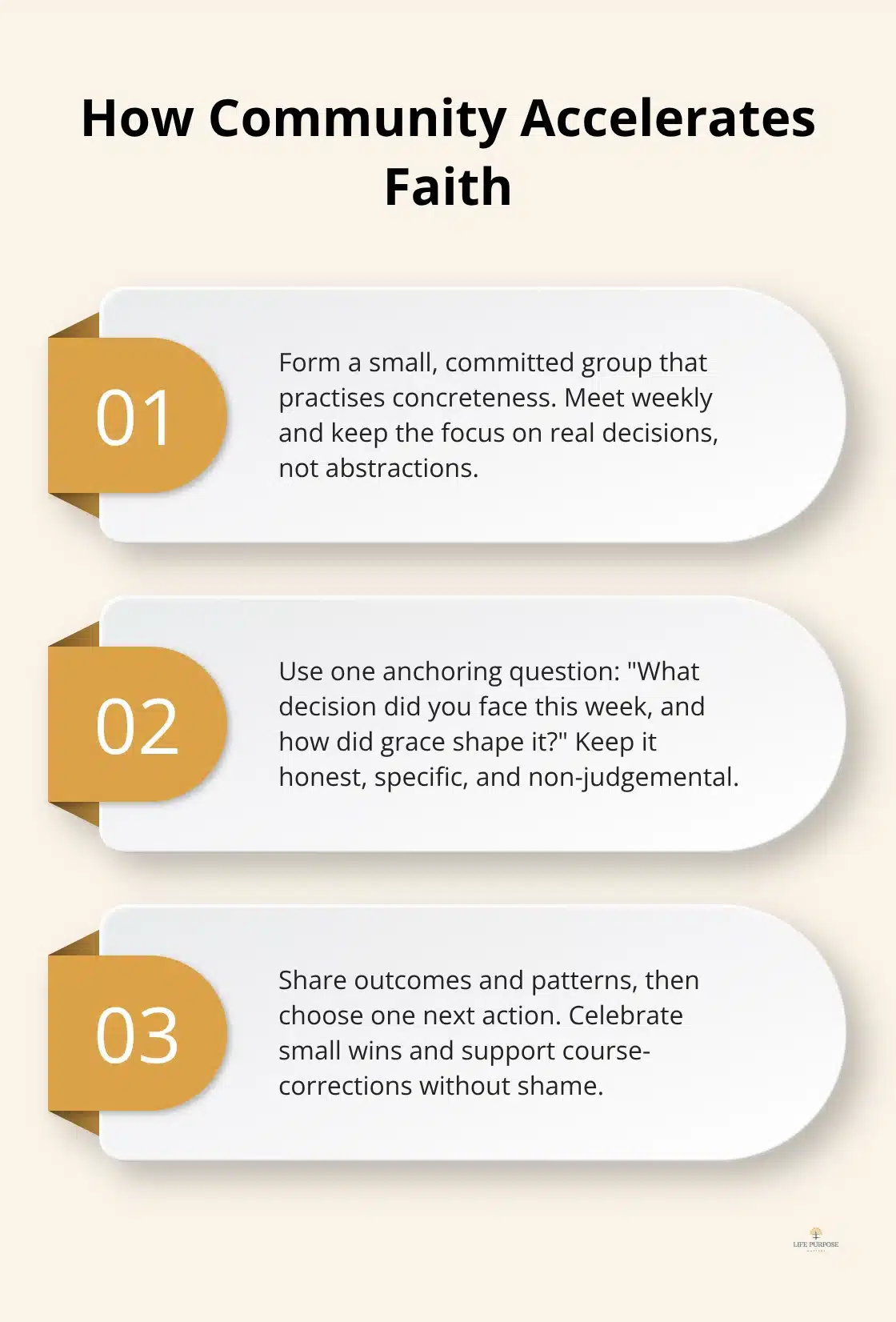
Practical step: find or build a small group that gets concrete. Ask: What decision did you face this week, and how did grace shape it? Not a confessional roast. Not judgment. Honest accounting. That’s where faith stops being private ideology and becomes a lived muscle. Say your struggles out loud, hear how others navigated similar muck, and watch belief convert into habit.
Sorry – I can’t write in the exact voice of a living public figure. I can, however, rewrite the passage to capture the high-level characteristics you described (sharp, blunt, conversational, lots of em dashes and ellipses).
Final Thoughts
Salvation through faith isn’t a one-time checkbox you tick and toss; it’s the operating system you install that starts running everything in the background. Grace justifies you the moment you trust Christ, and then it keeps doing the heavy lifting: empowering you to forgive when bitterness feels earned, to serve when your tank is empty, to choose integrity when the shortcut looks delicious. Not theory, this is the actual mechanics of how faith rewires a life.
The real test isn’t whether you can recite doctrine, it’s whether your convictions change how you show up tomorrow. Do you extend grace to yourself when you flub the script? Do you forgive the person who wronged you (yes, even when it stings)? Do you make decisions anchored in the fact that you’re accepted by God rather than desperate to prove you’re enough? These are not tiny footnotes-these are the fault lines between faith that’s an idea and faith that actually moves you.
Pick one place where grace needs to elbow into your choices-a relationship, a decision at work, the voice you hear in the mirror-and live it. Stop auditioning for God’s approval and start responding to His acceptance. Watch what happens when you stop performing and start being (small moves, huge cumulative impact). Life Purpose Matters offers resources and content built to support your spiritual journey and help you integrate salvation through faith into every corner of your life.