
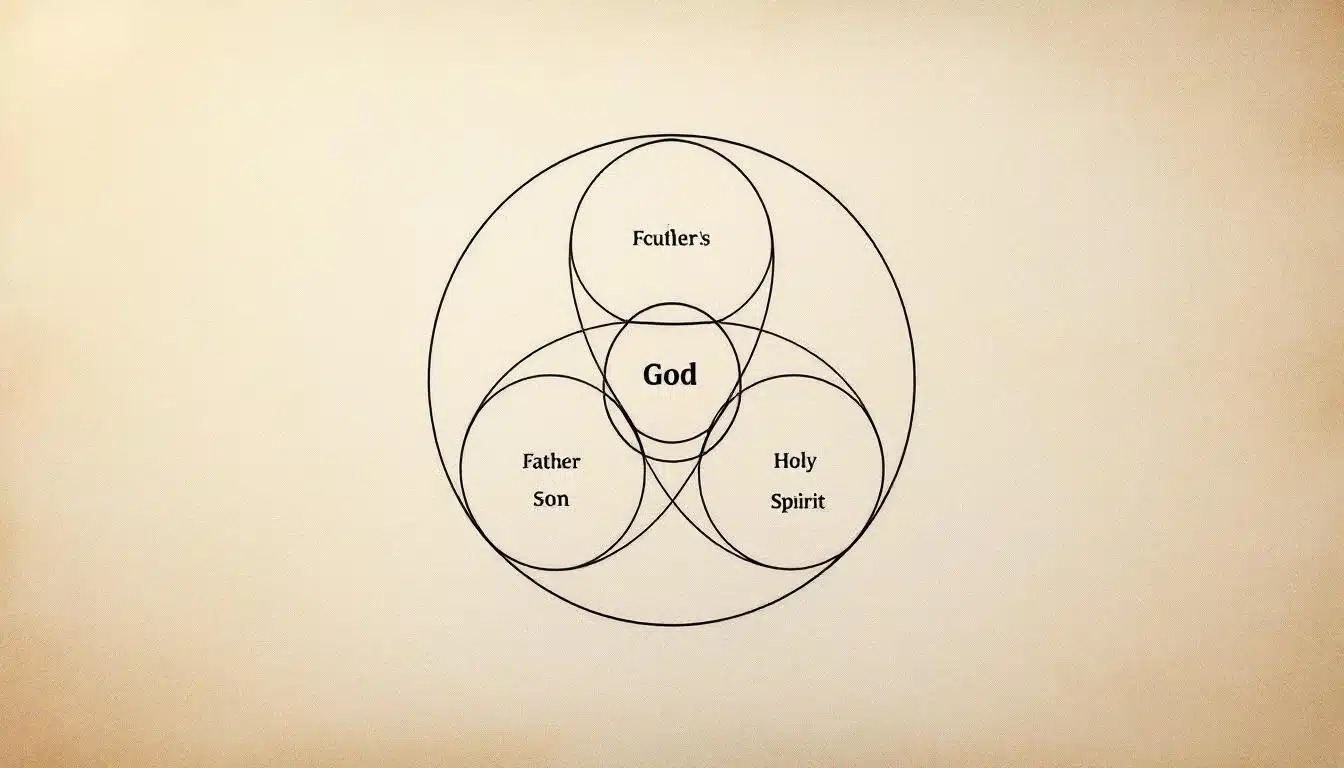
Walk into almost any older church and look closely at the stained glass or carved stonework, and you’ll likely spot three interlocking circles arranged within a shield. Most people never notice it at all.
That symbol, the Shield of the Trinity, has guided Christian faith for centuries, yet many of us walk past it without understanding its profound meaning. Here at Life Purpose Matters, we believe these ancient symbols still speak to us today, offering both spiritual depth and practical ways to strengthen our faith.
Origins and Historical Development of the Shield of the Trinity
When the Shield First Appeared
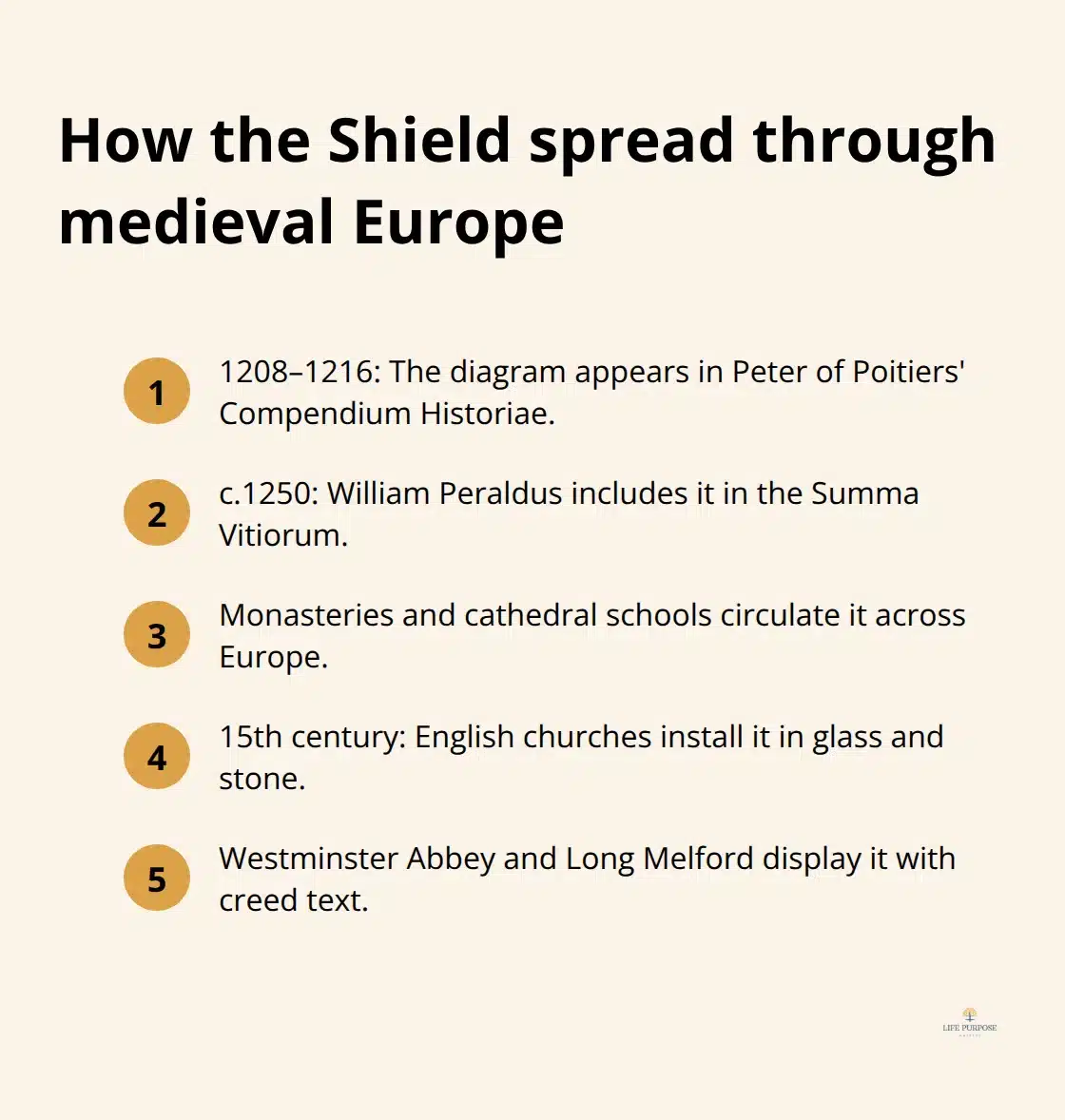
The Shield of the Trinity emerged around 1208–1216 in Peter of Poitiers’ Compendium Historiae, a manuscript that documented biblical genealogy and Christian doctrine. This timing reveals something important: the diagram didn’t appear in isolation. Medieval Christians faced real theological problems that demanded visual solutions. The 12th and 13th centuries tested Christian doctrine severely. Heretical movements like Arianism and Modalism threatened the church’s understanding of God’s nature. The Shield provided a direct answer to these threats. Its four-node structure with the central Deus connected to Father, Son, and Holy Spirit used simple geometry to state what centuries of theological debate had confirmed: the three Persons are fully God, yet only one God exists. The diagram worked because it required no extensive education to understand. In an era when most Christians couldn’t read Latin theological treatises, a visual tool that encoded the Athanasian Creed’s logic became invaluable.
How the Shield Spread Through Medieval Europe
Dominican friar William Peraldus amplified the Shield’s reach when he included it in his Summa Vitiorum around 1250, a moral instruction manual that spread across monasteries and cathedral schools throughout Europe. This decision transformed the Shield from an academic curiosity into a teaching instrument that reached ordinary clergy and monks. The Shield’s real power revealed itself when it moved beyond academic texts into lived worship spaces. The 15th century marked the turning point. Churches in England, particularly in East Anglia, began installing the Shield in stained glass and stone carvings. Westminster Abbey featured it prominently, and Long Melford Church paired a Shield window with the Athanasian Creed’s declaration Unus non tres-one God, not three.
This architectural integration served a strategic purpose, not merely a decorative one. Church leaders understood that when ordinary believers saw the Shield repeated in their worship environment, the Trinity doctrine moved from abstract theology into embodied faith. The vertical connections stating each Person is God, combined with horizontal negations preventing confusion between Persons, became a visual prayer that worshippers absorbed during every service.
Regional Variations in Christian Traditions
The Shield’s spread across Christian traditions happened unevenly, reflecting genuine theological differences among regions. Western European traditions, especially within Catholic and Anglican contexts, embraced the Shield as a standard teaching tool. Eastern Orthodox Christianity, however, developed different visual expressions of Trinitarian theology. This variation mattered theologically. Eastern traditions often resisted the Filioque clause that Western theology emphasized, and the Shield’s structure could accommodate both orientations depending on whether the Father occupied the top or bottom position in the triangle. These regional differences show how a single symbol adapted to express the same core doctrine while respecting distinct theological emphases. Understanding these variations helps modern Christians recognise that the Shield wasn’t a rigid formula imposed uniformly, but rather a flexible framework that different Christian communities shaped to match their own theological convictions and worship practices.
What Does Each Part of the Shield Actually Represent
The Four Nodes and Their Theological Weight
The Shield of the Trinity works because it translates abstract theological doctrine into visible geometry that your brain processes instantly. At its core, the diagram contains four nodes: the central Deus representing God’s single essence, and three outer nodes for the Father, Son, and Holy Spirit. The connecting lines between these nodes carry two Latin terms: est meaning is, and non est meaning is not.
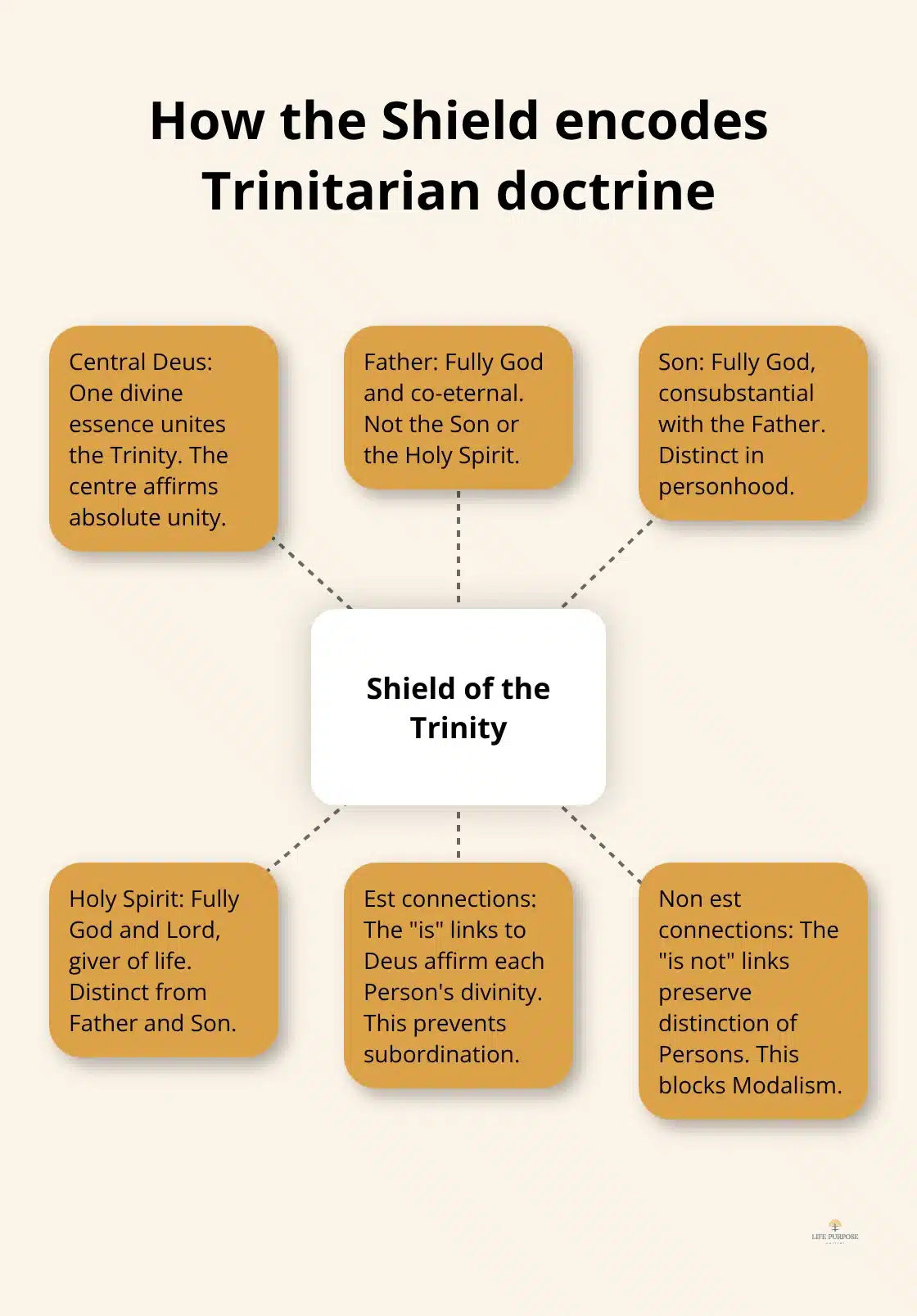
This seemingly simple structure encodes twelve distinct theological statements that medieval Christians needed to understand and defend against heretical movements.
How the Vertical Connections Assert Divinity
The vertical connections state what sounds straightforward but challenged heretics for centuries: the Father is God, the Son is God, and the Holy Spirit is God. Each statement appears twice because the logic runs bidirectionally, confirming that if the Father is God, then God is the Father. This bidirectional thinking matters practically for your faith because it prevents you from treating the Trinity as a hierarchy where the Father ranks above the Son or the Spirit. Medieval theologians recognised that without this bidirectional affirmation, believers would naturally assume the Father held supreme authority while the other Persons occupied subordinate positions.
The Horizontal Negations That Preserve Distinction
The horizontal connections establish what the Persons are not. The Father is not the Son, the Son is not the Holy Spirit, and the Holy Spirit is not the Father. This non est logic directly countered Modalism, a heresy that claimed God simply appeared in different forms at different times, like an actor changing costumes. Medieval theologians recognised that Modalism destroyed the reality of the Incarnation and the Pentecost because those events required distinct Persons acting simultaneously, not one God switching modes. When you study the Shield today, these negations prevent the most common mistake modern Christians make: collapsing the Trinity into vague monotheism where Father, Son, and Spirit become interchangeable names rather than distinct Persons with real relationships to one another.
Holding Two Truths Without Compromise
The Shield’s genius lies in forcing you to hold two truths simultaneously without compromising either one. The Athanasian Creed, which the Shield visually summarises, states this tension explicitly: we worship one God in Trinity and Trinity in Unity, neither confusing the Persons nor dividing the Substance. This isn’t poetic language meant to comfort you with mystery; it’s precision theology designed to protect Christian teaching from three major corruptions. Against Arianism, which claimed the Son and Spirit were created beings inferior to the Father, the Shield’s equal positioning of all three Persons in the diagram asserts their co-eternity and co-equality. Against Tritheism, which treated the Trinity as three separate gods, the central Deus anchors all three Persons in one divine essence. Against Modalism, which collapsed the three Persons into one changeable identity, the horizontal negations preserve genuine personal distinction.
Why Medieval Churches Made the Shield Visible
Medieval Christians painted and carved the Shield into their churches not because they enjoyed symbolic puzzles but because they needed a teaching tool that prevented theological drift. Modern churches largely abandoned visual theology in favour of preaching and written doctrine, which explains why many contemporary Christians struggle to grasp what the Trinity actually means. The Shield offers a corrective: it lets you see the problem the Trinity solves and the solution simultaneously. Without the Father, Son, and Spirit as distinct Persons, prayer becomes confused and the Incarnation becomes meaningless. Without their unity in one essence, you’ve abandoned monotheism. The Shield holds both truths in tension through its four-node structure, making abstract doctrine concrete enough to remember and teach to others. This visual clarity becomes especially valuable when you consider how the Shield functioned in actual worship spaces-not as decoration, but as a silent teacher that reinforced orthodox doctrine with every glance.
Living the Trinity in Your Daily Spiritual Practice
Anchor the Shield in Your Prayer Space
The Shield of the Trinity moves from medieval church walls into your actual spiritual life through deliberate, repeatable practices that anchor Trinitarian theology in how you pray, worship, and relate to God. Many modern Christians treat the Trinity as a theological abstraction they accept but never experience, which explains why the doctrine feels distant and impersonal. The Shield changes this because it gives you a concrete visual structure to return to during prayer and worship.
Start by printing or drawing the Shield yourself and placing it where you pray regularly. Research documents that medieval believers absorbed Trinitarian doctrine through repeated visual exposure in their worship spaces, and the same mechanism works today. When you see the Shield daily during your prayer time, your brain internalises the relationship between unity and distinction without requiring theological study.
Practice Structured Meditation on Each Connection
The specific practice that works best involves meditating on one connection at a time during your prayer sessions. On Monday, focus on the vertical connection affirming the Father is God. Tuesday, contemplate the Son is God. Wednesday, the Holy Spirit is God.
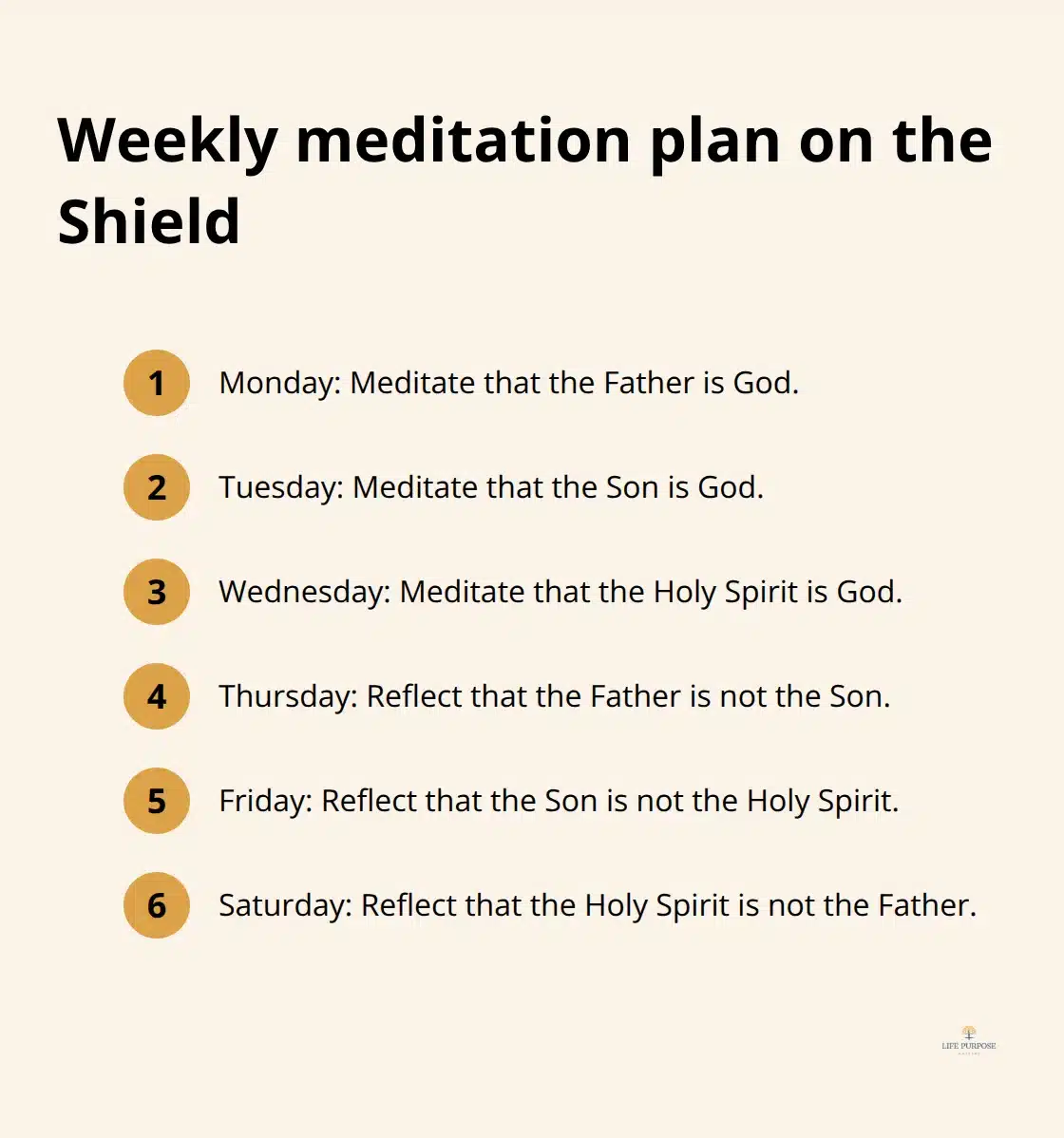
Thursday through Saturday, sit with each negation that preserves personal distinction. This structured approach prevents the Trinity from remaining abstract and transforms it into a lived reality that shapes how you address God in prayer.
When you pray the Lord’s Prayer, you can visualise how the Father receives your petition, the Son intercedes for you, and the Spirit empowers your words simultaneously, not sequentially or interchangeably. This mental practice rewires how you experience prayer itself.
Integrate the Shield Into Congregational Worship
Church communities that have reintegrated the Shield into their worship spaces report measurable shifts in how congregants understand and discuss Trinitarian theology. Grace Episcopal Church in Decorah, Iowa and Our Saviour’s Lutheran Church in Port Orange, Florida both feature Shield imagery prominently, and both churches note that members reference the diagram when discussing their faith with others.
The practical integration happens through multiple channels simultaneously: include the Shield in your church bulletin or worship guide with one statement from the diagram highlighted each week, project it during sermons on Trinity Sunday, and use it as a teaching tool in confirmation classes and Bible studies. The Shield works particularly well when churches display it alongside the Athanasian Creed’s actual text so worshippers see how the diagram translates dense theological language into visible form.
Propose Visual Theology to Your Worship Community
If your church lacks Shield imagery, you can initiate this change by proposing it to your worship committee with historical examples from Westminster Abbey and Long Melford Church demonstrating how previous generations used visual theology to strengthen faith. Modern Christians often assume that doctrine happens through words alone, but the Shield demonstrates that your brain processes and retains theological truth more deeply when multiple sensory channels engage simultaneously (visual, spatial, and conceptual).
The visual dimension activates memory pathways that pure auditory learning cannot reach, which explains why churches that abandoned visual theology in favour of exclusive verbal teaching saw corresponding declines in congregational understanding of core Christian doctrines. Your worship space communicates theology whether you intend it to or not-the Shield ensures that communication reinforces orthodox faith rather than leaving doctrine to chance.
Final Thoughts
The Shield of the Trinity bridges a gap that modern Christianity often leaves wide open. For centuries, this diagram functioned as far more than decoration in medieval churches-it served as a teaching instrument that made invisible theological truth visible and memorable. Your brain processes visual information differently than verbal instruction alone, which explains why churches that integrated the Shield into their worship spaces saw deeper congregational understanding of Trinitarian doctrine.
The Shield of the Trinity demonstrates that your faith deepens when multiple dimensions of your experience-visual, intellectual, and spiritual-engage simultaneously. Whether you print it for your prayer space, meditate on its connections during worship, or propose it to your church community, this ancient symbol translates doctrine into something you can see, remember, and teach to others. The diagram doesn’t require advanced theological training to grasp, yet it contains the precision that medieval theologians needed to defend Christian teaching against Arianism, Modalism, and Tritheism.
If the Trinity feels abstract or distant in your spiritual life, the Shield offers a concrete entry point that strengthens your ability to live your faith with purpose and conviction. Explore resources designed to help you integrate your faith more fully into daily life and discover how Christian symbols can transform your spiritual practice.