

I remember sitting in a church pew, surrounded by people who seemed to have it all figured out spiritually, while I was wrestling with questions that felt almost blasphemous to voice. My prayers felt hollow. My certainty had evaporated.
If you’ve been there-where doubt whispers louder than faith, where trusting God through trials feels impossible-you’re not alone, and you’re not broken. At Life Purpose Matters, we’ve found that weakness in faith isn’t a sign of failure; it’s often where real trust begins to take root.
When Faith Feels Weak, and Doubt Creeps In
Spiritual Struggle Arrives Quietly
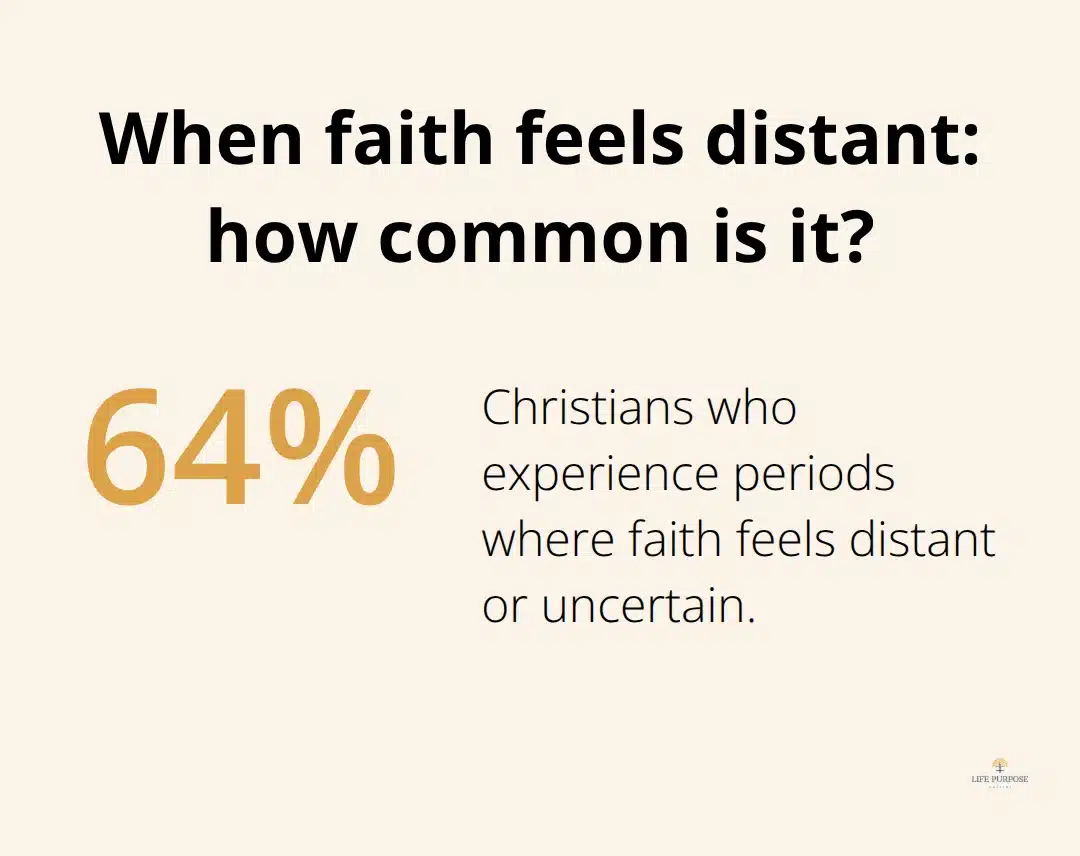
Spiritual struggle isn’t always dramatic. It doesn’t announce itself with thunder or require a catastrophic life event to show up. Sometimes it arrives quietly-a prayer that feels like talking to an empty room, a Bible passage that used to anchor you but now sits flat on the page, a Sunday morning when you can’t quite muster the energy to show up. The Barna Group found that 64% of Christians experience periods where their faith feels distant or uncertain, yet many suffer in silence because admitting doubt feels like admitting defeat.
What you experience when faith weakens isn’t weakness at all; it’s often the beginning of something deeper. The difference between doubt and lack of faith matters enormously.
Doubt Is Not the Same as Lack of Faith
Doubt is a question directed at God. Lack of faith is turning away from Him entirely. Job questioned God relentlessly throughout his suffering, yet Scripture calls him faithful. Peter sank into the water because fear overtook him momentarily, not because his faith vanished. David wrote Psalms filled with raw anguish and honest confusion, and those words became Scripture itself.
These weren’t people without faith; they were people whose faith was tested and refined in real time. Your doubt doesn’t disqualify you from genuine faith any more than a question disqualifies a student from learning.
What Actually Triggers Spiritual Doubt
The triggers that shake your confidence in God are usually specific and identifiable. Unanswered prayers that stretch on for months or years wear you down in ways that quick solutions never could. Suffering that serves no apparent purpose-a diagnosis, a loss, a betrayal-creates legitimate confusion about God’s character. Witnessing injustice or tragedy on a global scale can make trusting a loving God feel naive.
Social pressure and spiritual comparison, especially in church settings where everyone appears to have unwavering certainty, make you question whether your struggle means you’re spiritually inferior. Spiritual exhaustion from trying to maintain faith through relentless difficulty simply depletes your reserves. These aren’t character flaws or signs you need more prayer; they’re the actual weight of living faithfully in a broken world.
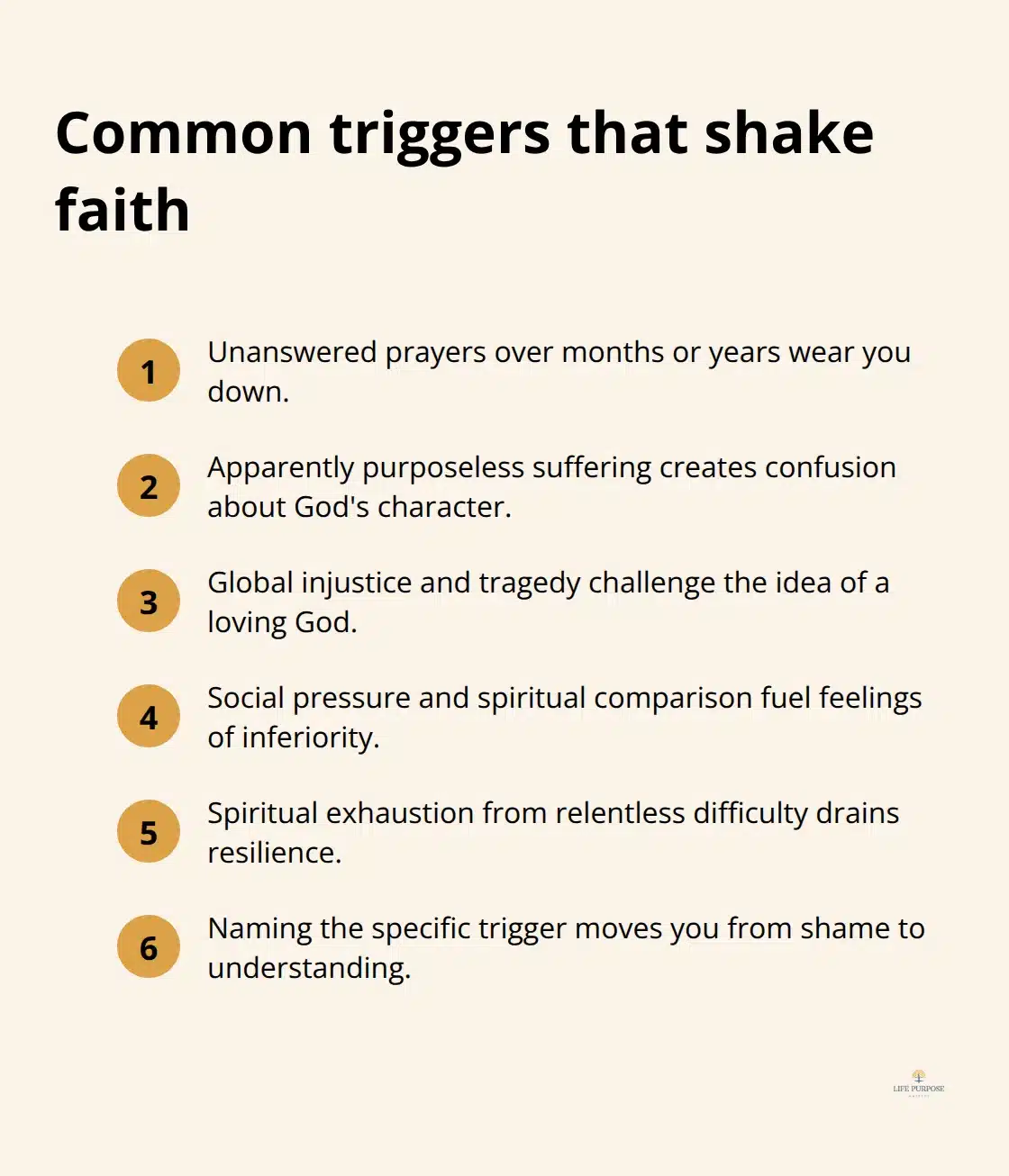
When you identify what specifically triggered your doubt, you stop treating faith as a vague feeling and start treating it as something rooted in real circumstances that deserve honest acknowledgement. This clarity matters because it moves you from shame to understanding, and understanding is where real faith is rebuilt. The biblical figures who walked through trials didn’t pretend their struggles away, and neither should you.
Biblical Figures Who Faced Faith When It Cracked
Job Argued With God and Stayed Faithful
Job’s story is often misunderstood as a tale of unwavering patience, but the reality is messier and more instructive. Job spent 42 chapters questioning God directly, not politely tiptoeing around his pain. He told God his suffering made no sense, that divine justice seemed absent, and that he wanted answers. What strikes readers most is that God did not rebuke Job for his doubt; God engaged with him. Job’s faith was not about maintaining certainty through suffering-it was about staying in conversation with God even when everything felt unfair.
The practical takeaway matters: when your faith wavers, staying in honest dialogue with God through prayer during suffering is itself an act of faith. Job did not pretend to understand. He argued his case and remained in a relationship with God simultaneously. That’s the model worth following when your own prayers feel more like complaints than praise.
Peter Sank Because Fear Overtook Him, Not Because Faith Vanished
Peter’s moment on the water reveals something equally important about faith and fear coexisting. Matthew 14:28-31 shows Peter stepping out of the boat with genuine faith, then sinking the moment fear overtook him. Jesus did not say Peter lacked faith; He asked why Peter doubted. The distinction matters: Peter’s doubt did not erase his earlier faith. He had already demonstrated faith by stepping out. His struggle happened within faith, not outside it.
This means your current wavering does not cancel out your past faithfulness, and it does not disqualify your future trust. Fear and faith can occupy the same moment, and recognising that prevents the spiritual shame that often deepens doubt. When you accept that doubt and faith coexist, you stop treating weakness as a disqualification.
David Spoke Truth to Himself While Acknowledging His Despair
David’s Psalms operate as a masterclass in honest prayer. He wrote about feeling abandoned, angry, confused, and desperate-yet these prayers became Scripture itself. Psalm 42:5 shows David talking to himself, reminding himself to hope in God despite feeling overwhelmed. He was not pretending strength he did not feel; he was actively choosing to redirect his thoughts toward God’s faithfulness while fully acknowledging his current despair.
This practical approach-naming the struggle, then intentionally redirecting toward God’s character-gives you a framework for your own prayers. David did not wait until he felt better to pray. He prayed his way through the darkness, speaking truth to himself about who God is even when circumstances suggested otherwise. His honesty and his faith operated together, not in opposition.
What These Three Figures Teach Us About Staying Faithful
Job, Peter, and David shared a common approach: they brought their full selves to God, including their confusion and pain, and they refused to abandon Him despite legitimate reasons to do so. None of them pretended their struggles away. Each one faced real circumstances that tested their faith to its limits. Yet each one also chose to stay connected to God through the difficulty.
Their examples show that faith does not require certainty, and doubt does not require abandonment. When you move forward with this understanding, you’re ready to take concrete steps that actually rebuild trust when your own faith has cracked.
How to Actually Rebuild Faith When Doubt Takes Over
Reconnect to God’s Promises Through Your Own History
When your faith wavers, the instinct is often to pray harder or read more Scripture, as if sheer effort will restore what feels broken. That approach misses what actually works. Faith rebuilds through deliberate, small actions that reconnect you to God’s character and His track record in your life. The key is moving from abstract belief to concrete practice.
Start with Scripture, but approach it differently than you might expect. Don’t search for comfort passages or try to manufacture certainty through inspirational verses. Instead, read the actual promises God made and track His faithfulness in fulfilling them. Psalm 23 isn’t primarily about feeling peaceful; it’s about acknowledging that God functioned as your shepherd before, even in valleys you didn’t think you’d survive. Isaiah 41:10 isn’t motivational fluff; it’s a direct statement: God will strengthen and help you, and He will uphold you. When doubt whispers that God is absent or uncaring, these aren’t nice ideas to meditate on-they’re historical claims about who God is.
Write three specific promises on paper. Next to each one, write a time in your past when God demonstrated that promise was true. Did He provide when you didn’t know how? Did He protect you from something you feared? Did He guide you toward something good? This isn’t positive thinking; it’s evidence-gathering. Do this weekly. Your brain needs concrete reminders that God’s promises have already proven true in your actual life, not just in theory.
Share Your Struggle With Someone Who Won’t Offer Platitudes
Connect with your faith community, but with brutal honesty about what you actually need. Most churches create spaces where people perform spiritual health rather than admit struggle. Find one or two people who can handle your real doubt without offering platitudes or spiritual bypassing. Believers who share their struggles with a trusted community member experience measurable increases in spiritual resilience compared to those who suffer silently.
Tell someone specific: I’m struggling to trust God right now, and I need you to pray for me and check in with me weekly. Not someday, but this week. Commit to that conversation. The accountability matters because isolation deepens doubt, while connection, even a messy, uncertain connection, reminds you that others have walked through this and found their way back. You’re not the first person in your church to question God, and you won’t be the last. Saying it out loud breaks the lie that you’re uniquely broken.
Practice Small Obedience That Doesn’t Require You to Feel Faithful
Practice obedience in small, daily ways that don’t require you to feel faithful. You don’t need to commit to a major spiritual overhaul. Instead, identify one small action that aligns with trusting God and repeat it consistently. If you struggle to believe God cares about your future, spend five minutes each morning writing down one thing you’re grateful for. Gratitude rewires your brain toward noticing God’s provision rather than fixating on what’s missing.
If you doubt God’s presence, set a phone reminder three times daily to pause and acknowledge God is with you, even if you don’t feel it. If you struggle to believe God wants good for you, serve someone else once weekly, not because it makes you feel spiritual, but because serving forces you to act as though God’s character is trustworthy. These small obligations aren’t about earning God’s favour or proving your faith. They’re about training your thoughts and actions toward trust while your emotions catch up.
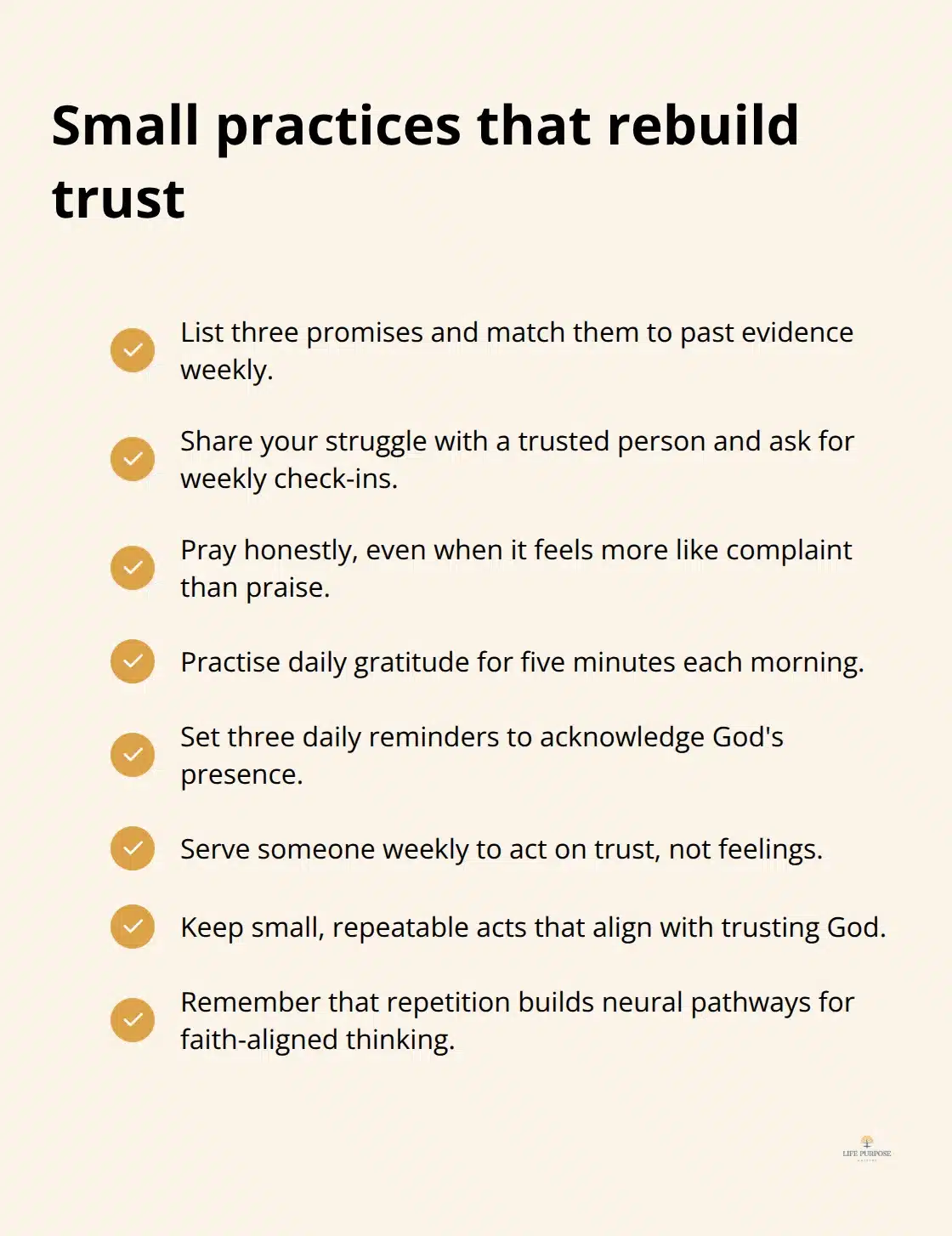
Consistent small actions, repeated over time, create neural pathways that make faith-aligned thinking feel more natural. You’re not faking it until you make it; you’re practising trust until trust becomes your default response again.
Final Thoughts
Your faith grows stronger not because struggle disappears, but because you choose to trust God while struggle remains. Every time you pray when prayers feel hollow, every time you act with obedience despite doubt, every time you admit your weakness to another believer instead of pretending certainty, you build something real. The Psalms exist because David refused to sanitise his pain, Job’s story endures because he argued with God and stayed faithful anyway, and Peter walked on water, sank, and was still called by Jesus-these weren’t people who achieved perfect faith, but people who kept showing up despite legitimate reasons to quit.
Trusting God through trials when faith feels weak means taking the next small step anyway, speaking truth to yourself when doubt whispers lies, and letting someone else carry part of your burden when you’re too tired to carry it alone. God doesn’t meet you when you’ve figured everything out; He meets you in your weakness, in your questions, in the moment you admit you don’t know how to trust anymore, but you’re willing to try. That’s where real faith begins-not in certainty, but in the choice to stay connected to God even when everything feels uncertain.
Your struggle isn’t a detour from your spiritual journey; it’s the journey itself, and you’re not walking it alone. If you’re ready to explore how your faith connects to your deeper purpose, visit Life Purpose Matters for resources designed to support you on this path forward.