

Peace feels impossible when anxiety takes over, you know the feeling: chest tight, thoughts sprinting, the future suddenly an opponent. Whether you’re wrestling with inner turmoil, sparring with someone else, or asking (loudly) what on earth God’s plan even is — Bible verses about peace land like anchors. They don’t fix everything… but they steady you. They give you a place to breathe.
At Life Purpose Matters, we pulled together 24 verses that speak to the different kinds of peace you actually need right now — quiet, bold, everyday, and emergency-level. Treat them like tools: open them, use them, come back to them (often). One read won’t do it; consistency will.
First, check out this beautiful piece, click here =>> He is My Peace
Finding Peace Within Yourself
Inner peace isn’t something that happens to you – it’s something you build, usually smack in the middle of chaos. Philippians 4:6-7 gives a mechanic, not a mystery: stop hiding your anxiety and name it out loud to God through prayer. Add thanksgiving to that mix, and something actually shifts. Your nervous system gets the memo – you’re safe enough to let go of the tight, white-knuckled grip. The verse promises that God’s peace will guard your heart and mind – not by vapourising the problem, but by stopping the spiral.
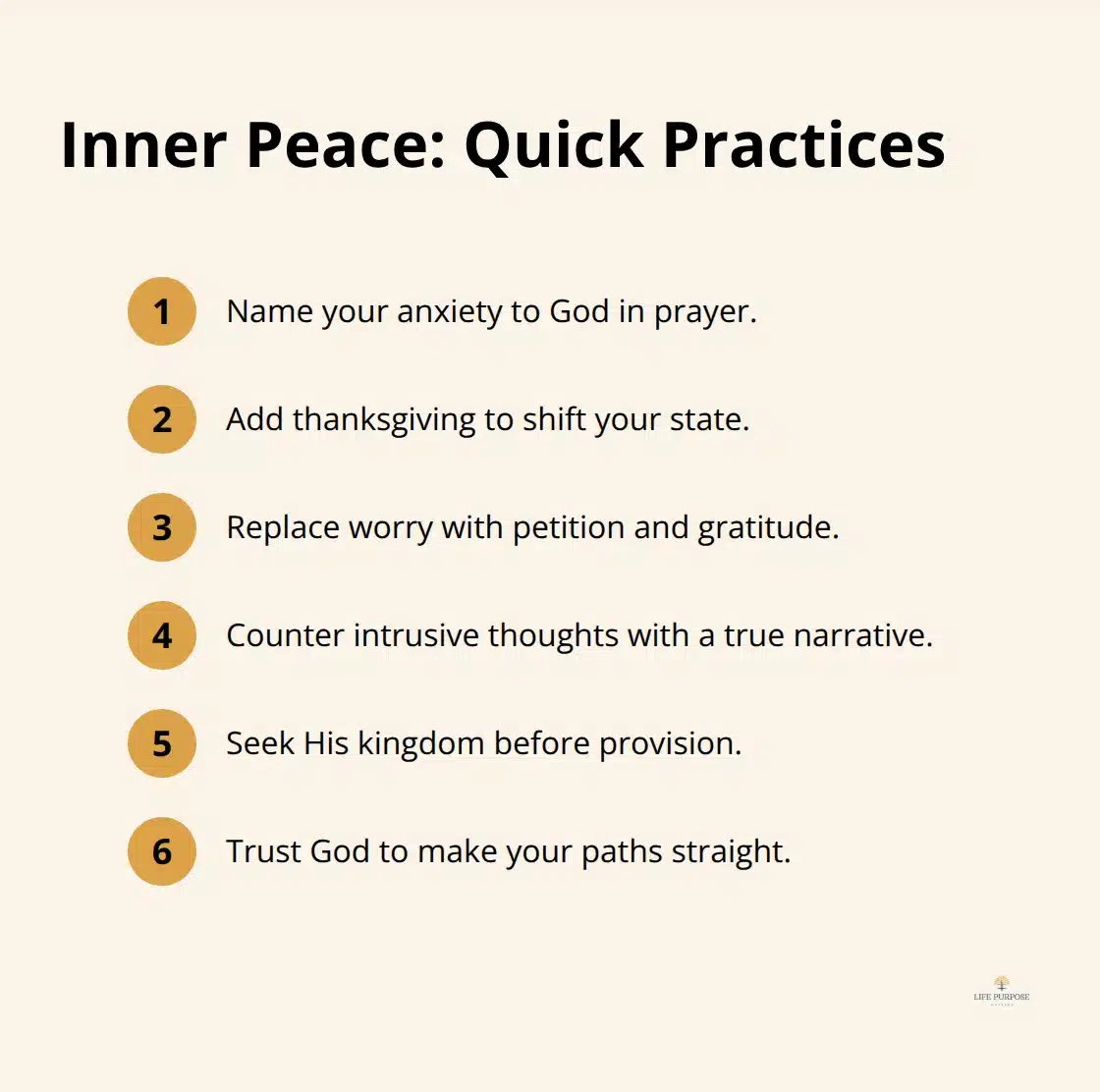
Why does it work? Because you replace the hamster wheel of worry with a loop of petition and gratitude. Proverbs 12:25 says what your gut already knows: anxiety drags the heart down, but a kind word lifts it. That kindness? It can land from someone else – or from you, delivered to yourself. Intrusive thoughts need a counter-narrative. Matthew 6:25-34 delivers one: can worry add a single moment to your life? No. Then Jesus pivots hard – stop obsessing over provision and start seeking His kingdom first. Everything else follows. This isn’t passive waiting – it’s an active redirection of mental energy toward what actually matters.
When Worry Won’t Stop
Psalm 55:22 gives you a physical verb: cast your burdens on the Lord. Cast – as in throw (not a careful placement). Offload with force – don’t hoard the weight. Isaiah 41:10 pairs with this: God strengthens you and holds you up with His righteous right hand. That’s concrete language – you’re not stranded. Luke 12:25 brings you back to the core truth: anxiety is profoundly unproductive. It doesn’t lengthen your life or solve tomorrow’s problems today. What it does is steal today – the present. Jeremiah 29:11-12 flips the narrative: God has plans to prosper you, not to harm you. Call on Him and pray – He listens. This is not abstract theology; it’s relational. You’re speaking to someone who’s already thinking about your future.
When You Need Solid Ground
Proverbs 3:5-6 issues a command: stop leaning on your own understanding. Your brain will invent worst-case scenarios all day long – and it will do so with confidence. Trust the Lord instead; let Him direct your paths. John 14:27 distinguishes Christ’s peace from the world’s (the world’s peace is conditional and brittle). Christ’s peace is independent of circumstances. You can have it while things fall apart. Romans 8:31-32 asks the foundational question: If God is for you, who can stand against you? He gave up His own Son for you – He will not withhold what you actually need. This is the bedrock beneath inner peace. Not fluff. Not pop-psych. Not luck. The conviction that someone infinitely powerful and unfailingly committed to your good has your back.
Moving From Inner Peace to Relationships
Those verses anchor you inward, but peace doesn’t stay bottled up. It spills into how you treat people, how you handle conflict, and how you show up in community. The next section explores what happens when you carry that inner calm outward – when the quiet inside starts to reorder the way you live with others.
Peace With Others
Inner peace is shallow if it never leaves the room – if it doesn’t push past your own skin and show up in how you handle other people. The second you step into disagreement, conflict, or a relationship that’s cracked, your calm gets tested – and quickly. Let the peace of Christ rule in your hearts, then live in peace as one body. That order matters: the peace inside informs the peace outside. Matthew 18:15-17 hands you the playbook: if someone wrongs you, go to them first. Not the group chat. Not three mutual friends. Direct. Private. Because gossip is cosy… and corrosive – it feels safer than confrontation but eats trust for breakfast. A one-on-one preserves dignity and leaves space for reconciliation. Ephesians 4:2-3 backs this up: bear with one another in love; be eager to keep unity through patience. And no – patience is not passive tolerance of abuse; it’s staying calm enough to see the other person’s humanity.
Defuse, Don’t Escalate
1 Peter 3:8-9 goes straight to the point: live in harmony, be sympathetic, love like siblings, be compassionate and humble. Don’t repay evil with evil or insult with insult. Repay with blessing. That’s counterintuitive to your wiring. Your nervous system wants to strike back; Scripture says defuse. When you refuse to escalate, the conflict starves for fuel. Proverbs 15:1 says it plainly-a soft answer turns away wrath; a harsh word stirs up anger. Tone matters. Word choice matters.
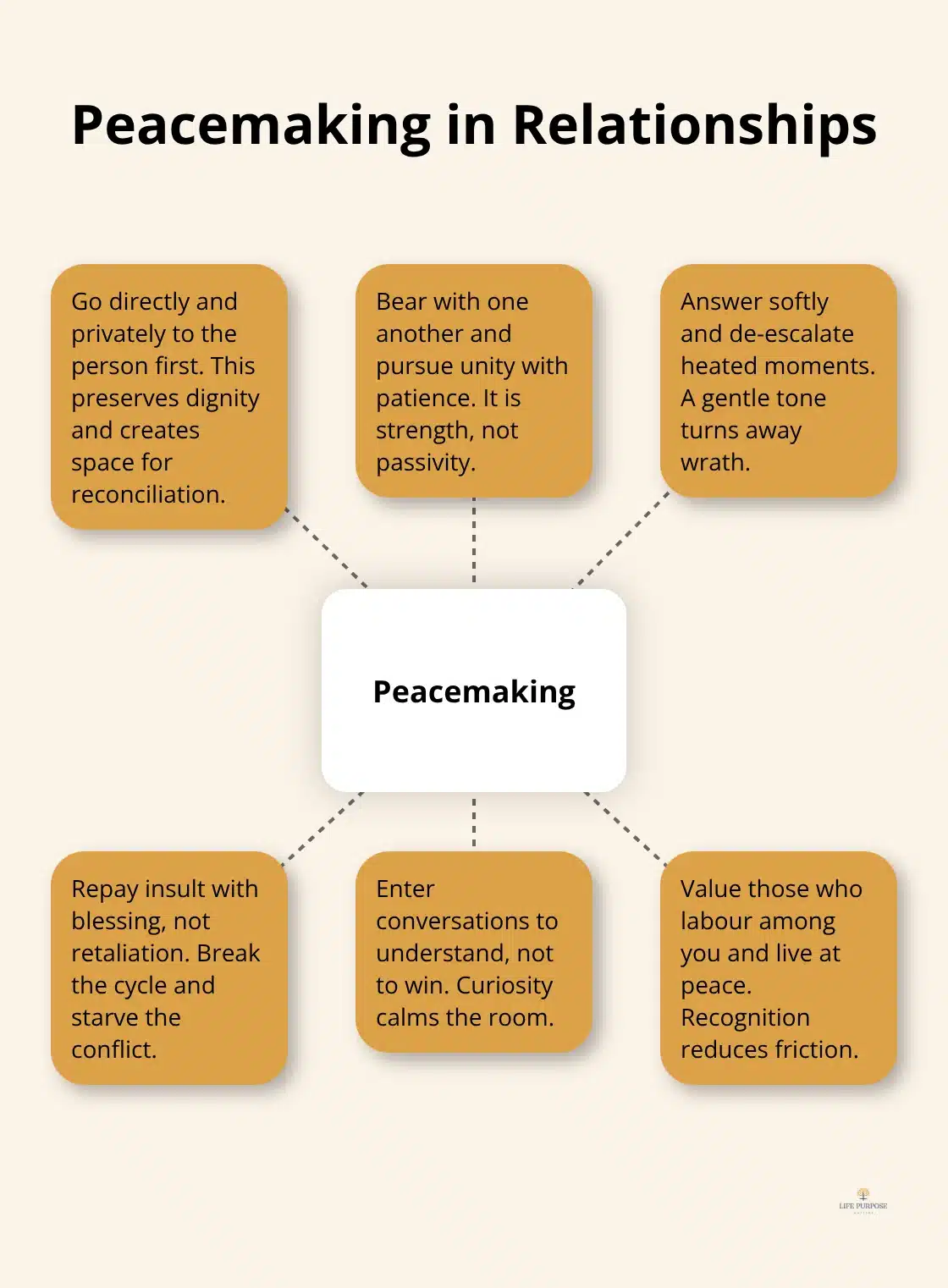
If you enter a hard conversation ready to win, you’ve already lost. If you enter ready to understand, things shift – and quickly.
Forgiveness as a Peace Strategy
Forgiveness is not a Hallmark moment – it’s practical economics. It’s releasing the IOU someone owes you, so it stops bankrupting your life. Ephesians 4:31-32: throw out bitterness, rage, anger, brawling, slander. Replace it with kindness, compassion, forgiveness – the same mercy you received. That last clause is the hinge: you forgive not because they deserve it but because you’ve been forgiven of far more. You’re forgiving because you’ve been forgiven. Colossians 3:12-13 adds the wardrobe change-put on compassion, kindness, patience; bear with one another; forgive as the Lord forgave you. Say the words. Name the release. Speaking it out quiets that part of you obsessed with getting even. Matthew 5:23-24 flips priorities: reconciliation beats ritual. If you remember someone has something against you while offering a gift at the altar, go be reconciled first. Clean relationships matter more than perfect performances. Unforgiveness leaks into sleep, focus, and presence. Let it go – it’s not soft, it’s smart.
Build Community Without Losing Yourself
2 Thessalonians 3:16 promises the Lord of peace will give you peace at all times and in every situation. That’s community-friendly because you’re not betting your calm on people being flawless – you’re betting it on God. Romans 12:18 is realistic: if it’s possible, as far as it depends on you, live at peace with everyone. That caveat is real – some folks won’t make peace; some relationships won’t heal. Your assignment: show up without bitterness, not pressuring reconciliation like it’s a KPI. 1 Thessalonians 5:13 says value leaders and those who labour among you; live in peace with each other. In offices, families, and churches, friction spikes when people feel unseen. Call out effort; it shifts the dynamic. James 3:17-18 sketches peacemaking behaviour: wisdom that’s pure, peace-loving, considerate, submissive, merciful, fruitful, impartial, sincere. Peacemakers who sow in peace reap a harvest of righteousness. This isn’t passive niceness – it’s intentional work that produces visible results.
The inner peace you build and extend outward faces its toughest exam: trusting that God holds the outcome. The final verses push you away from control and toward surrender – peace that’s not manufactured by perfect circumstances but granted by the One who already knows the ending.
When God Holds What You Cannot Control
Peace collapses the moment you insist on piloting outcomes; you think steering fixes everything. The verses here strip that fantasy away and, oddly, that’s liberating. 2 Corinthians 1:3-4 names God the God of all comfort – not a corporate soundbite, but the One who shows up in the mud and then equips you to help someone else climb out. This isn’t theoretical consolation – it’s relational and kinetic. You get comfort; you pass comfort; someone else steadies; the community hardens. Cycle repeats. Resilience compounds.
God’s Presence in Your Weakest Moments
Isaiah 46:4 is the antidote to the loud, anxious whisper that God bails when life goes sideways – “Even to your old age…I will carry you.” That promise covers the seasons where you’re most brittle, when future-anxiety spikes and loneliness looks like the final boss. God doesn’t cut the signal when things deteriorate – He cranks the volume. Psalm 138:8 gives the long view: the Lord will work out His plans; His steadfast love endures. Your job? Show up. Stop trying to engineer the whole thing. Romans 8:28 pushes harder – God works all things for good for those called according to His purpose. No – that doesn’t mean suffering suddenly tastes good or makes instant sense. It means God is resourceful enough to wring redemption from wreckage. Lamentations 3:21-24 is the daily reset button: mercies are new every morning; great is His faithfulness. Don’t carry the cargo of yesterday into today, for every morning hands you a restart – release what you can’t fix and take fresh strength.
God Protects What Matters Most
Psalm 23:1-6 remains the most practical protection text because it’s honest about reality – there will be valleys – but it promises presence. The Lord is your shepherd; you lack nothing. He leads you beside still waters and restores your soul. In the darkest valley, you fear no evil because He’s there – His rod and staff comfort you. This isn’t abstract theology; it’s tactile. God doesn’t vapourise danger – He walks through it with you, and His presence changes how you experience it. Isaiah 41:10 pairs with this: do not fear, for I am with you; I will strengthen you and uphold you. Strength arrives through relationship – not through circumnavigating trouble. Psalm 118:6 puts it bluntly: the Lord is with me; I will not be afraid. What can mere mortals do? That’s not swagger – it’s clarity. When your identity rests on God’s presence rather than applause, you stop performing and start living.
Victory Already Secured
John 16:33 lands the hardest, most useful truth: you can have peace in the middle of tribulation because He has already overcome the world. Peace isn’t about controlling outcomes – it’s about the final victory being a done deal. Revelation 21:3-4 explains why that matters: God dwells with people; He removes death, mourning, crying, and pain. The endgame is locked in – suffering is temporary, loss not ultimate, separation not forever. Hold that certainty now – it changes the calculus of how you move today.
Surrender as the Doorway to Calm
Proverbs 3:5-6 names the core: trust in the Lord with all your heart; don’t lean on your own understanding; He will direct your paths. Your intellect will invent scenarios and call it prudence – that’s actually anxiety dressed in a suit. Trust means stepping away from the control booth and letting God steer. Philippians 4:6-7 gives the practical: instead of anxiety, pray – be specific; tell God what you need. Add thanksgiving. The result: God’s peace guards your heart and mind. Not a poetic guard, but a sentry at the gate of your thoughts, that is stopping catastrophic spirals.
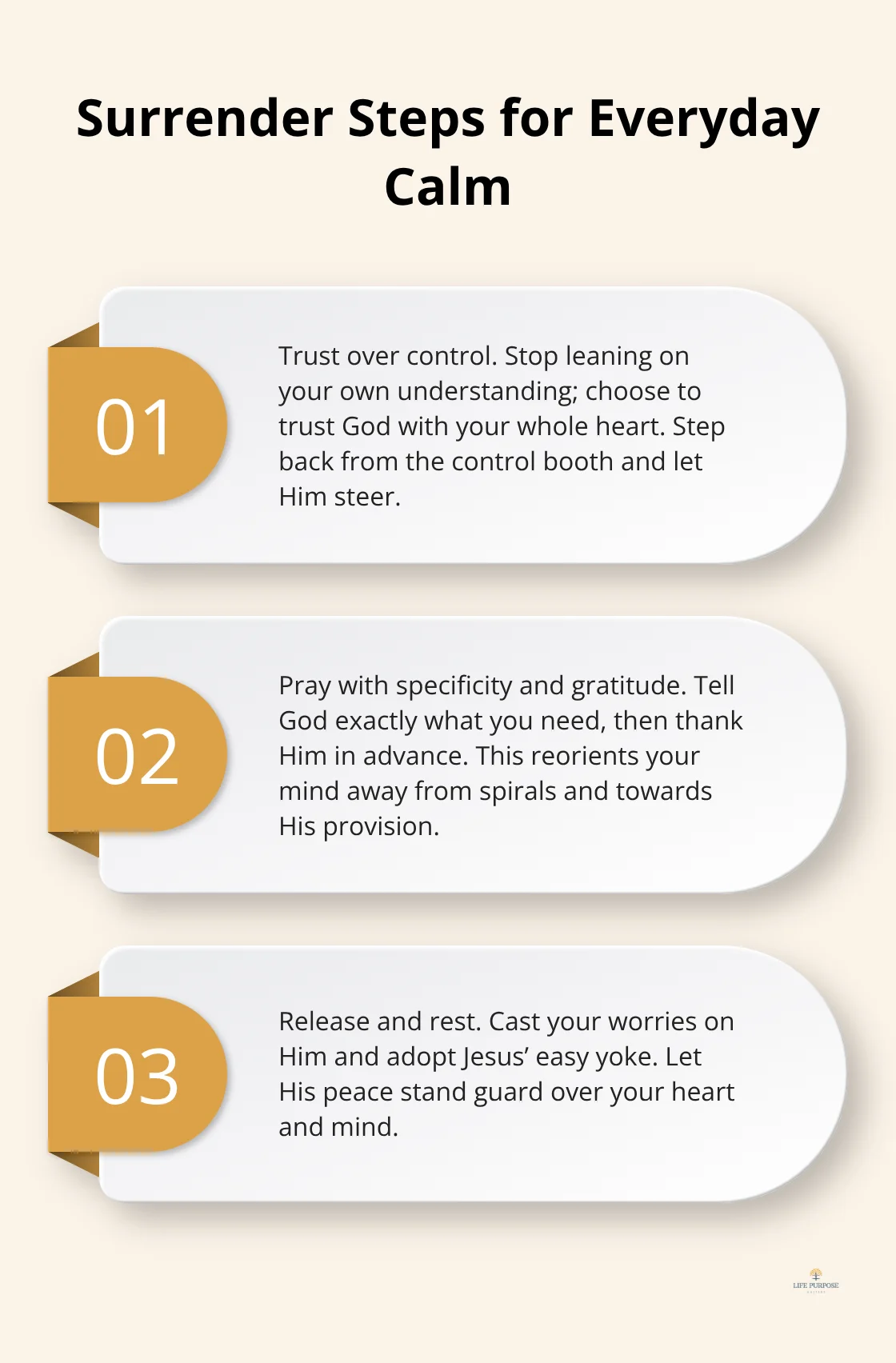
1 Peter 5:6-7 nails the posture: humble yourselves under God’s mighty hand, and at the right time He will lift you; cast all your worries on Him because He cares. Timing? His. Your job? Release the weight and believe He’s attentive. Matthew 11:28-30 extends the invite: come to Jesus, all who are weary, and He will give rest; take His yoke, learn from Him, and your soul rests. That yoke is lighter than the burden you’re hauling solo. Jeremiah 17:7-8 sketches the outcome of surrender as spiritual practice: blessed are those who trust in the Lord – like trees planted by a river, deep roots, fruit even in drought. Surrender doesn’t erase hardship – it roots you so deeply in provision that hardship can’t unseat you. Your capacity to produce and serve doesn’t hinge on external conditions; it hinges on the depth of your connection to God.
Final Thoughts
These 24 Bible verses about peace aren’t meant to sit on a page-they’re meant to live in your hands, your head, your nervous system. The real work begins when the screen closes and the moment arrives: the conversation that needs to happen, the anxiety that refuses to leave, the situation that can’t be controlled. That’s when a verse stops being an idea and becomes an anchor.
Pick one verse that lands hardest for you right now, and write it down. Not a quick tap, but hand-copy it. Pen to paper does something different to the brain…it roots the words deeper than any scroll. When scripture is written by hand, engagement happens; thinking slows; a line can actually reshape how thought moves. Put that verse where it will interrupt the day-phone lock screen, bathroom mirror, or desk. Repetition isn’t lazy-it’s the mechanism by which the brain rewires from panic toward trust.
Check out this beautiful piece, click here =>> He is My Peace
Build a rhythm around these verses-morning prayer, evening reflection, a quick midday pause when anxiety spikes-consistency matters far more than duration. No need for an hour; five minutes of focused, genuine engagement beats thirty minutes of distracted skimming every time. The format is secondary; practice is primary. We at Life Purpose Matters believe peace isn’t a luxury-it’s the foundation for living out your God-given purpose; when anxiety loosens its grip, showing up in relationships, work, and faith looks different.