

You know the feeling — you mean to read the Bible consistently, but life… intervenes. Work, family, social obligations, that endless scroll (yes, it wins) — finding even ten quiet minutes feels like hunting for a unicorn.
A Bible reading plan removes the guesswork and creates momentum. Think of it as autopilot for your spiritual life — set a simple route and let small, repeatable actions do the heavy lifting. At Life Purpose Matters, we’ve watched structured plans turn chaotic intentions into steady habits — without piling more stress onto an already full day.
Why Bible Reading Plans Work for Busy Christians
The Centre for Bible Engagement surveyed 40,000 people and found something striking – engaging with Scripture at least four times weekly produces measurable life changes: less loneliness, less anger, less bitterness, and fewer of those deadening habits (pornography, alcoholism). Here’s the kicker – one to three days per week? Practically the same as not engaging at all. The power isn’t in intensity. It’s in the habit. Four is a hard threshold. You need consistency, not heroic, sporadic bursts.
Removing Decision Fatigue
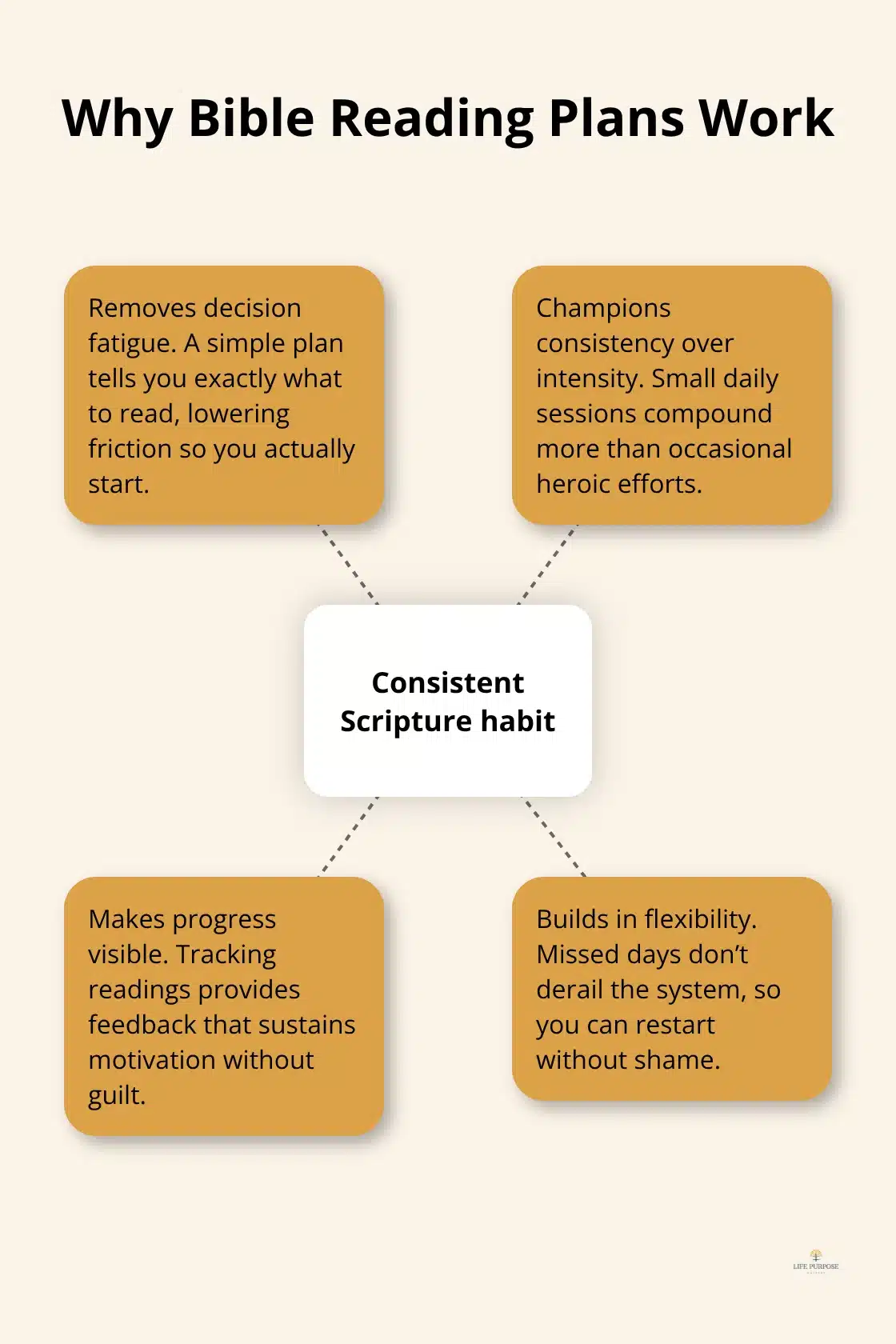
A reading plan does the heavy lifting – removes the friction. Instead of waking up and doing the scroll-and-stall (you know the routine), the plan tells you what to read. No decision fatigue. No fifteen minutes lost in your Bible app trying to feel inspired. The plan decides – you open the book – you read. Simple. Predictable. Human behaviour is lazy; plans exploit that in the best possible way.
Consistency Beats Intensity Every Time
Busy people fall for the lie that longer sessions equal progress. Not true. Daily consistency beats duration. Five to ten minutes a day, reliably, will outcompete a heroic hour once a month. Most New Testament books take under 30 minutes to read-many of the short epistles (2 John, anyone?) are under two minutes a day. A structured plan hands you small wins: finish a book, check it off, feel the dopamine – you show up tomorrow. That tiny, boring cycle compounds into real spiritual transformation. Momentum loves small, consistent acts.
Progress Tracking Creates Accountability
Checking boxes isn’t vanity – it’s feedback. Put a printable schedule by the coffee machine or on the mirror (yes, the bathroom mirror) – each tick is proof you’re moving forward. Your brain likes visible progress; it’s what keeps you honest without shame or inner scolding. Accountability doesn’t require a group chat or a stern friend – sometimes it’s just a pen and a list.
Built-In Flexibility Prevents Collapse
And here’s the grace note: plans accept failure. Miss a day – the plan survives. Miss a week – you restart without shame. That’s the point – the structure is designed for human lives, not for spiritual perfection. Willpower is fleeting; systems endure because they work with the brain’s wiring, not against it. So now that you get why plans work, the real question is practical: which plan fits the messy, beautiful life you actually lead? Pick one that schedules bite-sized wins, tracks progress, and forgives a missed day or two – then watch consistency do the heavy lifting.
Which Plan Fits Your Life
The 30-Day Sprint: Test the Habit
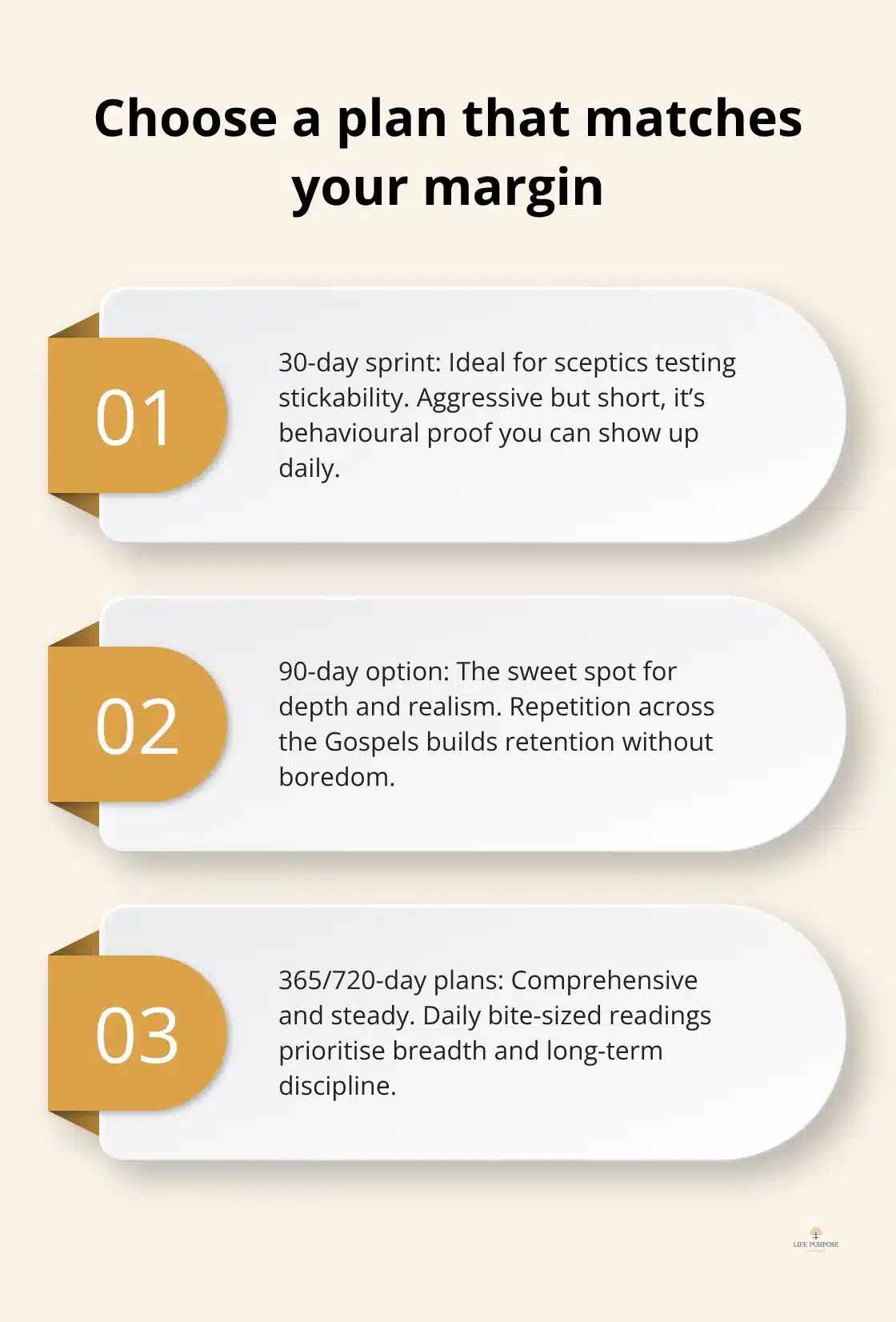
The 30-day sprint is for the sceptics-people who want to know if a habit will actually stick before they commit. Crossway’s 30 Days in the New Testament plan crams the New Testament into thirty days. It’s aggressive-but mercifully short, so motivation doesn’t implode on day fifteen. The victory here isn’t a theological marathon; it’s behavioural proof. Show up for thirty days and you’ve answered the only question that matters: can I be consistent? If yes-scale. If no-adjust.
The 90-Day Option: The Sweet Spot
Ninety days is the magic compromise-ambitious enough to feel meaningful, realistic enough to survive real life. Keith Ferrin’s New Disciple Challenge rotates through Matthew, Mark, Luke, John and Acts over roughly three months-two weeks on each gospel with Acts as the repeating spine. You get repetition (which is how learning actually happens) without the glaze-over boredom. Time commitment? Fifteen to thirty minutes daily, depending on your reading speed. Crossway’s totals (Matthew ~2h21m, Mark ~1h23m, Luke ~2h24m, John ~1h51m, Acts ~2h15m) break down to roughly 10–15 minutes per day per book when you spread the reading across two weeks.
Manageable. Effective. Wins the popularity contest.
The 365-Day and 720-Day Plans: Long-Term Commitment
The year-long plan is for people who want to be comprehensive-and are willing to grind. John MacArthur’s schedule moves through the Old Testament steadily (about three chapters a day-Old Test finishes in ~310 days) while cycling the New Testament more frequently. Most folks reread the New Testament a few times by year’s end while making steady progress through the Old. Expect 20–30 minutes per day on average. The Busy-Life 720-day option is the slow-and-steady alternative-two years of bite-sized daily readings built for chaos. Both routes reward discipline with breadth; one is a sprint that became a marathon, the other is a marathon you can actually breathe in.
How to Choose Your Plan
Pick based on real margin-not wishful thinking. How many minutes do you actually control each day? Not what you want-what you have. If you’re testing commitment, do the 30-day sprint. If you can give 15–30 minutes most days and want durable knowledge of the Gospels-90 days wins (it’s aggressive, repeatable, memorable). If you want the whole canon and are ready to show up for years-go annual or two-year. Practical winner? The 90-day plan-big enough to matter, short enough to finish, and repetition that builds retention rather than rote exhaustion.
Three Tactical Moves to Stay on Track
Three things keep you honest: 1) set a fixed daily time-mornings win (decision fatigue is real); 2) use a physical schedule you check off-paper beats mental promises every time; 3) pair the reading with a micro-reward-coffee, a favourite chair, five minutes of quiet. Audio counts-1.5x or 2x speed is engagement (commuting, cooking, cleaning-use those pockets). The Centre for Bible Engagement suggests four sessions a week is the floor for measurable change-miss a day or two, no catastrophe, but hit that threshold. Track consistency on paper-visible progress fuels behaviour more reliably than vague intentions. Nail the plan and the rhythm, then build the tiny systems that make showing up effortless.
Start Your Plan This Week
Pick Your Time Slot and Protect It
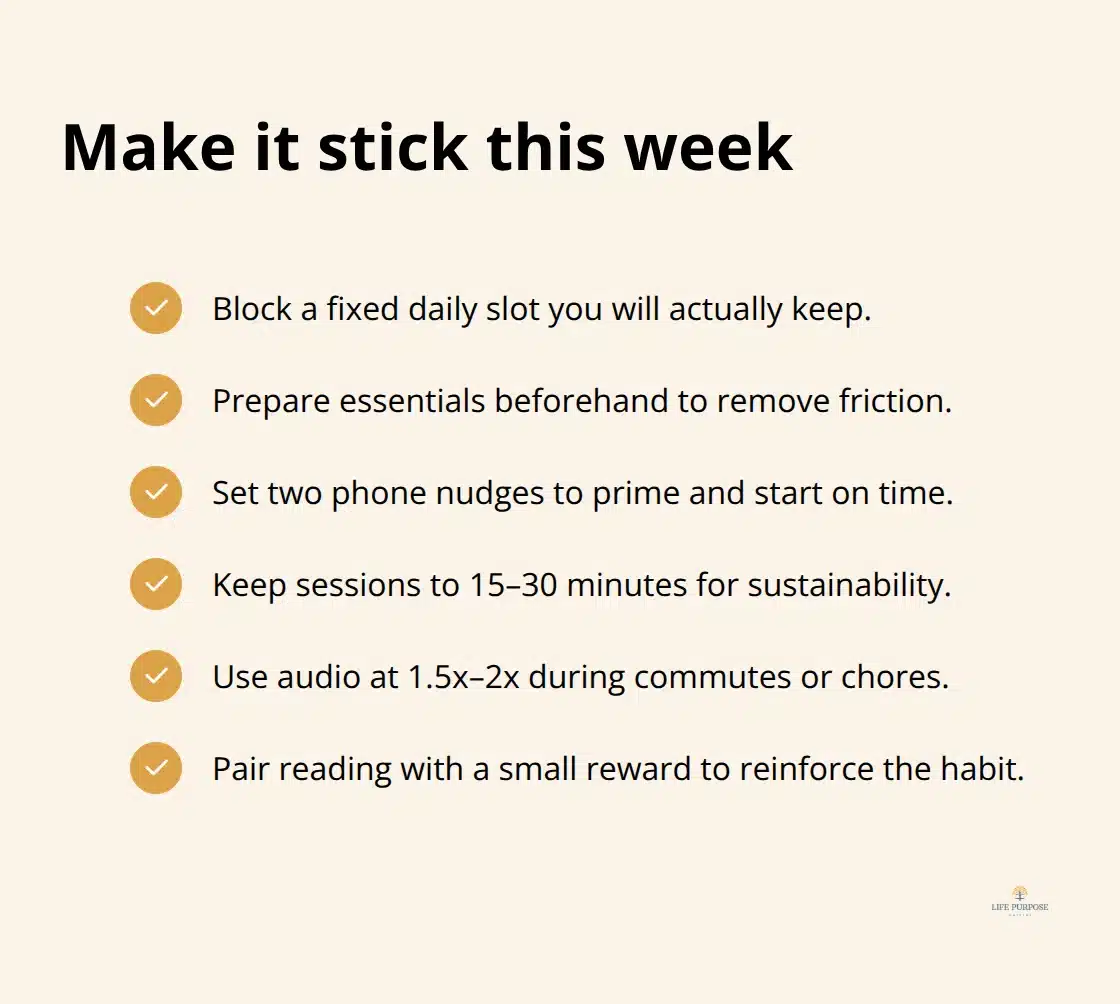
The second you pick a plan you move from thinking into doing-so don’t punt to next Monday. Block fifteen to thirty minutes on your calendar at the same time each day for the next seven days. Morning is the cheat code (decision fatigue hasn’t eaten your willpower yet)…but consistency beats the perfect hour every single time – so pick the slot you’ll actually keep. If mornings are fantasy, grab evenings – a fixed routine trumps ideal timing. Set two phone nudges: one fifteen minutes before to assemble the essentials (coffee, chair, Bible), another at reading time. That pre-reading ping matters – friction kills habits before they begin.
Download Your Schedule and Make It Visible
Next, download or print your plan’s schedule. Crossway has free PDFs for formats from 30 Days in the New Testament to the 90-day New Disciple Challenge (longer options, too). Print it. Tape it somewhere you see daily – mirror, kitchen, desk. Checking off days with a pen gives your brain the visible proof it wants; yes, digital tracking works, but paper wins for habit formation because the physical act cements the behaviour. If you use the Busy-Life 720-day plan or similar, sign up for daily email reminders via Bible Study Tools – automated nudges are cheap and they catch you when willpower tanks.
Match Your Plan to Your Real Schedule
Your first week lives or dies on one choice: which time slot survives contact with reality. Commute and nine-to-five? Morning reading before work or an audio Bible on the drive is your friend. Home with kids? Naptime or after-bedtime (yes, you’ll be tired – but it’s temporary) beats sporadic afternoon attempts. Travel a lot? Listening at 1.5x or 2x speed on planes and in hotels counts – frequency of engagement matters more than medium. Pair reading with a micro-reward: the same mug, a specific chair, five minutes of silence before you start. This isn’t motivational fluff – it’s operant conditioning. Your brain learns: reading time equals comfort – and comfort breedss repetition.
Choose Your Starting Point
For week one, pick the shortest plan that fits your schedule: ten minutes? Start with 2 John (under two minutes daily) and ramp up. Thirty minutes? Try Keith Ferrin’s New Disciple Challenge cycling through the Gospels. Testing commitment? Crossway’s 30 Days in the New Testament is your bootcamp. The goal isn’t finish-it-all – it’s show up seven days straight. Miss day five? Restart that day without drama and make day seven. One week of consistency proves you can do it – that proof beats any pep talk.
Final Thoughts
A Bible reading plan takes your scattered good intentions and turns them into measurable spiritual progress – not feelings, not vibes, real change you can point to. The data backs this up: four sessions a week produces less loneliness, less anger, less bitterness… and more confidence when you share your faith. The 30-day, 90-day and year-long tracks all work because they kill friction and install consistency.
The hard part isn’t the reading – it’s starting. You know what to do. You’ve read the options. You get why consistency matters more than duration. So this week: download the schedule, block the time, and begin. Test the waters with 2 John (short, sweet, non-threatening). Want meaningful depth? Take the 90-day New Disciple Challenge. Ready for the long haul? Go annual – the full arc.
Show up. Small, repeatable actions compound – not overnight, not dramatically, but over months and years they remake you. It’s not about perfection or heroic effort – it’s about presence. Visit Life Purpose Matters for additional resources and encouragement as you start your Bible reading plan today.