
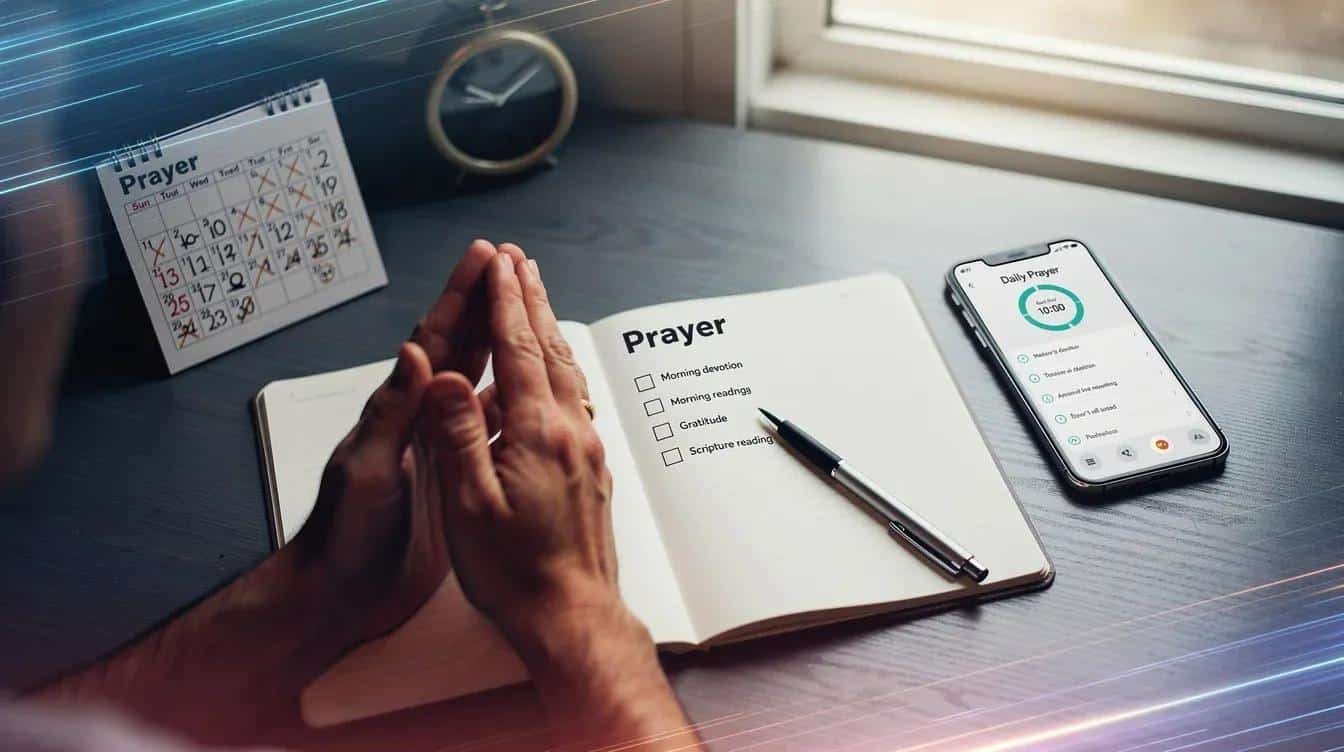
Prayer works best when it actually fits your life — your schedule, your doubts, your tiny victories. Most people struggle because they don’t know where to start… or what format will actually stick. Building a daily effective prayer routine doesn’t require complex theology. By pairing consistency with actionable, daily habits like keeping a prayer journal and structuring your thoughts, you can easily cultivate a meaningful and continuous conversation with God.
At Life Purpose Matters, we’ve created several guides to help — formats that feel natural, prayers that aren’t awkward or mystical, and a challenge that forces a daily shift. Practical, ready-to-use, and designed to produce real results.
Which Prayer Format Actually Works for Your Life
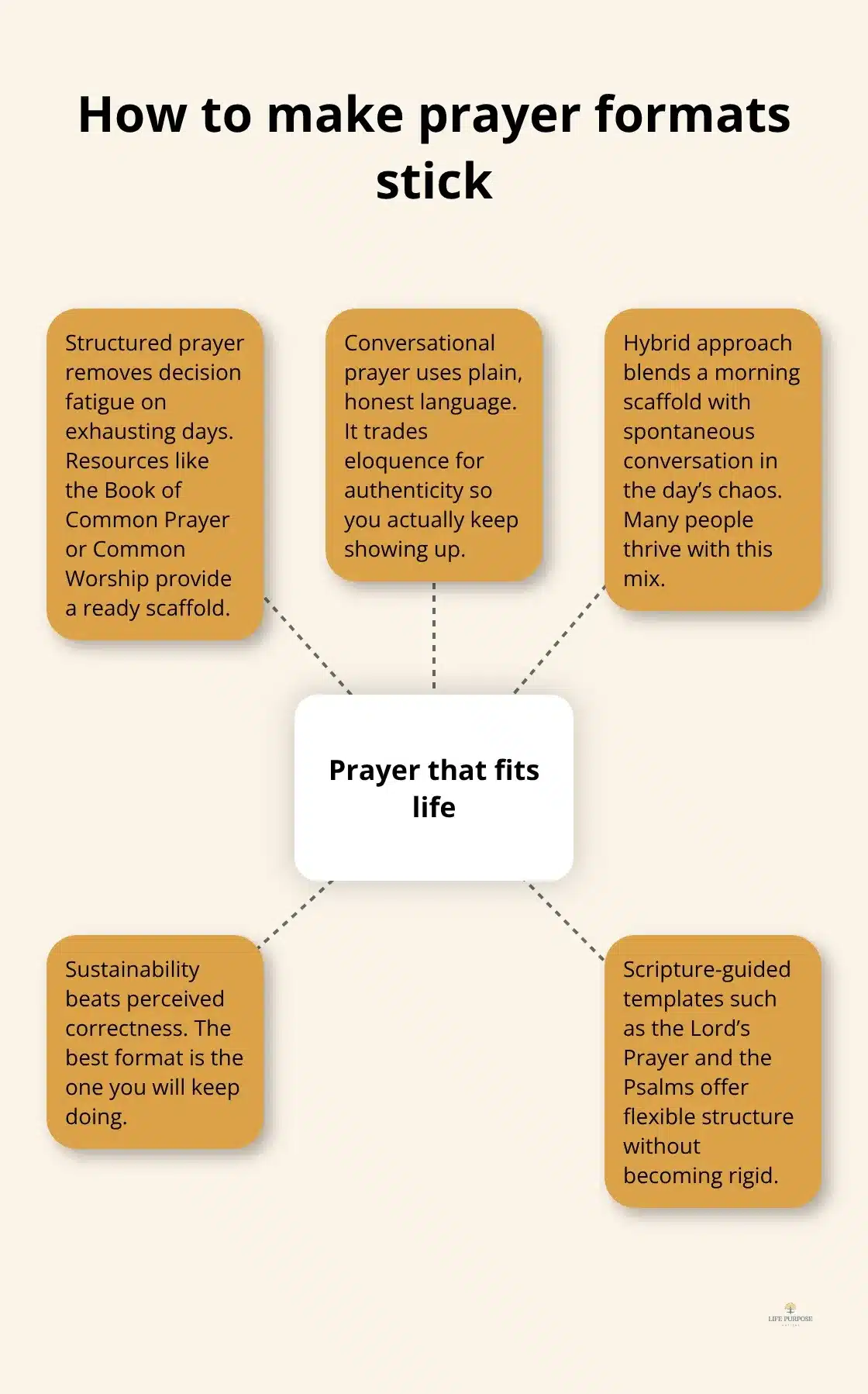
Most people treat prayer like a one-size-fits-all ritual – they memorise the Lord’s Prayer, recite it like a script, and then scratch their heads when nothing seems to budge. The reality is embarrassingly simple: the format that works is the one you’ll actually keep doing. Traditions exist for a reason – they’ve shepherded millions across centuries – but they only matter if the form fits your clock and your wiring. Plenty of folks bail on prayer because the format felt foreign, or pretentious, or logistically impossible. The Lord’s Prayer from Matthew 6:9-13 functions as a template because Jesus built it to orient us – to address God as Father, pursue God’s will, ask for daily needs with humility. But a template isn’t a cage. Use its structure for five focused minutes in the morning… or make it a running conversation with God between meetings. The Psalms prove this flexibility – raw complaint, ferocious gratitude, desperate pleading – all of it aimed at God, unapologetically human. What matters isn’t to act holy; it’s bringing the honest you – not a performance – to the conversation.
Conversational prayer beats perfection every time.
Conversational prayer is simple – talk like you would with someone you trust. No flourishes. No theological showboating. Just direct language, your rhythm, your mess. Authenticity beats eloquence every single time. Matthew 6:7-8 even takes the pressure off – don’t saunter into babble-land; God already knows the ask. That gives you permission to be blunt: “I’m anxious. I need help.” For anxiety, the verb is to cast your cares – Psalm 55:22 – and then actually let go. For guidance, commit your way and see if your steps straighten – Proverbs 3:5-6 isn’t poetic fluff; it’s operational advice. Structured prayer (Book of Common Prayer, Common Worship) is a great battery-saver – it removes decision fatigue on days you’re exhausted. Conversational prayer costs nothing but honesty. Most people thrive with a hybrid: a structured scaffold in the morning when you can, conversation in the chaos. Sustainability trumps perceived correctness – every time.
Scripture-based prayer anchors requests in God’s promises.
When you pray Scripture, you move from wish-list to claim – you’re standing on words that have weathered generations. Using Psalms, Proverbs, Isaiah, or New Testament promises isn’t inventive magic – it’s borrowing authority that’s already tested and tempered. Jesus used Scripture as his rebuttal in Luke 4:1-12 – that’s a template: when tempted, quote the truth. Gratitude is easy when you lean on Psalm 107:1 – “Give thanks to the Lord, for he is good…” – it’s a one-line reset. Morning prayer with Psalm 5:3 helps you posture yourself to listen and lay requests before God with expectation. Nighttime with Psalm 4:8? It’s an invitation to rest under protection. Practically, Scripture removes aimless wandering in prayer. Instead of vague asks, you pray for healing, courage, repair, forgiveness – language that’s been meaningful to people for centuries. Memorise a Psalm that maps to your situation and use it for a week – repetition builds muscle. You don’t need a PhD in theology; you need repetition and a willingness to let those words reorient your heart.
Moving your prayer into daily life
The goal isn’t a single daily appointment with God – it’s a continual posture (see 1 Thessalonians 5:16-18) where prayer becomes the lens for decisions, disputes, and surprises. Stop compartmentalising. Fold prayer into your actual life – work calls, messy conversations, the 2 a.m. anxiety hits. Integrate Scripture-based short practices across morning, midday, and evening, and your mind will habitually tilt toward God rather than treating prayer like an emergency-only tool. Test a format for two weeks. If it sticks – great. If it flops, good information. Real growth is iterative: try, measure, adjust. Once you land on a format that fits your life, you move from theory to practice – and that’s where measurable shifts show up in what you feel, how you decide, and who you become.
Prayers That Actually Work in Real Situations
Match Your Prayer to What You’re Actually Facing
Stop using bumper-sticker prayers for surgical problems. When the stakes are a job choice, a marriage on the rocks, or a health scare, you need language that fits the size of the moment. Proverbs 3:5-6 isn’t incense and mystery-it’s a decision protocol: commit your way, then let the Lord straighten the path. Practical, not mystical.
If you’re between two offers or at a life-pivot, pray that verse, then pay attention to how your mind gets nudged. The operative prayer for decisions is consecration-see Matthew 26:39-Jesus setting aside His preference to align with God’s. That posture matters: not “God, rubber-stamp my plan,” but “God, show me what actually matters.”
Write the decision down. Pray the Scripture. Wait three days. Notice which option keeps pulling at you.
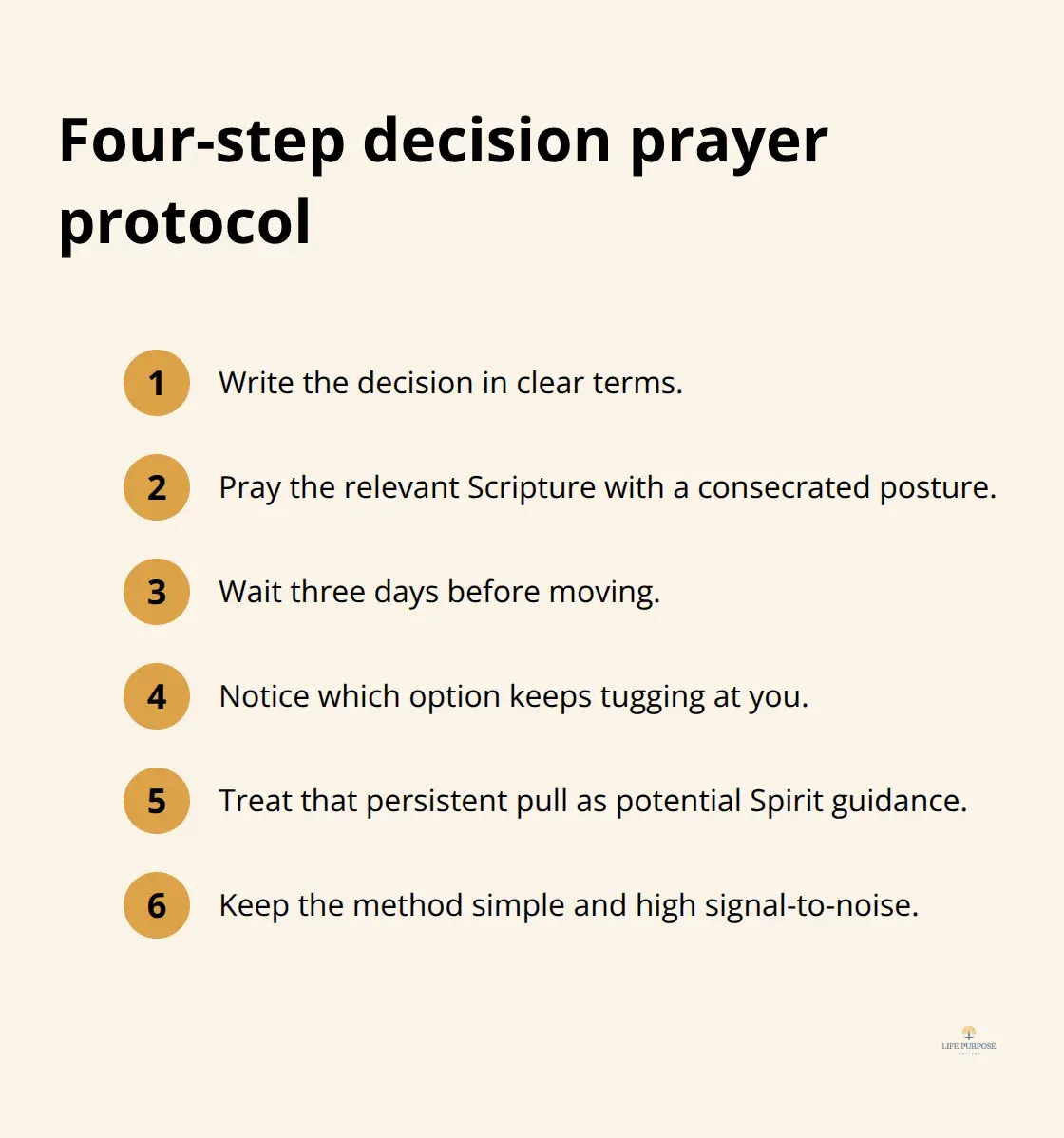
That pull? Often the Spirit’s voice. Simple method. High signal-to-noise.
Gratitude Prayers Work Fastest When Specific
Generic gratitude is like clicking “like” on life-fine, but shallow. Psalm 107:1 gives the frame: give thanks, for He is good-then fill in the blanks with specifics: one win, one mercy, one person who showed up. Say it out loud. Be precise.
Research shows gratitude shifts physiology and psychology fast-better health, more happiness, higher life satisfaction (see research link). The mechanism is boringly elegant: catalogue what’s working, and your brain stops hunting for the next problem. Do it consistently, and you’ll notice a change in days, not decades.
Healing and Strength Require Faith-Based Prayer
For healing and strength, anchor in James 5:15-the prayer offered in faith has power. This isn’t vending-machine theology-God isn’t a cosmic ATM-but approach with conviction, not a shrug. Psalm 55:22 tells you the move: cast your cares and trust in the sustainer.
When someone’s sick, or you’re neck-deep in anxiety or grief, pray by name, cite the Scripture, then act as if God has already heard. Stop rehearsing the disaster loop in your head. The shift from fear-spinning to settled trust is where healing begins. Sometimes that’s physical repair; often it’s emotional mending. Either way, act. Faith without follow-through is just rhetoric.
Intercession Compounds the Effect
Praying alone works-praying together multiplies. Acts 1:14 and 2:42 show a pattern: consistent corporate prayer creates measurable momentum. Why? Because it pulls you out of isolation and forces accountability.
If hardship is the headline, get one person and agree to pray for each other daily for 30 days. One sentence per prayer-guidance, gratitude, healing-send it each morning. Keep it under two minutes. Specificity forces clarity; witness forces follow-through. Small structure, big returns.
When Words Fail, the Spirit Steps In
Exhausted? Tongue-tied? Romans 8:26-27 gives permission: the Spirit intercedes when words fail. You don’t need oratory. You need cadence. Start with five minutes a day-one Scripture, one situation.
Two weeks in: your perception begins to shift. Four weeks: practical differences show up-a conversation goes differently, a decision clears, a weight lifts. Not magic-repetition realigns your instincts to truth until action follows. Prayer is the rehearsal; action is the performance.
30-Day Prayer Commitment That Actually Sticks
Set a Specific Time and Single Focus
Habits aren’t mystical-they’re logistics dressed up as virtue. The difference between prayer that transforms and prayer that quiets you is structure with wiggle room. A 30-day commitment forces the habit into being before your motivation shows up for roll call. A structured prayer challenge proves people crave direction-not because prayer is complicated, but because staying consistent is brutal. Pick a specific time: five minutes each morning beats the vague “sometime today” promise every time. Choose one focus for the week-guidance one week, healing the next, gratitude the third-so your mind doesn’t scatter like confetti across ten different tasks.
Write Your Prayer and Anchor It to Scripture
Don’t improvise on day one-write one prayer for each focus ahead of time. Use Scripture as the anchor (Psalm 5:3 for morning listening, Psalm 4:8 for nighttime rest, Proverbs 3:5-6 for decisions). The written line eliminates the friction of choosing words when you’re tired, or your brain is doing its usual inventory of anxieties. Pair your prayer with a worship playlist-music conditions your nervous system faster than silence, and that’s the trick: prepare your mind to hear instead of rehearse the grocery list.
Track Progress and Build Momentum
Put a checkmark on a physical calendar-simple, stupid, effective. The visual streak creates momentum (research on habit formation shows that visible progress triggers dopamine, which then doubles down on the behaviour). After about 21 days, something changes: discipline softens into desire-your brain starts craving the clarity prayer brings. It’s not mystical; it’s neurology with a halo.
Find an Accountability Partner
Isolation kills commitment. Accountability multiplies it. Find one person-a friend, family member, someone from your faith community-and exchange a single-sentence prayer or focus each morning. Keep it under thirty seconds. This isn’t therapy or airing grievances; it’s clarity and witness. The early church did this-gathered, prayed, showed up-because spiritual life is communal, not solo endurance.
Reflect and Share Your Insights
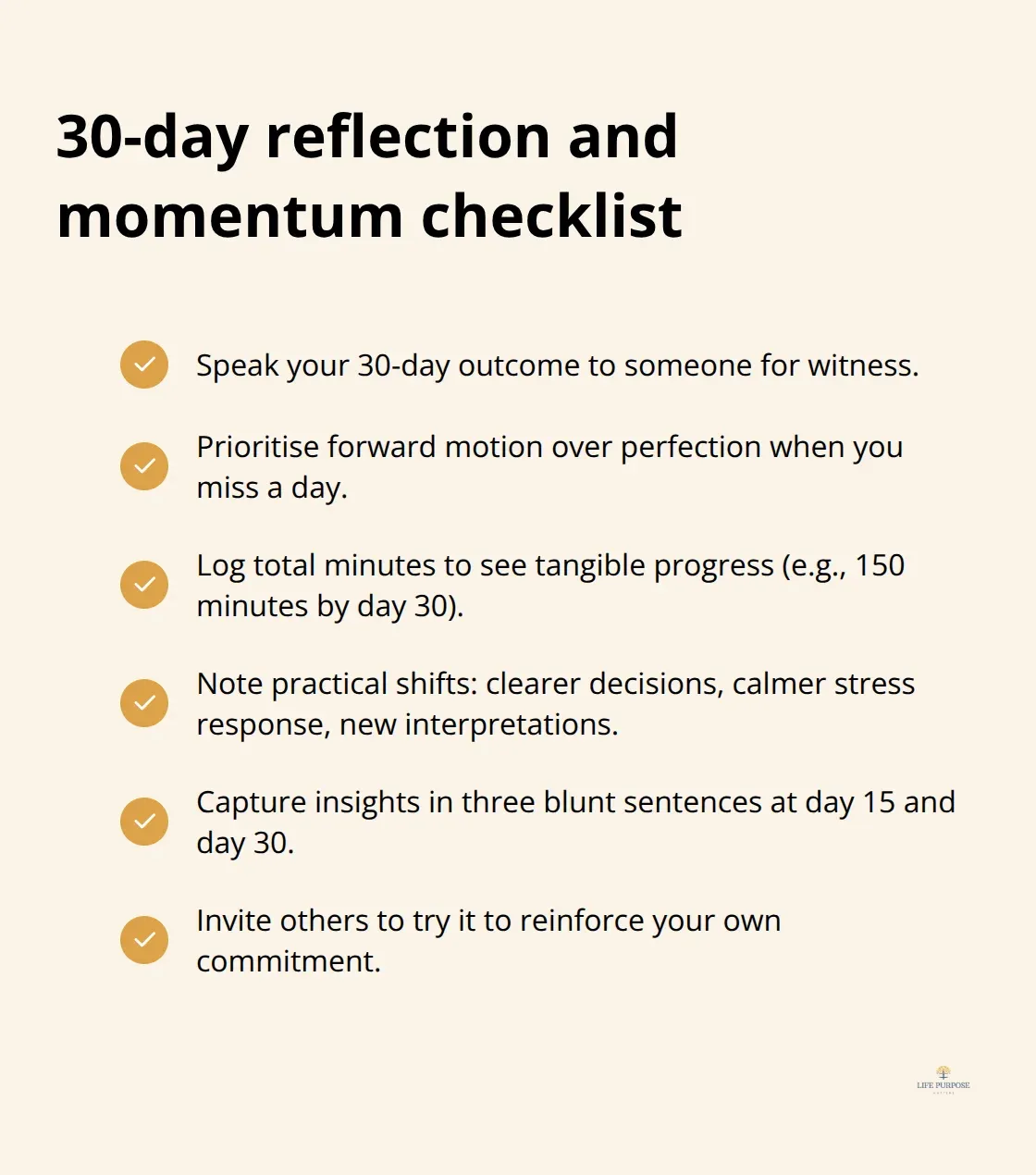
Check in at day 15 and 30. Write three blunt sentences answering: What shifted in how I think about my situation? What decision became clearer? What did I notice about God’s character? Don’t polish-honesty beats eloquence. Speak your 30-day outcome with your accountability partner or a small group; saying it out loud cements the insight and invites others to try. Missing a day doesn’t reset the whole thing-forward motion matters more than perfection. At day 30, you’ll have 150 minutes of focused prayer logged. That’s not theoretical-it’s measurable spiritual work that rewires how you make decisions, manage stress, and interpret what’s happening around you.
Final Thoughts
Effective prayer isn’t some mystical formula or spell you have to get right-it’s plain mechanics. Consistency, specificity, accountability-those are the levers. Five minutes a day, every day, trumps the heroic but sporadic hour-long session. Write down your focus-because vague intentions evaporate (and your brain loves an anchor). Tell someone what you’re praying for-because witness changes behaviour. These aren’t pietistic aphorisms; they work because your brain responds to repetition, clarity, and the social fact of being seen.
The changes you’ll notice won’t be cinematic-no lightning bolts or choir music…they’re quieter, practical, cumulative. A decision that suddenly seems obvious. A conversation that takes a different turn. Anxiety loosening its grip. After 30 days of focused prayer, you haven’t conjured miracles-you’ve rewired how you process stress and interpret events. That’s not airy theology-it’s neurology meeting practice. And the secret? Show up. Again and again.
Visit Life Purpose Matters to explore tools and resources designed to help you integrate faith into your actual life. Your next 30 days of prayer could reshape everything.