
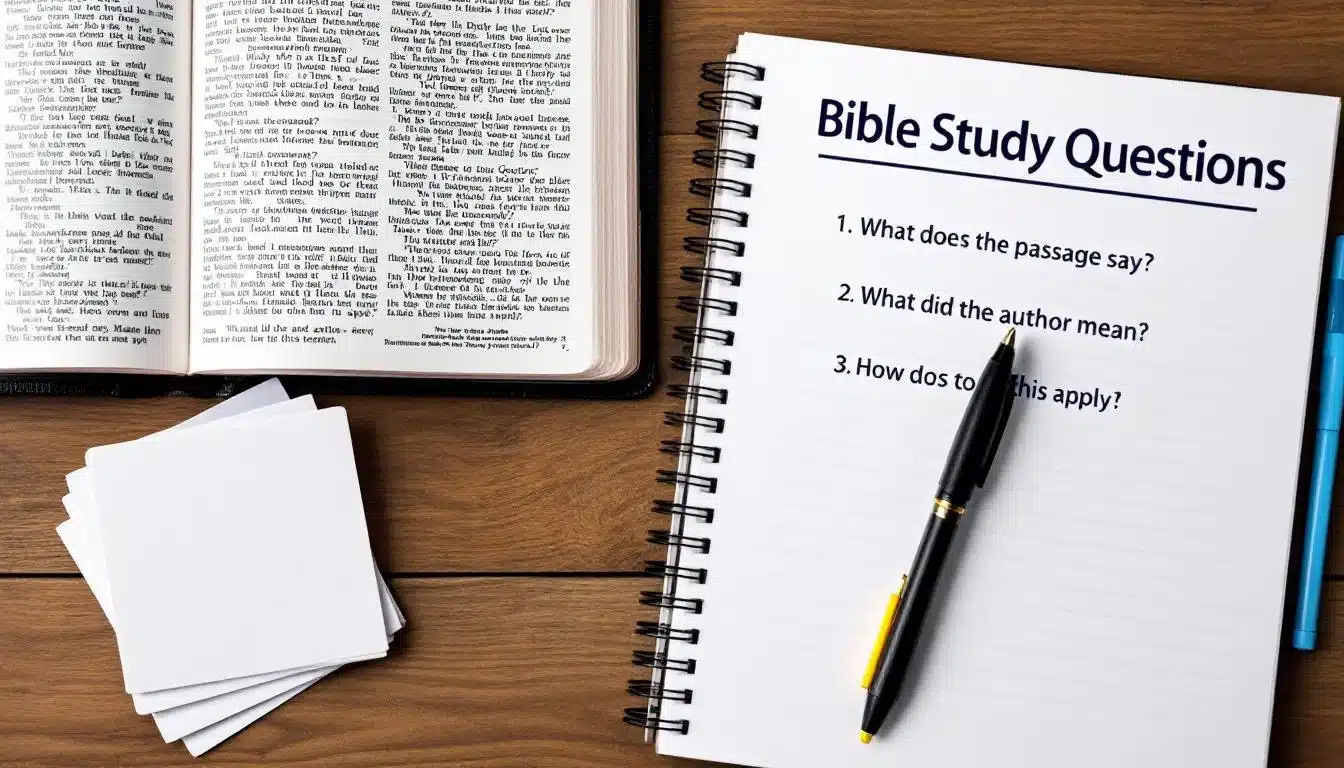
I once sat with a friend who’d been reading the Bible for years but felt stuck. The words were familiar, but nothing was clicking. Then she started asking herself real questions while reading, and everything changed. The difference between passively reading Scripture and truly understanding it often comes down to one thing: the questions you ask. At Life Purpose Matters, we’ve seen how the right Bible study questions transform a routine reading into genuine spiritual growth.
What Questions Reveal About Scripture and You
Three Levels of Understanding Work Together
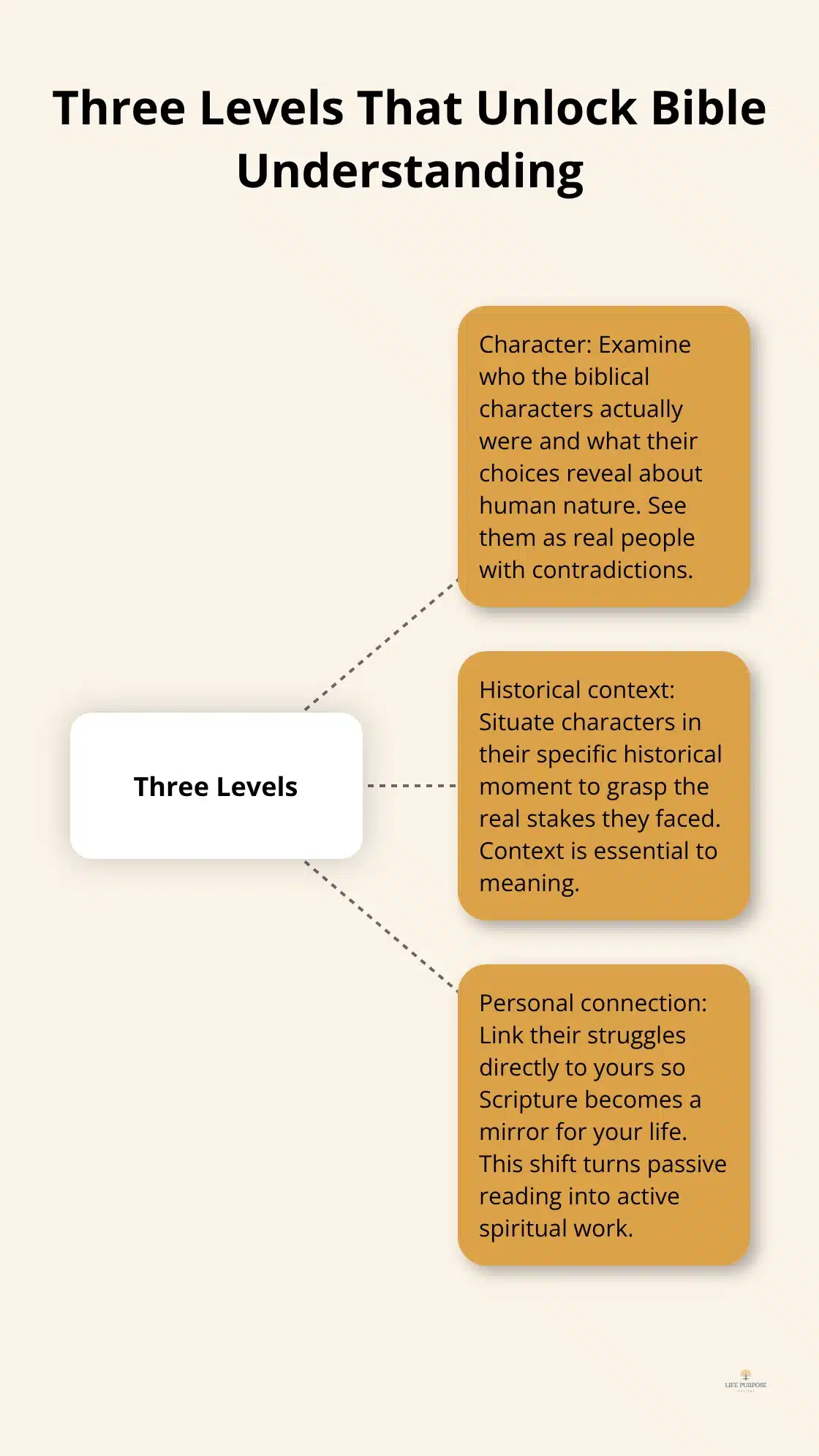
When you ask the right questions, Scripture stops being a collection of ancient stories and becomes a mirror for your own life. The most effective Bible study questions operate on three levels simultaneously: they examine who the biblical characters actually were, they situate those characters in their specific historical moment, and they connect their struggles directly to yours. Most people skip around between these levels without intention, which is why their Bible reading feels scattered. You need a framework that keeps all three working together.
Start With Character Analysis
Start with who specific people in Scripture were and what their choices reveal about human nature. When you read about Peter denying Jesus three times in John 13, don’t just note that it happened. Ask yourself: what was Peter afraid of? What did he value more than his commitment in that moment? What patterns in his life made him vulnerable to fear? These character analysis questions work because they force you to see biblical figures as real people with contradictions, not cardboard cutouts.
Layer In Historical Context
Then add the historical context: Peter lived in first-century Jerusalem under Roman occupation, where association with an executed criminal could mean actual danger. His denial makes more sense when you understand the real stakes he faced. This is where many Bible study resources fail-they treat context as optional background rather than essential to meaning. Context transforms how you interpret every choice a biblical character makes.
Connect It Back to Your Life
Finally, connect it back to your life with the hardest question: when have I done the same thing? Where do I deny my faith because I’m afraid of what others will think or what I might lose? This three-level approach transforms passive reading into active spiritual work. The Gospel Coalition’s approach to small-group Bible study emphasises starting with observation of what the text actually says before jumping to what it means. This matters because most people want to interpret immediately, skipping the essential step of seeing what’s actually written.
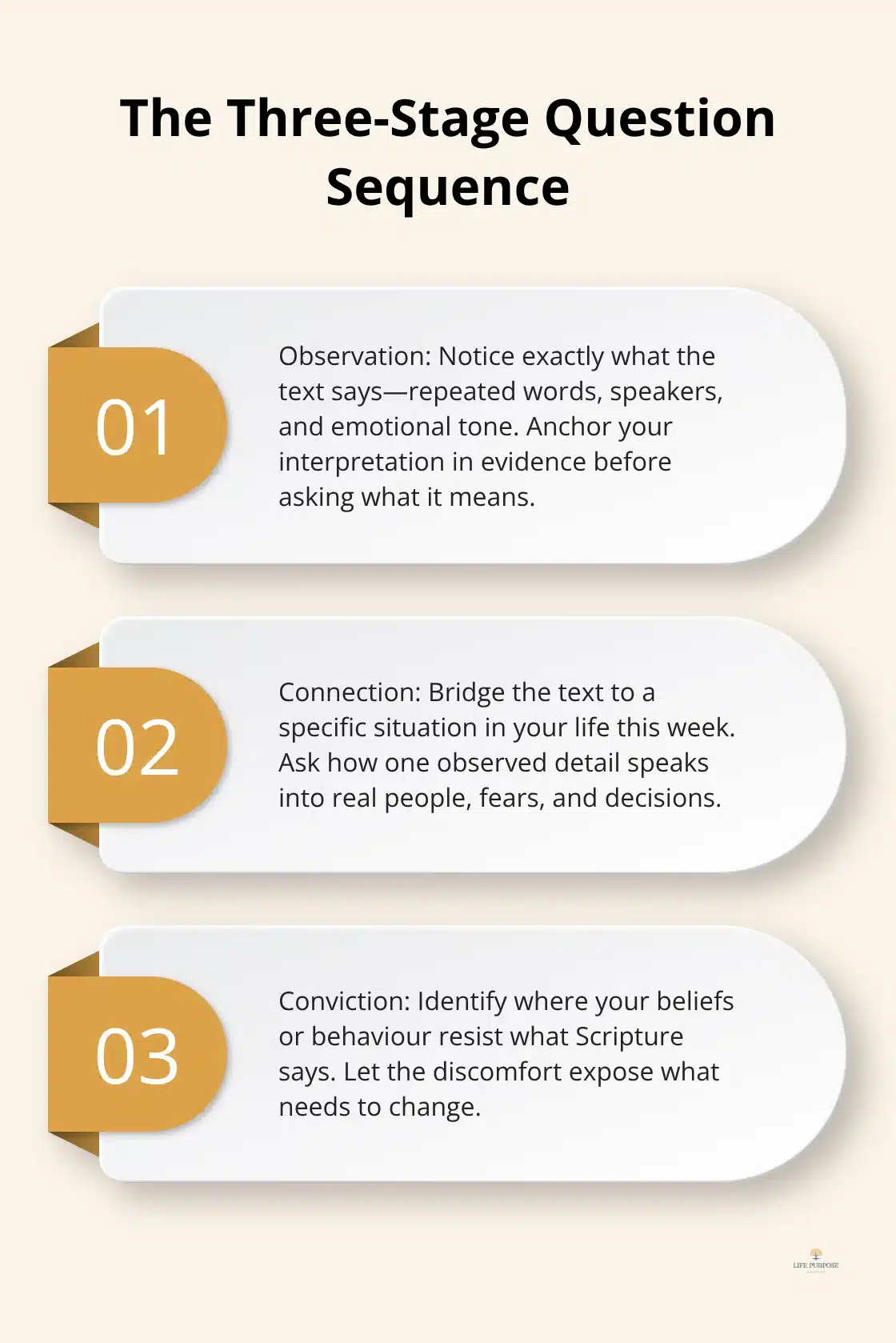
When you ask observation questions first, what words are repeated? Who is speaking to whom? What’s the emotional tone? You anchor your interpretation in evidence rather than assumption. Only after you’ve thoroughly observed should you ask interpretive and application questions. This sequence prevents you from projecting your own ideas onto Scripture and instead lets Scripture shape your thinking.
Challenge What You Already Believe
The questions that stick are the ones that challenge what you already believe. Instead of asking yes-or-no questions that confirm your existing understanding, ask questions that create tension. If you’re reading Jesus’s teaching about loving your enemies in Matthew 5, don’t just ask whether you should do it. Ask why Jesus would command something that feels impossible. Ask what loving an enemy actually looks like in your specific situation, not in theory, but with a real person you find difficult. Ask whether you’ve ever experienced someone’s love changing how you felt about them. These conviction questions are uncomfortable, and that’s precisely why they work. They prevent Bible study from becoming an intellectual exercise and instead make it transformative.
The most common mistake is treating questions as decorative, something to ask at the end of a study session to seem thorough. Instead, questions are the engine of understanding. They should drive your entire study from beginning to end, moving you from observation to interpretation to personal conviction in a logical progression. This progression matters because it trains your mind to read Scripture more carefully each time you open it. As you develop this habit, you’ll notice that the same passage reveals new layers of meaning-not because the text changed, but because you learned to ask better questions.
Building Questions That Actually Work
Observation Questions: Anchor Your Study in Evidence
The gap between a mediocre Bible study question and one that transforms your understanding is specificity. Vague questions like “What does this passage mean to you?” produce vague answers that vanish the moment you close your Bible. Instead, construct questions that move through three distinct stages: first, you observe exactly what the text says without interpretation; second, you ask how that observation connects to real situations in your life right now; third, you interrogate your own beliefs to see where Scripture challenges you.
Start your observation questions by focusing on the smallest details. Ask what words appear repeatedly in a passage, not because repetition is poetic, but because biblical authors repeated ideas they wanted to emphasise. When you read 1 John 1:1-4, notice that John uses the word “we” repeatedly while discussing what he and other eyewitnesses saw and heard. That’s not accidental. Ask yourself: why does John emphasise that multiple people witnessed Jesus, not just one? What difference does eyewitness testimony make to his credibility? These observation questions anchor your study in evidence rather than assumptions.
Connection Questions: Bridge Scripture to Your Circumstances
After you’ve observed thoroughly, shift to connection questions that bridge Scripture to your actual circumstances. Don’t ask abstract questions about how you should apply a passage. Instead, identify a specific situation you’re facing this week and ask how the passage speaks to it. If you’re studying Jesus calming the storm in Mark 4, don’t ask whether you should trust Jesus in difficult times. Ask: What storm am I in right now, and what would trusting Jesus look like in that specific situation, not someday, but this week? Name the people involved. Describe what you’re afraid of. This transforms Bible study from theoretical to tactical.
Open-ended questions work far better than yes-or-no questions because they invite deeper reflection and honest exploration. This sequence prevents you from projecting your own ideas onto Scripture and instead lets Scripture shape your thinking.
Conviction Questions Expose Where You Resist Scripture
Finally, ask yourself the hardest questions-the ones that expose where your beliefs conflict with Scripture. These conviction questions reveal the gap between what you claim to believe and how you actually live. If you’re reading about forgiveness, ask yourself: who have I refused to forgive, and what would actually need to change in me for that forgiveness to happen? These uncomfortable questions are where real spiritual growth begins (and where most people stop asking questions altogether).
The most common mistake is treating questions as decorative, something to add at the end of a study session to seem thorough. Instead, questions are the engine of understanding. They should drive your entire study from beginning to end, moving you from observation to interpretation to personal conviction in a logical progression. This progression matters because it trains your mind to read Scripture more carefully each time you open it. As you develop this habit, you’ll notice that the same passage reveals new layers of meaning-not because the text changed, but because you learned to ask better questions.
Moving From Questions to Consistent Practice
The real power emerges when you apply this three-stage question framework consistently across multiple passages. You’ll start to recognise patterns in how Scripture addresses similar situations, and you’ll develop intuition about which questions unlock the deepest insights. This consistency transforms Bible study from an occasional activity into a practice that shapes how you think and live. The next chapter explores how to sustain this practice over time and what happens when you commit to asking better questions week after week.
Question Formats That Actually Reveal Meaning
The questions that transform your Bible study follow specific patterns that work because they align with how your brain processes information and how Scripture functions. Different passages demand different question formats. When you trace a character arc across multiple books, you ask one type of question. When you compare how the Old Testament sets up what the New Testament fulfils, you ask a different question entirely. When you examine where your life contradicts Scripture’s teaching, you ask questions that cut even deeper. The format you choose determines what you’ll discover, which means selecting the wrong format wastes your study time.
Trace One Theme Across Multiple Passages
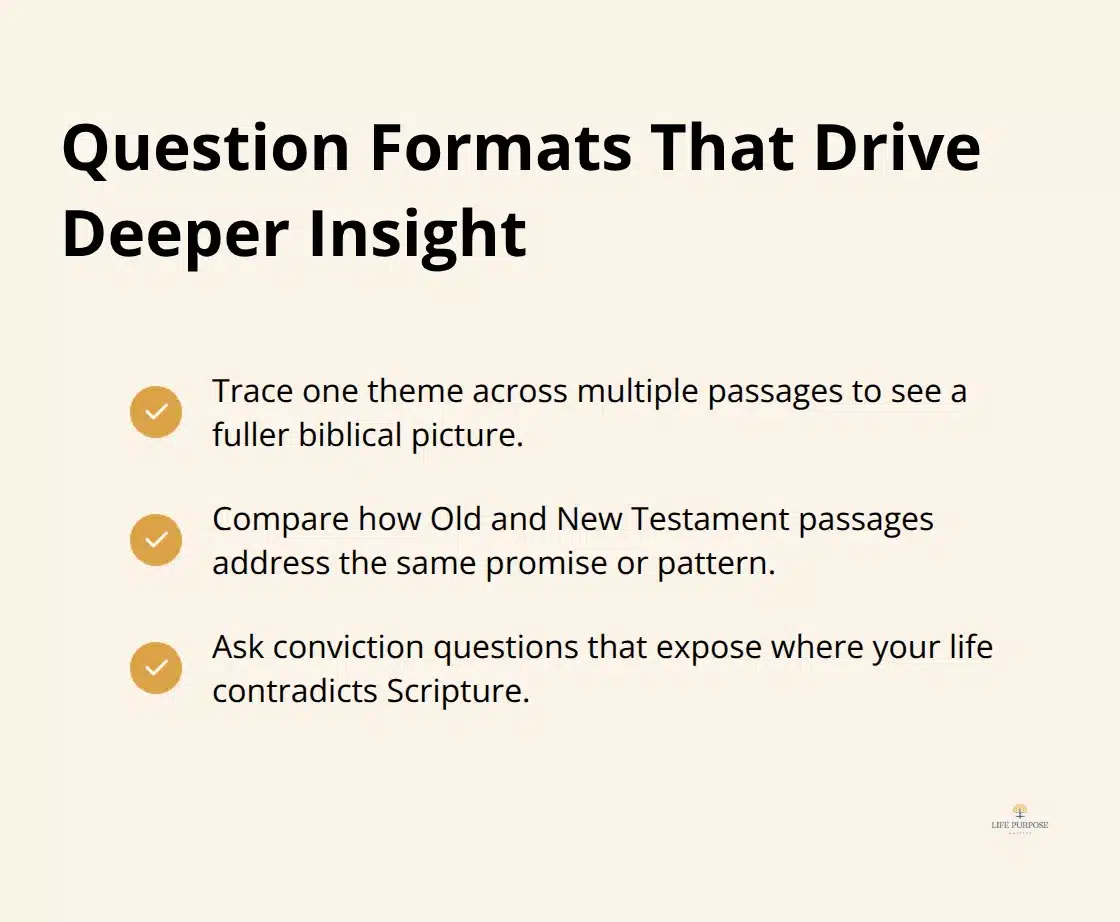
Follow a biblical concept through Scripture like a thread rather than studying it in isolation. Instead of examining forgiveness in one passage, trace what Scripture says about forgiveness in Matthew 18, Luke 17, Colossians 3, and Ephesians 4. Your questions shift from asking what one passage means to asking how different authors address the same topic from different angles. What does Matthew emphasise about forgiveness that Luke omits? Where do these passages agree, and where do they add different nuances? What situation in Paul’s letters prompted him to address forgiveness differently from the Gospel writers?
This topical approach prevents you from building your theology on a single passage. It forces you to see the full biblical picture instead. When you study mercy across both testaments, you notice that the Old Testament emphasises God’s mercy as compassion toward the vulnerable. In contrast, the New Testament emphasises mercy as the basis for how believers should treat each other. That’s not a contradiction-it’s deepening. Your questions should hunt for these connections rather than assume all passages say the same thing in the same way.
Compare How Old and New Testament Passages Speak to Each Other
The relationship between Old and New Testament passages creates some of the richest study material available, yet most people ignore it entirely. When you read Isaiah 53’s suffering servant passage, ask yourself how Matthew’s Gospel shows Jesus fulfilling this. What specific details does Matthew include that connect to Isaiah’s prophecy, and what details diverge? These comparative questions aren’t about proving the Bible is consistent (though it is), but about understanding how God’s plan unfolds across centuries.
Ask what the original Isaiah audience would have understood about the suffering servant, then ask what Matthew’s first-century Jewish readers would have recognised when they saw Jesus in that role. The tension between those two understandings is where real insight lives. When you study David’s kingship in 1 Samuel alongside how Jesus appears as the ultimate King in Revelation, ask what kind of king David was, what he failed at, and how Jesus’s kingship differs fundamentally. These questions prevent you from flattening Scripture into a single message and instead let you see how God works through history.
Ask Questions That Expose Your Resistance
The most uncomfortable format is the conviction question that reveals where you actually resist Scripture rather than just intellectually disagreeing with it. These questions work because they’re specific to your life right now, not hypothetical. When you read Jesus’s command to love your enemies, don’t ask whether you should do it. Instead, ask: who is my actual enemy right now, and what would loving them require me to do this week? Name the person. Describe the specific action. These questions work because they move from abstract principle to concrete behaviour.
Ask yourself what you’d lose if you obeyed this command: your reputation, your anger, your sense of being wronged. Name it. This honesty is where transformation begins. These conviction questions are hardest to ask because they expose the gap between your stated beliefs and your actual choices. Most people stop asking questions at this point because the answers are uncomfortable. That’s precisely why this format matters. The discomfort signals you’ve found something that needs to change.
Final Thoughts
Bible study questions transform passive reading into active spiritual work that shapes how you think and live. Character analysis reveals who biblical figures actually were, contextual questions ground their choices in real historical stakes, and application questions connect ancient struggles to your life right now. This three-part framework prevents your study from becoming scattered or superficial, and it works because it trains your mind to process Scripture systematically rather than randomly.
One week of asking better questions won’t change much, but three months of moving through observation, connection, and conviction questions will rewire how you read Scripture entirely. You’ll notice patterns you missed before, catch repeated words and ask why they matter, and recognise when a passage challenges something you actually believe rather than just something you claim to believe. This consistency strengthens faith far more than occasional insight or emotional moments during a service.
Start this week with one passage and read it through without any questions first. Then ask what words repeat, who speaks, and what the emotional tone is. Write down three observations. Next, ask how one observation connects to something happening in your life right now, and finally ask the hardest question: where does this passage challenge what I actually do, not just what I believe? We at Life Purpose Matters support your spiritual journey with resources designed to help you discover and live out your God-given purpose through deeper faith engagement.