
There is a particular kind of pain that doesn’t always have a name. It’s the ache of being passed over. Of watching someone else get chosen — for the promotion, for the relationship, for the role, for the love. It’s the quiet grief of being the one left behind, the one who didn’t make the cut, the one who was used but never truly valued.
If you’ve carried that pain for years, maybe even decades, this is written for you.
Because buried in the book of Genesis is a woman whose story speaks directly to that ache. Her name is Hagar. She was a slave, a foreigner, a woman used and then discarded. She was never anyone’s first choice. And yet, she received something extraordinary, something that even the great patriarchs of the faith did not receive in the same way.
God saw her.
Who Was Hagar?
Hagar’s story begins in Genesis 16. She was an Egyptian slave, a servant to Sarai, the wife of Abram. She had no status, no agency, no say in her own destiny. When Sarai grew impatient waiting for the son God had promised, she devised a plan, she would give her servant Hagar to Abram, and the child born of that union would be counted as Sarai’s own.
This was not Hagar’s choice. She was not consulted. She was used as a vessel, a means to an end.
“So after Abram had been living in Canaan ten years, Sarai his wife took her Egyptian servant Hagar and gave her to her husband to be his wife.” — Genesis 16:3 (NIV)
When Hagar became pregnant, the dynamics in the household shifted painfully. Tension flared. Sarai, who had orchestrated the entire situation, turned on Hagar with cruelty. And Abram, rather than protecting the woman now carrying his child, handed her back to Sarai’s authority.
“Then Sarai mistreated Hagar; so she fled from her.” — Genesis 16:6b (NIV)
So there she was — pregnant, alone, running through the desert wilderness. Discarded. Overlooked. Fleeing pain with nowhere to go.
Sound familiar?
The God Who Finds Us in the Wilderness
Here is where the story turns sacred.
In the wilderness, at a spring of water, an angel of the Lord appeared to Hagar. Not to Abram, who had the covenant. Not to Sarai, who had the position. To Hagar, the slave, the foreigner, the one who was nobody’s first choice.
“The angel of the Lord found Hagar near a spring in the desert; it was the spring that is beside the road to Shur.”— Genesis 16:7 (NIV)
Notice the word: found. God didn’t wait for Hagar to come to Him. He went looking for her. He tracked her down in her most desperate moment. He came to the woman the world had forgotten and said, in essence, I have not forgotten you.
He called her by name. He asked where she had come from and where she was going. He made her a promise, that her son Ishmael would be the father of a great nation:
“I will increase your descendants so much that they will be too numerous to count.” — Genesis 16:10 (NIV)
A promise of legacy. Spoken to a slave.
She Named God
What Hagar did next is one of the most astonishing moments in all of Scripture. She, an Egyptian slave woman with no theological training, no priestly lineage, no standing in the covenant community, she named God.
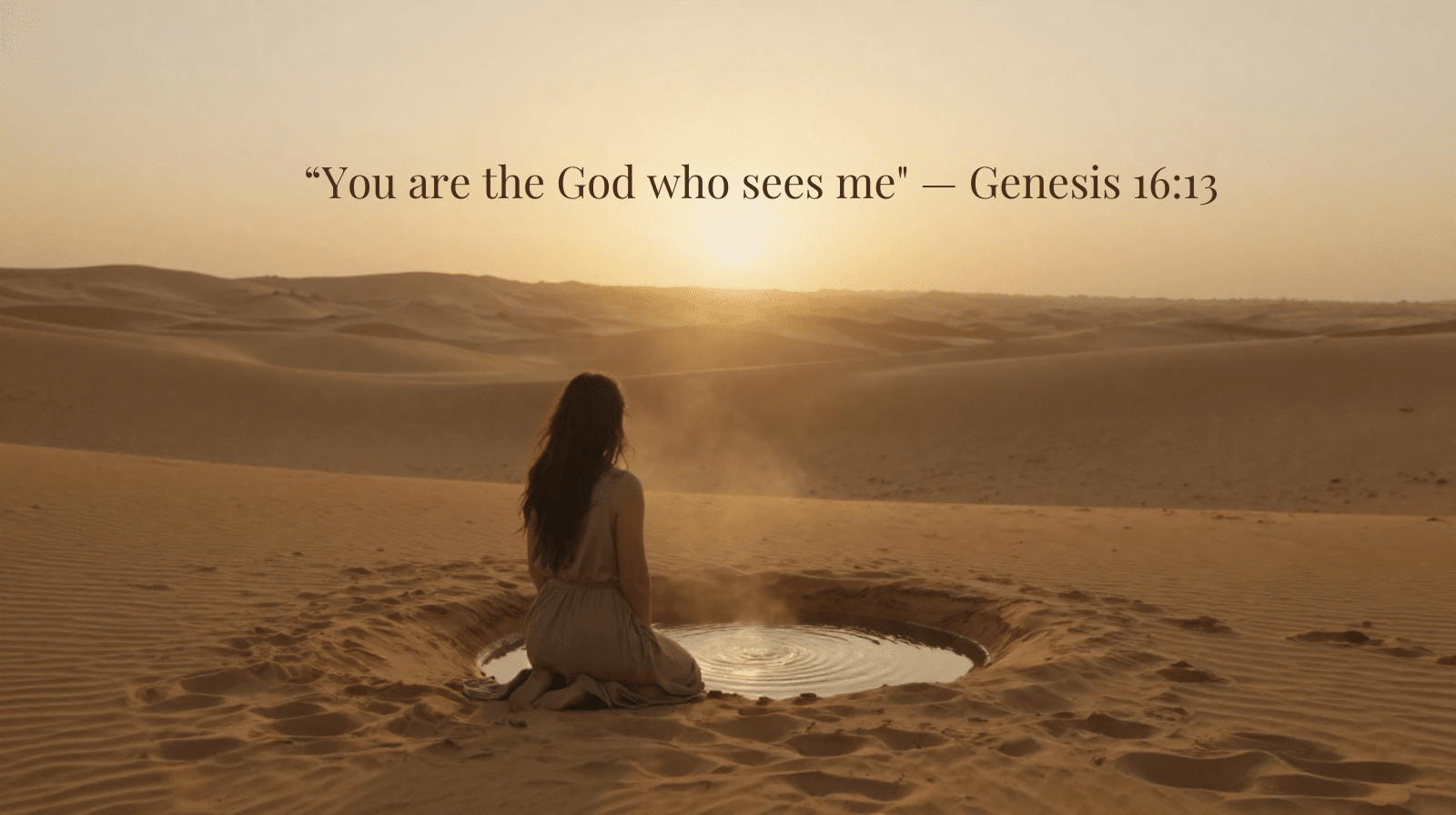
“She gave this name to the Lord who spoke to her: ‘You are the God who sees me,’ for she said, ‘I have now seen the One who sees me.'” — Genesis 16:13 (NIV)
El Roi. The God Who Sees.
This is the only place in the entire Bible where a human being gives God a new name. And it was not a patriarch. It was not a prophet. It was a rejected, runaway slave woman who had been used and cast aside.
She saw that she was seen. And in being seen, something in her changed.

The Second Wilderness
Years passed. Hagar returned and gave birth to Ishmael. But the pain was not over. When Sarah (now renamed by God) finally bore Isaac — the long-awaited son of the covenant — Hagar and Ishmael were cast out again. This time, permanently.
“Early the next morning Abraham took some food and a skin of water and gave them to Hagar. He set them on her shoulders and then sent her off with the boy. She went on her way and wandered in the Desert of Beersheba.” — Genesis 21:14 (NIV)
The water ran out. Hagar placed her son under a shrub, walked a short distance away, and sat down. She couldn’t watch her child die.
“And as she sat there, she began to sob.” — Genesis 21:16b (NIV)
This is one of the most raw, human moments in all of Scripture. A mother weeping in a desert, out of options, out of hope. Have you been there? Not necessarily in a physical desert, but in that inner place of complete depletion, where you’ve run out of resources, out of strength, out of hope?
And then, God came again.
“God heard the boy crying, and the angel of God called to Hagar from heaven and said to her, ‘What is the matter, Hagar? Do not be afraid; God has heard the boy crying as he lies there. Lift the boy up and take him by the hand, for I will make him into a great nation.'” — Genesis 21:17–18 (NIV)
“Then God opened her eyes and she saw a well of water. So she went and filled the skin with water and gave the boy a drink.” — Genesis 21:19 (NIV)
The water was already there. God opened her eyes to see what she couldn’t see through her tears.
What God Says to the Overlooked
Hagar’s story is not a footnote. It is a message, and here is what it says to every person who has lived in the pain of not being chosen:
1. Being overlooked by people does not mean being overlooked by God.
The world passed over Hagar. She was used, dismissed, and expelled. But God found her — twice. He is El Roi, the God who sees. He sees your rejection. He sees your years of waiting. He sees every moment you were passed over and every night you quietly grieved it.
“For the Lord does not see as man sees; for man looks at the outward appearance, but the Lord looks at the heart.” — 1 Samuel 16:7b (NKJV)
2. Not being chosen by others does not diminish your worth or your calling.
Hagar was not part of the covenant in the way Abraham and Sarah were. She was not the chosen vessel for the messianic line. And yet, God gave her a personal promise. He gave her a name, a destiny, and a future. Your value is not determined by who chose you. It is determined by the One who created you.
“For you created my inmost being; you knit me together in my mother’s womb. I praise you because I am fearfully and wonderfully made.” — Psalm 139:13–14a (NIV)
3. God meets us in the desert, not just the sanctuary.
Hagar didn’t encounter God at an altar. She met Him at a spring in the wilderness, and at a shrub in the desert. If you are in a wilderness season — dry, alone, exhausted, that is not a sign of God’s absence. It may be exactly where He plans to meet you.
“When you pass through the waters, I will be with you; and when you pass through the rivers, they will not sweep over you. When you walk through the fire, you will not be burned.” — Isaiah 43:2 (NIV)
4. What looks like rejection may be redirection.
Hagar was sent into the wilderness twice, and both times, God had provision waiting. Being removed from a situation that was wounding you is not abandonment. Sometimes God allows doors to close on places where we were being diminished, in order to open our eyes to the well that was always near.
A Word Directly to You
If you are reading this and you carry the weight of years spent feeling unchosen, unchosen by a parent who favoured a sibling, by a partner who chose someone else, by a church that overlooked your gifts, by a community that never quite made room for you, please hear this:
You are not invisible to God.
You are not a mistake. You are not plan B. You are not too much, or too little, or too late. You are seen by the God who tracked down a foreign slave woman in the desert and called her by name.
Your wilderness is not your ending. Hagar’s story didn’t end under that shrub. And yours doesn’t end here either.
The well is near. Ask God to open your eyes.
“The Lord is close to the brokenhearted and saves those who are crushed in spirit.” — Psalm 34:18 (NIV)
A Prayer for the Unchosen
Lord, I come to You as Hagar came — weary, wounded, and wondering if You see me. I have carried the pain of not being chosen for longer than I want to admit. Today I choose to believe that You are El Roi, the God who sees. You see me. You know my name. You have not forgotten me. Open my eyes to the well You have already prepared. Remind me that my worth was never determined by who chose me, but by the God who created me. In Jesus’ name, Amen.
“She gave this name to the Lord who spoke to her: ‘You are the God who sees me.'” — Genesis 16:13 (NIV)
You are seen. You are known. You are not alone.
If this post encouraged you, share it with someone who needs to be reminded that God sees them too.