

Scripture memorisation transforms how you connect with God’s Word. Instead of passively reading verses, you internalise them, making Scripture available whenever you need guidance, comfort, or strength. At Life Purpose Matters, we’ve seen how memorisation deepens faith and changes lives. This guide gives you proven techniques, a structured 30-day plan, and practical tools to start today.
How to Build a Strong Scripture Memory Foundation
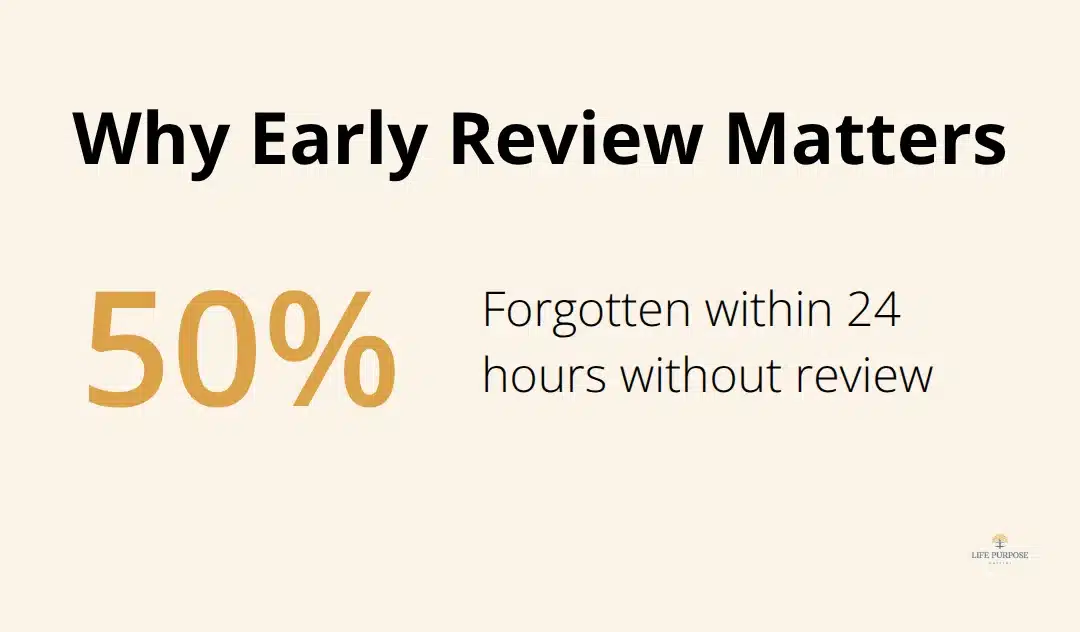
Your brain needs exposure to information multiple times before it sticks. Hermann Ebbinghaus, a 19th-century psychologist, discovered that you forget roughly 50 per cent of new information within 24 hours without review. This means your first review session must happen within 12 hours of initial memorisation to prevent steep decay. Start with your chosen verse: read it aloud five times slowly, then write it down by hand twice.
The combination of hearing, speaking, and writing engages multiple memory pathways simultaneously, making the verse harder to forget. Complete this within your first hour of choosing a verse. Most people skip this critical window and wonder why their memorisation fails after a few days.
Breaking Verses Into Chunks That Stick
Long verses intimidate the brain and trigger avoidance. A 15-word verse should be broken into three or four natural segments at punctuation marks or logical breaks in thought. Take Romans 8:1: “Therefore, there is now no condemnation for those who are in Christ Jesus.” Memorise the first segment until you can recite it perfectly, then add the second segment while reciting the first. This stacking method prevents cognitive overload and builds momentum. Never attempt to memorise an entire verse as one block. Research on working memory capacity shows adults can hold approximately 7 ± 2 items at once, so staying under 10 words per chunk keeps you within that capacity. Practice each chunk for two minutes before moving forward.
Check out this downloadable PDF – Christian Scripture Memorisation Kit, Identity in Christ Guided Workbook
Linking Verses to Mental Images
Visualisation anchors abstract words to concrete mental pictures. Take Philippians 4:6 and create bizarre, exaggerated images for each concept. Visualise yourself writing a thank-you card with oversized purple ink while standing in a grocery store. The more unusual and emotionally vivid the image, the stronger the memory trace becomes. Your brain prioritises unusual or emotionally charged information for survival. Once you have the image, mentally walk through it three times while reciting the verse aloud. Association strategies work similarly: connect new verses to places in your home, assigning Matthew to your kitchen, Mark to your bedroom, and Luke to your living room. This spatial memory technique leverages the fact that humans have exceptional memory for physical locations. When reciting, mentally walk through your home and place each verse in its assigned room.
Rooted in Him: 30-Day Spiritual Identity Devotional
Applying the Memory Palace Method
Josh Summers used a structured memory palace system to memorise the entire book of 2 Timothy (four chapters and 83 verses). He assigned each chapter to a specific room in a familiar location, then placed individual verses within that space using vivid mental images. This approach transforms abstract Scripture into a navigable mental map. Your memory palace works best when you choose a location you know intimately-your childhood home, your current residence, or even your workplace. The more detailed your mental visualisation of this space, the more effectively you’ll anchor verses to specific locations. Start with a single chapter and assign it to one room, placing verses sequentially along a mental path through that space. This method works because spatial memory is one of your brain’s strongest capabilities.
Your foundation is now set. The next step involves structuring your review schedule to lock these verses into long-term memory.
When to Review and What to Track
Ebbinghaus’s forgetting curve demands action within specific timeframes, or your effort dissolves. Your first review happens within 12 hours of memorisation-this is non-negotiable. The second review occurs two days later, the third at four days, then one week, and finally twice monthly thereafter. This schedule fights the brain’s natural decay pattern. If you miss a review window, reset the cycle entirely and start over with that verse.
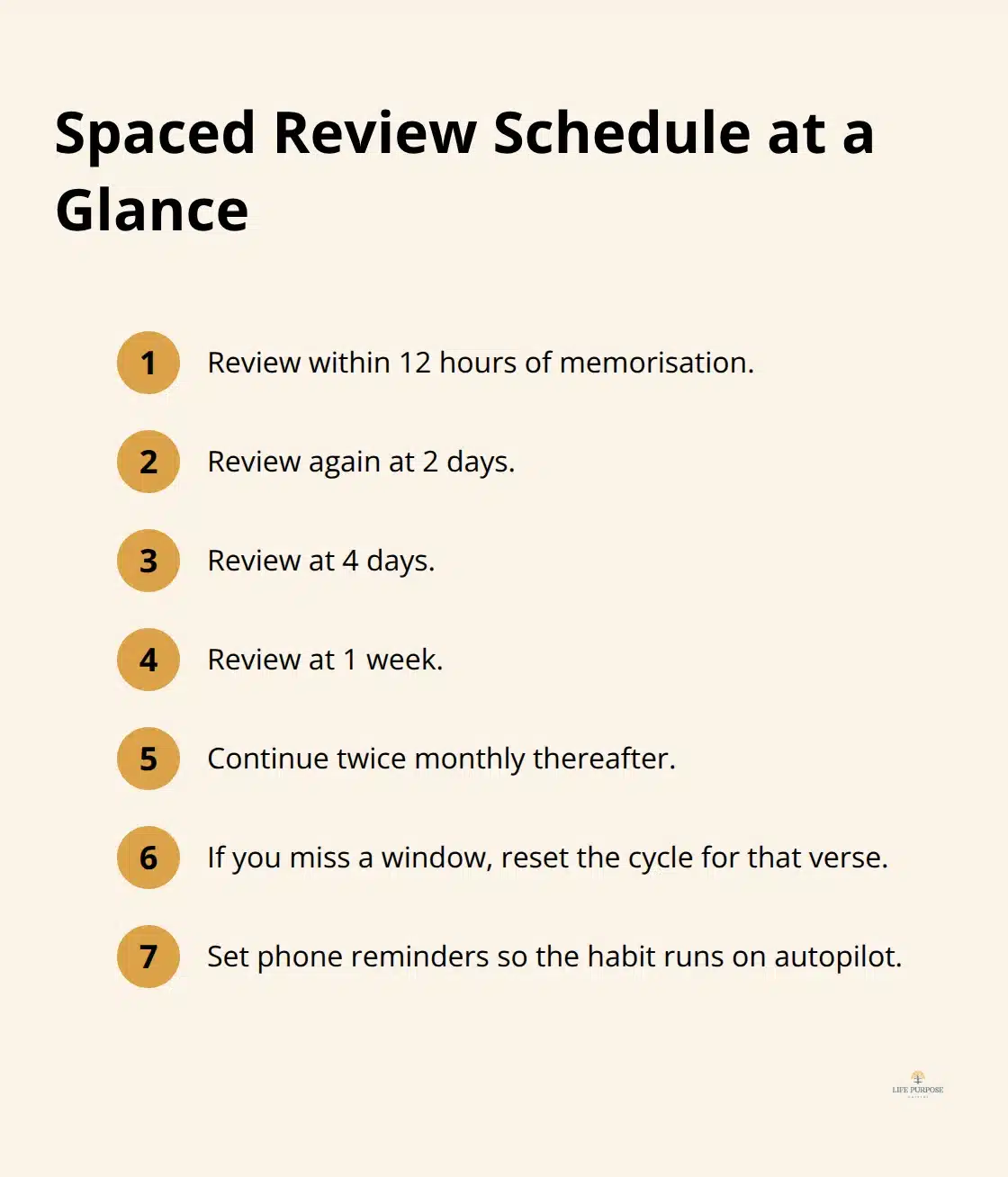
Skipping one session and hoping to catch up later wastes weeks of prior work. Set phone reminders for each review day so the habit runs on autopilot rather than willpower. Most people fail scripture memorisation not because the technique fails b, but because they abandon the schedule after two weeks when motivation dips.
Your First 30 Days with Four Foundational Verses
The 30-day starter plan addresses motivation loss by front-loading your effort with just four verses spread across the month, giving you breathing room to establish the rhythm before expanding your load. Week one focuses on Romans 8:1, the verse mentioned earlier. Spend five minutes daily reading it aloud with deliberate pacing, write it by hand twice, then create a mental image of yourself standing in a courtroom where the judge declares you innocent. Week two adds Philippians 4:6-7 for anxiety and prayer. Week three introduces Joshua 1:9 for courage during difficult seasons. Week four completes your starter set with Proverbs 3:5-6 about trusting God over personal understanding. Each week y, you maintain all previous verses while adding one new one. Your daily practice takes roughly ten minutes total, five for the new verse, five for reviewing the others. Track completion using a simple calendar where you mark each day you complete your review. This visual progress prevents the invisible effort trap w, where you work hard but never see evidence of advancement. After 30 days, you’ll have four verses locked into long-term memory and a sustainable daily habit requiring minimal willpower to maintain.
Adjusting Your Pace Without Abandoning Your Progress
Many people attempt to memorise ten verses simultaneously, burn out within two weeks, and quit entirely. The opposite mistake involves memorising so slowly that momentum dies. After your initial 30 days, add one new verse every ten days rather than weekly. This keeps challenges present without overwhelming your review schedule. If life circumstances demand your attention (illness, work stress, family crisis), drop to reviewing your existing verses only and pause new memorisation temporarily. This prevents guilt-driven abandonment of the entire practice. Once stability returns, resume adding new verses at your previous pace. Some weeks you’ll memorise quickly; others will move slowly. Flexibility preserves the habit across your lifetime rather than treating scripture memorisation as a sprint ending in exhaustion.
Automating Your Review Schedule
Digital apps like Anki or the Bible Memory App automate your review schedule and notify you which verses need attention today, removing the mental overhead of tracking dates manually. This technology handles the administrative burden so you focus only on recitation and review. Physical flashcards work equally well if you prefer tactile methods-carry them in your pocket and review during commutes or waiting periods. Some people record themselves reciting verses and listen back to catch mistakes, engaging auditory learning alongside visual review. The method matters less than consistency; choose the tool that fits your lifestyle and stick with it. Your next challenge involves selecting which verses to memorise and building a personal collection that addresses your spiritual needs.
Tools That Actually Work for Scripture Memory
The apps and systems you choose determine whether you memorise Scripture or abandon the effort after two weeks. Anki, a free spaced repetition app, automates your review schedule with precision that manual tracking cannot match. You input your verse, and Anki calculates exactly when you need to review based on Ebbinghaus’s forgetting curve, showing cards right before you would forget them. The Bible Memory App integrates Scripture directly into this system, letting you listen to verses in multiple translations while reviewing. Verse Locker and MemVerse work similarly, adding points and streaks to maintain motivation when willpower fades. These apps cost between free and fifteen dollars monthly, which is negligible compared to the mental energy they save.
Physical Methods That Require No Technology
Physical flashcards remain equally effective and require zero battery or internet. Cut index cards into thirds, write the verse reference on one side and the text on the other, then carry them everywhere. You can review during your commute, while waiting in line, or before bed. Some people record themselves reciting verses using their phone’s voice memo app, then listen back to catch errors and track improvement over time. This auditory method catches mistakes that silent reading misses because you hear yourself stumble on difficult passages. The tactile act of handling cards strengthens memory pathways that digital-only methods cannot reach.
Building Accountability Into Your Practice
Scripture memorisation fails most often not from weak techniques but from isolation. When nobody knows your goal, skipping review sessions feels consequence-free. A memorisation partner-whether a friend, family member, or mentor-provides real accountability that apps cannot replicate. You can set a weekly time to recite your verses to this person and let them correct you. This external feedback catches mistakes your own mind normalises through repetition. Some churches organise Scripture memory groups that meet monthly to recite together and celebrate milestones. The social pressure and shared purpose dramatically increase completion rates. Online accountability communities through social media or dedicated platforms connect you with others memorising the same verses when local groups prove difficult to find. The commitment deepens when you must report progress to another person rather than tracking silently in an app.
Combining Methods for Maximum Retention
Digital tools handle scheduling brilliantly but lack the tactile reinforcement that handwriting provides. Your strongest memorisation strategy layers multiple methods: use Anki or the Bible Memory App for scheduled reviews and reminders, maintain physical flashcards for tactile engagement during commutes, record yourself weekly to catch errors, and recite to an accountability partner every seven days. This redundancy feels excessive until you realise that verses memorised through one method alone fade faster than verses reinforced through multiple pathways. The brain encodes information more strongly when multiple senses engage simultaneously.
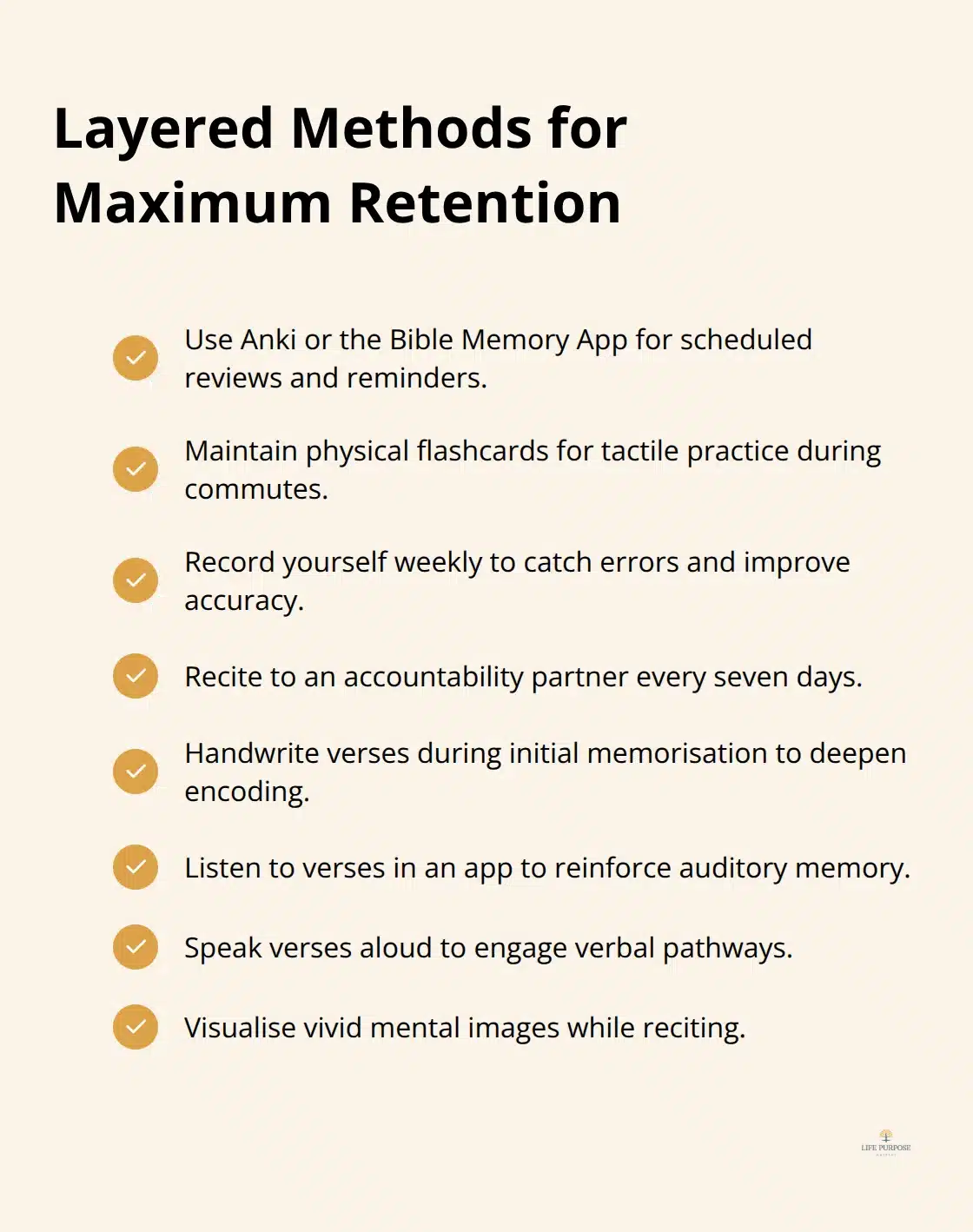
You write the verse by hand during initial memorisation, listen to it in an app during reviews, speak it aloud to your accountability partner, and visualise it mentally while reciting. This layered approach transforms verses from temporary memory into permanent knowledge that surfaces automatically when you need it spiritually.
Final Thoughts
Scripture memorisation transforms your relationship with God’s Word from passive consumption to active internalisation. The techniques you’ve learned-chunking verses, visualisation, memory palaces, and spaced repetition-work because they align with how your brain actually stores and retrieves information. You don’t need perfect conditions or exceptional memory to succeed; you need consistency, the right tools, and a realistic pace that sustains across months and years rather than burning out after weeks.
The long-term benefits extend far beyond recalling verses on command. Memorised Scripture becomes your mental refuge during crisis, your source of strength when doubt creeps in, and your constant companion throughout daily life. When anxiety strikes at 3 a.m., the words will surface automatically from memory, offering immediate comfort without requiring your phone or Bible. When you face temptation or moral confusion, memorised passages guide your decisions without needing external resources.
Your next step is simple: choose one verse from your 30-day starter plan and begin today. Start with Romans 8:1, read it aloud five times, write it by hand twice, and set a phone reminder for your first review within 12 hours. We at Life Purpose Matters believe that scripture memorisation deepens your spiritual foundation and connects you more intimately with God’s purpose for your life, positioning you to live out your faith with greater clarity and conviction.