

I once watched someone spend an entire dinner arguing with a family member over politics, both of them walking away angrier than when they sat down. It made me realise how desperately we need wisdom that actually works in real life. On a side note, if you ever need a conversation starter with me, please don’t talk politics, I will switch off within seconds! 😂
Jesus’ teachings offer practical solutions to the problems we face every day: loneliness, financial anxiety, division, broken relationships, and many others. At Life Purpose Matters, we believe these ancient principles aren’t dusty relics but living guidance for modern struggles. This post shows you how to apply Jesus’ core messages of compassion, generosity, and love to transform your relationships, finances, and community right now.
How Jesus Breaks Through Loneliness and Division
Loneliness has become a genuine crisis. The U.S. Surgeon General declared loneliness an epidemic in 2023, noting that the loneliness epidemic carries mortality risks similar to smoking. Jesus addressed this head-on with a radical command: love your neighbour as yourself. But here’s where most people miss the point-Jesus didn’t mean people you naturally like or those who share your beliefs. In Luke 10:25-37, the Good Samaritan passage makes this crystal clear. A Samaritan helped a Jewish man when Jewish religious leaders walked past. These groups despised each other. Jesus was saying your neighbour includes people who disagree with you, people from different backgrounds, people you’d normally avoid. This transforms how you approach loneliness and division.
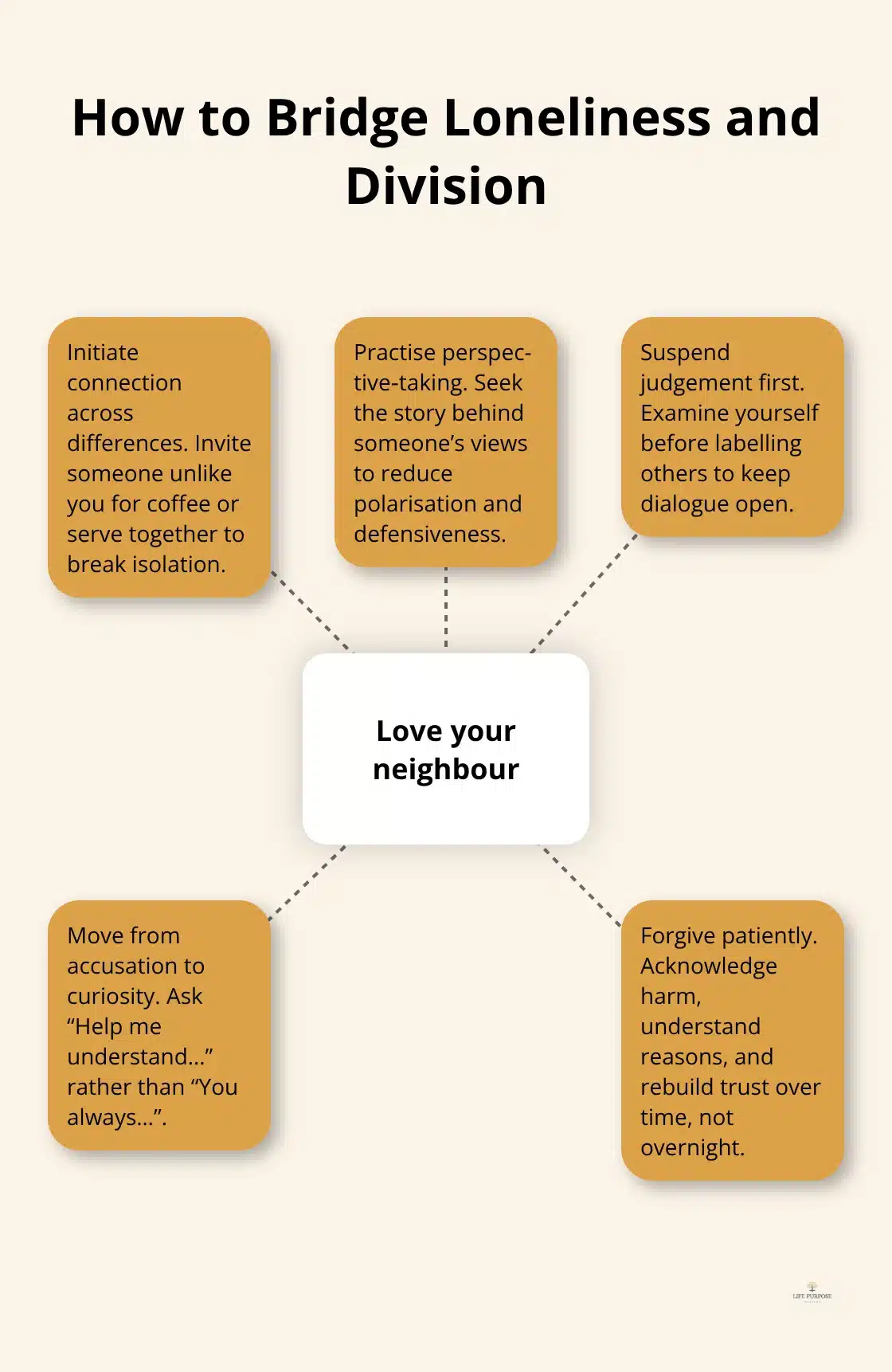
Instead of waiting for perfect friendships or communities that agree with you on everything, Jesus calls you to initiate connections across divides.
Start Small With Real Connection
Try inviting someone different from you for coffee. Call a relative you’ve been avoiding. Join a volunteer group where you’ll meet people outside your usual circle. The loneliness crisis often stems from echo chambers where we only encounter people like us. Breaking that pattern directly addresses the problem.
Judgment Destroys Communities Faster Than Disagreement
Jesus said don’t judge others, but most people stop reading there. Matthew 7:1-5 continues with the hard part: examine yourself first. When division happens in your workplace, church, or family, your instinct is to figure out who’s wrong. Jesus flips this. Ask yourself what you’re missing about the other person’s perspective. What experiences shaped their views? What pain might they be carrying? This isn’t about agreeing with them; it’s about understanding them before labelling them.
Research from the Greater Good Science Centre shows that perspective-taking reduces polarisation more effectively than factual arguments. People soften their positions when they feel genuinely understood, not when they’re proven wrong.
Understanding Precedes Forgiveness
Practising forgiveness in broken relationships requires the same approach. You cannot forgive someone you haven’t tried to understand. That’s not forgiveness; that’s just moving on. Real forgiveness means acknowledging what happened, understanding why they did it, and choosing to rebuild trust despite the hurt. This takes months or years sometimes, not days.
Start by asking questions instead of making statements. Replace “You always do this” with “Help me understand what was happening for you when that occurred.” That single shift moves conversations from accusation to curiosity, and that’s where healing actually begins. As you work through these relational challenges, you’ll discover that Jesus’ approach to compassion extends directly into how we handle our finances and resources-the next area where his teachings offer surprising practical wisdom.
Applying Jesus’ Message of Generosity to Financial Stress
Financial stress creates a particular kind of anxiety because money touches everything-your ability to pay rent, feed your family, and plan for the future. Jesus addressed money constantly, not because he was obsessed with it but because he knew we would be. His teaching cuts through the noise: money itself isn’t evil, but the worship of money destroys you. You cannot serve both God and money. That’s not poetic language; that’s a diagnosis. When your financial decisions flow from fear or greed rather than principle, you’ve chosen money as your master, and it’s a terrible master.
The practical application starts with a hard truth: if you’re financially stressed, generosity seems impossible. But Jesus didn’t teach generosity as something you do after you’re wealthy. He taught it as the pathway to freedom from money’s control. The shift happens when you stop asking what you can afford to give and start asking what you can afford to keep.
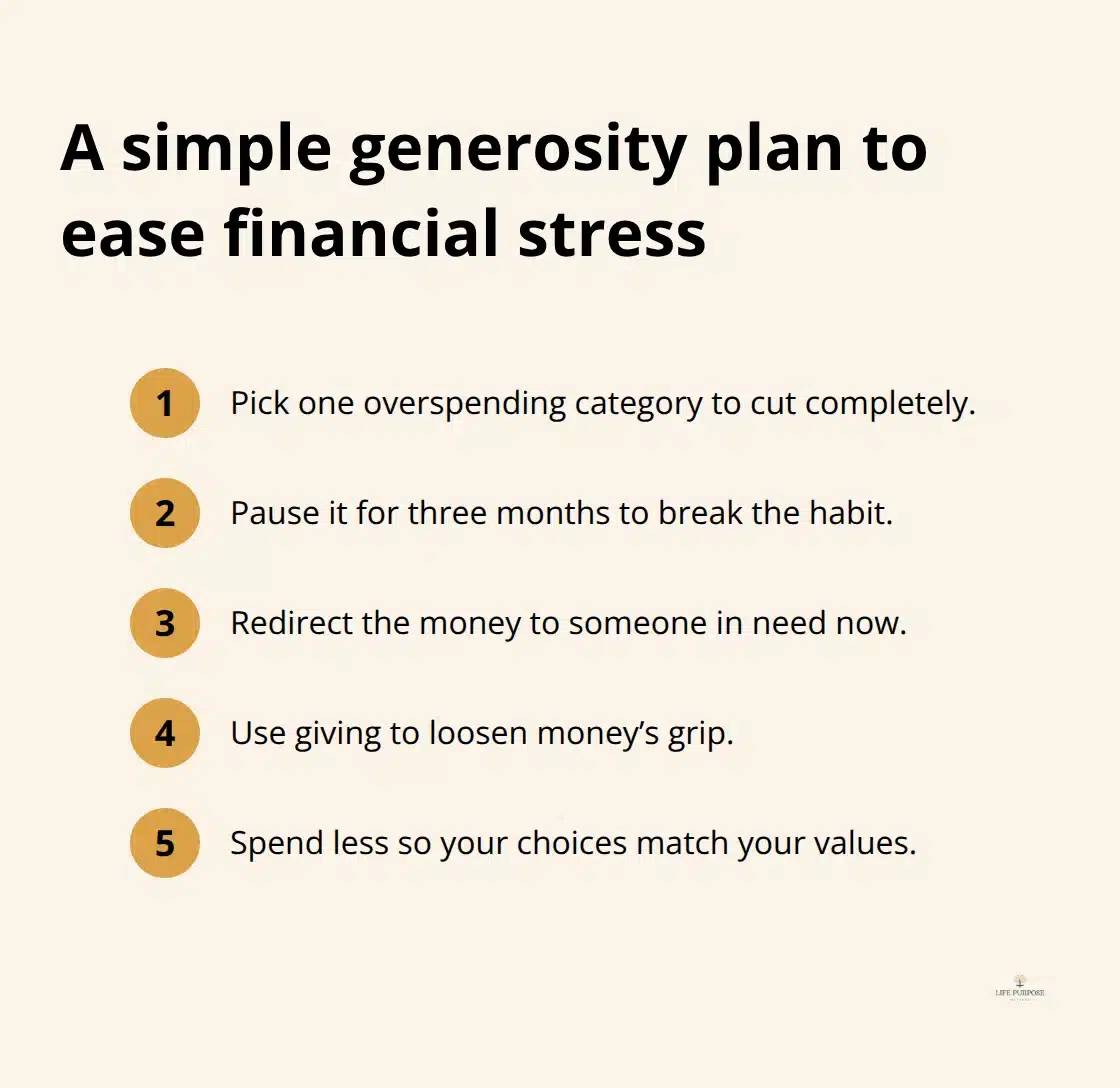
This reframes the entire conversation. Managing money God’s way transforms our financial decisions into opportunities to glorify Him and bless others.
Research from the American Psychological Association shows that financial anxiety correlates directly with isolation and shame, not with actual income level. People earning £100,000 report the same stress as people earning £40,000 when their spending patterns remain disconnected from their values. The antidote isn’t earning more; it’s spending less and giving intentionally.
Identify Where You Overspend
Start with one area where you overspend without thinking. Most people have subscriptions they don’t use, eat out more than planned, upgrading things that still work. Cut that spending completely for three months and redirect that money to someone in need. Not someday when you’re comfortable. Now. This isn’t about becoming poor; it’s about proving to yourself that money doesn’t control your choices. When you give despite having less, you break the spell money holds.
Discover Purpose Beyond Material Wealth
Jesus taught that purpose beyond material wealth happens through action, not contemplation. Volunteer at a food bank, and you learn more about meaning than any financial self-help book teaches. Work alongside people struggling with poverty, and you realise their problems aren’t solved by having more stuff-they’re solved by community, opportunity, and dignity. That knowledge rewires how you see your own possessions. God operates on generosity, not merit systems, and this principle reshapes how we understand both wealth and worth.
The research is detailed: volunteers report higher life satisfaction than people focused on accumulating wealth. People who volunteer experience a greater sense of purpose and life meaning across all income levels.
Break Free From Consumerism’s Grip
Overcoming greed requires recognising that consumerism isn’t about needing things-it’s about using purchases to fill emotional gaps. Loneliness, anxiety, and purposelessness drive consumption more than actual need. When you address the relational and spiritual emptiness through connection and service, the compulsion to buy weakens naturally. Your money becomes a tool for what matters instead of a substitute for what’s missing.
This shift from financial anxiety to financial freedom through generosity sets the stage for something even deeper: how love and acceptance transform the way you build community and stand against the forces that divide us.
Living Out Jesus’ Teachings on Love and Acceptance
Jesus did not teach love as a feeling you wait to experience. He taught it as a choice you make repeatedly, especially toward people who make that choice hardest. When he commanded love for enemies and strangers, he was not being poetic. He was describing the only path to communities that actually function across differences. The data backs this up. Research from the Harvard Study of Adult Development, which tracked individuals for over 80 years, found that strong relationships and community connections are the primary predictors of happiness and longevity, not wealth or status. Yet most communities fragment precisely where they should strengthen. You avoid people different from you, churches split over minor disagreements, and workplaces become battlegrounds of competing identities. Jesus diagnosed this problem clearly: you cannot build anything meaningful on judgment and exclusion. His solution was radical inclusion, which means you actively work to bring people into your circle, not wait for them to become more like you first.
Who Actually Gets Included in Your Circle
Start with one uncomfortable question: who do you naturally exclude? Maybe it’s people with different political views, different socioeconomic backgrounds, different sexual orientations, or different racial identities. Whatever the answer, that’s where your work begins. Inclusive communities do not happen through accident or policy. They happen when individuals make deliberate choices to cross boundaries. The Pew Research Centre found that Americans increasingly live in ideological bubbles, with 92 per cent of Republicans living in counties where Trump won and 88 per cent of Democrats living in counties where Biden won. This geographic and social sorting means you rarely encounter perspectives that genuinely challenge you.

Jesus’ teaching on loving your neighbour directly contradicts this pattern. Identify one person or group you naturally distance yourself from. Then take a specific action: attend their community event, ask them to coffee, volunteer in their space. Not to convert them or fix them. To understand them. When you spend time with people different from you, your brain rewires. You stop seeing difference as a threat and start seeing it as reality.
Acceptance Means Letting People Stay Exactly Who They Are
Acceptance requires you to release the fantasy that acceptance means agreement. You can fully accept someone’s humanity and dignity without endorsing every choice they make. This distinction matters enormously. Many people refuse to build bridges with those they disagree with because they interpret acceptance as endorsement. That’s false.
Jesus spent time with tax collectors and sinners, people whose choices he clearly rejected, yet he treated them with radical dignity and respect. The practical application means you stop requiring people to change their beliefs or appearance, or identity, before you’ll treat them well.
A parent with a gay child does not have to suddenly agree with every aspect of LGBTQ ideology to say: I love you, you belong here, I’m listening to your experience. A white person does not have to agree with every critique of systemic racism to say: I hear that your experience has been different from mine, and I want to understand it. A Christian does not have to abandon their faith to work alongside atheists on community problems. Acceptance is about recognising someone’s inherent worth, not about pretending you have no convictions. This maturity transforms neighbourhoods and organisations. Research shows that diverse teams with psychological safety outperform homogeneous teams on innovation metrics. That safety comes from knowing you’re accepted even when you disagree.
Standing Against Hatred Requires Naming It Clearly
You do not stay neutral when people face dehumanisation. Neutrality is a luxury available only to those not being targeted. Jesus did not tolerate abuse of vulnerable people. He confronted the religious leaders who burdened the poor, he challenged systems that excluded women and outsiders, and he demanded better from those with power. This means you speak up when you hear slurs, when you witness unfair treatment, when systems harm vulnerable people. But you do it in a way that invites people to become better, not in a way that shames them into defensive silence. Someone makes a racist joke. You say: ” That does not land with me, here’s why, and I know you’re better than that.” Someone discriminates against a colleague. You report it, and you also talk to that person privately if possible, asking what’s driving their behaviour. You stand against hatred while maintaining space for redemption. This balance is harder than either pure aggression or pure silence, but it’s the only approach that actually changes hearts. Research on deradicalisation programmes shows that people leave extremist movements through relationship and dialogue, not through public shaming or legal punishment alone. When you stand against injustice while treating perpetrators as human beings capable of growth, you create the conditions for actual transformation. That’s what Jesus modelled, and it’s what communities desperately need right now.
Final Thoughts
The pattern running through everything we’ve discussed is simple but demanding: Jesus’ teachings work because they address the actual root of modern suffering, not just the symptoms. Loneliness does not disappear because you make more friends; it disappears when you stop judging people and start genuinely knowing them. Financial anxiety does not vanish because you earn more; it vanishes when you stop worshipping money and start using it as a tool for something meaningful. Division in your community does not heal through compromise; it heals when you actively choose to build bridges across difference and stand against dehumanisation without losing your humanity.
These principles transform lives because they remain practical, not theoretical. They shape what you actually do on Tuesday afternoon when someone frustrates you, what you choose to buy or not buy, who you invite into your space, and how you speak about people you disagree with. The shift from knowing these ideas to living them is where everything changes-you cannot think your way into transformation, but you can act your way into it. Start somewhere small and specific: have one conversation with someone different from you this week, cut one spending category and give that money away, or examine one area where you judge someone and ask what you miss about their story.
We at Life Purpose Matters believe your spiritual journey is not separate from your daily struggles-it is the direct answer to them. If you are ready to explore how faith-based living addresses the specific challenges you face, visit our resources and discover how to integrate these teachings more fully into your life.
If I have touched a nerve with this article, I would love to read your comment. Please share in the comment box below. 💜