
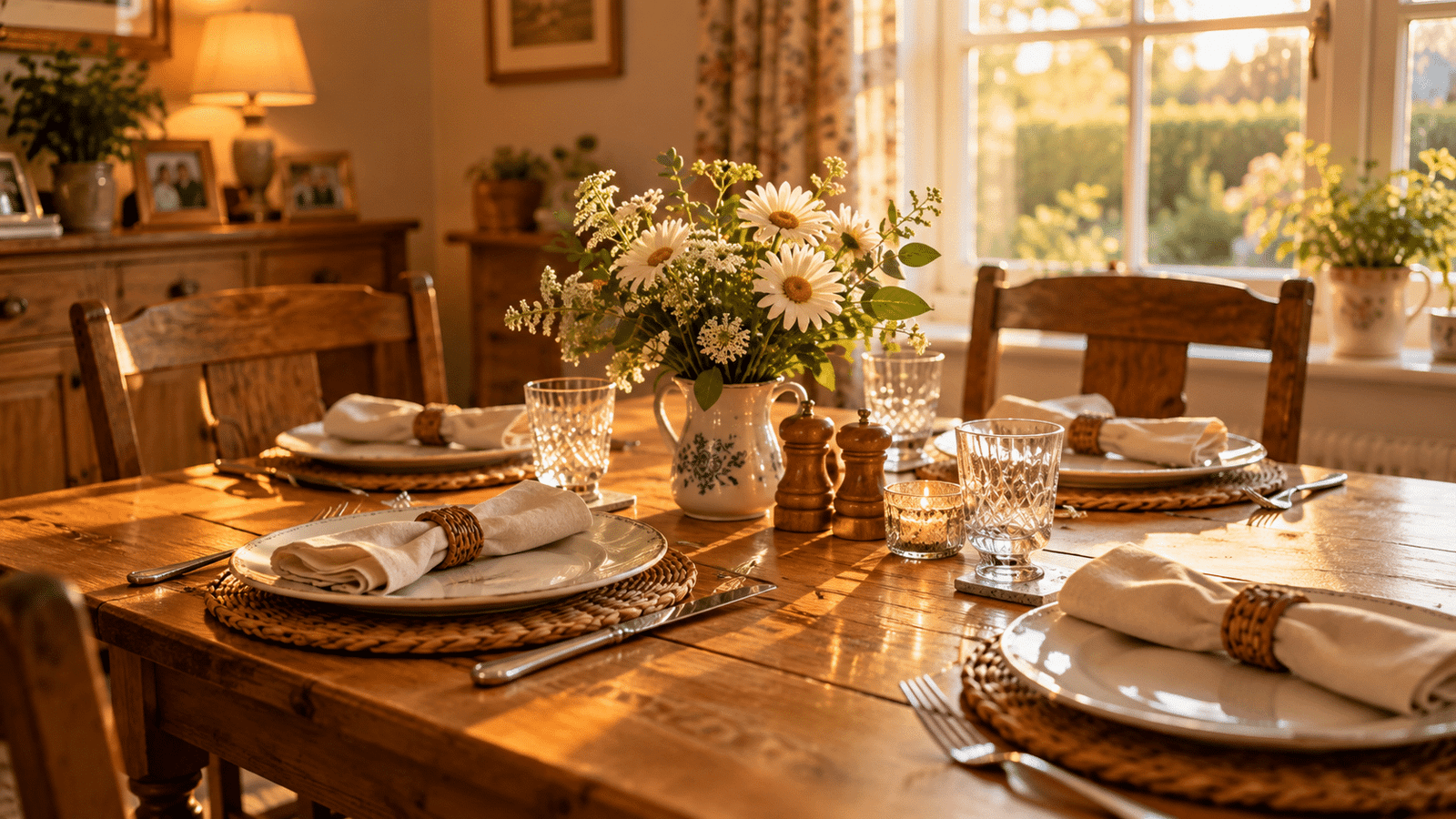
Some seasons of life grow quieter than we expected. That does not mean our purpose has disappeared.
Every Sunday at half past four, Margaret set the table for four.
She took the good plates from the cupboard, folded the cream napkins, placed the cutlery neatly beside each plate and put a small vase of flowers in the centre.
Then she cooked enough food for a family.
Roast chicken, golden potatoes, carrots glazed with honey and, if she had enough energy, a proper apple crumble with custard.
For years, Sunday dinner had been the heart of her home. Her husband, David, would sit at the head of the table; their two children would argue over the last roast potato, and Margaret would pretend not to notice when someone slipped the dog a piece of chicken beneath the table.
There had been noise, laughter, spilt gravy and the occasional disagreement about who had forgotten to buy milk.
She had complained about the chaos more times than she could count.
Now, she would have given almost anything to hear it again.
David had died three years earlier. Their son, Daniel, lived in Manchester with his wife and young family. Their daughter, Lucy, lived an hour away and worked long hours at a demanding job.
They visited when they could. They telephoned regularly. They loved their mother.
But they had lives of their own, as Margaret had always encouraged them to do.
And so, most Sundays, the house remained quiet.
One afternoon, Lucy arrived unexpectedly and found her mother arranging the plates.
“You’re doing it again, Mum.”
Margaret looked up. “Doing what?”
“Setting the table for four.”
“I’m having my dinner, aren’t I?”
“Yes, but why cook enough for an army? It’s only you.”
Margaret smiled faintly. “You never complained when there were four of us.”
“That was different.”
“Was it?”
Lucy sighed and put her handbag on a chair.
“Mum, you don’t have to keep doing all this. You could make something simple. Have a sandwich. Go out with your friends. Join a club. You can’t spend the rest of your life waiting for us to come home.”
The words were not unkind. Lucy spoke from concern, and Margaret knew it. 
Still, they landed heavily.
“I’m not waiting for anybody,” Margaret replied.
Lucy kissed her cheek, stayed for a cup of tea and left before dinner.
That evening, Margaret ate one small portion of chicken at the table. The other three plates remained in the cupboard.
She put the leftovers away, washed the dishes and sat in the sitting room with her Bible.
Her eyes settled on a familiar passage.
“Let us not grow weary in doing good.”
She had read those words many times. Tonight, however, she wondered whether she had mistaken doing good for holding on.
Had she become so attached to the life she once had that she could no longer see the life in front of her?
She prayed about it, although the prayer came out more like a question.
“Lord, if that season is over, what am I supposed to do with all this?”
The house offered no answer.
The following Sunday, Margaret cooked a smaller meal.
She set one place at the table, put a single plate on it and carried her dinner from the kitchen.
She sat down.
The silence was unbearable.
Halfway through her meal, she pushed her chair back and went to the kitchen for the washing-up bowl. There was hardly anything to wash.
She had never realised how much of her day had once been filled by ordinary things. Preparing food, laying plates, listening to stories, telling people to mind their elbows.
Now the hours seemed to stretch endlessly ahead of her.
She stood at the kitchen window and watched the rain falling across the garden.
That was when she noticed the little girl next door.
The child was standing beneath the porch, clutching a school bag against her chest. Her mother, Hannah, was trying to unlock the front door while balancing two shopping bags and a baby on her hip.
One bag split. Apples rolled across the path.
Margaret watched Hannah bend to retrieve them while the baby began to cry.
She opened her back door.
“Hannah, wait a moment. Let me help you.”
Hannah looked up, embarrassed. “I’m all right, thank you. Just having one of those days.”
Margaret recognised the expression. She had worn it herself many times.
“Well, those days are easier when somebody gives you a hand.”
She carried the shopping inside, found a clean towel for the baby and helped Hannah settle everyone in the kitchen.
The little girl, whose name was Sophie, stood near the doorway, looking at the table.
“Are you having dinner?” she asked.
Margaret glanced at the half-cleared plates.
“I’ve just finished, sweetheart.”
“Oh.” Sophie looked down at her shoes. “It smells nice.”
Something stirred in Margaret’s heart.
“Have you had yours?”
The child shook her head.
Hannah immediately protested. “Oh, please don’t trouble yourself. I’ll get something sorted when we get home.”
Margaret looked at the tired young mother, the baby in her arms and the little girl trying very hard not to ask for anything.
“There’s chicken in the oven,” she said. “And far too many potatoes. You would be doing me a favour.”
It was not entirely true. But it was the kindest way she could think of to open the door.
Within minutes, Sophie was sitting at Margaret’s table, eating roast potatoes with the concentration of someone who had not realised how hungry she was. Hannah sat beside her with the baby sleeping against her shoulder.
They talked about school, work, the weather and the difficulties of raising children when there never seemed to be enough hours in the day.
Margaret listened.
She did not offer advice unless Hannah asked for it. She did not tell Sophie to eat her vegetables, although she was tempted. She simply served another helping and put the kettle on.
When they finally left, Sophie turned at the door.
“Can we come again, Mrs Margaret?”
Margaret felt an unexpected warmth rise in her chest.
“If your mum says it’s all right, you may.”
Hannah smiled gratefully. “I think we would both like that.”
After they had gone, Margaret returned to the dining room.
Three empty plates sat on the table.
For the first time in a long while, the sight made her smile.
The following Sunday, Margaret set the table for three.
She did not know whether Hannah and the children would come. She had sent a message inviting them, but she had learnt over the years that life rarely follows a neat plan.
At ten past five, there was a knock at the door.
Sophie stood outside holding a bunch of daisies.
“Mummy said we could come!”
Margaret laughed and ushered them in.
That afternoon became the first of many shared Sunday dinners. Sometimes Hannah and the children came. Sometimes they could not. Occasionally, Lucy or Daniel visited too, and the house filled with the familiar noise of family.
But something had changed.
Margaret no longer measured the value of her Sundays by the number of people who came through her door. She had begun to understand that a welcoming home did not have to look as it once had to remain a place of purpose.
One Sunday, Lucy arrived early and found her mother arranging the table.
There were four plates this time.
“Expecting company?” she asked.
Margaret nodded towards the garden, where Sophie was helping her mother pick flowers.
“Yes. We have a little family coming for dinner.”
Lucy looked at her mother for a moment.
Then she rolled up her sleeves.
“Right. What needs doing?”
Margaret handed her a tea towel.
“Well, you can start by drying those dishes.”
And just like that, the kitchen was filled with conversation again.
Not the same conversations. Not the same people around the table every week. Life had moved on, as life must.
But the love had not left the house.
It had simply found another way to come in.
That evening, after everyone had gone, Margaret sat alone for a little while.
The table was cleared. The kitchen was quiet. A few crumbs remained beneath Sophie’s chair.
She bowed her head.
“Thank You, Lord,” she whispered.
She thought of the question she had asked Him weeks earlier.
What am I supposed to do with all this?
She had expected an answer that would arrive like a grand announcement, perhaps a new assignment or some extraordinary opportunity.
Instead, the answer had come through a hungry child, a tired mother and a table that had room for one more plate.
Margaret smiled.
Tomorrow, she would telephone Daniel. She would arrange to meet a friend for coffee. She might even join the community garden group she had been considering for months.
There was still so much life to live.
And next Sunday, she would set the table again.
Not because she was trying to bring back the past.
Because she had finally stopped believing that the best of her life had already happened.
Sometimes God does not restore a season in the way we remember it. Sometimes He shows us how to use what remains to bless someone in the season we are in.
Margaret had spent years setting the table for the people she loved.
She was only just discovering how many more places there were to set.
A Thought to Carry With You
Perhaps you are living through a season that feels smaller than the one before it. Your children may have grown up. Your career may have changed. A relationship may have ended, or a familiar role may no longer be yours.
It is natural to miss what was.
Give yourself permission to grieve those changes. You do not have to pretend that every ending feels wonderful.
But do not assume that a quieter season is an empty one.
The experience, kindness, wisdom and love you have gathered over the years still have somewhere to go. Your next opportunity to make a difference may arrive in an ordinary moment, through a conversation, an invitation or a need you happen to notice.
As Galatians 6:9 reminds us, let us not grow weary in doing good.
You may not be called to do what you once did. There may be someone who needs what you can offer now.
Your season may have changed. Your capacity to love has not.
A Question for Reflection
What is one thing you used to do that brought joy or comfort to others? Could you offer it in a new way in this season of your life?
If this story spoke to you, share it with someone who may need the reminder that their life still has purpose. And if you feel comfortable, tell us in the comments about a time when a small act of kindness made a difference to you.
May we learn to recognise the opportunities God places before us, even when they arrive looking like an ordinary Sunday afternoon.