
Most people pray sporadically, hoping their words reach somewhere meaningful. But without structure, those prayers often fade into the background noise of daily life.
A prayer journal changes that. At Life Purpose Matters, we’ve seen how writing down your prayers turns fleeting thoughts into a tangible record of your faith journey. You’ll track how God works in your life, notice patterns in your spiritual growth, and create space for the honest conversations that deepen your relationship with Him.
What Prayer Journaling Actually Does for Your Faith
How Handwriting Changes Your Prayer Practice
Writing prayers down shifts something fundamental in how you relate to God. Most people assume prayer journaling is just another spiritual habit to check off, but the reality is far more practical. When you physically write out your prayers instead of speaking them mentally, your brain processes the words differently. Research shows that handwriting activates more neural pathways than typing, meaning your prayers engage deeper levels of thought and emotional processing. You’re not just saying words; you’re slowing down enough to think about what you actually believe and what you’re asking for. This matters because vague prayers produce vague results. Specific, written prayers force you to clarify your requests, gratitude, and confessions in ways mental prayer often skips entirely.
The Power of Looking Back at Your Prayers
The second major shift happens when you look back. Most people never revisit their prayers, so they miss the evidence of God’s work in their lives. When you journal consistently, you create a record that proves His faithfulness in measurable ways. You can flip back to prayers from six months ago and see exactly how He answered them, how circumstances changed, or how your perspective shifted. This isn’t sentimental nostalgia; it’s spiritual documentation that strengthens your faith during difficult seasons. During crises or periods of doubt, you have concrete proof that God has shown up before. You can point to specific dates, specific prayers, specific answers. That tangible evidence is far more powerful than abstract faith statements.
Spotting Patterns in Your Spiritual Growth
Additionally, journaling reveals patterns in your spiritual life that you’d otherwise miss. You might notice that your prayers shift from complaint-focused to gratitude-focused over weeks, or that certain struggles cycle back repeatedly, or that you’re growing in specific areas of maturity. These patterns help you understand where God is working and where you still need growth. The act of writing also creates vulnerability that spoken prayer sometimes avoids. When you journal, you’re writing to God in complete honesty without an audience or social filter. You can express anger, doubt, confusion, and raw emotion without performance. That honesty opens space for genuine transformation because God meets you where you actually are, not where you think you should be spiritually. This foundation of authentic expression prepares you to establish a sustainable spiritual discipline that fits your life.
Starting Your Prayer Journal Without Overthinking It
Choose Materials You’ll Actually Use
The biggest mistake people make is waiting for perfect conditions before they start. You don’t need an expensive leather-bound journal or a fancy pen. You need paper and something to write with, and you need to start today. Pick whatever notebook appeals to you physically. Some people prefer thick, bleed-resistant paper if they use fountain pens or markers. Others grab a spiral-bound notebook from their desk. The format matters far less than the consistency of actually using it.
Starting your prayer journal with whatever materials are immediately available is an effective strategy for managing stress, reducing anxiety, and increasing productivity. The act of buying the perfect journal often becomes procrastination disguised as preparation. You’re better off with a five-dollar composition notebook you start using today than a fifty-dollar journal you’ll buy next month. What matters is that you can write freely without worrying about ruining something expensive or precious.
Some people prefer digital options, but handwriting remains superior for prayer journaling specifically. The slower pace of pen on paper forces your brain to engage differently than typing does, and you eliminate the temptation to check notifications while you’re supposed to be praying.
Anchor Your Practice to an Existing Routine
Once you have your materials, anchor your journaling habit to an existing part of your day. Don’t create a new time slot or assume you’ll find five extra minutes somewhere. Instead, tie prayer journaling to something you already do consistently. Many people journal immediately after their morning coffee, during their lunch break, or right before bed. The specific time matters less than the trigger.
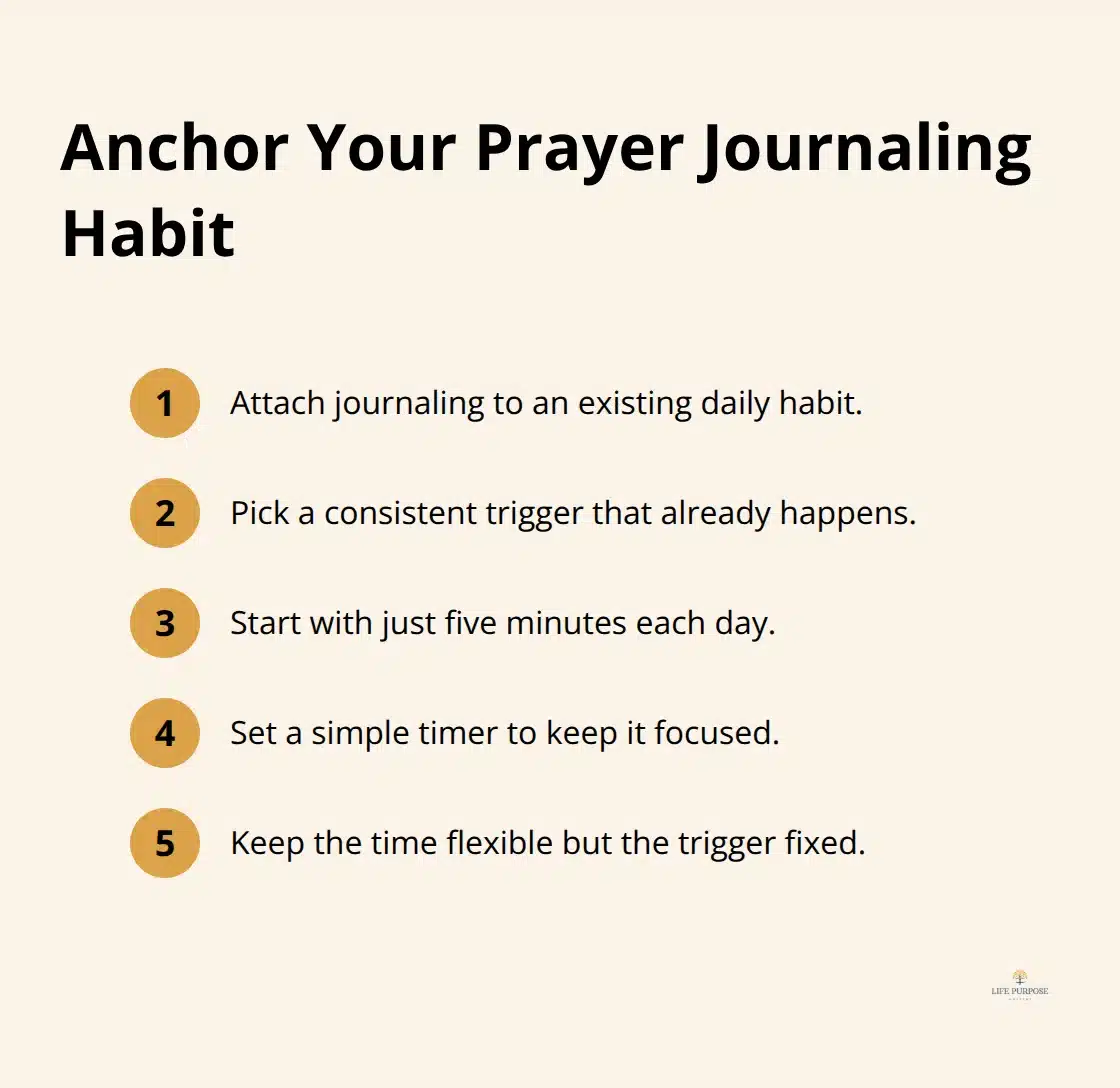
Research on habit formation shows that linking a new behaviour to an existing routine increases success rates dramatically. You’re not adding an entirely new task to your schedule; you’re attaching it to something that already happens. Start with just five minutes. Set a timer if you need to. Your first entry doesn’t require profound spiritual insights or lengthy paragraphs. A single sentence counts.
Structure Your First Entry with ACTS
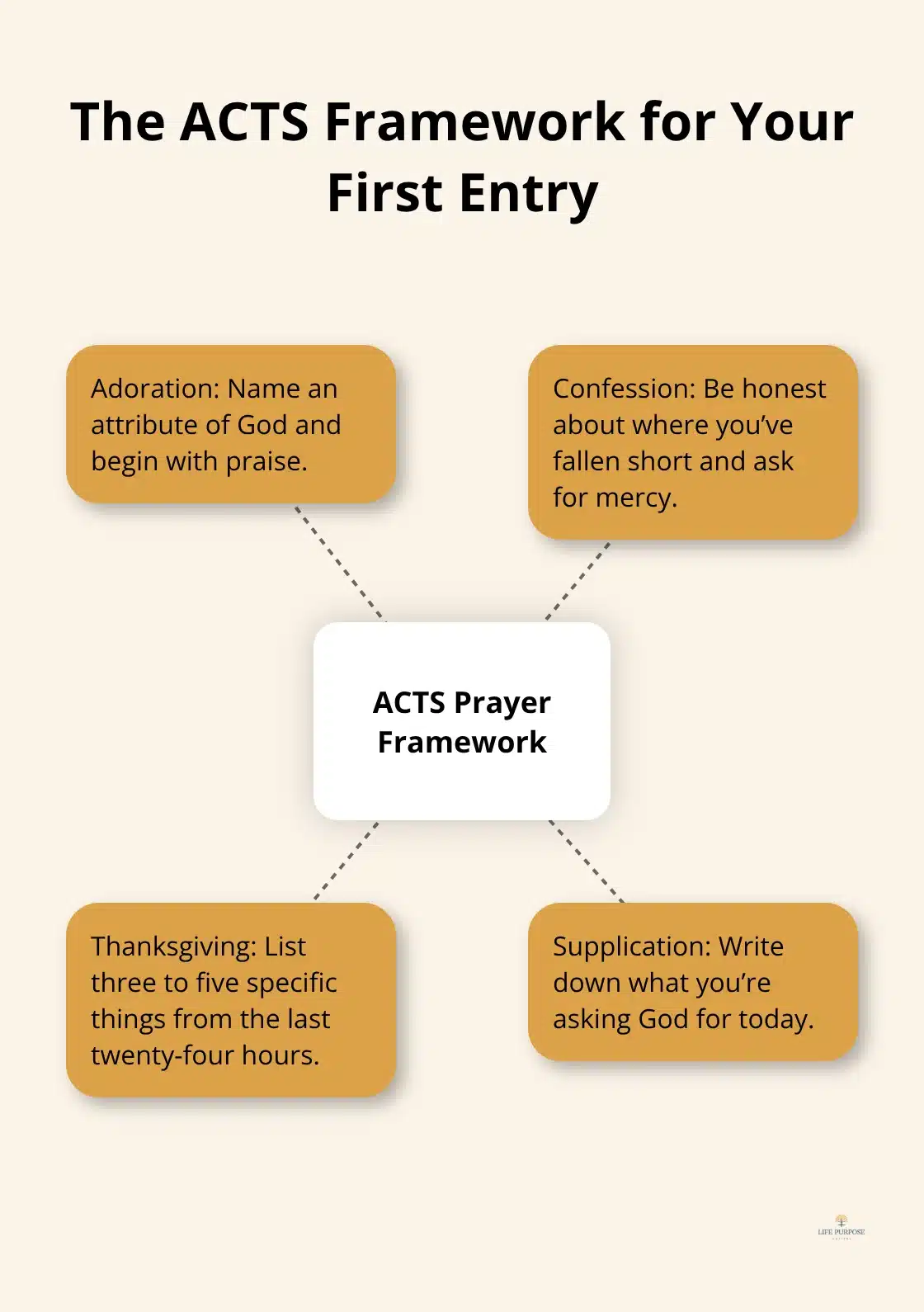
Write what’s actually on your mind, what you’re grateful for, what you’re struggling with, or what you’re asking God for. The ACTS framework helps structure this: start with Adoration (name something about God’s character), move to Confession (be honest about where you’ve fallen short), express Thanksgiving (list three to five specific things from the last twenty-four hours), then end with Supplication (write down what you’re asking God for). This framework prevents your prayers from becoming one-sided complaint sessions.
Date every entry so you can trace how God worked. The dates themselves become evidence of His faithfulness over time. This simple practice transforms your journal from a collection of scattered thoughts into a spiritual record you can revisit during seasons of doubt or celebration. With your first entries complete and a routine established, you’re ready to address the obstacles that typically derail prayer journaling habits.
Keeping Your Prayer Journal Alive When Life Gets Messy
Most prayer journals fail between weeks three and eight. Not because people lose faith or stop believing in prayer, but because life interrupts. Work deadlines pile up, family crises demand attention, or you miss a day and then feel too guilty to restart. This pattern repeats constantly because the solution isn’t motivation or willpower-it’s removing friction from the practice itself. If you wait until you have thirty minutes of quiet time, you’ll journal maybe twice a month. If you demand profound spiritual insights in every entry, you’ll freeze up on ordinary days.
Treat Prayer Journaling Like a Daily Essential, Not a Performance
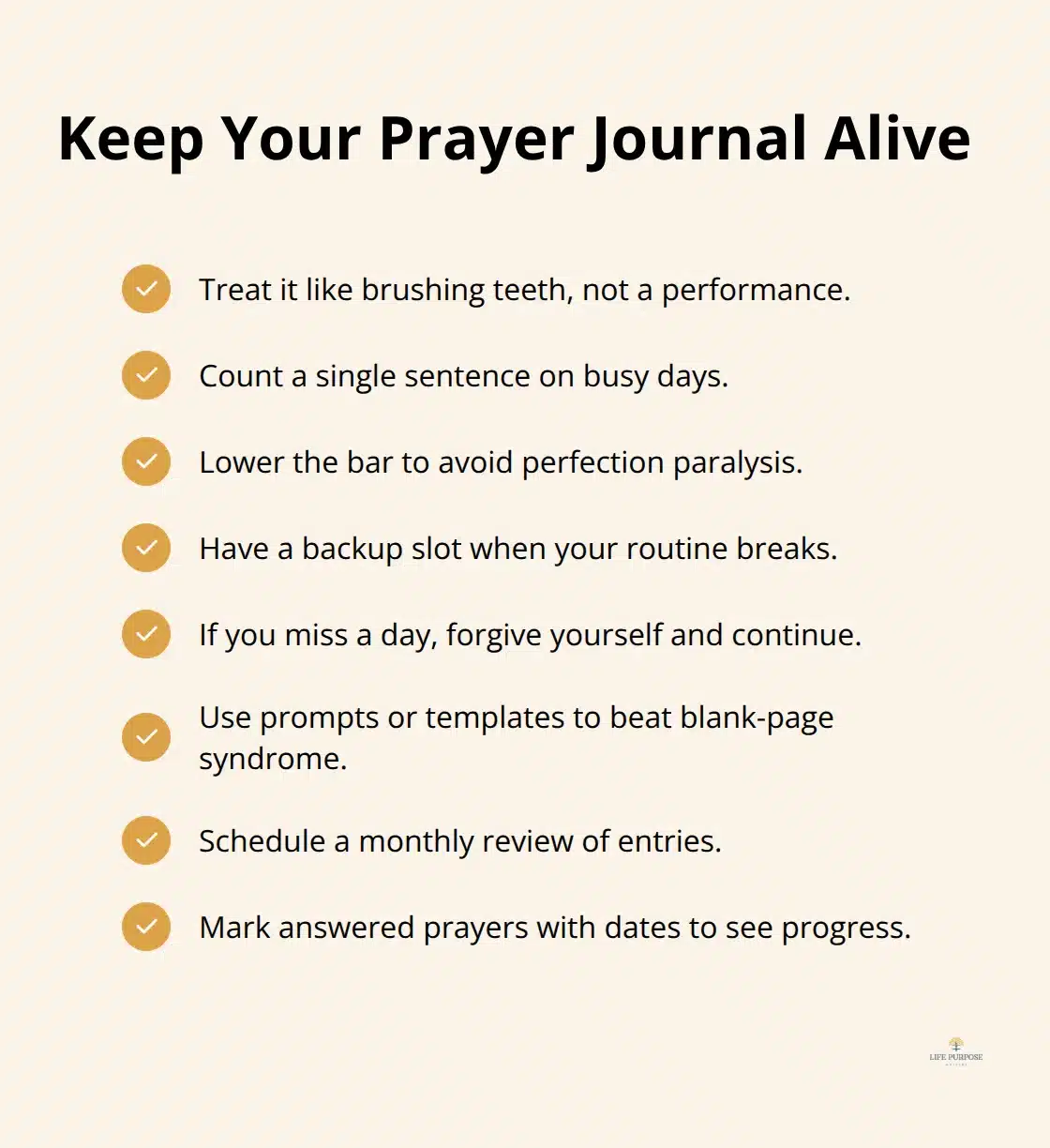
The most successful prayer journalers treat their practice like brushing teeth, not like writing a novel. A single sentence on a hectic Tuesday counts. A rushed paragraph before bed counts. Inconsistency is infinitely better than perfection followed by abandonment. Set a lower bar than you think you need.
Your journal doesn’t care if you’re tired, distracted, or uninspired. God doesn’t grade your entries.
When obstacles hit, most people respond by abandoning the habit entirely rather than adjusting it. Instead, have a backup plan. If your morning routine gets disrupted, journal at lunch. If lunch fails, write one sentence before sleep. If you miss a day completely, you don’t restart from zero; you simply pick up the next day without shame or guilt. Research on habit recovery shows that one missed day doesn’t destroy a habit, but the shame spiral afterwards often does. Forgive yourself quickly and write your next entry.
Use Structures and Prompts to Solve the Blank Page Problem
Structures and prompts solve the blank page problem that derails so many journalers. When you sit down with no direction, your mind goes blank, or your prayers become generic repetitions of the same requests. Specific prompts force deeper thinking. Instead of writing generally about gratitude, a prompt asking for three specific things from the last twenty-four hours makes you pause and actually remember moments you’d otherwise forget.
Free downloadable prayer journal templates with structured sections for scripture, prayer points, dates, and notes on answered prayers work exceptionally well for this reason. You can also create your own system. Some people dedicate Monday to prayers for family, Tuesday to community concerns, Wednesday to church leadership, Thursday to personal struggles, and Friday to thanksgiving. This rotation prevents prayer from becoming repetitive and ensures you cover different areas of your life systematically. Others use the STOP framework: Sorry (confession), Thank you (gratitude), Others (intercession), Please (personal requests). Having a framework means you never stare at a blank page wondering what to write.
Review Your Entries to See God’s Faithfulness
The real transformation happens when you actually reread what you’ve written. Most journalers never look back, which means they miss the entire point. Schedule a monthly review where you flip back through entries and note what’s changed, what prayers got answered, what patterns emerged, and where God showed up. Mark answered prayers with a date so you can see the timeline of His work. This practice shifts prayer journaling from a one-way conversation into a dialogue where you can see His responses. That visible evidence of answered prayer strengthens your faith far more than any sermon or book can.
Final Thoughts
Prayer journaling isn’t a spiritual luxury reserved for people with perfect routines or deep theological training. It’s a practical discipline that transforms how you pray, how you remember God’s faithfulness, and how you understand your own faith journey. The three core shifts we’ve covered-writing prayers instead of speaking them, looking back at what God has done, and spotting patterns in your spiritual growth-compound over months and years into a foundation that sustains your relationship with Him through every season.
Starting requires nothing more than what you already have. Pick a notebook sitting on your desk right now. Tie journaling to something you already do daily. Write your first entry using the ACTS framework (Adoration, Confession, Thanksgiving, Supplication). The obstacles will come-missed days, busy seasons, moments when your prayers feel inadequate. Those moments don’t mean you’ve failed; they mean you’re human. The people who maintain a prayer journal long-term aren’t more disciplined or more spiritual than anyone else. They simply treat the practice like something essential rather than something optional, and they adjust when life gets messy instead of abandoning it entirely.
Your prayer journal becomes a record of God’s work in your life that no sermon, book, or conversation can replace. You’ll flip back to prayers from years ago and see exactly how He answered, how He redirected you, how He grew you through struggles you thought would break you. That tangible evidence of His faithfulness becomes your anchor during seasons of doubt, and we at Life Purpose Matters encourage you to explore more resources that support your spiritual journey at Life Purpose Matters.