

I once knew someone who carried anger like a stone in their pocket for years. Every time they thought about the person who hurt them, that stone literally got heavier. Carrying anger is incredibly exhausting. That metaphor captures exactly how resentment builds over time — it doesn’t hurt the person who wronged you, but it slowly weighs you down. It takes a lot of energy to keep that heavy stone in your pocket! That said, there is a strong link between forgiveness and emotional wellbeing; the reason this link is so strong is that nobody can break it except the one carrying unforgiveness chooses to. Forgiveness is a vital psychological tool linked to higher life satisfaction and lower rates of anxiety, depression, and stress. By consciously releasing resentment, you reduce chronic inflammation, lower blood pressure, and break the cycle of destructive rumination that fuels emotional distress.
At Life Purpose Matters, we’ve seen how unforgiveness quietly destroys people from the inside out. The good news? Forgiveness and emotional wellbeing are deeply connected, and healing is possible.
If you are struggling with unforgiveness, check out my workbook on Amazon – GRACE IN RELEASE: 30 Days to Forgiveness, Healing and Freedom
What Does Forgiveness Actually Mean in Christian Faith?
Christianity offers a radically different framework for forgiveness than what the world teaches. In Matthew 18:21-22, Jesus tells Peter to forgive not seven times but seventy times seven, which means forgiveness isn’t a limited resource you eventually run out of. This isn’t poetic exaggeration.
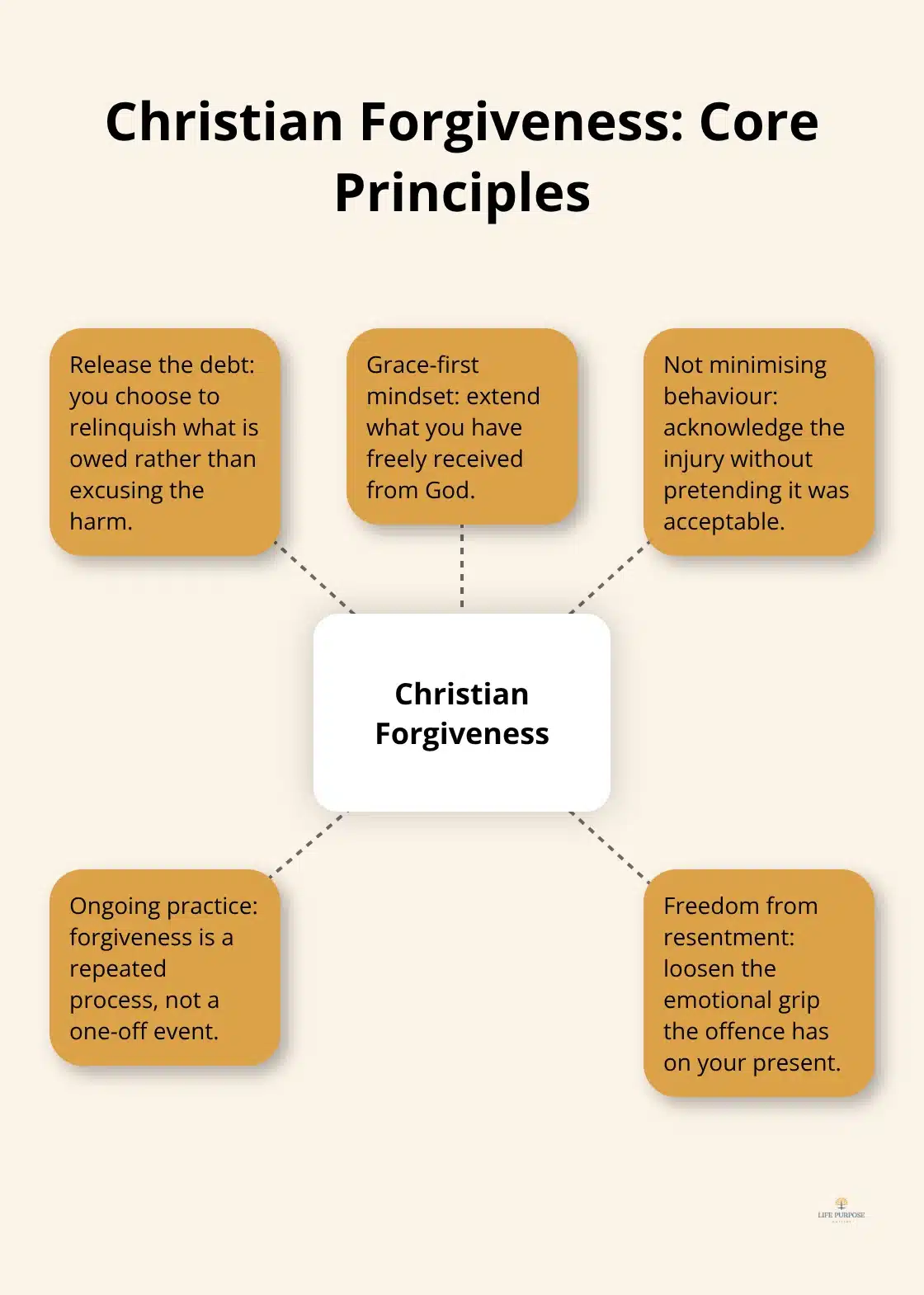
Jesus is saying that forgiveness is the operating system of Christian life, not an occasional transaction. When you forgive in a Christian context, you’re not excusing their behaviour, minimising the harm, or pretending the injury never happened. You’re making a spiritual decision to release the debt they owe you. This matters enormously because many people stay trapped in unforgiveness because they think forgiving means saying what happened was okay. It wasn’t. But holding onto anger about it won’t undo the past-it only poisons your present.
Grace Changes Everything
God’s grace is the foundation that makes forgiveness possible at all. Romans 3:23-24 states that all have sinned and fallen short of God’s glory, yet are justified freely by His grace through redemption in Christ. If you’ve experienced grace yourself-that undeserved gift of forgiveness from God-you have a template for extending it to others. This isn’t about waiting for someone to prove they’ve changed or earning forgiveness through their actions. Research shows that forgiveness therapy reduces depression, anger, hostility, and stress while increasing happiness and life satisfaction. The Christian perspective adds a spiritual dimension: when you forgive through God’s grace, you’re not doing it because the other person deserves it. You’re doing it because you’ve been forgiven much, and that transforms how you relate to others. Grace removes the burden of keeping score.
Breaking the Cycle of Resentment
Unforgiveness creates a feedback loop where you replay the hurt repeatedly. Each time you think about what happened, your brain treats it as if it’s happening now, intensifying the emotional wound. The REACH Model offers a practical Christian approach: Recall the hurt honestly, Empathise with the offender’s humanity, offer an Altruistic gift of forgiveness (recognising your own need for grace), Commit to forgive publicly or privately, and Hold onto that forgiveness when doubts arise. This model works because it acknowledges that forgiveness isn’t a single moment of decision but a process you return to repeatedly. A grudge doesn’t protect you from future harm-it only ensures the past person continues to wound you today. Forgiveness, from a Christian standpoint, is reclaiming your freedom from that person’s power over your emotions.
Moving From Understanding to Action
The theological foundation of Christian forgiveness sets the stage for what comes next. Understanding what forgiveness means spiritually is one thing; actually practising it in your daily life is another. The path forward requires you to confront your pain directly and work through the emotions that unforgiveness has created.
Why Unforgiveness Damages Your Health
The anger you hold isn’t just affecting your mood-it systematically damages your body. Research found that forgiveness therapy reduces depression, anger, hostility, and stress while simultaneously increasing happiness and life satisfaction. But here’s what matters more: studies of people who held grudges showed measurable increases in cortisol, the stress hormone that weakens your immune system, disrupts sleep, and accelerates ageing. When you refuse to forgive, your nervous system stays in a constant state of threat detection. Your blood pressure rises, your digestion suffers, and your cardiovascular system works overtime. One study tracked people nursing long-term resentment and found they experienced more anxiety, worse sleep quality, and higher rates of heart disease than those who practised forgiveness. The physical cost of unforgiveness isn’t theoretical-it happens in your body right now if you hold onto anger. Your rumination about the past doesn’t change what happened; it only poisons your present moment with yesterday’s wound.
How Resentment Hijacks Your Brain
Grudges sabotage your decision-making and mental clarity. When you repeatedly rehearse a hurtful event, your brain’s perception distorts. Neuroscience shows that rumination makes the memory feel closer in time, intensifying your emotional response each time you think about it. This means the more you replay the hurt, the fresher and more painful it becomes, even years later. Your executive function-the part of your brain responsible for planning, problem-solving, and rational thinking-becomes impaired under chronic stress from unforgiveness. This explains why people stuck in resentment often make poor choices in relationships, work, and finances. They operate with a compromised cognitive system.
The Physical Toll of Carrying Anger
Your body treats emotional wounds like physical threats. Chronic stress from unforgiveness triggers your fight-or-flight response repeatedly, flooding your system with cortisol and adrenaline. Over time, this constant activation exhausts your immune system, making you more susceptible to illness.
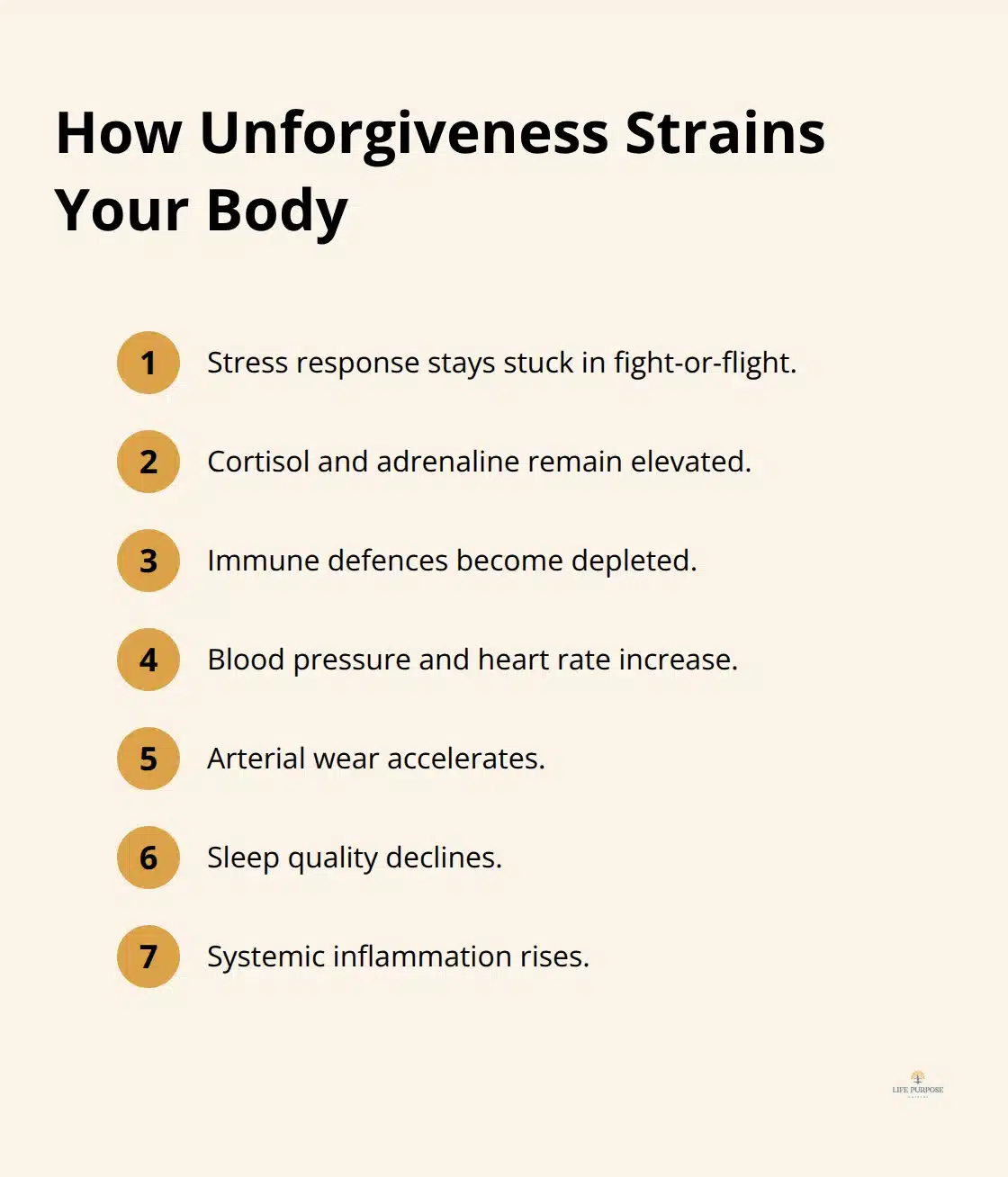
Your cardiovascular system bears particular strain-elevated blood pressure and increased heart rate from sustained anger accelerate wear on your arteries. Sleep suffers too, since your nervous system can’t fully relax when you carry unresolved anger. The inflammation that results from chronic stress affects everything from your joints to your digestive health. These aren’t minor inconveniences; they represent real physiological damage that compounds the longer you hold the grudge.
Breaking the Rumination Cycle
The REACH Model provides a practical framework to interrupt this destructive pattern: Recall the hurt honestly, Empathise with the offender’s humanity, offer an Altruistic gift of forgiveness (recognising your own need for grace), Commit to forgive publicly or privately, and Hold onto that forgiveness when doubts arise. When you feel the urge to replay the hurt, you pause and consciously empathise with the offender’s humanity, offer yourself the same grace you’ve received from God, and recommit to forgiveness. This isn’t weakness or passivity. It’s tactical mental health management that restores your clarity and resilience. Each time you interrupt the rumination cycle, you weaken the neural pathways that sustain the grudge and strengthen your capacity for peace.
What Happens When You Choose to Forgive
The shift from unforgiveness to forgiveness doesn’t happen overnight, but it does happen. Your nervous system gradually learns that the threat has passed. Your cortisol levels drop, your sleep improves, and your immune function strengthens. Your brain’s executive function returns online, allowing you to make clearer decisions and see situations with more nuance. The physical and mental benefits accumulate as you practise forgiveness consistently. This restoration of your wellbeing creates the foundation for the next step: actually moving through the forgiveness process with concrete, actionable steps that address both your spiritual and emotional needs.
How to Start Forgiving When It Feels Impossible
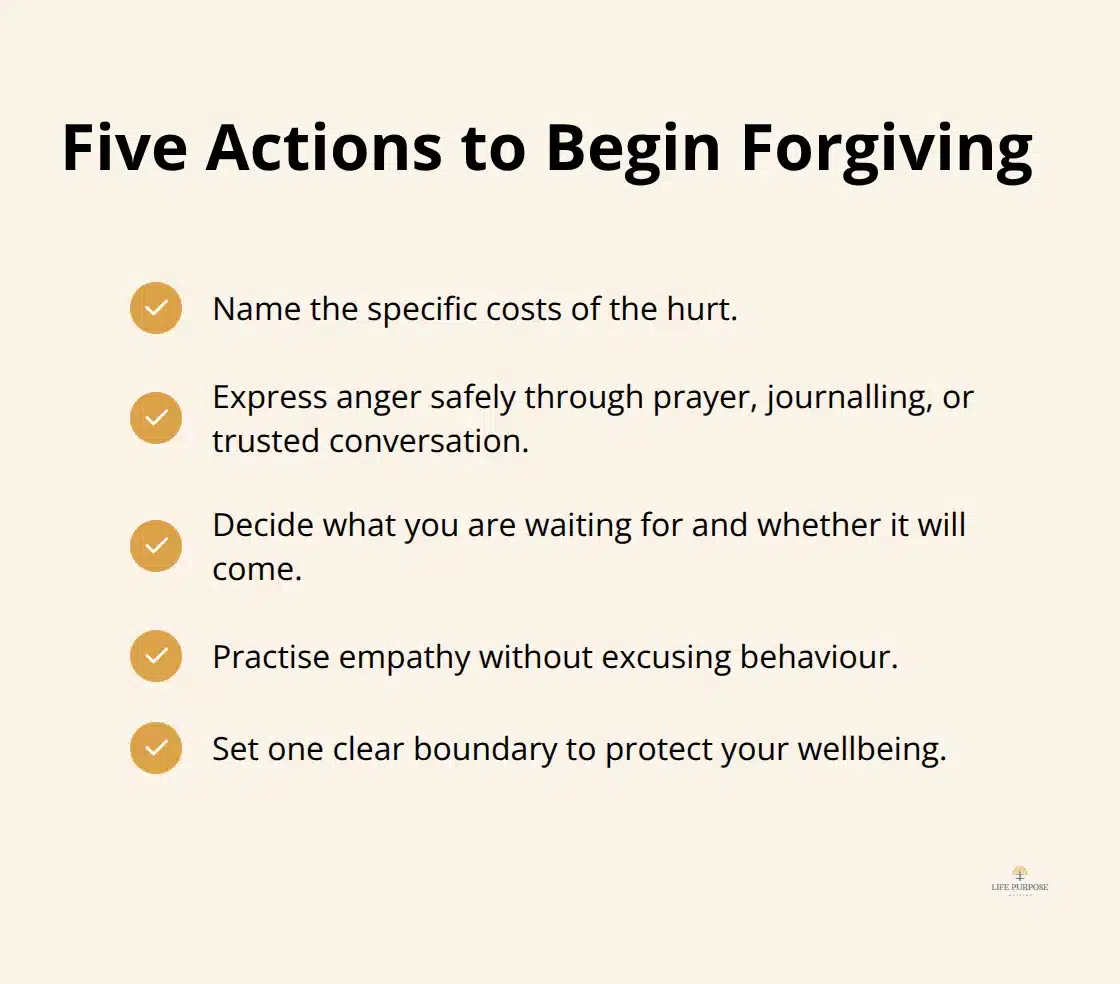
Forgiveness does not start with warm feelings toward the person who hurt you. It starts with brutal honesty about what that hurt has cost you. Before you move forward, you need to name the specific damage: the sleepless nights, the destroyed friendships, the career opportunities you avoided because you could not trust anyone, the way you flinch when someone mentions their name. Write these down. Not to wallow, but to acknowledge that your pain is real and deserves attention. Research on forgiveness interventions shows that people who explicitly identify the emotional and relational costs of their unforgiveness are more likely to successfully move through the forgiveness process than those who minimise or ignore their wounds. The Enright Model, a leading evidence-based approach developed across four phases, begins with uncovering-honestly confronting what happened and how it has shaped you. This clarity matters because you cannot release what you refuse to acknowledge.
Name Your Pain Without Minimising It
The first step requires you to sit with discomfort. Most people skip this part because it hurts, but that avoidance keeps you trapped. Write down exactly what this unforgiveness has stolen from you. Did it damage your ability to trust? Did it cost you friendships or professional opportunities? Did it rob you of sleep, peace, or joy? Specificity matters here. Vague acknowledgement (“I’m hurt”) does not activate the same healing response as concrete detail (“I avoided that promotion because I could not trust my boss after what happened”). When you name your pain with precision, you stop minimising it, and your brain can finally process it as real.
Express Your Anger in a Safe Space
Once you have named your pain, shift your attention to what forgiveness actually requires from you spiritually and practically. Prayer becomes your primary tool, but not the generic kind. Specific, honest prayer where you tell God exactly how angry you are, how betrayed you feel, and how unfair this situation seems. Theologians and researchers alike agree that suppressing anger delays healing; expressing it in a safe space-whether through prayer, journaling, or conversation with a trusted spiritual director-allows you to process it rather than bury it. Your anger is not your enemy. It is information. It tells you that something violated your values or boundaries. Honour that signal instead of silencing it.
Examine What You Are Actually Waiting For
After you have released the raw anger, move into reflection. Ask yourself three concrete questions: What would I need from this person to feel truly wronged (an apology, changed behaviour, acknowledgement)? Am I waiting for something that may never come? What would my life look like if I stopped waiting? These questions matter because they force you to examine whether you hold onto unforgiveness because you protect yourself or because you punish the other person. The distinction changes everything. Once you recognise that your grudge primarily harms you, the path forward becomes clearer.
Practise Empathy Without Excusing Behaviour
Start practising the REACH Model’s empathy step. Consider the offender’s circumstances without excusing their behaviour. Did they lack awareness? Were they acting from their own wound? Understanding their humanity does not validate their actions; it simply removes the dehumanising anger that keeps you psychologically tied to them. This step trips up many people because they confuse empathy with approval. You can understand why someone hurt you and still hold them accountable. You can see their struggle and still refuse to accept their behaviour. Empathy is not surrender. It is clarity.
Establish Boundaries That Protect Your Wellbeing
Finally, establish one concrete boundary that protects your wellbeing moving forward. This might mean limited contact, declining invitations to events where you will see them, or simply committing to ending conversations that rehash old pain. Boundaries and forgiveness work together. You can forgive someone and still decide they do not belong in your inner circle. This clarity removes the false choice between forgiveness and self-protection, allowing you to heal without sacrificing your emotional safety.
Final Thoughts
Forgiveness is not a destination you arrive at once and then remain there permanently. You return to it, sometimes daily, sometimes moment by moment. The work you’ve done in this article-naming your pain, releasing anger, practising empathy, establishing boundaries-forms the foundation of a spiritual life that actually works in the real world. Each time you interrupt a rumination cycle, each time you pray instead of rehearse the wound, each time you choose to see someone’s humanity instead of their harm, you actively heal your nervous system and reclaim your peace.
The connection between forgiveness and emotional wellbeing shows up in measurable ways. Research consistently demonstrates that people who practise forgiveness experience lower rates of depression, anxiety, and heart disease, and they report feeling genuinely free. Your sleep improves, your relationships deepen because you no longer filter every interaction through past betrayal, and your body finally releases the chronic stress that unforgiveness created. This freedom is what Jesus meant when He spoke about forgiveness seventy times seven-not a quota, but a way of life where you no longer remain imprisoned by what others have done to you.
Healing through forgiveness isn’t linear, and old anger will resurface on difficult days. When it happens, you simply return to the tools you’ve learned: recall the hurt honestly, empathise with the offender’s humanity, offer yourself grace, recommit to forgiveness, and hold on. At Life Purpose Matters, we believe that living your God-given purpose becomes possible when you release the stones you’ve been carrying, and the peace you find through forgiveness becomes the foundation for genuine freedom.
If you are struggling with unforgiveness, check out my workbook on Amazon – GRACE IN RELEASE: 30 Days to Forgiveness, Healing and Freedom