

I once sat in a church service where someone asked why we even talk about three persons in one God-wouldn’t it be simpler to just pick one? That question stuck with me because it revealed how many people feel confused about this core Christian belief.
At Life Purpose Matters, we’ve found that understanding why the Holy Trinity is important transforms how people pray, worship, and live out their faith. This doctrine isn’t abstract theology-it shapes your relationship with God in practical, everyday ways.
Where Did the Trinity Come From?
Scripture Reveals the Trinity
The Trinity wasn’t invented in a church boardroom. It emerged from early Christians wrestling with Scripture and their lived experience of God. When Jesus commanded his followers to baptise in the name of the Father, Son, and Holy Spirit in Matthew 28:19, and when Paul wrote about the grace of Christ, the love of God, and the fellowship of the Holy Spirit in 2 Corinthians 13:14, believers faced a real problem: How do we worship one God while encountering God in three distinct ways?
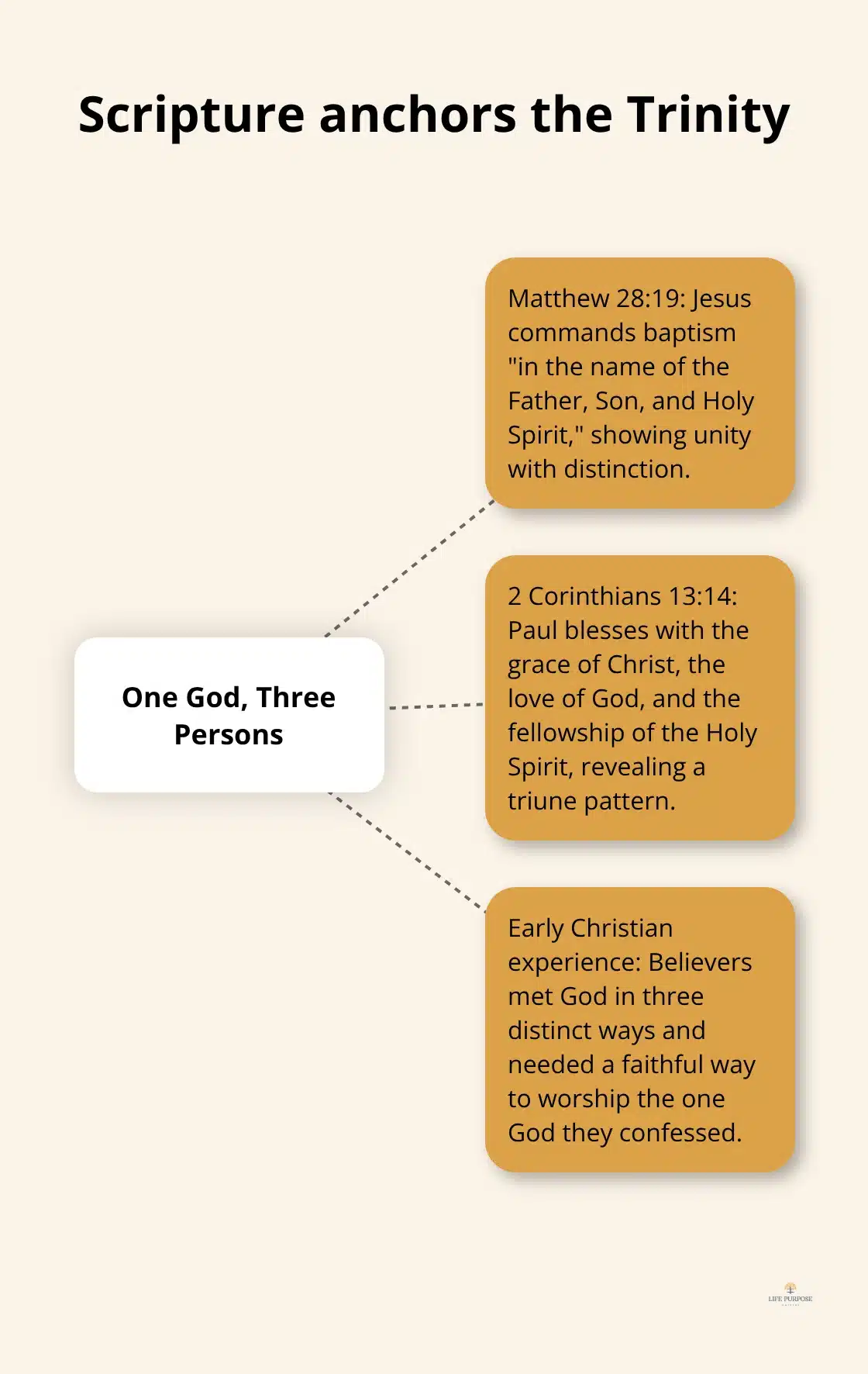
The early church didn’t start with abstract philosophy. They started with what they actually experienced-meeting God as Creator, encountering Jesus as saviour, and feeling the Holy Spirit’s presence guiding them. This wasn’t theoretical. It was survival.
How the Early Church Defended the Trinity
Christians needed to explain their faith to sceptics, defend it against false teaching, and understand what they believed well enough to die for it. The Council of Nicaea formalised this understanding through the Nicene Creed, which explicitly named Father, Son, and Holy Spirit as one God. This wasn’t splitting God into pieces or creating three gods-it was clarifying that monotheism (belief in one God) doesn’t mean God is impersonal or distant. God is fundamentally relational, existing in eternal relationship with himself.
The Trinity Grounds Your Actual Experience of God
What matters practically is this: The Trinity grounds Christian faith in something verifiable. You don’t worship an abstract concept. You encounter God through the Father’s creative power, Christ’s redemptive love shown on the cross, and the Holy Spirit’s ongoing guidance in your daily decisions. The Apostles’ Creed, still recited in churches worldwide, anchors belief in this threefold God.
When you pray, you’re not addressing a distant monarch. You’re speaking to the Father through Christ, empowered by the Spirit. Augustine’s framework-Father is God, Son is God, Spirit is God, yet Father is not Son, Son is not Spirit, Spirit is not Father, and there is one God-provides the logical skeleton.
Love as God’s Fundamental Nature
The real power lies in application. Understanding that God exists as three persons in relationship teaches you something vital about how to live. Love is God’s fundamental nature. The Father, Son, and Holy Spirit eternally give themselves to one another. That self-giving love overflows into creation and redemption.
When you grasp this, your relationships transform. You stop viewing people as obstacles and start seeing them as invitations to participate in God’s loving community. This shift from abstract doctrine to lived reality opens the door to understanding how the Trinity actually shapes the way you pray, worship, and connect with others in your faith community.
How the Trinity Transforms Your Prayer Life and Relationships
Prayer Becomes Participation, Not Performance
Understanding the Trinity shifts how you actually pray and connect with God. Most people pray to a distant authority figure, treating God like a heavenly CEO who occasionally checks in. The Trinity demolishes this framework. When you grasp that God exists as Father, Son, and Holy Spirit in eternal relationship, you realise prayer isn’t about petitioning a remote judge-it’s entering into the self-giving love that defines God’s nature. Augustine’s insight on Trinitarian love identifies the Father as the lover, the Son as the beloved, and the Holy Spirit as the mutual love between them. When you pray through Christ in the Spirit’s power, you don’t interrupt God’s day. You participate in the relational dynamic that has always existed at the heart of reality. This changes everything about how you approach worship. Instead of performing religious duties, you join a conversation that never stops. Your prayers become less about convincing God to care and more about aligning yourself with the love already flowing between the three persons of the Godhead.
Practically, this means spending less time on formulaic prayers and more time on conversational honesty. Tell the Father what’s actually happening in your life. Acknowledge Christ’s presence in your struggle. Invite the Spirit’s guidance into your specific decisions.
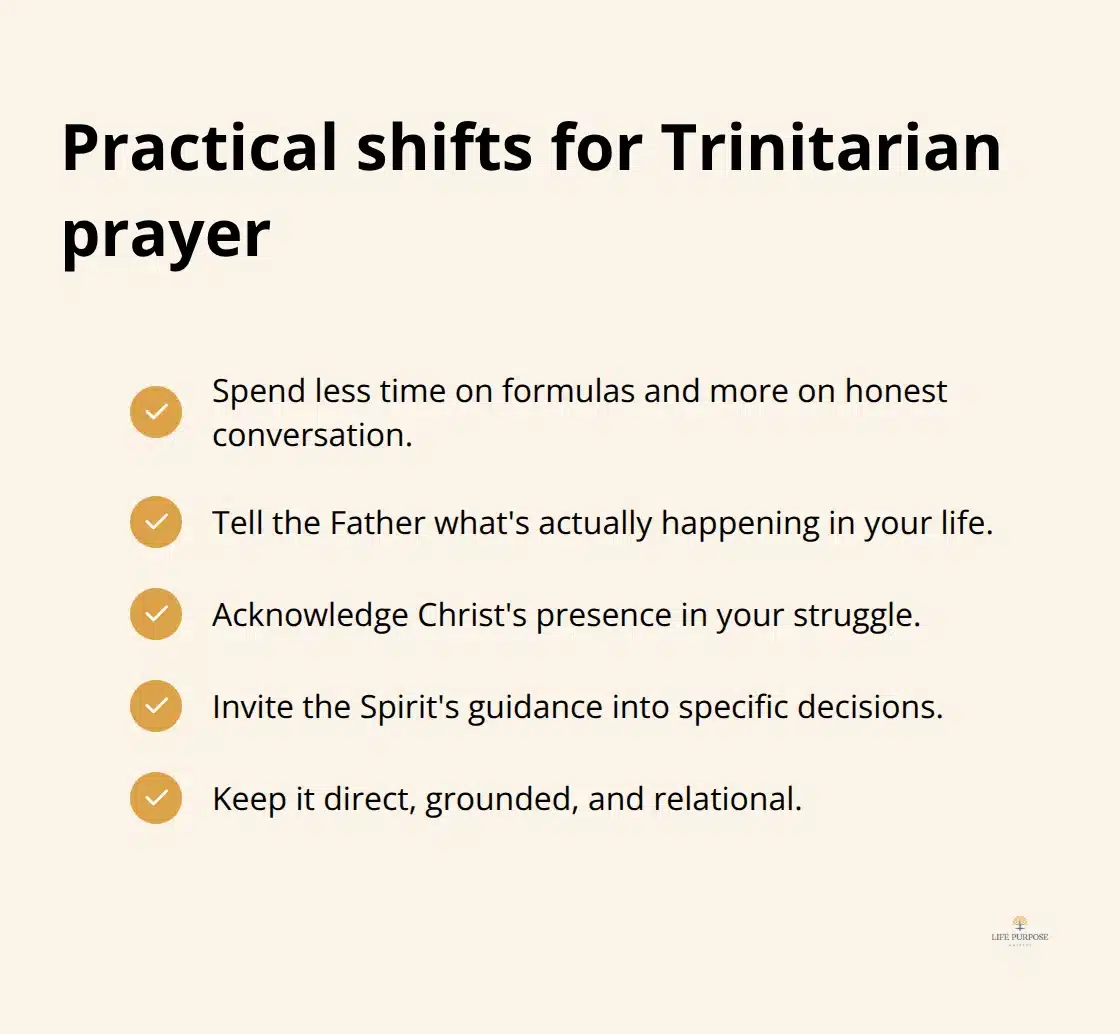
This isn’t mystical-it’s direct and grounded.
Community Reflects God’s Relational Nature
The Trinity also reshapes how you build community. If God himself exists in relationship, then human connection isn’t optional spiritual decoration. It’s the image of God expressed through flesh and time. Peter Leithart argues that without the Trinity, righteousness becomes impossible because righteousness exists only in relationship, not in isolation. You can’t be righteous alone. This means your faith community isn’t a collection of individuals pursuing personal enlightenment. It’s the body of Christ, where the Father’s creative care, the Son’s sacrificial love, and the Spirit’s unifying presence work through actual people.
When conflict arises in your church or small group, you’re not just managing personalities. You’re either reflecting or rejecting the Trinity’s model of mutual honour and self-giving. Trinitarian community relational emphasis correlates with greater life satisfaction and resilience during crisis. The Trinity-shaped community doesn’t tolerate gossip, exclusion, or power plays because these betray the relational nature of God. Instead, it demands hospitality, forgiveness, and genuine presence.
What Trinity-Centred Community Actually Requires
This is harder than attending a service. You must show up for people when they’re messy, doubting, and difficult. You must choose vulnerability over performance. The Trinity-shaped community doesn’t emerge from polite distance or surface-level friendships. It demands that you risk rejection, admit weakness, and invest in others’ spiritual growth even when they disappoint you. This relational commitment (rooted in how the Father, Son, and Holy Spirit eternally give themselves to one another) transforms a congregation from a collection of strangers into a living witness to God’s nature. When outsiders observe this kind of authentic community, they don’t see religious performance. They see something rare: people who actually love each other across differences, who confess failures without shame, and who celebrate each other’s victories as their own. This visible expression of Trinitarian love becomes the most compelling argument for Christian faith-far more persuasive than any theological argument. As you move deeper into how the Trinity shapes your personal spiritual journey and guides you toward your God-given purpose, you’ll discover that this relational foundation isn’t just about community dynamics. It’s about how the Father, Son, and Holy Spirit actively work in your life to redirect your choices, heal your wounds, and align your purpose with God’s redemptive work in the world.
What the Trinity Is Not
God Is One, Not Three
The biggest trap people fall into is thinking the Trinity means God is three separate gods working together like a committee. This misunderstanding leads straight to polytheism, which Christianity explicitly rejects. Monotheism-belief in one God-is non-negotiable in Christian faith. Deuteronomy 6:4 states it plainly: “Hear, O Israel, the Lord our God, the Lord is one.” Jesus affirmed this same truth when asked about the greatest commandment. The Trinity doesn’t contradict monotheism. It clarifies what monotheism actually means.
God is not one in the way a single person is one. God is one in nature, substance, and essence, while existing as three distinct persons. The Father, Son, and Holy Spirit aren’t three gods voting on decisions. They’re three persons sharing one divine nature, eternally united in purpose and love. This distinction matters practically because it shapes how you worship. You’re not praying to three separate beings who might disagree with each other. You’re addressing the unified God who reveals himself in three ways.
Augustine’s framework clarifies this without confusion: Father is God, Son is God, Spirit is God, yet Father is not Son, Son is not Spirit, Spirit is not Father, and there is one God. That’s not a riddle. It’s precision language that prevents heresy. The Athanasian Creed hammered this point home because early Christians kept drifting toward either polytheism or denying Jesus’s full divinity. The church fathers chose neither extreme. They insisted on holding both truths simultaneously: one God, three persons.
Each Person Possesses Full Divinity
The second misconception assumes the three persons are somehow less than fully God or that one person ranks higher than the others. This error, called subordinationism, creeps into churches today when people treat the Holy Spirit as optional or view the Son as less authoritative than the Father. Scripture contradicts this repeatedly. Colossians 1:16 states that all things were created through the Son, not by the Father alone. John 1:1-3 affirms the Son’s full divinity and creative power.
The Spirit isn’t a force or impersonal energy-the Spirit is a person who grieves, intercedes, and guides with intention. Each person of the Trinity is fully God, coequal, and coeternal. Practically, this means your prayer life shouldn’t skip the Spirit or treat Jesus as a middleman rather than God himself. When you address the Father, you’re not bypassing the Son or the Spirit. You’re engaging with unified divine action.
Unity and Distinction Coexist
The third major confusion involves thinking unity and distinction are contradictory. They’re not. The Trinity holds both truths at once: God is completely unified in nature and purpose, yet genuinely three in person. This isn’t illogical-it’s how reality actually works at the deepest level.
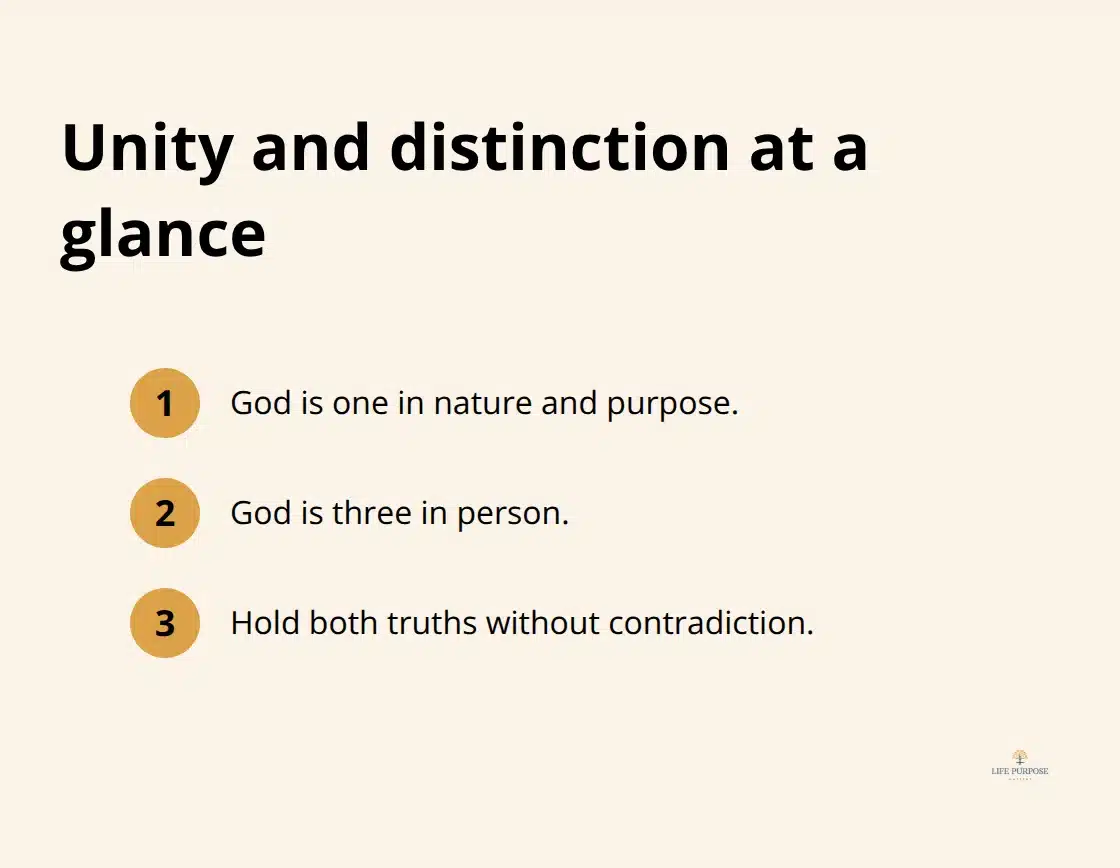
The Father loves the Son, the Son glorifies the Father, and the Spirit unites them in mutual giving. That’s genuine distinction operating within perfect unity.
Deny the distinction and you end up with modalism, claiming God just wears different masks. Deny the unity and you’re back to polytheism. The Trinity forces you to hold both truths without collapsing into either error. This shapes how you approach your own relationships and community. You can be fully committed to your church while remaining distinct from it. You can hold strong convictions while honouring others’ perspectives. The Trinity models how unity doesn’t require uniformity.
Final Thoughts
The Trinity isn’t a theological puzzle you solve and move on from. It’s the foundation that holds your entire spiritual life together. When you understand why the Holy Trinity is important, you stop treating faith as a set of rules to follow and start experiencing it as a living relationship with the God who created you, redeemed you, and guides you daily. Your personal faith becomes unshakeable when it rests on this truth, because the Father didn’t create you as an afterthought, the Son didn’t die for you as a transaction, and the Spirit doesn’t guide you as a distant force.
This foundation directly shapes how you live out your God-given purpose. The Trinity reveals that your life isn’t about personal achievement or climbing some spiritual ladder-it’s about participating in God’s redemptive work in the world. Christ’s sacrifice on the cross reconciles all creation to God, and the Holy Spirit empowers you to join that work through how you treat others, the choices you make, and the love you extend to your community. The Spirit’s guidance speaks through Scripture, wise counsel, and inner conviction, so you navigate life not alone but aligned with God’s redemptive purposes.
This is why understanding the Trinity matters so deeply-it’s not abstract theology but the lens through which you see God, yourself, and your calling. If you’re ready to explore how this foundation transforms your spiritual journey, discover resources designed to help you live out your God-given purpose.