

I once met someone who was taking every supplement under the sun, attending therapy weekly, and praying faithfully, yet still felt broken. She was treating her body, mind, and spirit separately, like three different people living in one skin. That’s when she realised holistic healing isn’t about fixing isolated parts; it’s about restoration that touches every dimension of who you are.
At Life Purpose Matters, we believe God designed you as an integrated whole. When you align your physical health, mental peace, and spiritual foundation, something shifts. This blog post walks you through exactly how to do that.
What Does Scripture Really Say About Healing Your Whole Self
Scripture Treats You as One Integrated Person
Scripture doesn’t treat your body, mind, and spirit as separate departments that need different management. Genesis 1:29 shows God providing seed-bearing plants and fruit as the foundation for nourishment and healing from the very beginning. This wasn’t a spiritual principle disconnected from physical reality; it was a concrete provision for your whole person. When Jesus healed people, he didn’t just fix their bodies. He addressed their spiritual condition, their mental state, and their place in the community. In Mark 8:25, Jesus restored not just physical sight but the ability to see clearly in every sense.
Restoration as an ongoing process
First Peter 5:10 promises that the God of all grace will restore, confirm, strengthen, and establish you after suffering. This isn’t healing as a one-time event; it’s restoration as an ongoing process that touches every layer of who you are-physical, mental, and emotional. The apostle Paul wrote in 2 Corinthians 5:17 that when you’re in Christ, the old has passed away and the new has come. That’s not metaphorical language about your spiritual status alone; it describes a fundamental shift that affects how you think, how you treat your body, and how you engage with the world.

How Modern Wellness Aligns with Biblical Design
The integration of faith with healing your whole self isn’t new-it’s a return to how healing actually works. Prayer and meditation produce measurable results. Research published in JAMA Internal Medicine found that mindfulness-based interventions reliably reduce anxiety, depression, and stress with clinically meaningful effects. A Mediterranean-style diet, which emphasises whole foods and plant-based nutrition, is associated with lower depression risk according to Harvard’s School of Public Health. The National Sleep Foundation recommends 7 to 9 hours of sleep nightly, and sleep quality directly influences your immune function and healing capacity.
Your Choices Work Together
These aren’t secular practices competing with faith; they’re ways you cooperate with how God designed your body to function. Proverbs 3:7-8 instructs you to fear the Lord and turn from evil, noting that this brings healing to your body. Your physical choices, your mental habits, your spiritual practices, and your relationships all work together-when you neglect one area, the others suffer; when you strengthen one, the others benefit.
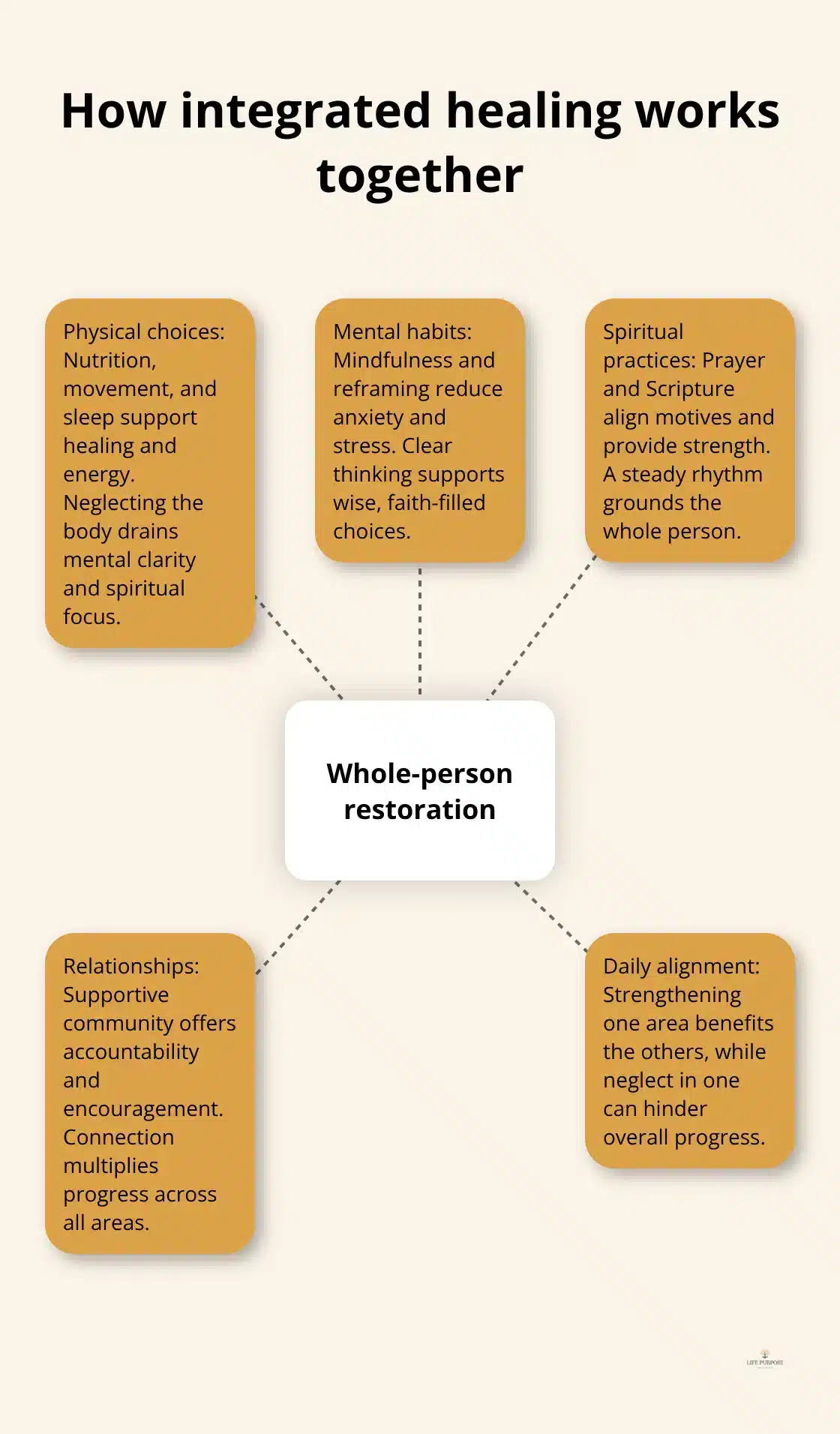
That’s not just wellness theory; it’s how restoration actually happens in a human life. This integrated approach to healing sets the stage for the practical steps you can take right now to align your physical health, mental peace, and spiritual foundation.
Building Your Daily Practice for Wholeness
Start with Prayer and Meditation
Prayer and meditation are not luxuries for people with extra time-they form the foundation that rewires how your brain processes stress and connects with God. Research shows mindfulness-based interventions produce clinically meaningful reductions in anxiety and depression. Start with 10 to 15 minutes daily rather than an hour of idealised practice that never happens. Pick a specific time, like right after waking or before bed, and stick with it for 30 days before evaluating whether it works. Use a simple framework: spend five minutes in silence, five minutes reading a passage from Scripture that speaks to your current struggle, and five minutes in conversational prayer where you speak to God as you would to someone you trust. The Centres for Disease Control and Prevention recommends this kind of regular reflection as part of stress management, and the evidence is clear: consistency matters far more than duration.
Move Your Body and Prioritise Sleep
Your body needs direct care through movement and rest. The CDC states that 150 minutes of moderate physical activity per week reduces the risk of depression and significantly improves mood. This does not require a gym membership or marathon training; a 30-minute walk most days counts. Walking outdoors provides additional benefits, as exposure to nature lowers cortisol levels and promotes mental clarity. Pair this with sleep: the National Sleep Foundation recommends seven to nine hours nightly because sleep directly influences immune function and your body’s ability to heal.
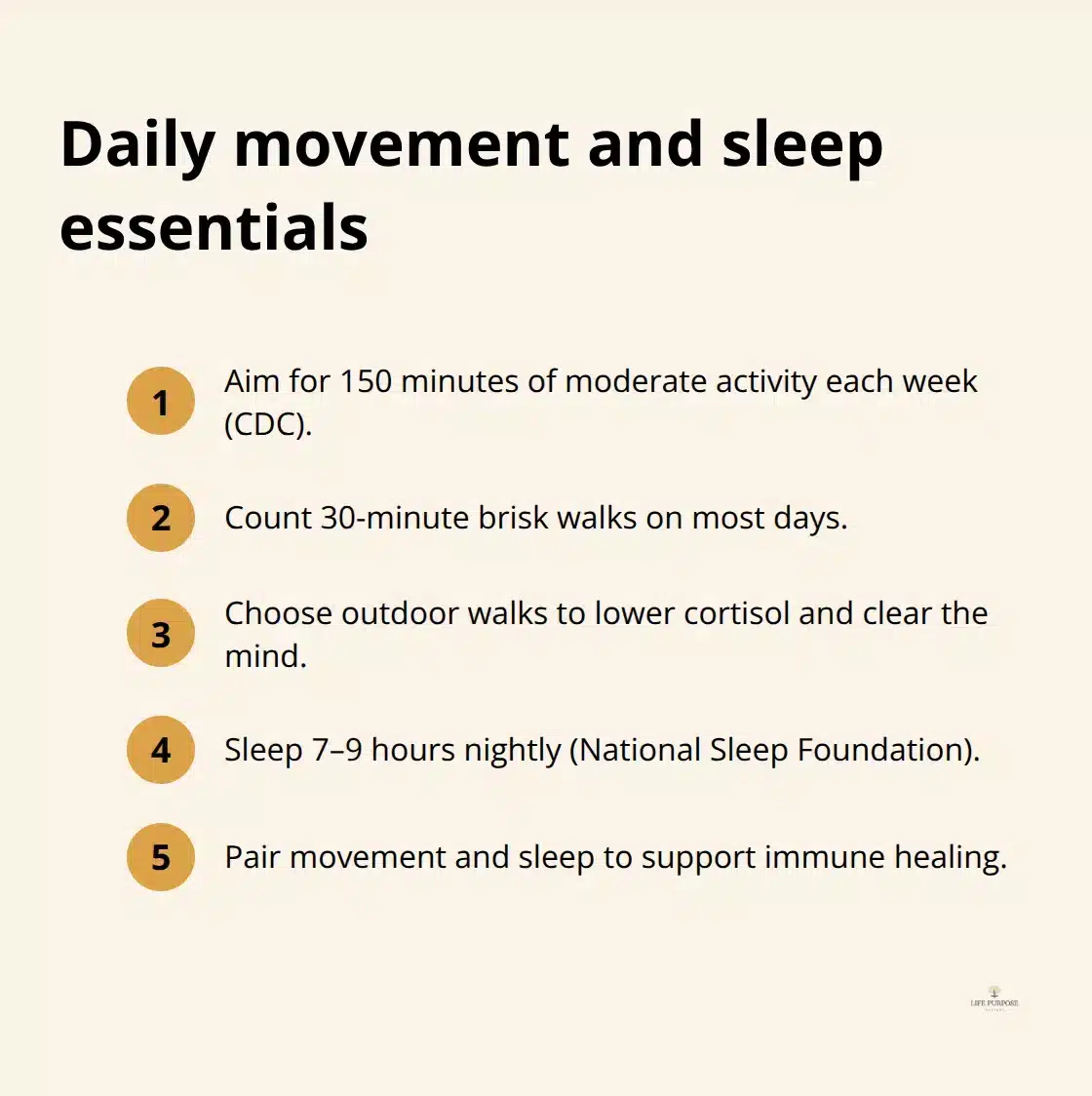
Track these three elements for two weeks, and you will notice shifts in energy, clarity, and emotional resilience.
Build Accountability Through Community
Community transforms individual practices into sustainable habits. Find one person or a small group willing to check in with you weekly about your progress. This is not confession or judgement; it is accountability that keeps you moving forward when motivation fades. Faith-based support groups specifically designed around wellness provide this structure while connecting you with others pursuing similar integration of faith and health. Many churches now offer holistic wellness workshops covering nutrition, stress management, and spiritual practices together. If your church does not offer this, start small: invite one trusted friend to join your prayer practice or take walks together.
The research is striking. A landmark meta-analysis found that strong social connections are linked to lower mortality risk, meaning your relationships literally extend your life. This integration works because isolation weakens all three dimensions of healing simultaneously, while connection strengthens them all. Your body, mind, and spirit do not heal in isolation; they heal together, supported by people who know you and care about your progress. As you establish these daily rhythms and build your support network, you are ready to face the obstacles that inevitably arise on any healing journey.
When Healing Stalls, What Comes Next
Doubt Arrives Right on Schedule
Doubt creeps in around week three of your new prayer practice. You’ve been consistent, you’re sleeping better, but that nagging anxiety still surfaces at 3 a.m. Your friend’s healing from illness looks nothing like yours-slower, messier, incomplete in ways that feel unfair. These moments expose a hard truth: holistic healing rarely follows the timeline you imagined. The World Health Organisation reports that 264 million people worldwide experience depression, and an estimated 4.4% of the global population currently experiences an anxiety disorder. What the statistics don’t capture is the specific moment when you wonder if faith actually changes anything when your circumstances refuse to shift.
Most people abandon their practice at this point, not because it doesn’t work, but because they misunderstood what working actually means. Doubt and fear aren’t signs of spiritual weakness; they’re invitations to build a more honest, resilient faith. When healing doesn’t match your expectations, the problem isn’t God’s design-it’s the narrative you inherited about how fast restoration should happen.
Redefine What Progress Actually Looks Like
Research from the National Institute of Mental Health shows that trauma-focused therapies like cognitive behavioural therapy produce measurable improvements, but they typically require 12 to 20 sessions before substantial shifts appear. Your body’s healing timeline operates similarly. The gut-brain axis research demonstrates that dietary changes influence mood and inflammation, yet these shifts take weeks, sometimes months. Expecting transformation overnight sets you up for disappointment that feels like failure.
Instead, track specific markers: How many days this week did you complete your prayer practice without skipping? Did you sleep more than six hours on average? Did you move your body at least four times?
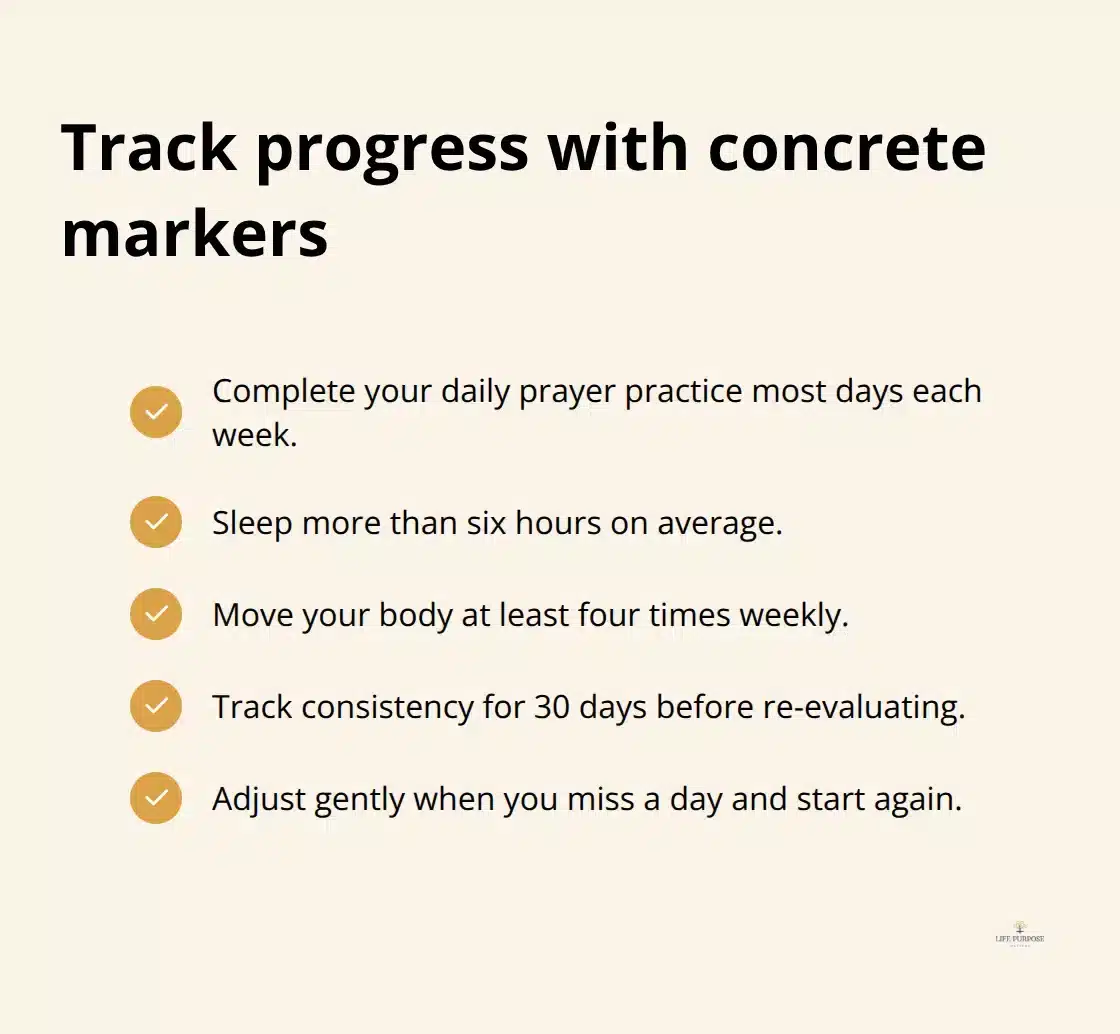
These concrete measures replace the vague feeling that nothing is working. When you notice you completed your practice six out of seven days, you have evidence of progress, even if your circumstances haven’t changed.
Fear Disguises Itself as Practical Concern
Fear often wears a reasonable mask. You fear that if you rest, productivity will suffer. You fear that prioritising your health signals selfishness. You fear that God won’t come through if you can’t maintain perfect consistency. First Peter 5:10 promises restoration, but it doesn’t promise perfection in the process. The Centres for Disease Control and Prevention recommends 150 minutes of moderate activity weekly, not 300. The National Sleep Foundation targets seven to nine hours, not twelve. Your practice doesn’t require flawlessness; it requires showing up when you can.
When you miss a day of prayer, you start the next morning again without shame. When you sleep five hours instead of eight, you adjust the next night rather than abandon sleep entirely. This is how restoration actually works-not through white-knuckle discipline, but through gentle, repeated return to what matters. Second Timothy 1:7 states that God did not give you a spirit of fear, but of power, love, and a sound mind. A sound mind develops through practices that interrupt anxiety spirals: the CDC identifies regular physical activity as reducing depression risk significantly, mindfulness interrupts catastrophic thinking patterns, and community accountability prevents isolation from amplifying fear.
When Healing Looks Nothing Like You Expected
Healing that doesn’t match your expectations requires a fundamental shift in how you measure progress. Your neighbour’s restoration involved a complete health reversal in six months. Yours involves learning to function well within chronic limitations. Both are restoration. Both honour God’s design. A landmark meta-analysis on social connections found that strong relationships extend lifespan, which means your healing journey literally impacts how long you live-but only if you’re connected to people who witness your progress and remind you it’s real when you can’t see it yourself.
Find someone willing to hear your doubt without trying to fix it. Tell them specifically where you feel stuck. Ask them to name one change they’ve noticed in you since you started this integrated practice. Their outside perspective becomes the mirror when your own vision clouds over. This is not weakness; it’s wisdom.
Final Thoughts
Holistic healing requires you to show up day after day, season after season, even when momentum fades, and doubt creeps in. Your body needs movement, your mind needs rest, and your spirit needs prayer, and connection with God-these aren’t temporary fixes but the foundation of how God designed you to live. Scripture promises that God restores, confirms, strengthens, and establishes you right now, in the middle of your messy, real life, because you were never meant to be fragmented.
Click Here to Download 👉👉 YOUR FREE WELLNESS CHECKLIST
The obstacles you face aren’t proof that this doesn’t work; they’re proof that real transformation demands patience, community, and grace. When you stumble, you get back up; when you doubt, you reach out to someone who believes; when healing looks different from what was expected, you adjust your expectations rather than abandon the practice. We at Life Purpose Matters walk alongside you on this journey, offering Christian living inspiration and faith-based encouragement to help you discover and live out your God-given purpose.
Your healing journey has already started. Keep moving forward.