
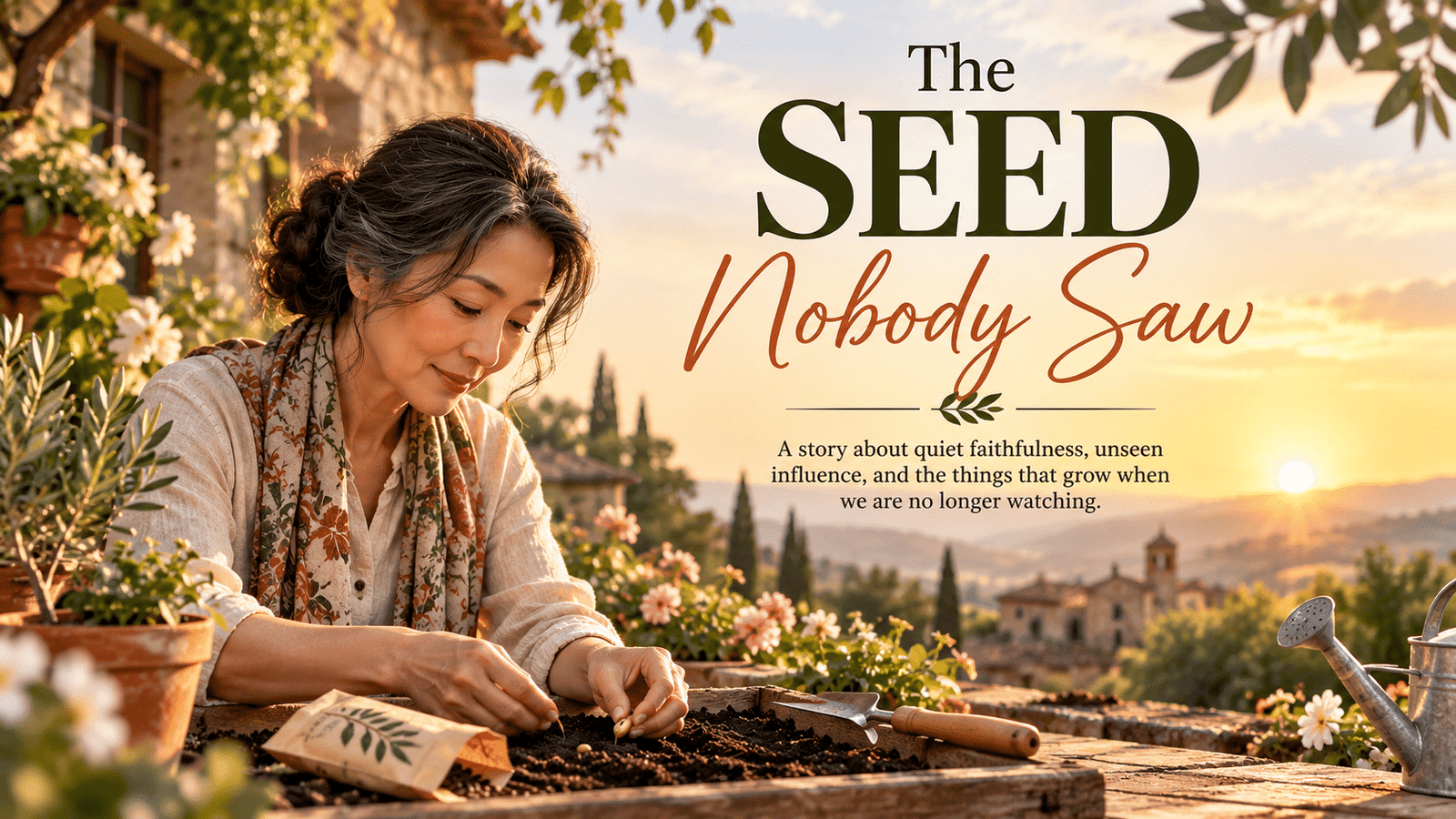
A story about quiet faithfulness, unseen influence, and the things that grow when we are no longer watching.
Miriam had a small habit that nobody understood.
Every Friday morning, before the town had properly awakened, she would leave her little house with a basket over one arm and a folded piece of paper in her coat pocket.
Sometimes the basket contained a loaf of bread, a few apples and a jar of soup. Sometimes it held nothing more than a bunch of flowers from her garden.
She never knocked for long. She would leave whatever she had brought on a doorstep, ring the bell, and walk away before anyone answered.
On other days, she slipped handwritten notes beneath doors.
You are doing better than you think.
Someone is grateful you are here.
Please do not give up on yourself.
She signed none of them.
Miriam had not always been this way. Once, she had been a woman who measured her days by what she had accomplished. She kept lists, made plans and took pride in seeing things through.
Then life had taught her something rather inconvenient.
Not everything that mattered came with proof that it had worked.
Her husband died when she was forty-eight. Her only son moved abroad, where work and family gradually filled the spaces between their telephone calls. The house grew quieter, the garden grew wilder, and the years began to pass with a speed that seemed almost impolite.
It was during that season of loneliness that Miriam started her Friday visits.
At first, she did it because she knew what it felt like to be forgotten.
There was the young mother at Number 14, who always looked exhausted when she collected her post. Miriam began leaving groceries outside her door.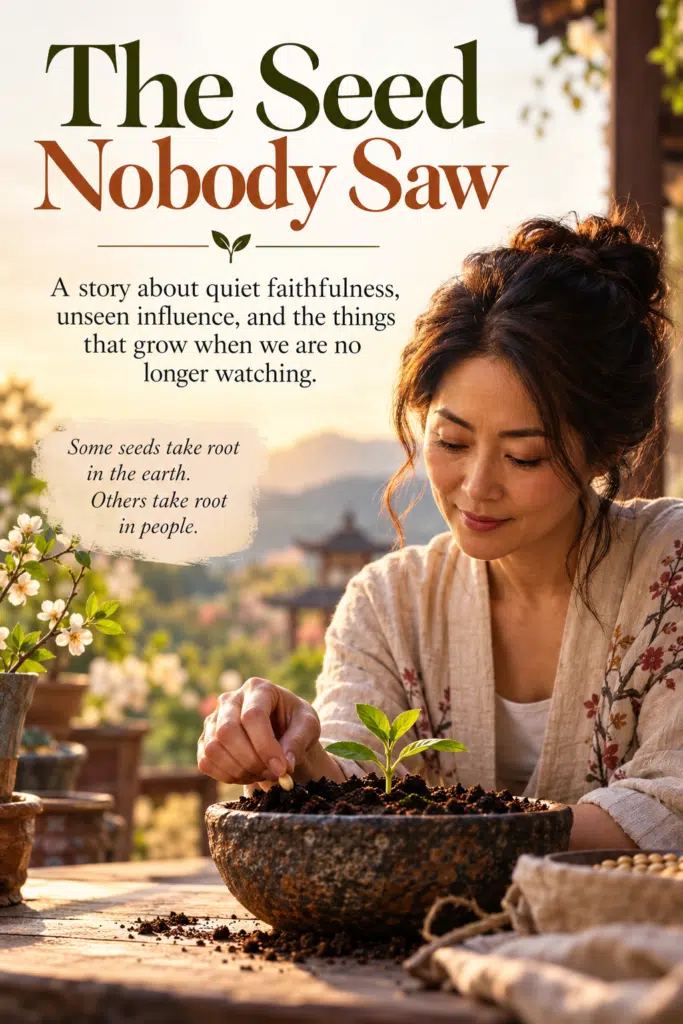
There was Mr Ellis, the retired schoolmaster who had stopped attending the town’s gatherings after his wife died. Miriam left flowers on his windowsill whenever she passed.
And there was a teenage boy who sat alone on the bench beside the old railway bridge. She never approached him. She simply left a paper bag containing a sandwich and a bottle of water on the bench one morning, then did the same the following week.
She never knew whether he ate them.
That was the trouble with her little habit. She rarely knew anything.
The young mother moved away without a word. Mr Ellis died in the spring. The boy eventually stopped appearing at the bridge.
Miriam wondered whether her kindness had meant anything at all.
Perhaps the groceries had been thrown away. Perhaps the flowers had gone unnoticed. Perhaps the notes had been read with a shrug before being discarded with the day’s rubbish.
She had no way of knowing.
Still, every Friday, she went out.
Years passed.
Her knees began to trouble her. Her eyesight weakened. The basket grew lighter, and the walks grew shorter. Some Fridays, she managed only two houses. On others, she stayed home and wrote notes at her kitchen table, asking a neighbour to deliver them.
One winter morning, she sat by the window watching rain gather on the glass.
On the table lay a small pile of folded notes.
She picked one up and read it.
You matter more than you know.
For the first time in many years, Miriam found herself asking a question she had been too busy to ask before.
What if none of it made a difference?
She had not expected applause. She had not wanted thanks. But surely, somewhere along the way, there ought to have been some small sign that her efforts had counted.
A changed life. A grateful face. A single sentence to tell her that she had helped.
There was nothing.
Miriam folded the note again and placed it in the drawer.
Perhaps, she thought, she had mistaken a kind impulse for a calling.
Perhaps she had spent years scattering seeds over ground that would never allow anything to grow.
That Friday, for the first time in many years, Miriam did not leave the house.
Nor did she go out the Friday after that.
By the third week, she had almost persuaded herself that it no longer mattered.
Then someone knocked at her door.
Miriam opened it to find a young woman standing on the step, holding a small wooden box.
“I hope you don’t mind my coming,” the woman said. “My name is Anna. I don’t think we’ve met.”
Miriam invited her inside.
Anna placed the box on the table but did not open it immediately. She looked around the little sitting room, at the books on the shelves and the photographs above the fireplace.
“My mother used to live at Number 14,” she said.
Miriam remembered the house. She remembered the tired young woman and the groceries she had left on her doorstep.
“She never told us who brought them,” Anna continued. “When I was little, we were having a very difficult time. My father had left, my mother had lost her job, and there were days when she didn’t know how she would feed us.”
Miriam said nothing.
“She told me once that somebody had left a bag of food outside our door. Then it happened again. And again. She said it was the first time in months that she had felt somebody cared whether we were all right.”
Anna opened the box.
Inside lay dozens of folded pieces of paper, some yellowed with age, others worn soft at the edges.
“My mother kept every note she found. When she died last year, I found these among her things.”
She lifted one carefully and passed it to Miriam.
The handwriting was unmistakable.
You are doing better than you think.
Miriam’s eyes filled with tears.
Anna smiled gently.
“That note changed things for my mother. She began leaving little messages for other people. When I was old enough, she took me with her. We left food for a family down the road. We visited an elderly man who lived alone. We wrote notes and tucked them into library books.”
She paused.
“I grew up believing that kindness was something you did, even when nobody was watching.”
Miriam looked down at the box.
“My mother taught me,” Anna continued, “and I have taught my children. I work with families now. Whenever I meet someone who feels invisible, I remember those notes.”
For a long moment, neither woman spoke.
Then Anna reached into her bag and produced a photograph.
It showed a little garden behind a community centre. There were raised beds, flowers, vegetables and a wooden bench beneath a young tree.
“We started a community garden last year,” she said. “People come there when they have nowhere else to go. Some need food. Some need company. Some simply need somewhere to sit without being asked to explain themselves.”
She turned the photograph over.
On the back, someone had written a few words:
For the kindness that started long before we knew its name.
Miriam ran her thumb over the writing.
“I didn’t know,” she whispered.
“I know,” Anna replied. “That is why I wanted you to see.”
After Anna left, Miriam sat beside the window for a long time.
The rain had stopped. A thin ribbon of sunlight lay across the garden, touching the bare earth beneath the old apple tree.
She thought of the young mother who had moved away, the schoolmaster who had died, and the boy beside the railway bridge.
She wondered where they were now. She wondered what had become of them.
She still did not know.
But for the first time, she understood that not knowing was not the same as nothing happening.
The next Friday, Miriam asked her neighbour to help her carry the basket.
They visited two houses, then three. At the last one, Miriam left a small paper bag containing bread, apples and a note.
She rang the bell and began walking away.
Behind her, the door opened.
“Mum!” a child’s voice called. “Someone’s left us something!”
Miriam did not turn around.
She simply smiled and continued down the path.
That evening, she returned to her garden and knelt beside a small patch of earth. From a paper packet, she took a handful of seeds and pressed them into the soil.
She covered them gently.
Then she stood, brushed the earth from her hands and went inside.
Spring would come when it came.
And whether she was there to see it or not, something would grow.
Some seeds take root in the earth. Others take root in people. And the most important ones may grow for years in places we will never see.
What If You Never See the Harvest?
We often look for evidence that our efforts have mattered. We want to know that the encouragement we offered helped, that our kindness made a difference, and that the time we invested in someone was not wasted.
Yet some of the most meaningful things we do leave no immediate evidence of their impact.
A kind word may stay with someone for years. A small act of generosity may restore their faith in people. A moment of patience may become the example they one day follow with their own children.
We may never hear the full story.
The Bible reminds us in Galatians 6:9 not to grow weary in doing good, because there is a harvest in due season if we do not give up.
That is not a promise that every effort will produce the result we expect, or that we will always live to see its outcome. It is an encouragement to remain faithful in doing what is good.
So, if you have been showing up, giving quietly, praying for others, or offering kindness without recognition, do not be too quick to dismiss the value of what you have done.
You are responsible for the seed you sow. You cannot always control the soil, the season or the harvest.
Keep sowing what is good. The story of a seed does not end when it leaves your hand.
Continue Your Journey of Faith
Sometimes, we sow faithfully without seeing a harvest. We pray, serve, encourage and keep going, trusting that God sees what others may overlook.
If you are walking through a season of waiting, wondering or uncertainty, Waiting on the Lord offers an opportunity to slow down, reflect on Scripture and strengthen your trust in God’s timing.
You may not see the whole picture today. You can still walk faithfully with God.
Have you ever discovered that a small act of kindness you offered made a difference you never expected? If you feel comfortable sharing, I’d love to hear your story.
CLICK HERE ==>> Explore the Waiting on the Lord Guided Scripture Workbook