

Many Christians feel unprepared when conversations about faith turn challenging. You might struggle to articulate why you believe what you believe, or worry you’ll say something that doesn’t hold up under scrutiny.
At Life Purpose Matters, we’ve created this guide to Christian apologetics basics so you can speak about your faith with genuine confidence. We’ll walk you through practical strategies, real arguments, and conversational techniques that actually work.
What Apologetics Really Means
Apologetics isn’t about admitting you’re wrong or feeling sorry. The word comes from the Greek apologia, which means defence or persuasive explanation. When you defend your faith, you’re giving reasons for what you believe and why those reasons matter. First Peter 3:15 commands believers to be prepared to give a reason for their hope when asked. This isn’t optional for pastors or theologians-it’s for every Christian who wants to speak confidently about their convictions. The early church father Justin Martyr understood this well. He spent his life arguing for Christianity’s truthfulness in public settings, showing that defending faith has deep roots in Christian tradition.
How Apologetics Works in Real Life
Paul modelled this approach throughout his ministry. He reasoned with Jews in synagogues, debated with philosophers in Athens, and even quoted pagan authors to reach Gentile audiences in Acts 17. This tells you something important: apologetics happens outside church walls, in real conversations with people who don’t share your beliefs. It’s not about winning arguments or proving someone wrong. It’s about helping sceptics understand why Christian claims deserve serious consideration. When you can articulate what you believe and why, conversations shift. People sense your conviction. They see you’re not defensive or angry-you’re genuinely confident in your position. That confidence opens doors to deeper dialogue.
Why Confidence Changes the Conversation
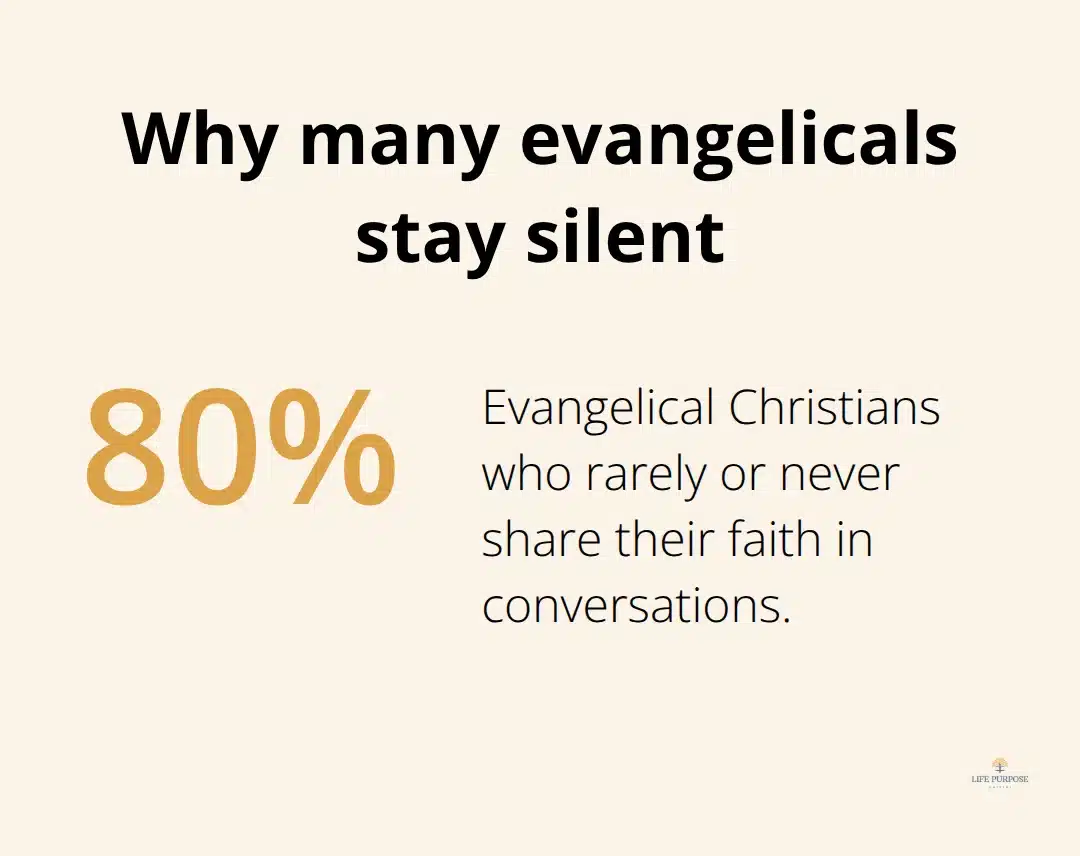
Many believers stay silent because they fear saying the wrong thing. Research on evangelical Christians shows that roughly 80 percent rarely or never share their faith in conversations, often citing fear of rejection or looking foolish. But here’s what happens when you prepare: your anxiety drops, and your authenticity increases.
People respond better to someone who says “I don’t know, but I’ll find out” than to someone who fumbles through an answer.
Knowing basic arguments about the resurrection, the reliability of the Gospels, or God’s existence gives you anchors. You don’t need to memorise every detail. You need to understand the core claims and why they matter. The resurrection provides the strongest foundation for Christian hope. It’s not about your personal feelings or spiritual experiences-it’s about a historical event that actually happened. Once you grasp that distinction, conversations become easier. You’re not defending vague spirituality. You’re defending concrete, verifiable claims about Jesus.
Standing on Historical Ground
When someone asks why you believe, you can point to evidence: the historical reliability of Gospel accounts, fulfilled Old Testament prophecies, and the transformation of the disciples after witnessing the resurrection. These aren’t abstract concepts. They’re real historical arguments that sceptics have engaged with for nearly 2,000 years. That’s why confidence matters so much. You’re not making up your faith as you go. You’re standing on a foundation that scholars, historians, and believers have examined and defended across centuries. This foundation equips you to move into actual conversations with real people-which means you need to know what questions they’ll ask and how to respond thoughtfully.
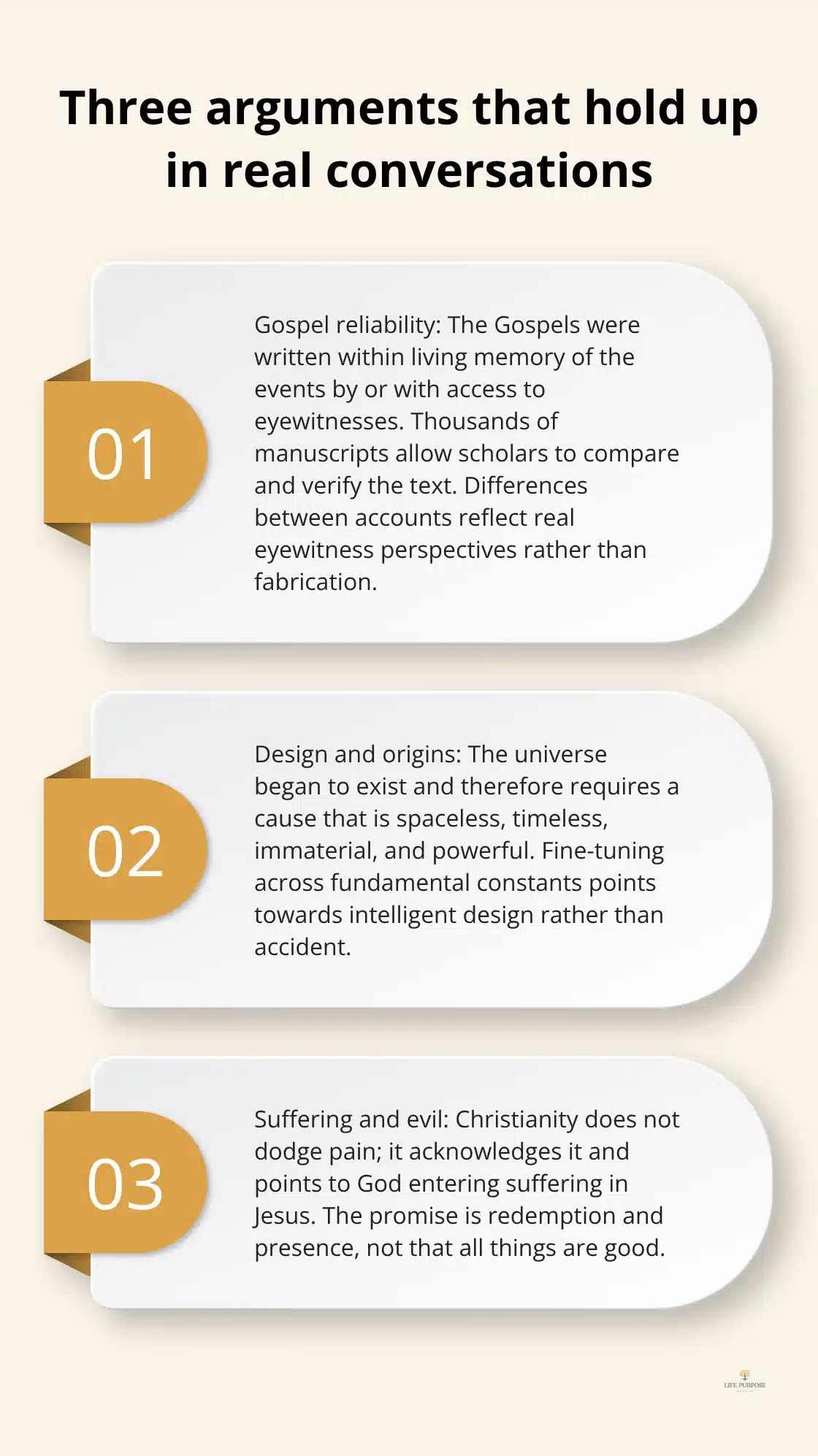
The Three Arguments That Hold Up in Real Conversations
When someone challenges your faith, three arguments consistently emerge as the strongest defences. Each one works because it connects to evidence people can examine themselves.
Gospel Accounts Survive Historical Scrutiny
The Gospel accounts within decades-eyewitnesses recorded them while people who knew Jesus still lived. Manuscript evidence far exceeds other ancient texts. F. F. Bruce, a respected historian, documented over 5,800 Greek New Testament manuscripts, compared to roughly 643 for Homer’s Iliad. The earliest fragments of John’s Gospel date to around 125 AD, only 25-50 years after the events described.
This matters practically. When sceptics claim the Gospels are legendary, you can point to this timeline. Legends require generations to develop. Matthew, Mark, Luke, and John wrote while eyewitnesses still lived and could contradict false claims. The differences between Gospel accounts-like Matthew and Luke describing different numbers of angels at the tomb-actually strengthen credibility. Ancient forgers would have harmonised everything perfectly. Real eyewitnesses report the same event from different angles.
You don’t need to memorise manuscript dates. Just remember this: the Gospels were written early, by people with direct access to events, and preserved in thousands of copies that scholars can compare. When someone says the Bible was corrupted over time, you can confidently say that’s impossible given the manuscript evidence.
The Design Argument Speaks to Modern Sceptics
The second argument focuses on existence itself. The Big Bang theory, confirmed by Hubble’s 1929 observations of cosmic expansion and supported by the Second Law of Thermodynamics, shows the universe had a beginning. Whatever begins to exist requires a cause. That cause must be spaceless, timeless, immaterial, and unimaginably powerful-exactly what the Bible describes about God.
Fine-tuning of the universe makes this argument even stronger. Gravity is calibrated to roughly 1 in 10 to the 36th power for life to exist. The expansion rate of the universe sits at 1 in 10 to the 60th power. The electron-to-proton ratio requires precision to 1 in 10 to the 37th power.

Over 400 characteristics of Earth and our solar system must align for advanced life-from the Moon’s size to atmospheric density to the arrangement of giant planets.
When sceptics ask why God exists, you can flip the question: why does anything exist at all, and why is it fine-tuned for life? These aren’t abstract philosophical puzzles. Physicists acknowledge these observations as real. You don’t need a science degree to use this argument. Try saying: a universe with a beginning needs a cause, and a universe precisely calibrated for life points toward intelligent design. Most people find this more compelling than philosophical abstraction.
Suffering and Evil Require Honest Answers
The third argument is the hardest because it addresses pain. Sceptics will ask how a good God allows suffering. This is where many Christians fumble by offering platitudes. Don’t do that. Instead, acknowledge the tension is real. God’s sovereignty and human freedom coexist-Scripture doesn’t resolve this fully, and honest faith admits it.
Jesus didn’t explain suffering away. He experienced it. Isaiah 53:10 describes God’s servant suffering for others’ sake. Romans 8:28 promises God works all things toward good, not that all things are good. When someone shares personal suffering, listen first. Don’t immediately theologise. Then you can say: God grieves with us in suffering. He didn’t cause evil-humans and spiritual forces did. God’s response was to enter suffering himself through Jesus and offer redemption.
This isn’t a complete answer to the problem of evil, but it’s honest. It shows you take their pain seriously rather than dismissing it with doctrine. Many people return to faith not because suffering disappears but because they encounter God’s presence within it. These three arguments form your foundation, but knowing them isn’t enough. You also need to know how to actually use them in conversation-which means understanding how to listen, ask the right questions, and avoid the mistakes that shut down dialogue before it starts.
How to Actually Listen Before You Speak
Most Christians approach faith conversations backward. They prepare answers before understanding the question. Tim Muehlhoff, a communication professor at Biola University, studied how believers engage sceptics and found that those who listen first dramatically increase their chances of meaningful dialogue. Proverbs 18:13 warns against answering before hearing, and that ancient wisdom still applies. When someone challenges your faith, your instinct is to defend immediately. Resist it. Ask instead: What does this person actually believe? Why do they believe it? Where did these convictions come from?
A Harvard Negotiation Project study showed that understanding someone’s reasoning-not just their conclusion-creates openings for real conversation. Start with open questions. Rather than saying “Don’t you think the resurrection happened?” try “What would convince you that Jesus rose from the dead?” The second question invites them to think. It also reveals what evidence matters to them. Some people care about historical documents. Others prioritise personal experience. Some want philosophical consistency. Once you know what moves them, you can reference the arguments that actually land. This approach takes patience, but it works. People sense when you genuinely want to understand their perspective versus when you’re waiting for your turn to talk.
Find Common Ground Before You Differ
After listening, identify where you agree. Every sceptic has shared questions about suffering and meaning. These universal questions create bridges. C.S. Lewis argued that shared questions build friendship better than shared answers. If someone doubts God’s goodness because of suffering, you both care about justice and compassion-you just reach different conclusions. Name that agreement. Say something like: I see why that troubles you. I struggle with suffering too. Here’s what I’ve found helps me.
This approach acknowledges their concern as legitimate rather than dismissing it. Avoid the trap of agenda anxiety. You don’t need to cover every apologetic argument in one conversation. Pick one clear goal for the moment: answer their specific question, clarify a misunderstanding, build relationship, or set up a future discussion. That focus prevents you from overwhelming them with information they’re not ready to process.
Respond to Tension With Empathy, Not Defence
When tension rises, ask deeper questions instead of defending harder. Deborah Tannen, a linguist who studied argument culture, found that adversarial debate shuts down thinking. Empathy keeps it open. If someone attacks Christianity harshly, ask why that matters so much to them. Often anger masks hurt. A person wounded by Christians needs to know you hear their pain before you defend theology. This matters practically: relationship quality determines whether future conversations happen at all.
Share Your Story Without Making It About You
Personal testimony is powerful because it’s harder to argue with experience. But most Christians tell their conversion story wrong. They make it about how good they felt or how much their life improved. Sceptics hear self-help language, not gospel truth. Instead, share what changed in your understanding of reality. Maybe you realised the historical evidence for the resurrection was stronger than you thought. Maybe you saw God answer prayer in ways coincidence couldn’t explain. Maybe you experienced forgiveness you couldn’t achieve on your own.
Ground your story in specifics. Vague spirituality doesn’t convince anyone. Say: I was sceptical about the resurrection until I read F.F. Bruce’s analysis of manuscript evidence. That shifted everything for me. Or: I thought forgiveness was impossible until I experienced it through Christ. Those concrete details invite questions. They show faith isn’t blind. They demonstrate that smart people can examine evidence and change their minds.
Randy Newman’s research on questioning evangelism shows that personal stories combined with clear truth create more openness than either alone. When sceptics see someone they respect take their own doubts seriously and work through them honestly, defences lower. That’s when real conversation begins. The goal isn’t to convince through eloquence. It’s to show that Christian conviction rests on something solid-history, evidence, and transformed lives-not emotion or wishful thinking.
Final Thoughts
Confidence in Christian apologetics basics comes from knowledge combined with real practice. You now understand the core arguments that hold up under scrutiny-the historical reliability of the Gospels, the design of creation, and honest responses to suffering. Start small in your next conversation about faith: listen first, ask one thoughtful question, and share one specific detail from your own journey. Each conversation builds your comfort level and strengthens your ability to articulate what you believe.
The arguments we’ve covered have survived centuries of scrutiny because they rest on history and evidence, not wishful thinking. When you speak from that foundation, people notice your words carry weight. F.F. Bruce’s historical work on the Gospels, Tim Keller’s The Reason for God, and Randy Newman’s Questioning Evangelism offer deeper exploration of these arguments and help you move beyond basics into genuine confidence.
Your faith conversations don’t need to be perfect-they need to be honest. When you admit uncertainty, people trust you more; when you listen before speaking, doors open; when you ground your faith in evidence and personal transformation, sceptics take you seriously. We at Life Purpose Matters have created additional resources to support your spiritual journey, including guides on faith conversations and witnessing skills that help you practice Christian apologetics basics in real relationships.