
“I need more than a feeling” is one of the most common reasons people give for walking away from faith, or never embracing it in the first place. They want solid ground, not just sentiment — and when it comes to the resurrection, there’s more historical ground to stand on than most people realise.
At Life Purpose Matters, we believe the evidence for resurrection deserves a serious look. The historical record-from early Christian writings to non-Christian sources-tells a remarkably consistent story. What follows isn’t theology dressed up as fact. It’s an examination of what actually happened, and why it transformed everything.
What Evidence Did Early Christians Actually Document?
The Earliest Written Record: Paul’s Creed
Paul’s letters contain something historians rarely find: a creed written before the Gospels themselves. In 1 Corinthians 15:3–8, Paul records what he received from earlier Christians, likely within two to eight years of the crucifixion. This creed states Jesus died for sins, was buried, rose on the third day, and appeared to Peter, the Twelve, over 500 at once, James, and all the apostles. Scholar Gerd Lüdemann dates this formula to within the first few years after Easter, making legendary development virtually impossible.
The specificity matters. Paul names Peter first, then the Twelve, then James by name. These aren’t vague spiritual claims; they’re concrete, testable assertions about who saw what and when. The early Christians didn’t hide behind anonymity or mystery. They put names to their witnesses.
Non-Christian Historians Confirm the Core Facts
Outside the Christian community, the evidence corroborates core facts without promoting Christian theology. Josephus, writing around 93 CE in his Antiquities, mentions that Jesus was crucified under Pontius Pilate. Tacitus, the Roman historian, confirms in his Annals that Jesus died under Pilate during Tiberius’s reign. Neither writer believed in the resurrection, yet both confirm the execution. This matters because sceptics can’t dismiss the accounts as Christian propaganda when pagan historians independently verify the same event.
Four Gospels, One Consistent Core
The four Gospels-Matthew, Mark, Luke, and John-all report the empty tomb, all mention women as first witnesses, and all describe physical post-resurrection encounters. Mark, the earliest Gospel, ends abruptly at the empty tomb around 70 CE. Matthew and Luke, written roughly a decade later, add appearance narratives. John, composed around 90–110 CE, includes detailed encounters where Jesus eats fish, invites touch, and appears through locked doors.
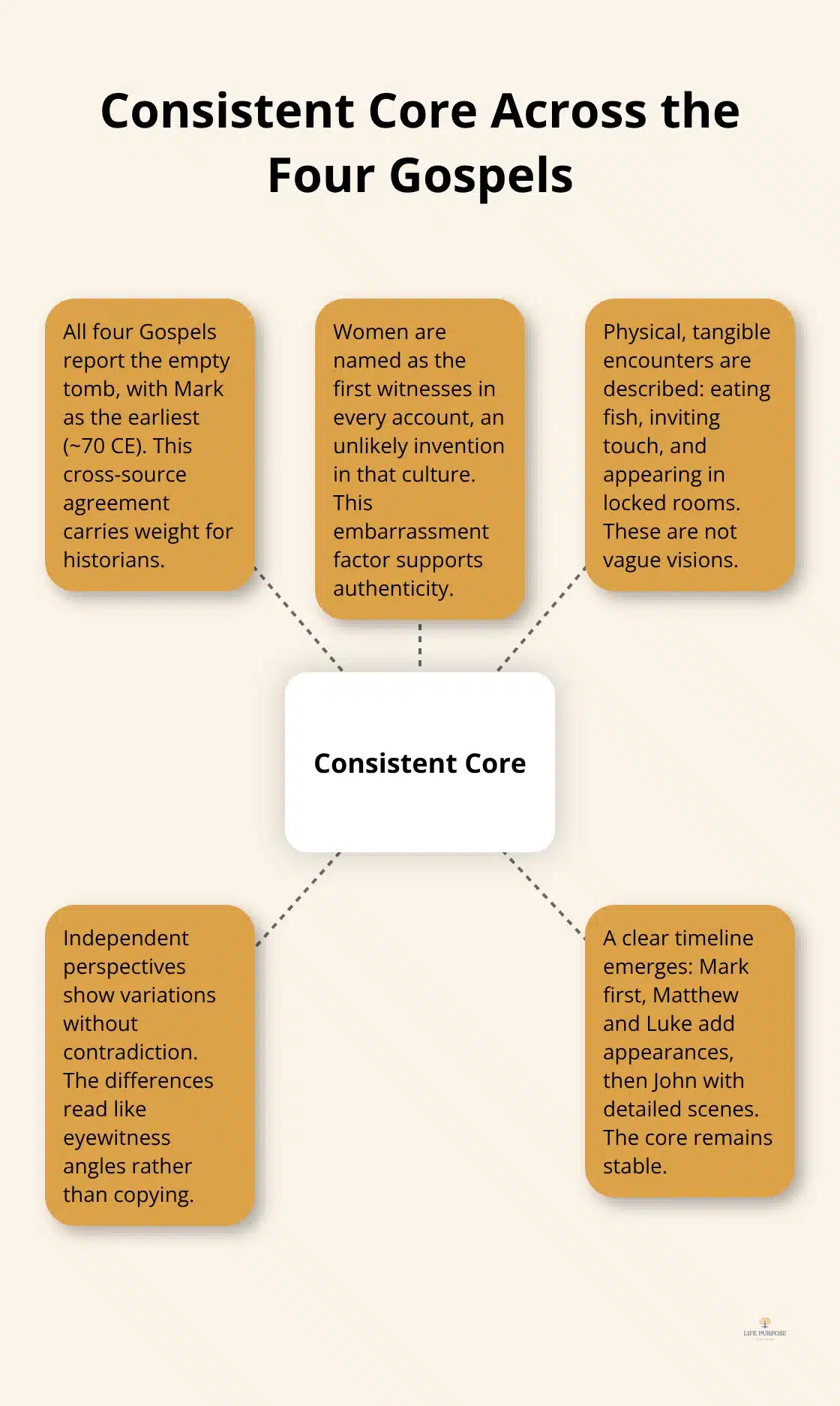
Rather than contradicting each other, these accounts show a consistent core: the tomb was empty, Jesus appeared physically, and these appearances transformed terrified disciples into bold proclaimers. The variations in detail actually strengthen the case. If all four accounts were identical word-for-word, historians would suspect copying. Instead, each Gospel preserves independent testimony about the same foundational events. This is precisely what you’d expect from eyewitnesses who describe the same extraordinary experience from different angles and contexts.
What happened next reveals why these disciples risked everything to proclaim what they witnessed.
The Transformation of the Disciples
The disciples weren’t naturally brave people. After Jesus was arrested, they didn’t stand at the cross shouting his name. They hid behind locked doors in Jerusalem, convinced they’d be next. John’s Gospel tells us they locked the doors for fear of the Jewish leaders. These weren’t heroes waiting for their moment. They were frightened people in genuine danger. Yet within weeks, these same disciples publicly proclaimed the resurrection in the very city where Jesus had been executed, knowing full well the authorities could arrest and execute them too.
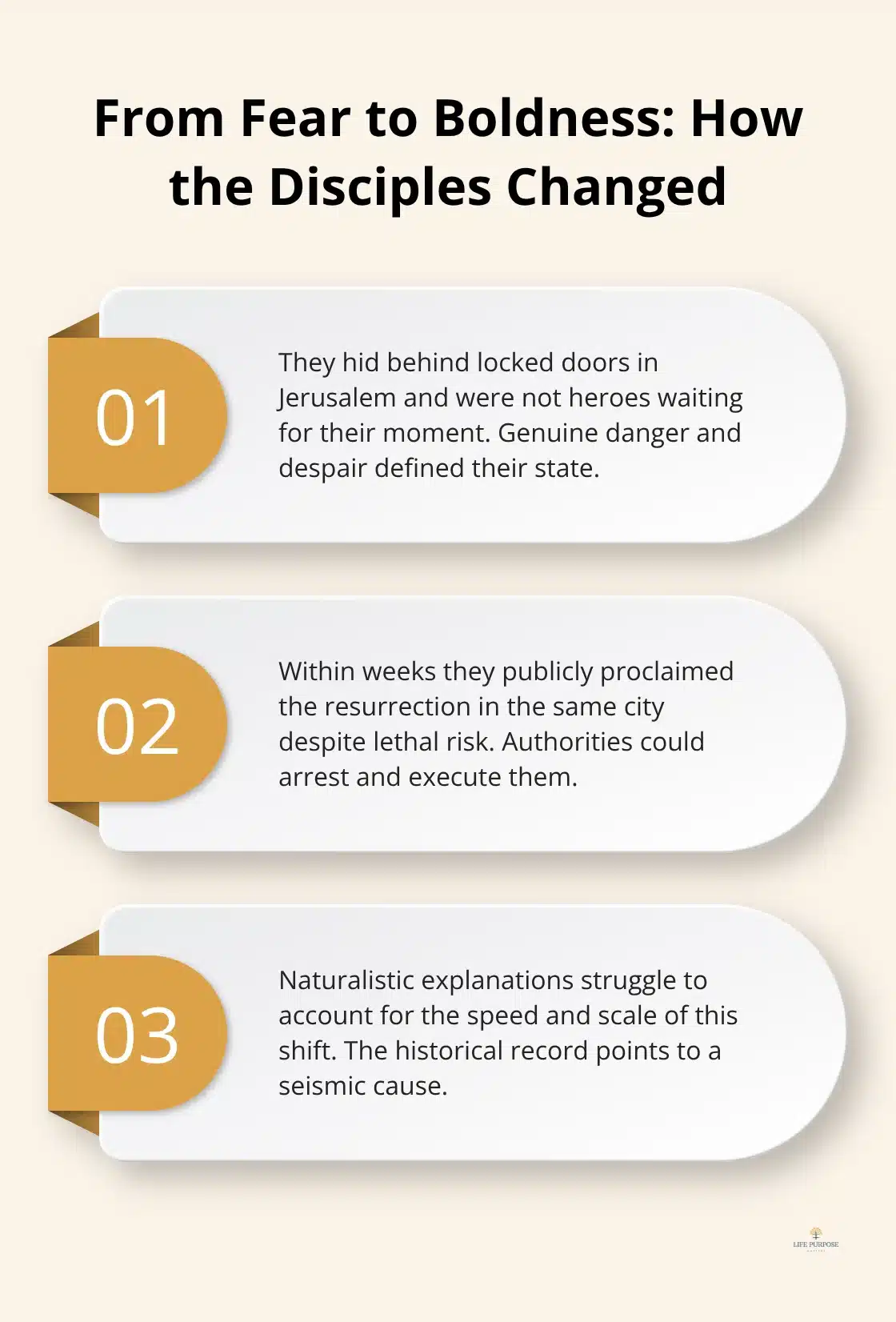
Something seismic shifted their behaviour, and the historical record leaves us with a puzzle that naturalistic explanations struggle to solve.
Peter’s Dramatic Reversal
Peter’s transformation stands out most clearly. During Jesus’s trial, Peter denied even knowing him three times. Matthew, Mark, and Luke all preserve this embarrassing detail, suggesting the Gospel writers weren’t inventing flattering stories. Yet Acts describes Peter standing before the Sanhedrin-the same council that had condemned Jesus-and declaring boldly: I must obey God rather than human authority. This wasn’t the same man. According to Acts 4:13, the council members noticed the disciples’ boldness and recognised they had been with Jesus. Peter faced arrest, flogging, and threats. Instead of retreating, he and the other apostles rejoiced that they had been counted worthy to suffer shame for the name of Jesus.
The Cost of Their Conviction
The historical reality is stark: people don’t voluntarily endure torture and execution for something they know is a lie. They might die for a false belief they genuinely hold, but they won’t face persecution for a deliberate hoax they created themselves. James, Jesus’s brother, apparently didn’t believe in him during his ministry, according to John’s Gospel. Yet James became the leader of the Jerusalem church and was eventually executed for his faith, according to the historian Josephus. Paul, initially a persecutor of Christians, experienced what he called an encounter with the risen Jesus that redirected his entire life. He gave up his status as a respected Pharisee to become a tentmaker and missionary, enduring beatings, shipwrecks, imprisonments, and ultimately execution.
Why This Matters Historically
These weren’t people seeking power or wealth. They lost both. They weren’t delusional fanatics either; Paul’s letters reveal a sharp, educated mind wrestling with genuine theological complexity. The disciples’ willingness to suffer without any earthly reward remains one of the most psychologically difficult facts for sceptics to explain away using conventional theories about hallucinations, legend growth, or conspiracy. What transformed these terrified followers into bold proclaimers? The answer lies in what they claimed to have witnessed-and the physical evidence that corroborated their testimony.
What Actually Happened After the Crucifixion
The Empty Tomb: A Fact Nobody Disputed
The empty tomb isn’t a theological invention created decades later. All four Gospels report it, and this consistency across independent sources matters enormously to historians. Mark, written around 70 CE, mentions the empty tomb without embellishment. Matthew, Luke, and John, written over the next forty years, all preserve the same basic fact: the tomb where Jesus was buried stood empty. What makes this historically significant is that nobody in the first century disputed the empty tomb. The Jewish leaders didn’t argue that the body remained there. Instead, according to Matthew 28:11–15, they alleged the disciples stole it-an admission that conceded the tomb’s emptiness. When your opponents reject your core claim but only offer an alternative explanation, you’ve established something historically solid.
Women as First Witnesses: The Embarrassment Factor
The criterion of embarrassment strengthens this case considerably. All four Gospels name women as the first witnesses to the empty tomb and to the risen Jesus. In first-century Jewish culture, women’s testimony held less legal weight than men’s in court proceedings. No Jewish writer fabricating a resurrection story would invent female witnesses first. This detail is so awkward for the Gospel writers’ own cultural context that it almost certainly reflects what actually happened rather than what they wished had happened.
Physical Encounters, Not Spiritual Visions
The post-resurrection appearances present concrete, physical encounters that defy the hallucination theory many sceptics propose. Luke emphasises this explicitly: Jesus invites the disciples to touch him, eats fish in front of them, and insists he isn’t a ghost or spirit but flesh and bones. John records similar details: Thomas touches Jesus’s wounds, Jesus eats, and he appears in locked rooms. These aren’t vague spiritual visions. They’re described as bodily, tangible encounters where people interact with a physical presence.
The 500 Witnesses Problem for Sceptics
Paul’s early creed lists appearances to Peter, the Twelve, over 500 believers at once, James, and all the apostles. The sheer number of witnesses-especially the 500 mentioned in 1 Corinthians 15:6-makes mass hallucination implausible. Hallucinations are private, individual experiences. They don’t occur simultaneously to hundreds of people across different locations and contexts.
James: A Sceptic Becomes a Martyr
The appearances also occurred to sceptics. James, Jesus’s own brother, apparently didn’t believe in him during his ministry, according to John 7:5. Yet James became a leader of the Jerusalem church and was eventually executed for his faith, as the historian Josephus confirms. People don’t reverse their fundamental convictions about their own family members based on a shared delusion. They reverse them when they encounter something undeniably real that demands explanation.
Final Thoughts
The evidence for the resurrection rests on four pillars that historians across different worldviews acknowledge. Jesus died by crucifixion, documented by Christian and non-Christian sources alike. His tomb stood empty, a fact even his opponents didn’t dispute. Hundreds of people reported encountering him physically after his death, including sceptics like James, who had every reason to doubt.
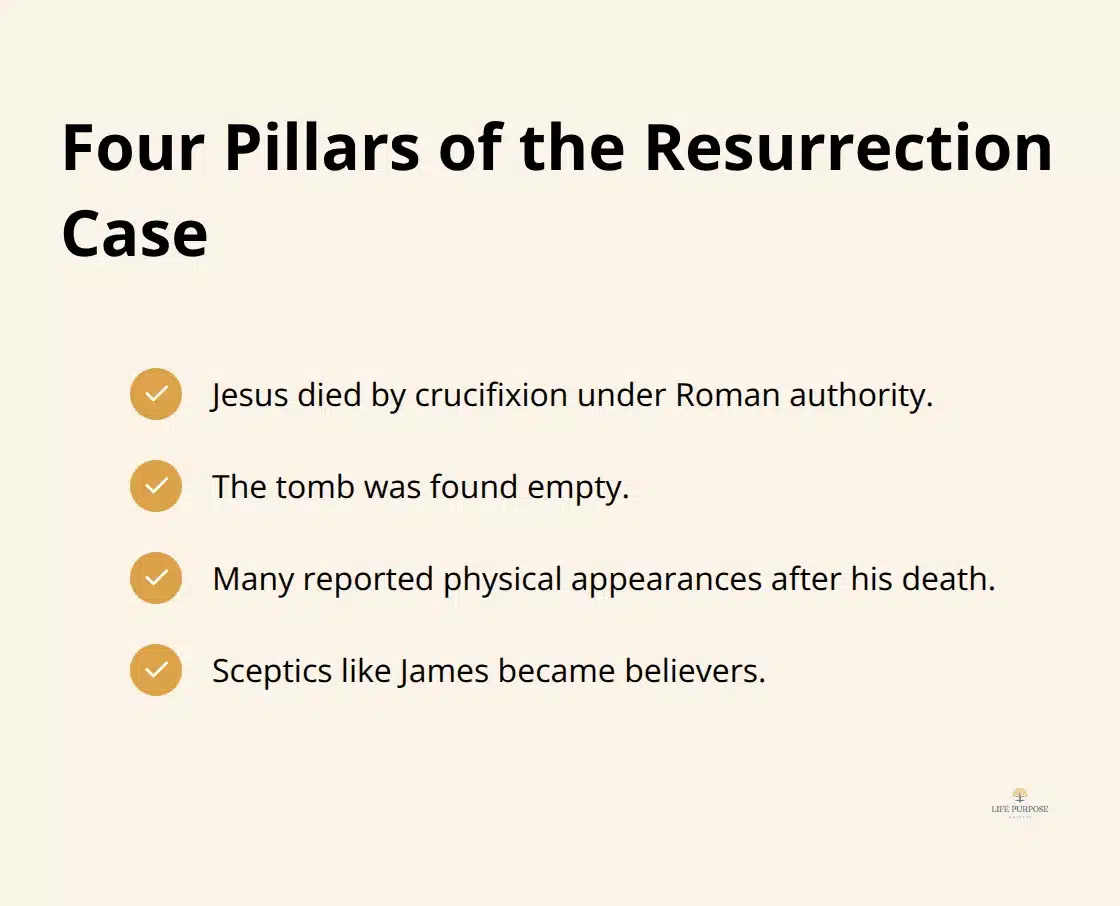
This convergence of independent data points demands explanation, and the naturalistic alternatives each fail to account for all four facts simultaneously. The resurrection hypothesis explains why the tomb was empty, why appearances were physical and public rather than private visions, why sceptics became believers, and why terrified followers became martyrs. Sceptical scholars like Bart Ehrman and Gerd Lüdemann, who reject the supernatural, still affirm the core historical facts-they simply propose different explanations.
For those who follow Christ, the evidence for the resurrection validates Jesus’s claims about himself and his authority, promising that death isn’t final and that God’s power extends beyond the natural world. The same power that raised Jesus from death shapes how we face suffering, treat others, and understand our purpose. Explore what this hope means for your daily life by visiting Life Purpose Matters to discover resources designed to deepen your faith and help you live out your God-given purpose with confidence grounded in historical reality.