

I once sat across from someone who’d spent years wrestling with doubts about their faith, only to find unexpected peace when they started learning about creation science. They realised that understanding God’s design through scientific evidence didn’t weaken their beliefs; it deepened them.
At Life Purpose Matters, we’ve seen this pattern again and again. When you explore how creation science reveals the intentionality behind our world, something shifts in how you relate to your faith.
What Creation Science Reveals About God’s Intentional Design
Two Books, One Author
Creation science rests on a straightforward premise: God created the world, and the evidence in nature reflects that creative act. This approach doesn’t dismiss scientific inquiry or ignore data. Instead, creation science integrates what we observe in the natural world with what Scripture tells us about God’s design. You’re essentially reading two books written by the same Author-the Bible and nature itself.
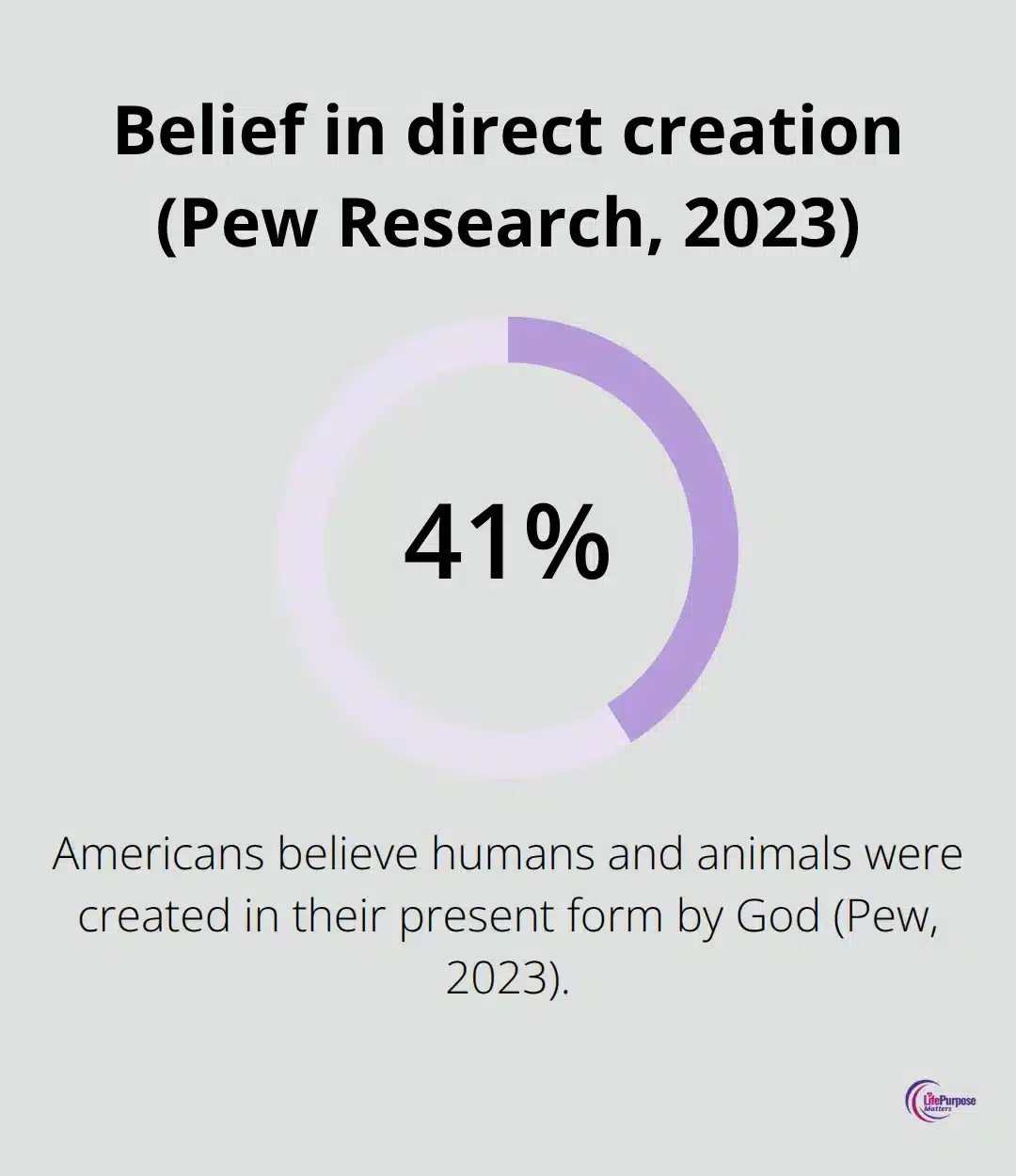
The key difference between creation science and evolutionary theory comes down to starting assumptions. Evolutionary theory assumes that natural processes alone explain the complexity of life over billions of years. Creation science interprets the same scientific data through the lens of an intelligent Creator who designed life with intentionality. A 2023 Pew Research survey found that 41% of Americans believe humans and animals were created in their present form by God, while many others hold to theistic evolution or other frameworks.
Interpreting Evidence Through Faith
You’re not choosing between science and belief-you’re choosing how to interpret evidence. The fossil record, DNA complexity, the precision of physical constants, and the origin of life itself all become windows into understanding God’s creative power rather than obstacles to faith.
The Mathematical Case for Design
The mathematical improbability of life arising by chance alone presents a compelling starting point. When you consider that a single living cell requires hundreds of proteins working in concert, the odds become incomprehensibly small. This isn’t theological speculation-it’s mathematical observation.
Fine-Tuning Points to Purpose
The fine-tuning of universal constants demonstrates remarkable precision. Alter the strength of gravity by even 1%, and stars cannot form. Change the electromagnetic force slightly, and chemistry becomes impossible. These constants appear calibrated for a universe capable of sustaining life (a phenomenon sometimes called the Anthropic Principle). Creation science interprets this precision as evidence of design rather than cosmic accident.
Genesis 1:1 states that God created the heavens and the earth. When you examine the intricate systems holding creation together, that statement gains tangible weight in your understanding of God’s character and capability. This recognition of design in nature sets the stage for exploring how people actually experience faith transformation when they encounter these truths firsthand.
When Faith Meets Evidence
How Real People Experience Faith Transformation
The shift from intellectual doubt to spiritual confidence often happens quietly. A medical doctor in Arkansas spent years as a theistic evolutionist until a conversation about carbon dating, fossil records, and the age of the Earth fundamentally changed his perspective. He realised that creation science wasn’t asking him to abandon critical thinking-it was inviting him to think more critically about the assumptions underlying evolutionary frameworks. This transformation reveals the real power of creation science: your faith stops feeling defensive and starts feeling grounded.
A 2019 Gallup survey showed that 40% of Americans hold a creationist view, and among those who do, 73% report that their faith feels stronger and more resilient. That’s not a coincidence. When you can articulate why the precision of universal constants, the complexity of DNA, or the origin of consciousness points toward design rather than randomness, you’re no longer relying on hope alone-you’re standing on observable reality.
Science and Scripture as Complementary Revelations
A Chinese student in Iowa experienced this shift when studying how science and Scripture align. He moved from seeing them as opposing forces to understanding them as complementary revelations of the same Creator. That perspective change rewired how he approached both his studies and his prayer life. The integration happens when you stop treating these two domains as competitors and start treating them as partners in revealing God’s nature.
Building Your Creation Science Practice
The practical integration of creation science into your faith happens through deliberate, consistent engagement. Start with foundational works like The Creator and the Cosmos, which walks you through cosmological evidence for design, or Who Was Adam?, which addresses anthropology through a creation lens.
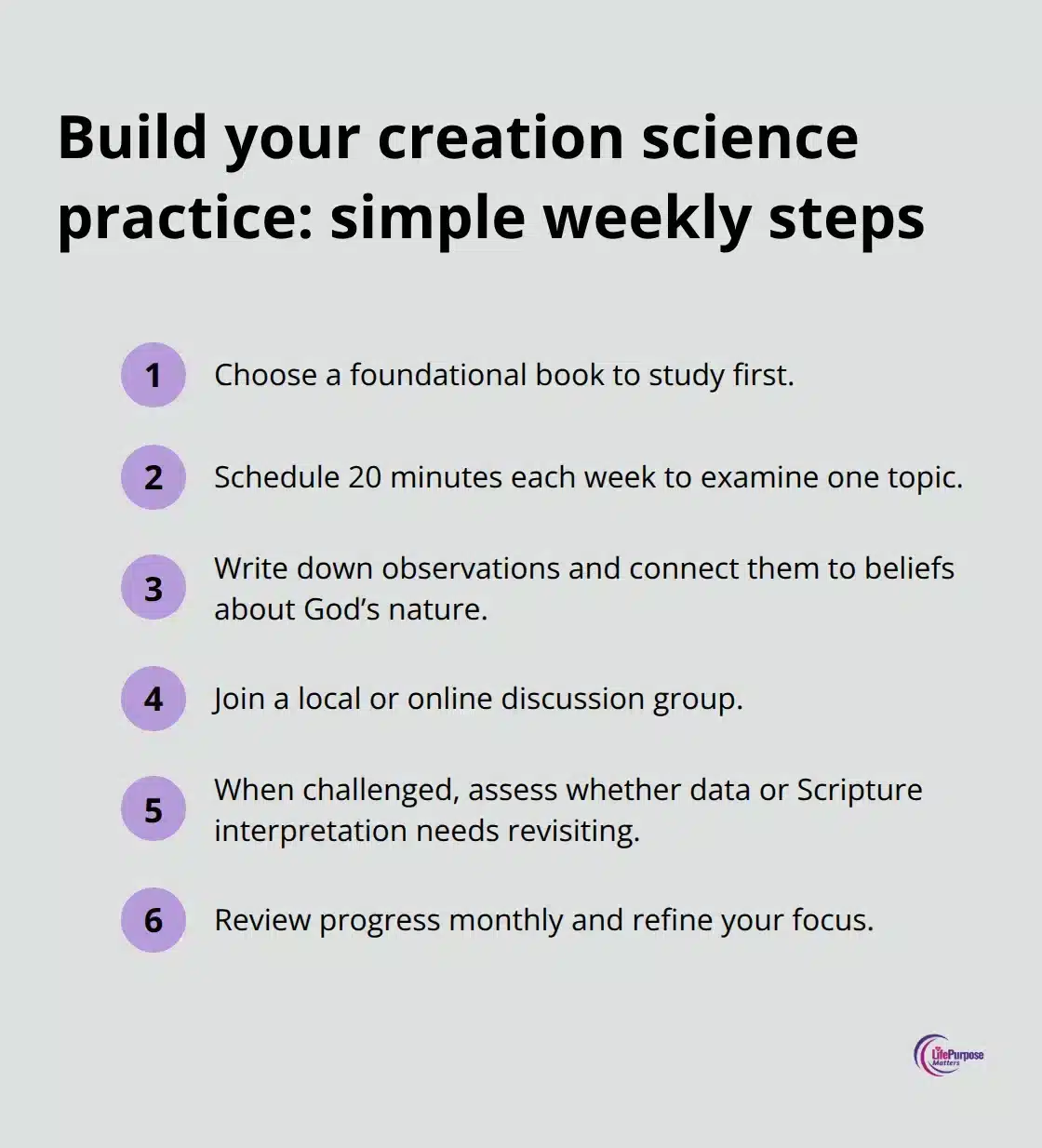
Spend 20 minutes weekly examining one specific area-whether that’s the mathematical improbability of protein formation by chance, the fine-tuning of electromagnetic forces, or the information encoded in DNA. Write down what you observe and how it connects to what you believe about God’s nature.
Join a local study group or online community focused on creation-science conversations; Pew Research Centre reports that 58% of Christians who discuss faith with peers report stronger conviction in their beliefs. When you encounter scientific claims that seem to contradict Scripture, resist the urge to dismiss either one. Instead, ask whether the interpretation of the data or the interpretation of Scripture might need reconsideration.
Transforming Doubt Into Spiritual Practice
A New England couple restored their shaken faith by reading Genesis-focused resources together, then deliberately visiting natural history museums and discussing what they observed through a creation-focused lens. They transformed a potential source of doubt into a monthly spiritual practice. The key is treating creation science not as a defensive weapon but as a lens that makes God’s intentionality visible in everyday observation.
As you build this practice, you’ll find that misconceptions about creation science-and how it relates to genuine scientific knowledge-begin to dissolve. The next section addresses these common misunderstandings head-on, showing you how creation science actually complements rather than contradicts what we know about the natural world.
Clearing Up the Myths About Creation Science
Creation Science Doesn’t Reject Scientific Knowledge
The biggest obstacle to understanding creation science isn’t the evidence itself-it’s the false choice people believe they must make. You’ve probably heard that accepting creation science means rejecting legitimate scientific knowledge, or that it’s incompatible with fields like medicine, geology, or genetics. That’s simply untrue. Creation scientists hold PhDs in biochemistry, astrophysics, and palaeontology. They publish in peer-reviewed journals and contribute meaningfully to their fields. A medical doctor in Arkansas didn’t abandon his clinical training when he shifted from theistic evolution to creation science; he sharpened his ability to evaluate evidence critically.
The confusion stems partly from how the debate gets framed in the media and education. When creation science gets lumped together with anti-science sentiment, people assume the two are inseparable. They aren’t. Creation science is a framework for interpreting data, not a rejection of data itself.
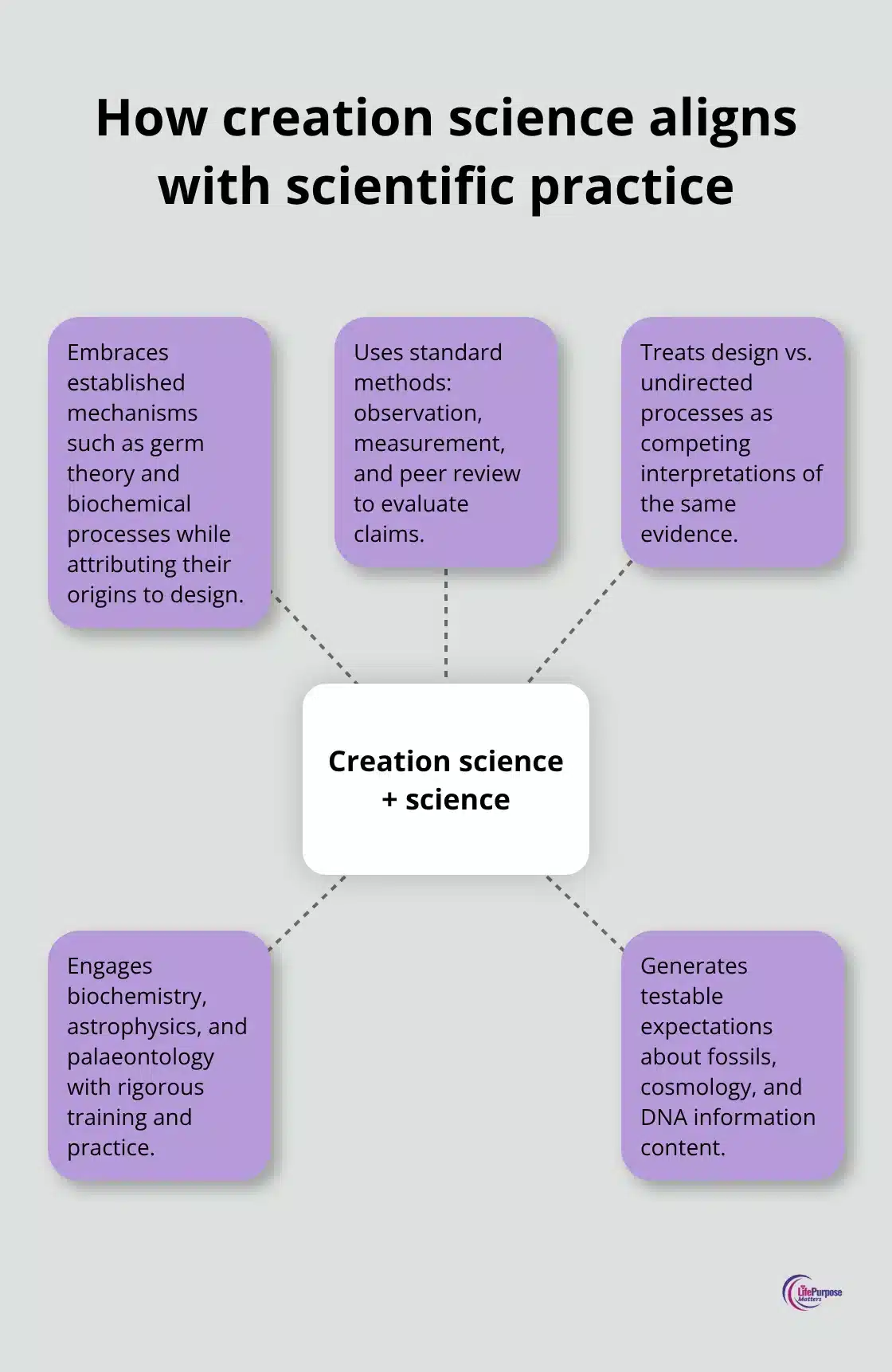
You can fully embrace the germ theory of disease, understand how antibiotics work at the molecular level, and accept that the universe operates according to consistent physical laws-all while maintaining that an intelligent Creator designed these systems.
The Real Disagreement Isn’t About Studying Nature
The actual disagreement between creation science and evolutionary frameworks concerns whether the universe’s staggering complexity and fine-tuning point toward design or emerge purely through undirected processes. Both approaches study nature carefully. Both examine fossils, DNA sequences, and physical constants. The difference lies in interpretation, not in scientific rigour or commitment to evidence.
Creation Science Makes Testable Predictions
Another widespread misconception holds that creation science can’t make testable predictions or contribute to genuine scientific progress. This objection misses how the creation model actually works. When you interpret the fossil record through the lens of a global flood event, you generate specific predictions about sedimentation patterns that palaeontologists can examine. When you apply design inference frameworks to biological systems, you make concrete claims about information complexity in DNA that researchers can measure and compare against random-sequence models.
Organisations like the Institute for Creation Research and Reasons to Believe produce research that engages with specific cosmological, geological, and biological questions using standard scientific methodology. You don’t have to agree with their conclusions to recognise that they conduct actual investigative work, not circular theology dressed up as science. The confusion often happens because critics conflate the label of science with particular conclusions. A framework can employ rigorous methodology and still reach different interpretations of evidence than mainstream academia accepts. That’s how scientific progress actually works through competing explanations evaluated against data.
Engage With Primary Sources, Not Caricatures
If you want to understand creation science properly, stop waiting for permission from institutions that assume evolutionary frameworks are beyond question. Read primary sources instead of secondhand critiques. The Creator and the Cosmos walk you through cosmological evidence with specific numbers about the universe’s expansion rates and cosmic background radiation. Who Was Adam? addresses human origins by examining genetic data, archaeological findings, and anthropological records directly. When you engage with actual creation science writing, you’ll discover it’s far more intellectually rigorous and evidence-engaged than popular caricatures suggest.
Final Thoughts
The journey from intellectual doubt to spiritual confidence requires you to examine evidence rather than abandon critical thinking. Creation science shows that rigorous investigation of the natural world actually strengthens faith rather than weakens it. When you understand how the fine-tuning of universal constants, the complexity of DNA, and the mathematical improbability of life by chance all point toward intentional design, your belief in God transforms from something you hope is true into something you recognise as reasonable.
Your next step is straightforward: pick one area of creation science that genuinely interests you, whether cosmology, biology, or anthropology, and spend the next month exploring it through primary sources like The Creator and the Cosmos or Who Was Adam?. Join a study group or find an online community where you can discuss what you’re learning with others. When you encounter claims that seem to contradict Scripture, resist the impulse to choose between them-instead, ask whether the interpretation of the data or the interpretation of Scripture needs reconsideration.
At Life Purpose Matters, we believe that grounding your faith in reality happens when you stop treating faith and science as opposing forces. Creation science offers that integration by transforming your relationship with God from something you maintain through willpower into something you recognise through observation.