

I once sat in a church car park for twenty minutes, completely paralysed by a simple decision. Should I take the job offer or stay put? I prayed, I waited, I felt nothing but confusion. That’s when I realised I’d never actually learned how to listen for the Spirit’s guidance, I just hoped it would show up. At Life Purpose Matters, we’ve found that most Christians desire spirit-led living, but don’t know where to start. The good news? Tuning into spiritual guidance isn’t mystical or complicated. It’s a learnable skill that gets stronger with practice.
What Spirit-Led Living Actually Looks Like
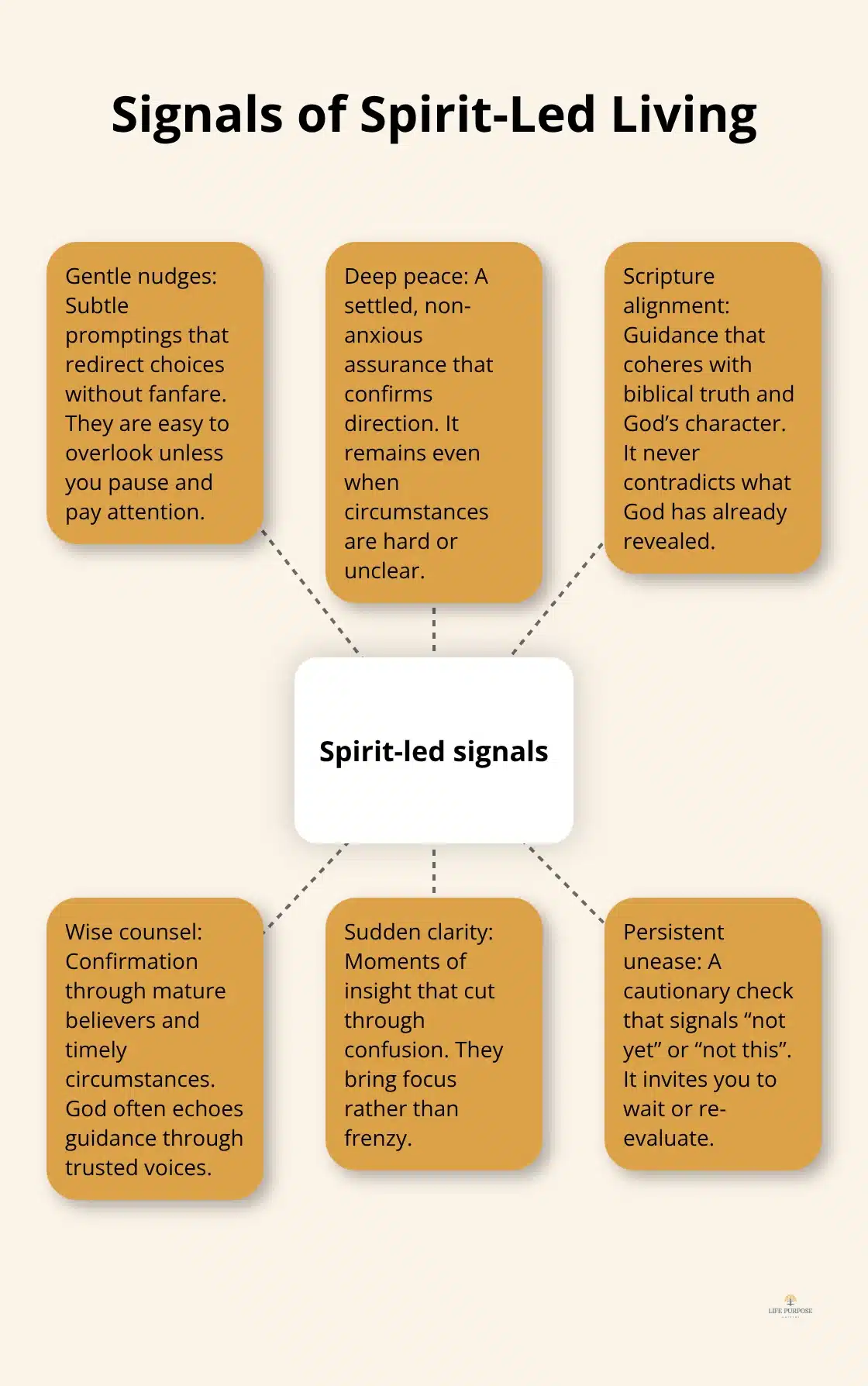
Spirit-led living means you make decisions aligned with God’s will rather than your own preferences or circumstances. In practical terms, this happens when you pause before responding to a situation, check your internal state for peace or unease, and ask yourself whether your next move honours God. Galatians 5:25 tells us to keep in step with the Spirit, and that’s exactly what this looks like in real life: you’re not waiting for dramatic signs or hearing audible voices. Instead, you develop sensitivity to gentle nudges, sudden clarity, or a persistent sense that something is off.
The Self-Directed Versus Spirit-Directed Choice
When you choose a job because it pays more but feel constant anxiety, that’s self-directed living. When you turn down money because something inside you signals that the role conflicts with your values, that’s the Spirit at work. The distinction matters because self-directed choices often feel urgent and logical in the moment, while Spirit-directed choices frequently contradict what seems reasonable. You might pass up a lucrative opportunity because you sense God calling you elsewhere, or stay in a difficult situation because you sense growth is still happening.
Self-directed choices typically produce anxiety, defensiveness, or the need to convince others you’re right. Spirit-directed choices create an underlying peace, even when the path is hard or unclear. That peace serves as your confirmation signal. Additionally, self-directed living keeps you focused on immediate outcomes and personal comfort, while Spirit-led living orients you toward growth, obedience, and alignment with God’s character.
Why Recognition Proves So Difficult
Most Christians struggle to recognise the Spirit’s signals because nobody taught them what His voice actually sounds like. The New Testament mentions the Holy Spirit many times, yet many believers treat His guidance like a mystery rather than a relationship. They expect dramatic interventions instead of learning that the Spirit typically speaks through Scripture, through circumstances, through wise counsel, and through that quiet inner knowing that feels different from ordinary thoughts.
The real problem is that we’ve confused spiritual guidance with emotional certainty. You don’t need to feel confident about a decision for it to be Spirit-led. In fact, some of God’s most important directions feel counterintuitive or even terrifying initially. What matters is that persistent sense of alignment-the kind of peace that remains even when circumstances are difficult.
The Validation Trap
Many Christians also struggle because they listen for validation rather than truth. They pray about a decision they’ve already made and hope the Spirit rubber-stamps it. True Spirit-led living requires genuine openness to changing your mind, which is uncomfortable and costly. John 16:13 promises that the Spirit will guide you into all truth, but truth-seeking requires vulnerability. It means you ask hard questions about your motives and remain willing to hear answers you don’t want.
The Church’s Teaching Gap
Most churches emphasise knowing God’s Word but spend little time teaching how to hear God’s voice in the present moment. You learn theology but not discernment. You understand Scripture but not how to apply it to Tuesday morning when you’re frustrated with your spouse or tempted to compromise at work. The gap between knowledge and practice is where most Christians get stuck-and it’s exactly why practical techniques matter so much. The next section shows you how to close that gap.
Practical Techniques to Tune Into Spiritual Guidance
The gap between wanting Spirit-led guidance and actually receiving it closes through deliberate practice. Most Christians pray vaguely and hope clarity arrives, but the Spirit responds to intentional effort. You need specific techniques that train your spiritual sensitivity the way athletes train their bodies.
Create Space for Prayer and Contemplation
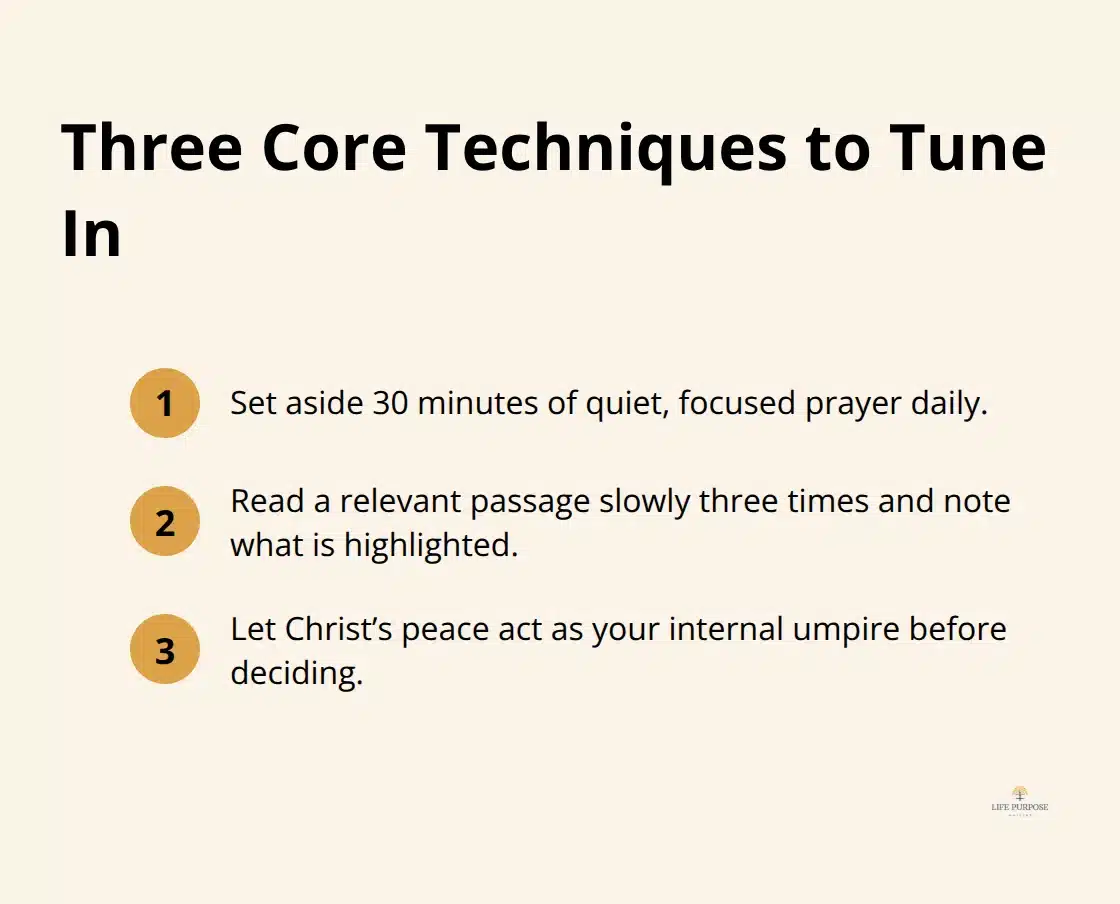
Protected time for prayer and contemplation matters more than you might think. Not casual prayer while driving or distracted thoughts between tasks, but thirty minutes minimum where you sit quietly and invite the Spirit to speak. Research on contemplative prayer found that prayer activates the front part of the brain, which helps you focus and make better decisions and lowers stress.
Start with a specific question or situation you need guidance on. State it clearly, then sit in silence for at least fifteen minutes. Write down whatever comes to mind without filtering or judging it. Many Christians skip this step because it feels unproductive, but the Spirit often speaks in the silence, not in the noise of your busy thinking. If you struggle with silence, use Scripture as your anchor.
Practice Active Listening Through Scripture Study
Active listening through Scripture study means you stop reading the Bible to gather information and start reading it to hear God’s current direction. Choose a passage relevant to your situation, read it slowly three times, and ask yourself what God is highlighting for your specific circumstances. Luke 12:12 promises that the Holy Spirit will teach you in the moment what you should say, and that principle extends to what you should do.
Many believers miss this because they read Scripture academically, extracting principles rather than listening for present direction. When you read about Peter’s boldness or Paul’s perseverance, ask yourself how the Spirit wants to develop that quality in you right now. Write down the connections. This transforms Scripture from ancient wisdom into a living conversation with God.
Pay Attention to Peace as a Confirmation Signal
Peace serves as your internal compass. Colossians 3:15 says let the peace of Christ rule in your hearts, and that peace confirms the Spirit’s direction. When you sense genuine peace about a decision, not excitement or relief, but a deep alignment, that’s the Spirit confirming the direction. When you feel persistent unease, anxiety, or the need to convince yourself a choice is right, that’s the Spirit signalling caution.
Most Christians ignore this signal because they want logical proof or external validation. The Spirit rarely provides either. Instead, develop the habit of pausing before major decisions and noticing your internal state. If peace is absent, wait. If peace is present, move forward even if circumstances look uncertain. This simple practice eliminates months of second-guessing and keeps you aligned with God’s actual direction rather than your preferences.
These three techniques work together to sharpen your discernment. But knowing what to do and actually doing it are two different things, especially when doubt and fear show up to complicate your decisions.
Overcoming Obstacles to Spiritual Discernment
Doubt and fear aren’t signs you’re doing something wrong-they’re normal obstacles that every Christian faces when trying to hear God’s direction. The problem isn’t that doubt shows up; it’s that most people treat doubt as a reason to stop listening instead of a signal to listen harder. When you face a major decision, fear whispers that you might make the wrong choice, lose money, disappoint people, or miss God’s will entirely. That fear feels real and urgent, which makes it easy to mistake for the Spirit’s caution.
Distinguishing Between Caution and Anxiety
The difference between the Spirit’s caution and fear matters enormously: the Spirit’s caution produces peace underneath the concern, while fear produces anxiety and urgency. Start noticing this distinction in small decisions first. When you consider whether to speak up in a meeting or reach out to someone, pause and check your internal state. Does the hesitation feel like protective wisdom or like anxiety trying to keep you small? One creates clarity; the other creates paralysis.
Most Christians never develop this sensitivity because they rush through decisions without checking their internal signals. You need to slow down intentionally, sit with the discomfort for a few minutes, and let the distinction become obvious. Galatians 5:22 lists peace as one of the Spirit’s fruits, so the absence of peace is genuinely significant information about whether a direction aligns with God’s will.
Separating Your Wants From God’s Direction
Your personal desires are powerful and persistent-they feel like truth because they live inside your own mind. You want financial security, so a high-paying job feels like God’s direction. You want to avoid conflict, so staying silent feels like wisdom. You want to be liked, so agreeing with others feels like kindness. The Spirit’s direction frequently contradicts what you want, which is exactly why distinguishing between them matters so much.
One practical test: ask yourself whether you’d make this choice if nobody would ever know about it. If you’re considering a career move partly because it impresses people, that’s personal desire mixed in. If you’re staying in a difficult relationship partly because you fear judgment, that’s fear disguised as obedience. The Spirit’s direction holds up under scrutiny because it aligns with God’s character and values, not just your comfort.
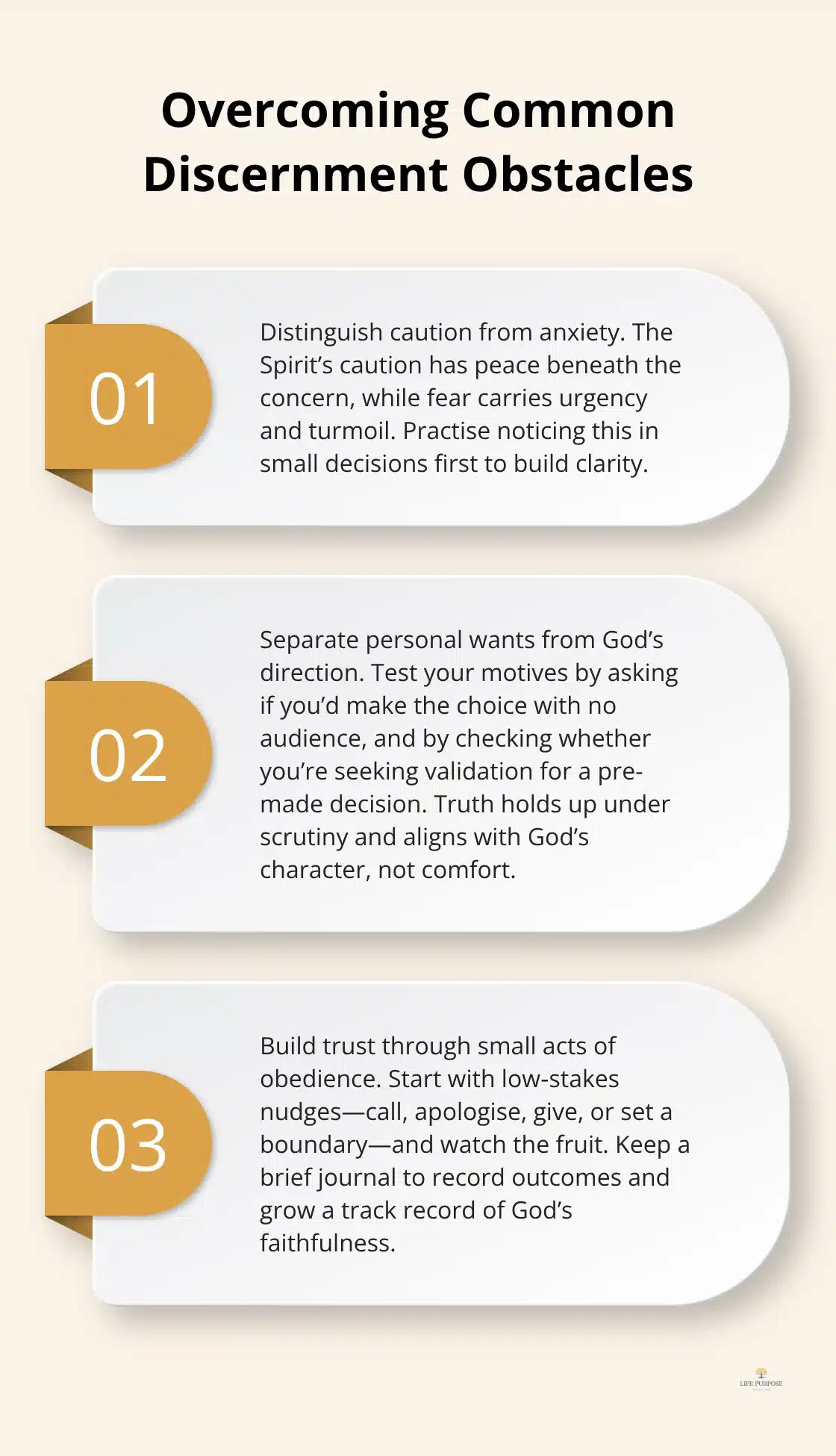
Another test involves checking whether you seek validation for a decision you’ve already made or genuinely ask what God wants. When you pray about something, are you hoping God agrees with you, or are you actually willing to change course? Most people discover they’re in the validation camp, which blocks real discernment. Start noticing when you feel defensive about a decision-that defensiveness usually indicates personal desire rather than Spirit-led direction. The Spirit’s guidance doesn’t require you to convince anyone, including yourself.
Building Trust Through Small Acts of Obedience
Trust in God’s guidance doesn’t come from understanding His complete plan or having emotional certainty about major decisions. It comes from repeatedly obeying small nudges and watching God follow through. When the Spirit prompts you to call someone, make that call. When you sense you should apologise or speak up or set a boundary, do it and notice what happens. These small acts of obedience build evidence that the Spirit actually knows what He’s doing.
Start with decisions that feel low-stakes: reaching out to an old friend, having a conversation you’ve been avoiding, giving to someone in need. When you act on these small promptings and see good results, you develop actual confidence in the Spirit’s guidance rather than theoretical confidence. This is why many Christians struggle with major decisions: they’ve never practised obedience in small ones, so they have no track record of God’s faithfulness to draw from.
Build that track record intentionally. Keep a simple journal where you note when you sense the Spirit’s nudge and what happens when you obey or ignore it. After a few months, you’ll have concrete evidence that obeying the Spirit produces better outcomes than following your own logic. That evidence transforms doubt from a barrier into a question you can actually investigate rather than a reason to give up.
Final Thoughts
Spirit-led living tips work only when you actually practise them. You now understand what Spirit-led living means, you have three concrete techniques to sharpen your discernment, and you know how to navigate the obstacles that trip up most Christians. The real work starts tomorrow when you face an actual decision and must choose between your preference and what the Spirit signals.
Start small and don’t wait for a major life decision to practise these techniques. Use them on Tuesday when you’re deciding whether to have a difficult conversation or on Friday when you’re choosing how to spend your evening. Small acts of obedience build your confidence and develop genuine trust in God’s guidance rather than hoping it works out.
The peace you’re looking for isn’t something you manufacture, or earn-it’s available right now through the Holy Spirit who already dwells in you. Visit Life Purpose Matters to explore resources and faith-based encouragement designed to support your spiritual journey and help you live out your God-given purpose within a Christian framework. The Spirit is patient and ready to guide you into all truth.