
Stress and anxiety affect millions of people every single day. Peace through prayer isn’t about having every answer lined up like ducks in a row to war against stress or anxiety. It’s about carving out tiny pockets of stillness — deliberate and repeatable. This can help to remap how you react when life turns up the heat. Yes, that simple; it’s practical and very transformative
At Life Purpose Matters, we’ve watched prayer do something quietly subversive: it calms the cluttered mind and steadies the heart; all that’s required is practice.
What Happens to Your Body When You Pray
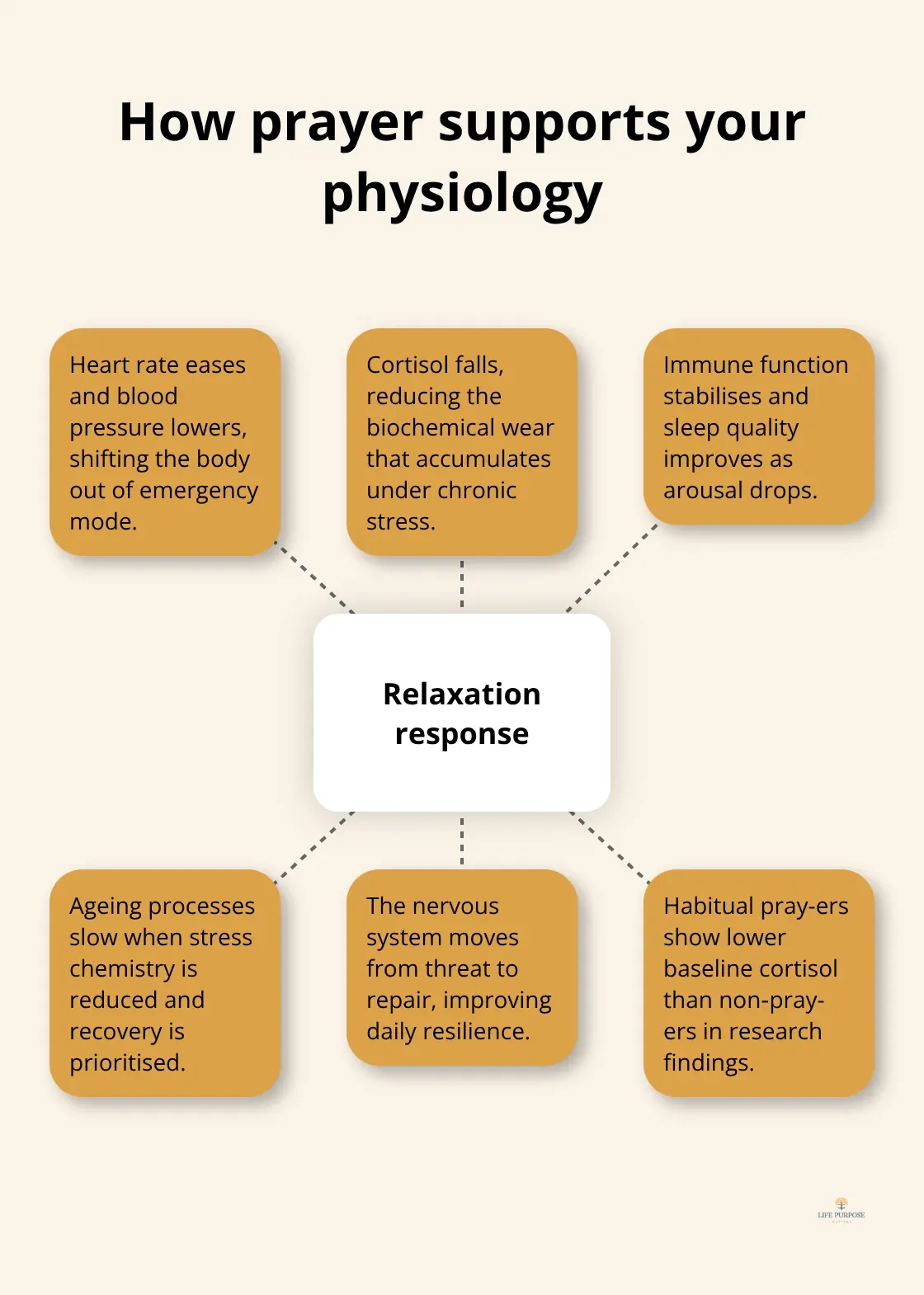
Prayer isn’t wishful thinking dressed up in incense and soft light. When you pray, your body moves off the emergency runway and into what scientists call the relaxation response. Coined by a Harvard cardiologist in the 1970s, the term is gloriously literal – your heart rate eases, blood pressure slides down, and cortisol levels fall. Cortisol is the body’s stress currency – when it’s high, your immune system takes hits, sleep frays, and ageing accelerates. A study in Psychology of Religion and Spirituality found that habitual prayerful individuals have lower baseline cortisol than those who do not pray. Not a marginal footnote – a meaningful difference. Prayer, in short, creates the physiological conditions for repair instead of relentless wear.
The Science Behind Calm
Duke tracked prayer and anxiety – and the results are blunt: structured prayer produced improvements comparable to some meds, minus the pharmacy aisle of side effects. The American Journal of Health Promotion saw the same pattern in patients with anxiety and depression – add prayer to the routine, and symptoms drop measurably. Mechanism? You’ll like this – when attention anchors in prayer, the brain’s threat-detection dial turns down. The amygdala – the brain’s alarm bell – quiets. You’re not pretending problems don’t exist. You’re training the nervous system to treat them differently. That’s why prayer beats distraction: distraction buries the problem temporarily. Prayer rewires how a threat is perceived.
Building Emotional Resilience Through Faith
Faith doesn’t make life easier – it changes the distribution of how difficulty lands. People who pray daily don’t live in a stress-free utopia. They handle blows differently. Pew’s longitudinal work shows daily pray-ers report higher life satisfaction and lower depression rates than non-pray-ers. This is more than mood tinkering. Faith cultivates what psychologists call psychological hardiness – mental reserves that let setbacks be setbacks, not existential collapses. When prayer connects you to something bigger than the current mess, perspective shifts. Problems stop being eternal verdicts and become temporary chapters. Big difference – feeling crushed versus feeling stressed but anchored.
Moving From Understanding to Action
The science is clear – knowledge doesn’t flip the switch. You have to pray. The physiological benefits show up when practice replaces reading about practice. Belief is optional; behaviour is not. The body responds to the act, not the argument. So learn the techniques, do the repetition, make it a habit. Understanding sets the stage. While doing changes to the daily show.
How to Pray When You Have Five Minutes or Less
Prayer doesn’t require an hour of silence or a monastery retreat – and the science backs this up. Even brief, focused prayer sessions activate the relaxation response and lower cortisol. The trick is not how long you sit; it’s how often and how intentionally you show up. Five focused minutes a day beats a scattered thirty every so often. Your nervous system responds to frequency – not marathon sessions.
Start With What Fits Your Life
Start with what fits your actual life, not some Instagram-spiritual ideal. Morning prayer? Ninety seconds. Sit upright. Breathe slowly – four counts in, six counts out. Then speak three specific things you hand to God that day. Name them. Don’t generalise. Say them out loud. Your brain registers spoken words differently than private thoughts – they land.
Reset When Stress Spikes
Afternoon prayer is a desk-or-car reset – two minutes when stress spikes. Close your eyes, name one thing that frustrated you, ask for a shift in perspective, breathe deeply three times, and move on.
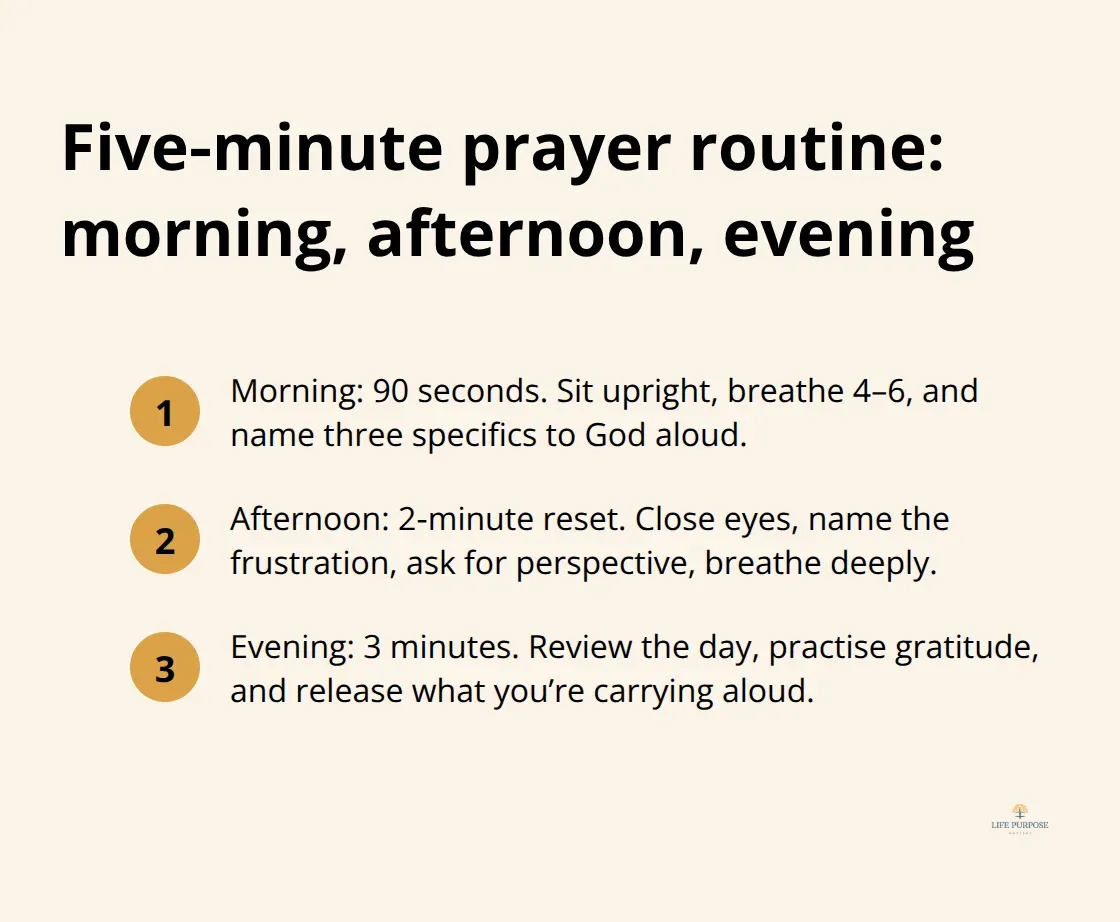
Evening prayer? Three minutes: review what went well, what didn’t, what you’re grateful for, and what you release. Say it – don’t write it. Just speak it into the quiet.
There’s data here: naming emotions during prayer reduces their grip compared to silent rumination. It’s a short circuit for the nervous system.
The Mistake That Stops You
The mistake most people make is waiting for the perfect moment or the perfect words. Spoiler: neither shows up. Start tonight with a sixty-second prayer – sit, breathe slowly, say one sentence about what weighs on you, then one sentence about what you trust God with. That’s it. Do it tomorrow morning before coffee. Do it again at lunch.
The repetition rewires your stress response – not eloquence, not length, not perfect theology. Your body learns by practice that you have a mechanism to shift from threat mode to calm mode. That mechanism is prayer. Build it now while life is manageable so it’s standing when life is not.
Making Prayer Stick When Life Gets Messy
Build the Right Structure First
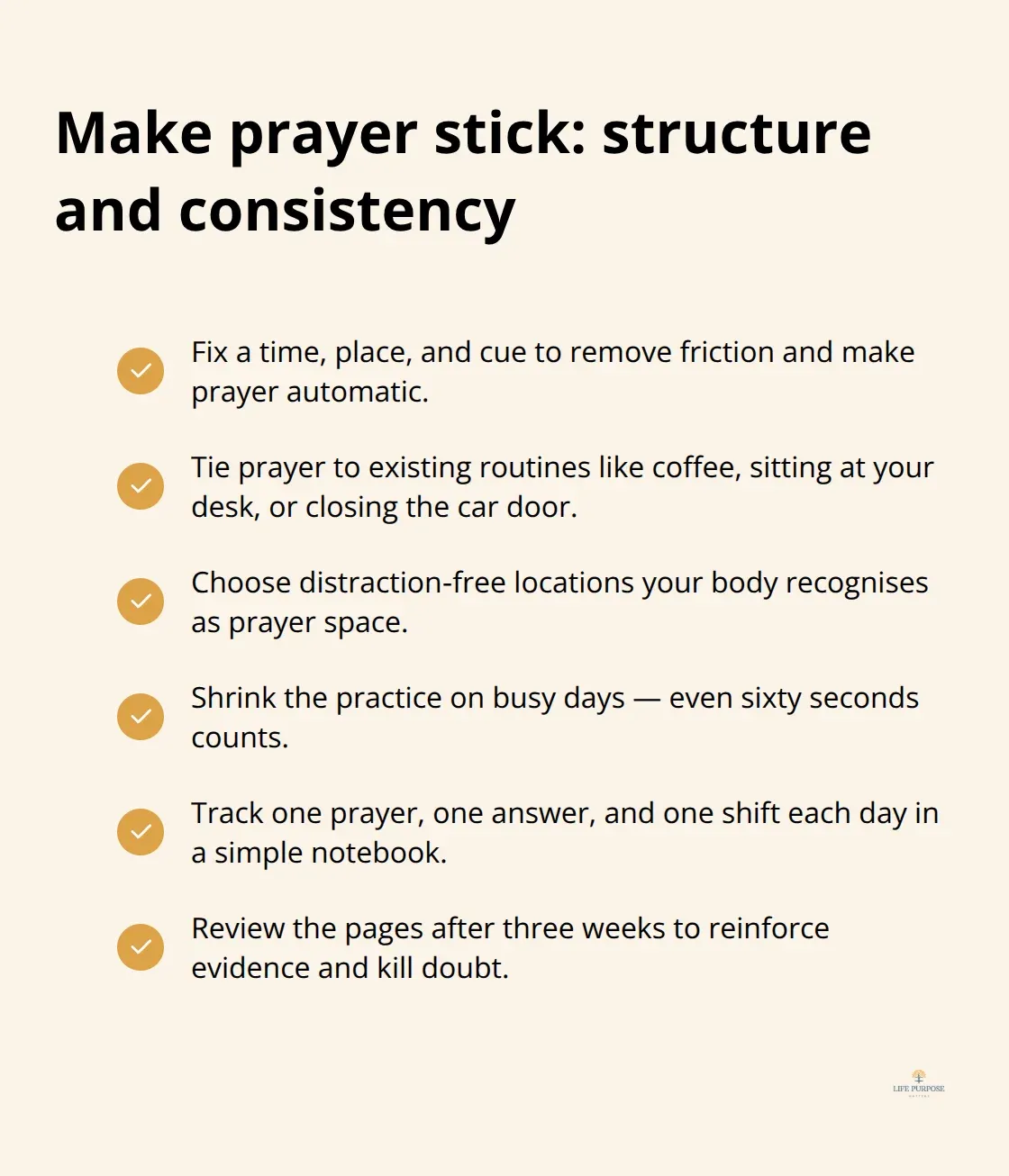
People skip prayer not because faith is thin but because they treat it like a membership card-good intentions, zero follow-through. Motivation is a sugar high; structure is the house. You want reliability? Build architecture: a time, a place, a trigger that removes the argument with your own brain. The brain loves habit loops-cue, routine, reward… prayer should live in that framework.
Pick a location that’s non-negotiable: the kitchen table before the house wakes up, your car before you walk into the office, your bed before sleep-something that signals to your nervous system: this is prayer space, not distraction space. Not the couch where Netflix lives. Not your phone where notifications scream. Make the place so obvious the body shows up even when the mind is tired.
Anchor prayer to existing routines
Timing matters – big time. Studies show people who latch new habits onto existing routines win far more often than those who try to brute-force willpower. So piggyback prayer onto something you already do without thinking. After you pour the first coffee. Right after you sit at your desk. The moment you close the car door. That single move removes the friction that murders consistency.
Shrink Your Practice When Life Interrupts
Life interrupts – it’s not a bug, it’s the operating system. Work crises, sick kids, travel – none of it pauses for holy intentions. So be surgical: shrink the practice instead of abandoning it. Sixty seconds on chaotic mornings. A quiet corner in a hotel lobby. An airport bathroom stall (yes). The point isn’t length – it’s presence. Presence beats performance every time.
Track What Happens, Not Just What You Do
Tracking what happens through writing amplifies consistency more than almost anything else. You don’t need a slick app (though Pray.com or YouVersion can help); a cheap notebook is usually superior. Each day, write three things: one thing you prayed about, one answer you noticed, one shift in how you felt. Simple. Brutal. Honest.
That notebook becomes evidence – proof that prayer moves things. Three weeks in, doubt will whisper; you flip the pages and the whisper dies.
Final Thoughts
Peace through prayer doesn’t arrive like a lightning bolt – it accrues. Small acts of showing up, over and over… that’s the slow compounding that steadies a life. You’ve seen the science-cortisol dips, the amygdala quiets, resilience tightens. Useful to know. Useful to remember. But data is the map; you still have to walk the terrain.
The turning point isn’t mystical. It’s mundane. Prayer stops being another checkbox and becomes the handrail you grab when everything else tilts. That change is earned by repetition, not revelation. Sixty-second resets at your desk (yes, sixty seconds) rewire your system far more reliably than perfect theology ever will.
Say the thing out loud. Name the weight instead of brooding beneath it. Watch what your body does when you stop carrying the secret – breathing slows, shoulders drop, decisions sharpen. Track the differences. Evidence matters. If prayer moves things, you’ll see it in the small, boring metrics of daily life.
Start tonight-one time, one place, one sentence to God. Repeat tomorrow. Repeat the day after. Train your nervous system to expect a switch from panic to presence. Over time, the mechanism becomes habit; the habit becomes refuge.
Visit Life Purpose Matters for resources and community support as you align your prayer practice with your larger calling (no sermon required-just steady work).