

Two people can read the exact same verse and walk away with two completely different conclusions. It happens in Bible studies every week, and it’s rarely because someone is careless — it’s because reading Scripture well is a skill, not something we’re born already knowing.
That’s when I realised most of us read Scripture the same way we scroll through our phones-surface level, quick, and without much thought. At Life Purpose Matters, we believe your biblical interpretation can go much deeper. This guide walks you through practical methods to move from plain reading to genuine insight.
Plain Reading: Starting with the Text as Written
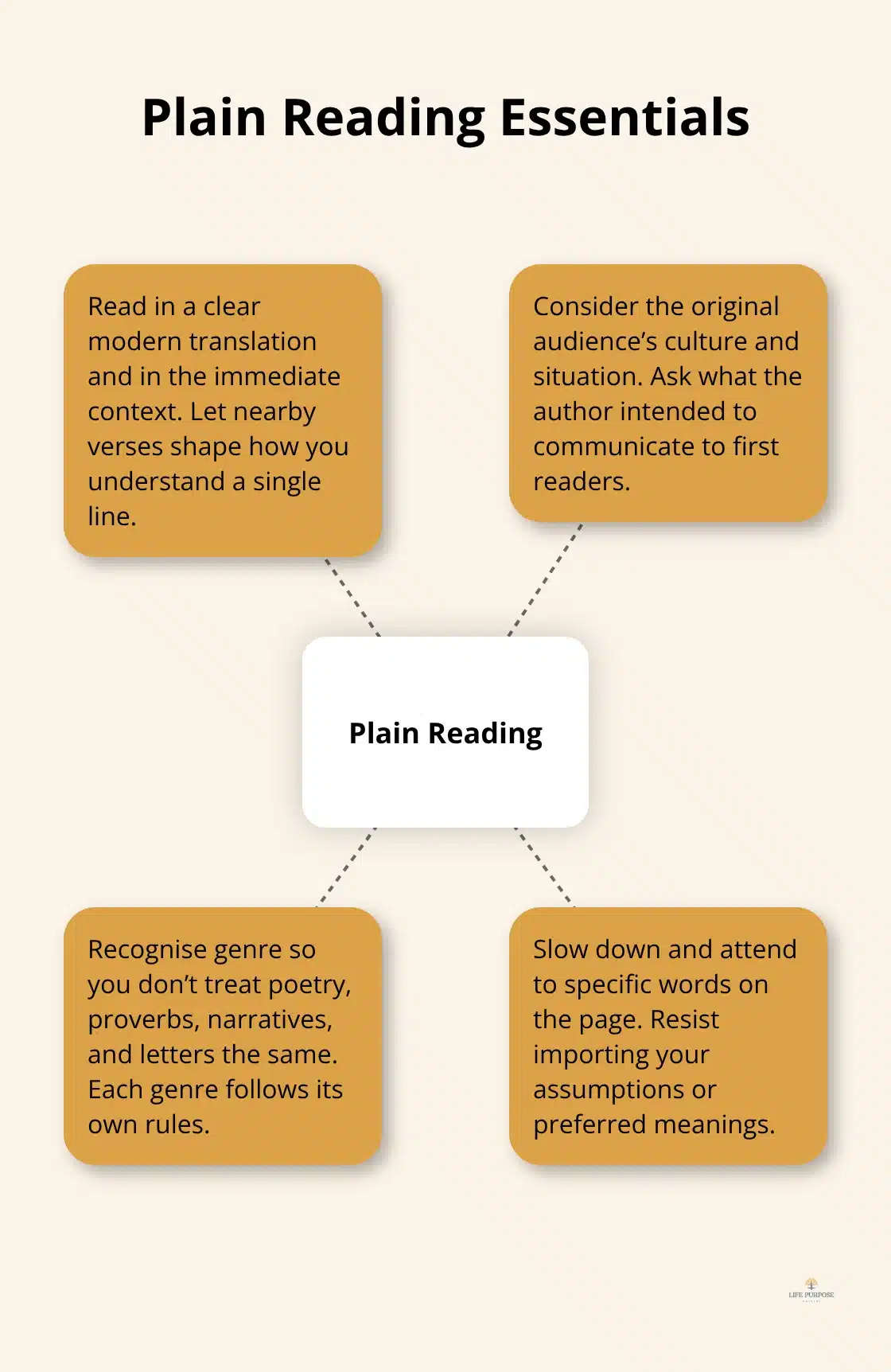
The first step toward genuine biblical insight sounds obvious but most people skip it entirely: read what the text actually says, not what you think it should say. This means treating Scripture like written communication from real authors to real audiences, not like a fortune cookie where you extract whatever meaning feels right in the moment. When you open your Bible, your job is to understand what the original writer intended to communicate to their first readers, which requires you to slow down and pay attention to the specific words on the page.
Read the Text in a Translation You Understand
Start with a passage multiple times in a translation you can actually understand. The New King James Version might sound poetic, but if you constantly pause to decipher 16th-century English, you work too hard. Try a modern translation like the ESV, NIV, or NASB that balances word-for-word accuracy with readability. Then read the passage in its immediate context, not isolated. Matthew 18:20 says wherever two or three gather in Jesus’s name, he is there with them. Most people treat this as a blanket promise for any gathering, but read the surrounding verses and you’ll see Jesus specifically talks about church discipline and conflict resolution. The verse means something entirely different when you know what prompted it. This is not theoretical-context changes everything about what a passage actually teaches.
Understand What the Original Audience Knew
The Bible was written to ancient people living in completely different circumstances than you do. A first-century reader would have understood cultural references, social customs, and unspoken assumptions that we miss entirely. When Paul tells believers to greet one another with a holy kiss, modern Western readers either cringe or ignore it. But in the first-century Mediterranean world, kissing on the cheek was a standard greeting among close friends and family. Understanding that historical and cultural reality helps you see Paul isn’t commanding something weird-he calls for genuine warmth and affection in the church community. When you encounter something confusing or culturally distant, ask yourself what this would have meant to someone living in 30 AD or 60 AD, not what it means to you in 2026.
Recognise How Genre Shapes Meaning
The Bible contains multiple literary genres, and treating a proverb like a promise or a parable like a historical narrative will wreck your interpretation. Proverbs are observations about how life generally works, not ironclad guarantees. When Proverbs 22:6 says train up a child in the way they should go and they will not depart from it, this is wisdom literature offering general guidance, not a promise that perfect parenting prevents rebellion. Poetry operates differently too-Psalm 91:4 talks about God covering you with his feathers and his wings sheltering you. This is beautiful metaphorical language expressing God’s protection, not a literal description of God’s anatomy. You read Exodus as narrative history, the Psalms as poetry and prayer, the Gospels as biographical narrative focused on theological meaning, and Paul’s letters as occasional correspondence addressing specific church problems. Each genre has its own rules, and ignoring those rules turns Scripture into whatever you want it to mean.
Now that you understand how to read the text as it was written, you’re ready to move beyond surface-level interpretation. The next step involves methods that uncover layers of meaning beneath the plain reading-techniques that scholars and serious students have used for centuries to extract richer theological insight from Scripture.
Deeper Methods: Moving Beyond Surface Level
Once you’ve mastered plain reading, you’re ready to see what lies beneath the surface. Scholars at academic institutions have spent decades developing practical techniques that reveal layers of meaning most casual readers miss entirely. These methods aren’t mystical or overly complicated-they’re systematic approaches that anyone willing to invest time can learn and apply.
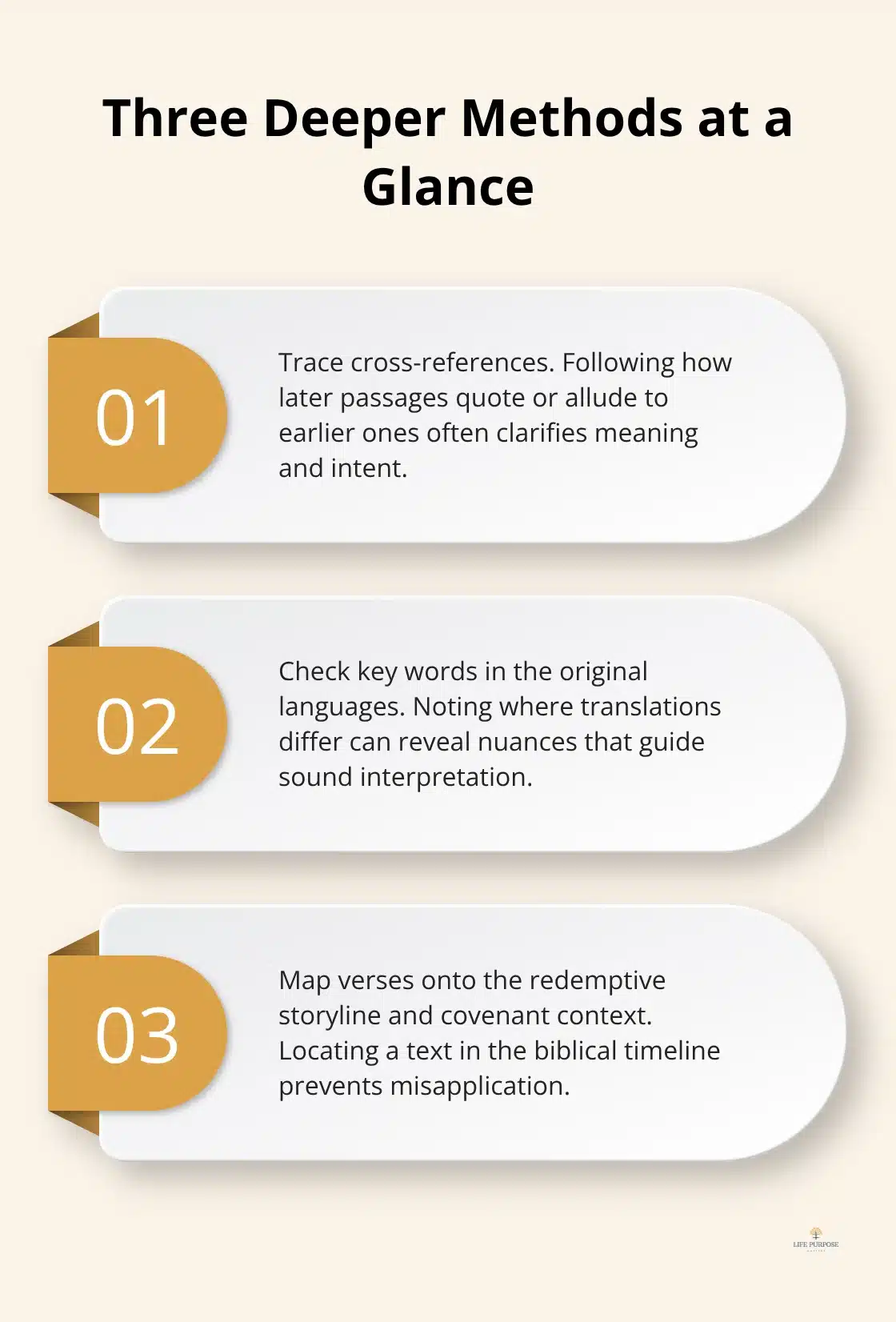
The difference between someone who reads the Bible once and someone who reads it deeply isn’t intelligence or spiritual gift; it’s simply knowing which interpretive tools to use and when to use them.
How Scripture Points to Itself
The Bible constantly references itself. When you notice these connections, entire passages suddenly make sense in ways plain reading alone never reveals. Matthew 1:23 quotes Isaiah 7:14 about a virgin bearing a son, and understanding that Old Testament context transforms how you read the Christmas narrative. The Gospel writers deliberately wove Old Testament passages into their accounts because they wanted readers to see Jesus as the fulfilment of Israel’s story. This isn’t mystical typology-it’s the authors being explicit about their interpretive choices.
When you encounter a passage that seems to reference something else, stop and investigate. Paul’s discussion of the law in Romans 7 becomes infinitely clearer when you trace it back to the Ten Commandments and the covenant at Sinai. Most Bible software lets you click on a verse and instantly see cross-references. Use these tools relentlessly. A single afternoon spent following cross-references through Romans, 1 Corinthians, and Galatians teaches you more about Paul’s theology of grace than months of casual reading. The discipline here is simple: when a passage confuses you or seems incomplete, ask what other parts of Scripture address the same topic.
Why Original Words Matter More Than Translation
Every translation involves choices, and those choices shape how you understand the text. The Greek word metanoia gets translated as repentance in some versions and turning around in others-two translations that point toward different spiritual realities. Repentance can sound like guilt and shame, while turning around emphasises a new direction. The original Greek word contains both ideas simultaneously, but English forces you to choose. This matters because it determines whether you feel condemned or hopeful when you encounter the concept.
You don’t need to become fluent in Greek or Hebrew to benefit from this work. Free resources let you click any word and see the original language alongside multiple translation options and word definitions. When studying Matthew 6:11, the phrase translated as daily bread actually comes from a Greek word that appears nowhere else in ancient literature-scholars genuinely debate whether it means bread for the coming day, essential bread, or bread beyond necessity. Understanding that uncertainty prevents you from building theology on a word choice nobody can definitively explain.
The practical tip: when a passage seems to teach something important, verify how different translations handle key words. If translations differ significantly, you’ve found a spot where knowing the original language actually matters. Spend thirty minutes investigating those words rather than assuming your translation settled the question. This attention to linguistic detail (the precise meaning of individual terms) opens doors that surface-level reading keeps firmly shut.
Connecting Passages Across the Biblical Story
Scripture unfolds a redemptive narrative-Creation, Fall, Redemption, and Consummation-and covenants mark major changes in God’s people. When you map passages onto this overarching story, individual verses suddenly fit into a coherent whole. Jeremiah 29:7 tells exiles to seek the welfare of the city where they live. Most readers treat this as a universal instruction for all times, but the passage makes far more sense within exile and covenant context. The prophet wasn’t offering timeless civic advice; he was telling displaced people how to live faithfully in a foreign land. Understanding that historical situation transforms the verse from generic wisdom into specific pastoral guidance for a particular crisis.
You can apply this same approach to any confusing passage. Ask yourself where it sits in the biblical timeline and what covenant framework applies. Does this passage come before or after the cross? Does it address Israel under the old covenant or the church under the new covenant? These questions aren’t academic exercises-they determine what a passage actually teaches and how it applies to your life today. The Bible is not a random collection of sayings; it’s a unified story with a clear direction, and recognising where each passage fits within that story prevents misinterpretation.
Now that you understand how Scripture references itself, how original languages shape meaning, and how the overarching biblical narrative provides context, you’re equipped to apply these insights to your own spiritual life. The next chapter shows you exactly how to take these deeper methods and transform them into practical wisdom that shapes how you live.
Practical Application: Bringing Interpretation into Your Life
Understanding Scripture deeply means nothing if it stays locked in your head during Sunday service. The real test of biblical interpretation arrives Monday morning when you face actual decisions, relationships, and circumstances that demand wisdom. This is where most people stumble. They can discuss typology and original languages brilliantly, then live exactly like everyone else. The entire point of studying Scripture is transformation, not intellectual achievement. You need a concrete system for taking what you discover in deeper interpretation and actually applying it to how you think, decide, and act. The gap between knowledge and practice is where most spiritual growth dies, and closing that gap requires deliberate structure.
Transform Abstract Theology into Concrete Action
Start with one passage you’ve already studied deeply using the methods from earlier chapters. Let’s say you’ve worked through Romans 12:2 about renewed thinking, traced its connection to Ephesians 4:23, checked how Paul uses the Greek word nous elsewhere, and mapped it onto the larger redemptive narrative about transformation. Now comes the hard part: what does this actually mean for your specific life right now? Write down three concrete situations where your current thinking patterns create problems. Maybe you catastrophise about finances, judge people harshly, or assume the worst about others’ intentions. Pick one and ask yourself how your thinking would change your response. If you genuinely believed God works all things together for good (Romans 8:28) in your financial anxiety, what would you do differently this week? Would you stop checking your account obsessively? Would you have one honest conversation about money with your spouse? Would you research one financial planning resource instead of scrolling news about economic collapse? The passage moves from abstract theology to concrete Tuesday afternoon action. This specificity matters enormously. Your biblical interpretation needs the same specificity.
Select Resources That Deliver Real Value
Most Christians own multiple commentaries and theological books they’ve never opened. You don’t need a massive library; you need three to four genuinely excellent resources you’ll actually use repeatedly. Start with one solid study Bible. The ESV Study Bible contains over 20,000 notes written by evangelical scholars and costs around thirty dollars. The NIV Cultural Backgrounds Study Bible specifically addresses the historical and cultural context we discussed earlier, making it invaluable when you encounter something culturally distant.
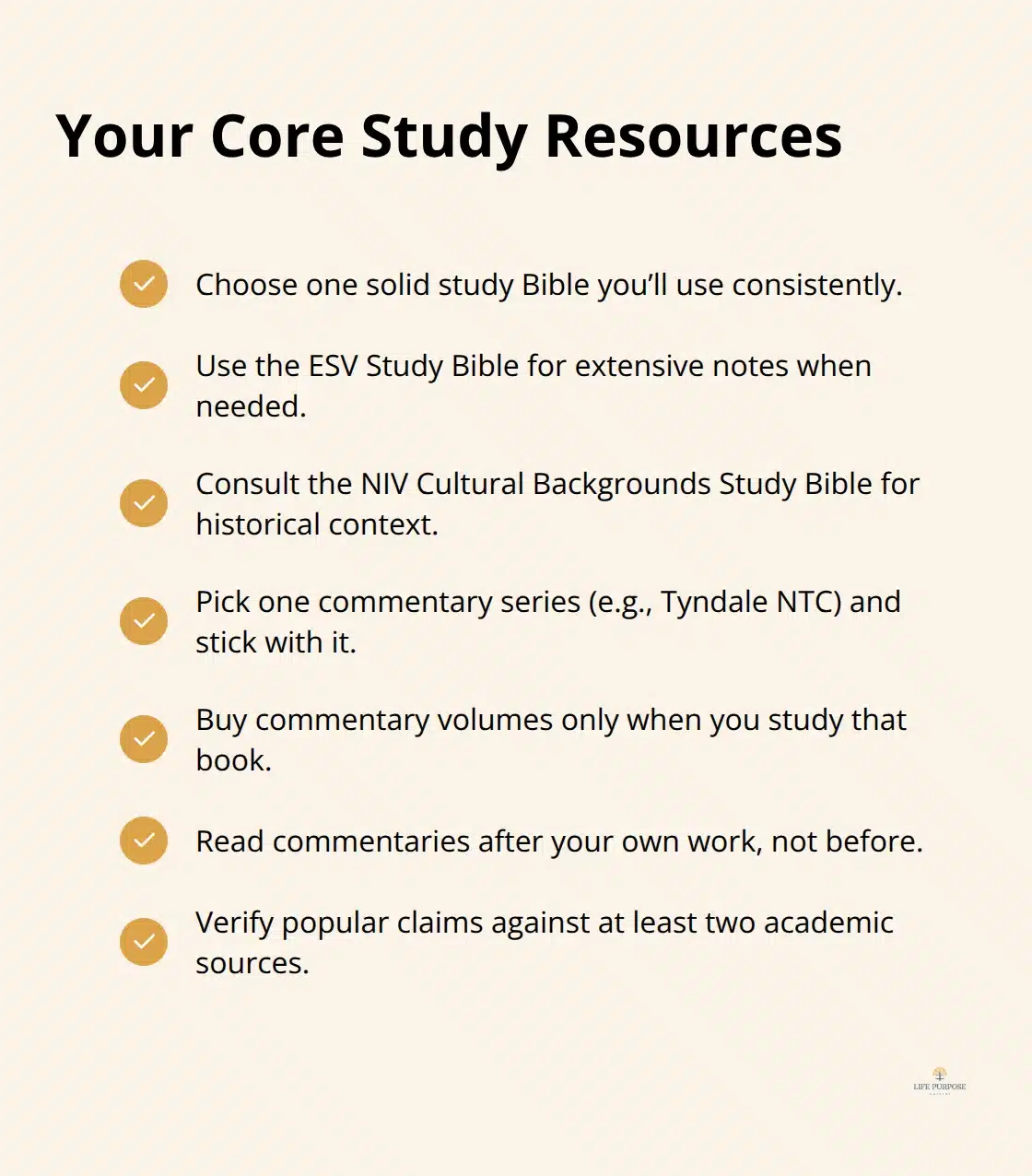
Pick one and use it consistently rather than jumping between five different study tools. For deeper work, find one commentary series and stick with it. The Tyndale New Testament Commentaries balance scholarly insight with readability and an cost twelve to eighteen dollars per volume. Don’t buy commentaries for every book of the Bible. Purchase them one at a time as you actually study that book. This prevents wasting money on resources you’ll never touch. When you consult a commentary, read it after you’ve done your own work, not before. Read the passage, ask your own questions, check cross-references, examine original language words, then open the commentary to see what experienced interpreters noticed. This order matters because reading commentary first poisons your thinking. You’ll unconsciously adopt their interpretations instead of developing your own. The commentary becomes a conversation partner validating or challenging your insights, not a substitute for personal study. Avoid popular pastors’ blogs and social media theology entirely. These sources prioritise engagement and simplicity over accuracy. When someone with a platform makes a claim about Scripture, verify it against at least two academic sources before accepting it. The Civil War era in America demonstrates exactly how dangerous this gets. Scholars like Mark Noll documented how churches North and South used identical biblical passages to argue opposite positions on slavery. The Southern churches weren’t stupid; they had access to the same Bible. They simply prioritised different interpretive frameworks and consulted theological resources that reinforced their preferred conclusions. This happened because they didn’t verify claims against rigorous scholarship. Your theological resources should come from university presses, reputable evangelical publishers, and scholars with actual credentials in biblical studies, not from whoever has the largest following.
Establish a Study Rhythm That Lasts
Consistency matters infinitely more than intensity. Someone who studies Scripture thirty minutes daily for a year gains vastly more insight than someone who studies eight hours once monthly. Your brain consolidates learning through repetition and spacing, not through marathon sessions. Choose a specific time and location for study. This isn’t spiritual; it’s neuroscience. If you study Scripture after your morning coffee at the kitchen table, your brain eventually triggers the study impulse when you sit down with coffee. This removes decision fatigue and willpower requirements. Start with a realistic commitment. Thirty minutes daily beats sixty minutes three times weekly because consistency trains your mind better than intensity. Choose one biblical book and read it completely through once in a modern translation without any study tools. This takes three to four weeks for a Gospel or Paul’s epistles. Read it in chunks roughly equivalent to what you’d hear in a church service, usually four to seven chapters. Notice what stands out, what confuses you, what seems to repeat. Write down three genuine questions the book raises for you. Then spend the next six to eight weeks studying that single book deeply using the methods we’ve discussed. Study one chapter or section per week. Read it in multiple translations. Check cross-references. Investigate key word meanings. Read what scholars say. This rhythm prevents the overwhelming feeling of trying to understand the entire Bible simultaneously while building genuine expertise in one book. After completing this cycle, you’ll have moved from plain reading to genuine insight in one biblical book. That’s the template. Repeat it with different books throughout your year. You’ll finish two to three books deeply studied per year. After five years, you’ve studied fifteen books with the kind of depth that actually transforms thinking and behaviour.
Final Thoughts
You’ve now moved from surface-level reading to genuine biblical insight. The journey from plain reading to deeper methods to practical application isn’t a destination you reach once and finish-it’s a rhythm you establish and maintain throughout your life. The most spiritually mature people we know aren’t those who memorised the most verses or attended the most seminars, but those who consistently study Scripture using both scholarly rigour and spiritual sensitivity, then actually live out what they discover.
This biblical interpretation guide has shown you three distinct approaches that build on each other. Plain reading teaches you to respect what the text actually says rather than imposing your preferences onto it. Deeper methods reveal layers of meaning through cross-references, original languages, and the overarching redemptive narrative. Practical application transforms intellectual understanding into changed thinking and behaviour. Scholarly study prevents you from building theology on misunderstandings, while spiritual discernment prevents you from treating Scripture as merely historical information.
Moving forward means committing to one biblical book and studying it deeply using the methods you’ve learned. Thirty minutes daily beats sporadic intensity, and one book studied thoroughly beats skimming the entire Bible. We at Life Purpose Matters believe this kind of deep engagement with Scripture is essential for discovering and living out your God-given purpose.