

I once sat with a friend who’d lost her job, her home, and nearly her faith. She kept asking: if Jesus could heal the sick and feed thousands, why couldn’t He fix her life? That question stuck with me because it’s the one that millions of Christians wrestle with today. At Life Purpose Matters, we believe Jesus’ miracles aren’t ancient stories locked in history books-they’re living proof that God still works in our broken world.
Why Jesus’ Miracles Proved He Was God’s Son
Miracles as Divine Authority in Action
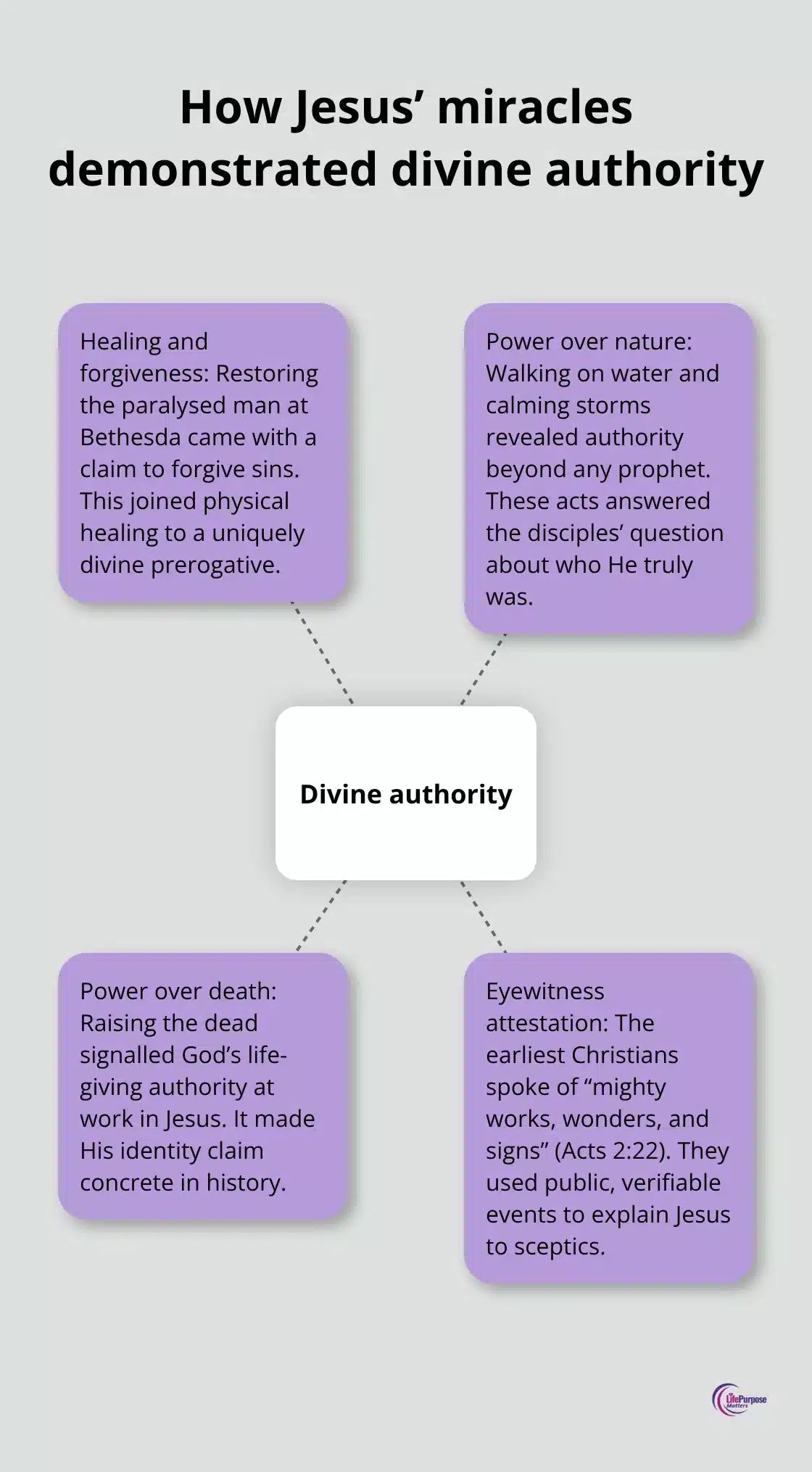
The early Christians didn’t need centuries of theological debate to understand what Jesus’ miracles meant. They witnessed them firsthand or heard accounts from people who had. When Jesus healed the paralysed man at Bethesda in John 5, He didn’t just restore mobility-He claimed the authority to forgive sins, something only God could do. The religious leaders understood immediately that Jesus was making a claim about His own divinity.
This wasn’t ambiguous.
Miracles in first-century Jewish culture weren’t entertainment; they were declarations of power and authority. When Jesus walked on water, calmed storms, and raised the dead, He answered a specific question His disciples kept asking: Who are you really? The answer came through action, not just words. Acts 2:22 describes Jesus as a man attested to God by mighty works and wonders and signs that God did through Him. This wasn’t poetic language-it was how the earliest Christians explained who Jesus was to sceptics.
How Miracles Opened Doors for the Gospel
The apostles themselves performed miracles in Jesus’ name, and Acts records that these signs and wonders added thousands to the church. When Peter healed the lame beggar at the temple gate in Acts 3, the crowd’s amazement became an opportunity to preach the gospel. The miracle opened ears that might otherwise have stayed closed. This pattern repeated throughout Acts. Miracles weren’t the goal; they were the gateway. They made people stop, pay attention, and listen to a message about Jesus they might have otherwise dismissed.
The Historical Weight of Eyewitness Testimony
What makes this historically significant is that early Christians staked their entire movement on the reality of these miracles. They didn’t spiritualise them away or treat them as metaphors. Paul wrote in 1 Corinthians 15:14 that if Christ hasn’t been raised, Christian faith is futile. He treated the resurrection as a historical fact that could be verified or refuted. The first believers faced persecution, torture, and death because they believed they’d encountered the risen Jesus and witnessed His supernatural power. People don’t die for a lie they know is a lie, especially not when they could save themselves by recanting.
The consistency of miracle accounts across all four gospels and throughout Acts suggests these weren’t fabrications added later. Different authors reported similar miracles with different details, which is exactly what you’d expect from multiple eyewitnesses rather than coordinated fiction. Matthew, Mark, Luke, and John didn’t collaborate to create a unified miracle narrative. Yet their accounts align on core events like Jesus feeding crowds, healing the sick, and rising from the dead.
Why This Foundation Matters for Modern Faith
For modern believers, this historical foundation matters because faith in Jesus isn’t built on wishful thinking or cultural mythology. It rests on claims that the earliest Christians were confident enough to die defending. When you’re wrestling with whether God actually intervenes in human affairs, that conviction from people closest to the events carries weight that abstract theology never could. These weren’t distant legends-they were events that shaped the lives and deaths of those who witnessed them. The question then becomes not whether miracles happened, but what they reveal about God’s character and His willingness to act in human history. Understanding this foundation prepares us to see how those same miracles speak directly to the struggles we face today.
What Jesus’ Healing Miracles Teach Us About Suffering
Suffering as the Space Where God’s Power Becomes Visible
When Jesus healed the blind man in John 9, His disciples immediately asked whose sin caused the blindness-the man’s or his parents’. Jesus rejected that entire framework. He said the blindness existed so God’s works could be displayed in his life. That’s radically different from how most of us process suffering. We assume pain means punishment, failure, or abandonment by God. Jesus’ healing miracles actually teach the opposite: suffering can become the space where God’s power becomes most visible.
The blind man didn’t need a theological explanation for his condition. He needed sight, and Jesus gave it to him. When you’re in physical or emotional pain, you don’t need someone to explain why it happened. You need hope that it can change. Jesus’ healing miracles provide exactly that. They show someone who saw human pain and responded with immediate, tangible action.
Faith Changes How You Move Through Pain
The woman with the issue of blood in Mark 5 spent twelve years and her entire life savings on doctors. Nothing worked. When she touched Jesus’ cloak, her bleeding stopped instantly. More importantly, Jesus told her that her faith had healed her, not because faith is magic, but because she believed God could and would intervene in her suffering. That belief transforms how you move through pain.
Instead of accepting suffering as permanent, you start asking what God might do next. Studies on chronic pain patients show that those who maintain spiritual hope and faith report significantly better pain management and quality of life outcomes compared to those without spiritual resources. When you approach suffering with the expectation that God acts in history, your entire relationship with that suffering shifts.
Provision Miracles Shatter the Scarcity Mindset
Jesus’ miracles of provision cut directly against the scarcity mindset that dominates modern life. He fed five thousand people with five loaves and two fish because He saw a hungry crowd and felt compassion. The disciples calculated the problem: there wasn’t enough food, and nobody had money. Jesus didn’t debate scarcity economics. He worked with what existed and multiplied it. That’s not about magic; it’s about a fundamentally different approach to resources.
When you believe God provides, you stop hoarding and start sharing. You stop waiting for perfect conditions before you act. The widow who gave her last two coins in Mark 12 gave more than the wealthy people who contributed large sums from their abundance. Jesus recognised her act as the greater gift because she gave from genuine trust in God’s provision, not from surplus. This directly challenges how most people handle money, time, and energy. You tell yourself you can’t volunteer until finances stabilise. You can’t mentor someone until your schedule clears. You can’t be generous until you have enough. Jesus’ provision miracles demolish that logic.
Transformation Happens Through Encounters With Power
Personal spiritual transformation in Scripture happens through encounters with Jesus’ power, not through self-improvement programmes. When Jesus called Levi the tax collector in Luke 5, He didn’t offer a twelve-week course on ethical business practices. He said, Follow me. Levi immediately left everything and followed Him. That’s the transformation that happens in a moment because the person encountered someone with undeniable authority and power.
Modern spiritual growth often emphasises gradual habit-building and self-discipline. Those things matter, but they’re insufficient without a genuine encounter with God’s transformative power. The demoniac in Mark 5 was living in tombs, cutting himself, and was completely isolated from the community. After Jesus cast out the demons, he was sitting, clothed, and in his right mind. His entire life changed because he encountered Jesus’ power over the spiritual forces destroying him.
You can’t think your way out of certain patterns. You can’t willpower your way into genuine change. You need to encounter something bigger than yourself that has the authority and ability to transform you from the inside out. That’s what these transformation miracles demonstrate. They show people encountering Jesus, experiencing His power directly, and becoming completely different as a result. This foundation of personal transformation through divine encounter sets the stage for understanding how ancient miracles speak directly to the contemporary challenges you face today.
When Life Feels Hopeless, Miracles Remind You God Still Acts
The problem with most advice about faith during hard times is that it offers nothing practical. Someone tells you to pray more, have more faith, or trust God’s timing while your marriage collapses or your diagnosis arrives. Jesus’ miracles don’t offer platitudes. They offer evidence that God intervenes in circumstances that seem completely beyond repair. When you face a contemporary crisis, these ancient stories become remarkably practical. The feeding of the five thousand wasn’t a theoretical exercise in trust. Jesus saw physically hungry people, and He fed them. The woman with chronic bleeding didn’t need encouragement to think positively about her condition. She needed healing, and she received it. This shift transforms how you approach your current struggles. Instead of treating your difficult circumstances as problems you must solve alone through willpower and strategy, you start asking what God might do if you genuinely believed He intervenes in human affairs the way He did in Scripture.
How to Actually Use Miracle Stories When Everything Goes Wrong
Most people read a miracle story, feel momentarily inspired, then return to their anxious default. The practical shift happens when you stop treating miracles as historical curiosities and start treating them as templates for how God responds to specific human needs. When you face financial pressure, the feeding miracles show you God’s response to scarcity.
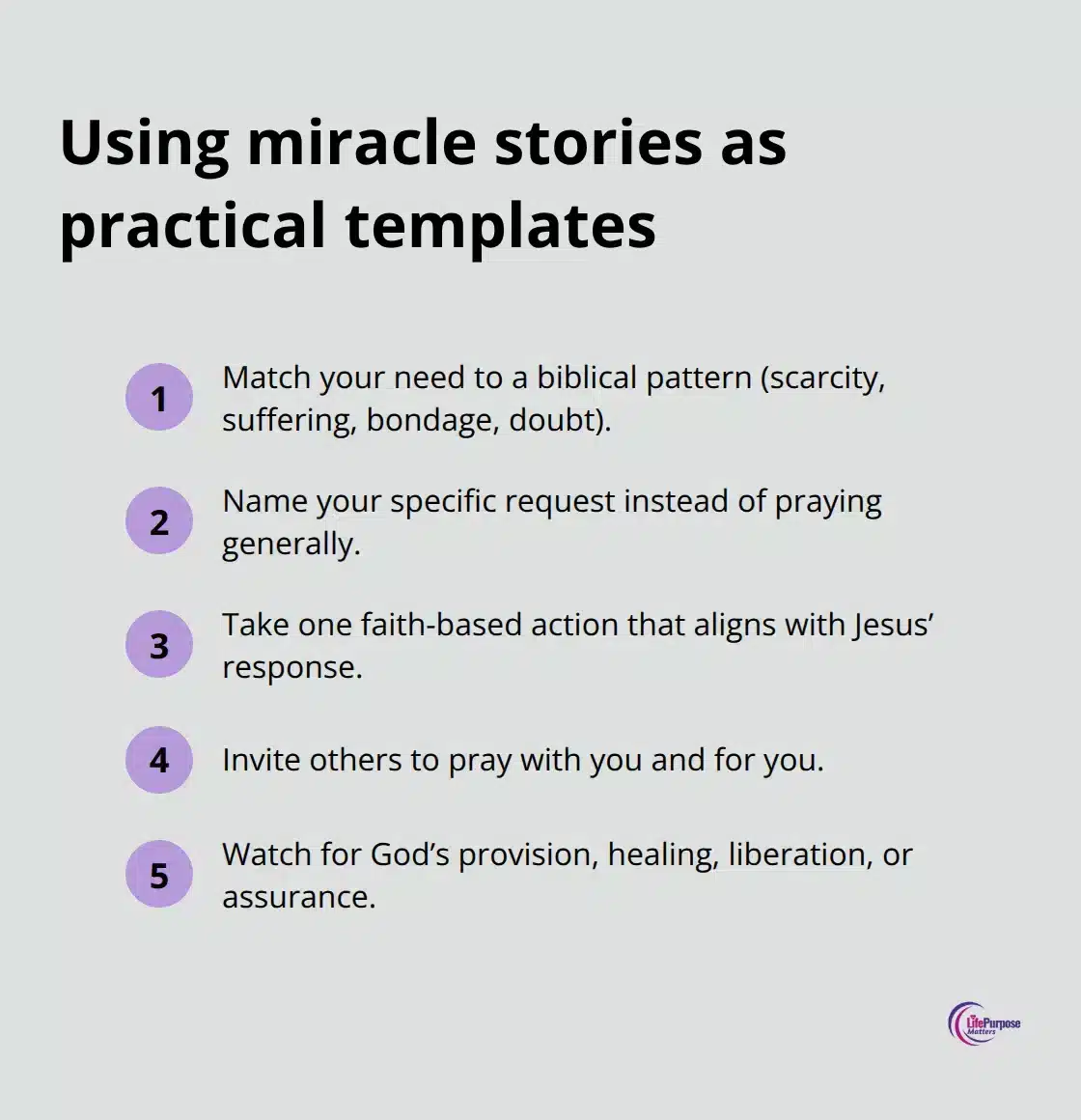
When you suffer physically, the healing miracles show you God’s compassion toward pain. When you feel spiritually stuck, the transformation miracles show you that God breaks chains others said were permanent. Specificity matters. Don’t just read that Jesus healed people generally. Read Mark 5 about the woman with bleeding and ask yourself what parallels exist in your situation. She’d exhausted her resources and her hope. She took one desperate action based on the belief that Jesus could help; then He did. That narrative structure applies directly to your crisis. You’ve tried conventional solutions. You’ve spent time, money and effort. Nothing worked. At some point, you either give up or you take a different kind of action based on faith in God’s intervention rather than faith in your own problem-solving ability. That’s not abstract theology. That’s a practical decision you make when you’re desperate enough to try something different.
Faith in Intervention Changes What You Actually Do
Most Christian teaching about faith fails because it treats faith as a feeling or a mental state rather than as the foundation for different action. But faith in God’s intervention produces measurably different behaviour. Christians who believe God actively intervenes in their lives report significantly higher resilience during crises and faster recovery from depression compared to those who view God as distant or uninvolved. That’s not because positive thinking is powerful. It’s because believing God acts changes what you actually do. If you believe God intervenes, you pray differently. You’re not going through motions or hoping for luck. You’re making requests to someone you believe has both the power and the willingness to help. You confide in others and ask for prayer support because you believe corporate intercession matters. You make decisions based on what you believe God wants, not just on what seems practical. You take risks you wouldn’t otherwise take because you’re trusting something beyond your own competence. When you believe in divine intervention, you act like someone who believes in divine intervention. That produces different outcomes because you’re operating from a different set of assumptions about what’s possible.
Connecting Your Crisis to God’s Pattern of Response
The ancient miracles reveal a consistent pattern in how God responds to human need. He sees people in pain and responds with compassion. He sees people in scarcity and provides abundance. He sees people trapped in destructive patterns and offers liberation.
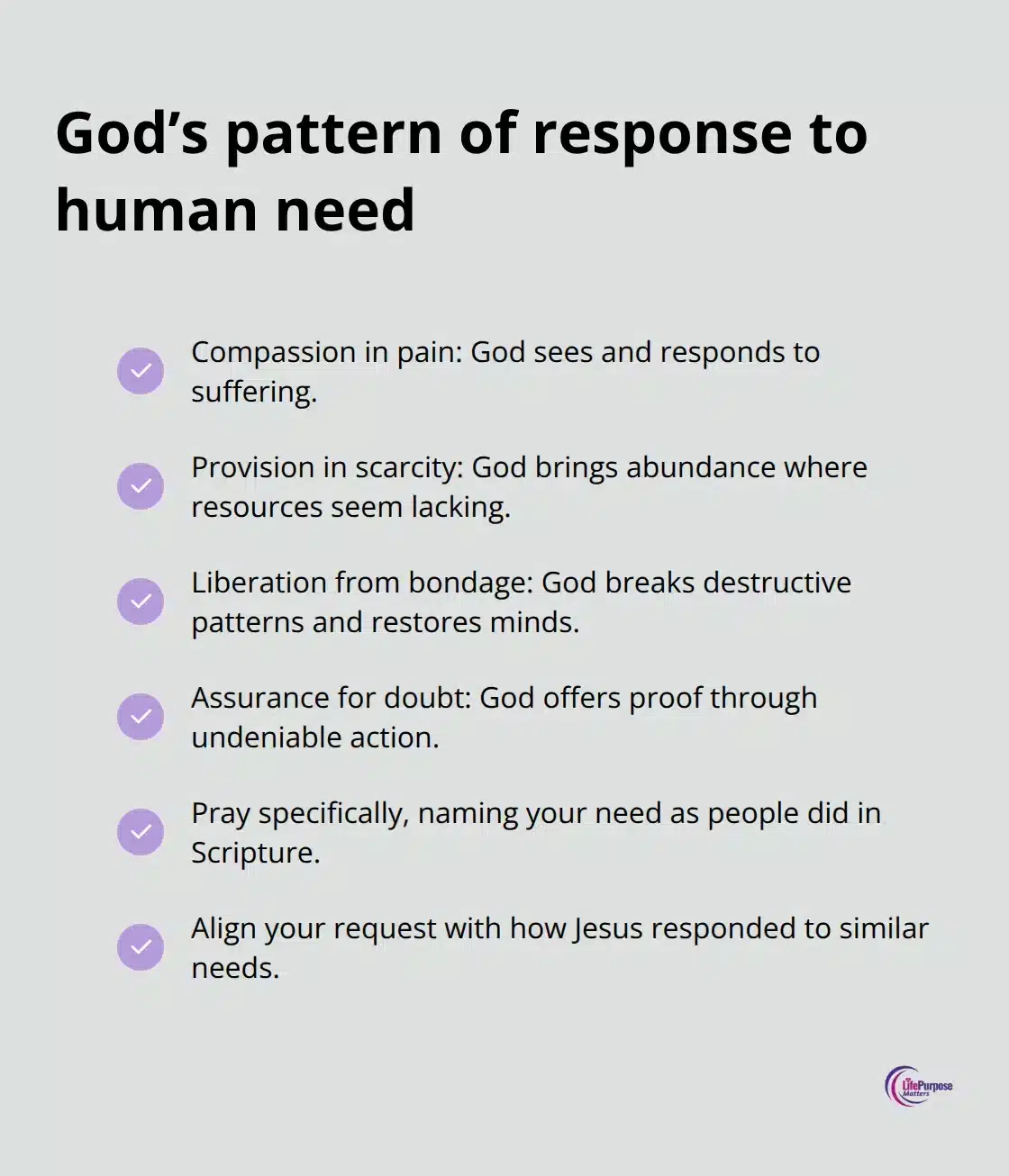
He sees people doubting His character and offers proof through undeniable action. Your contemporary crisis fits one of these patterns. You’re either suffering physically or emotionally, facing genuine scarcity, trapped in a destructive cycle, or wrestling with doubt about whether God actually cares. The miracle story that matches your situation isn’t coincidental comfort. It’s a template showing you how God has responded to that exact kind of human need throughout history. This is why specific prayer matters more than generic prayer. Instead of asking God to help generally, you name your specific need and connect it to how Jesus responded to similar needs in Scripture. You’re not manipulating God or using magic formulas. You’re aligning your request with how God has demonstrated He responds to human suffering and need. You’re saying, God, You healed the woman with bleeding after twelve years of suffering. I’ve suffered in this way for this long. I’m asking you to respond to my need the way you responded to hers. That’s not presumptuous. That’s faith based on God’s demonstrated character and His willingness to act.
Final Thoughts
Your friend who lost everything and questioned whether God could fix her life wasn’t asking for theology-she was asking whether God actually shows up when circumstances fall apart. Jesus’ miracles answer that question with undeniable proof. The same Jesus who healed the sick, fed the hungry, and liberated the oppressed exists now, and His willingness to intervene hasn’t diminished one bit.
We at Life Purpose Matters have watched these ancient stories transform people’s faith when they stop treating them as historical artefacts and start treating them as evidence of God’s character. Pick one miracle story that matches your current struggle, read it slowly, and notice what Jesus saw in that situation and how He responded. Then ask yourself what it would look like to trust that same response in your circumstances-and take one small action based on that trust.
Pray specifically, name your need the way people in Scripture named theirs, and tell someone else what you’re trusting God for because faith spoken aloud becomes stronger. Explore resources to deepen your faith journey at Life Purpose Matters, where we help you integrate these truths into your daily spiritual life and discover your God-given purpose.