

I once attended a Bible study class where they were teaching about the Trinity, and the minister was trying to explain the Trinity to his congregation using only New Testament passages. Halfway through, someone asked, “Where does this actually start in the Bible?” That question stayed with me. Most people assume the Trinity is a concept found only in the New Testament, but the Old Testament contains surprising evidence that God’s nature was always understood as both plural and unified.
At Life Purpose Matters, we’ve found that many Christians miss these foundational clues hidden throughout Hebrew Scripture. This post walks through the biblical evidence for the Trinity in the Old Testament, from the language used to describe God to the mysterious figures and events that foreshadow what comes later.
What the Hebrew Language Reveals About God’s Plural Nature
The Elohim Pattern: Plural Form, Singular Action
The word Elohim appears roughly 4,000 times throughout the Old Testament, and this fact alone tells you something significant about how the Hebrew writers understood God. Elohim is grammatically plural, yet it pairs with singular verbs when describing God’s actions. This wasn’t accidental-the Hebrew writers made deliberate choices about how they spoke of the divine. When Genesis 1:26 records God saying “Let us make man in our image,” the Hebrew construction uses plural pronouns alongside a singular divine subject, creating a linguistic tension that demands explanation.
What Early Interpreters Saw in the Text
Early Hebrew scholars didn’t dismiss this as a mere grammatical quirk. The Apostolic Fathers-including Justin Martyr, Irenaeus, and Tertullian-often spoke of Christ as “our God” and “God incarnate,” recognising the divine plurality embedded in Scripture. They weren’t reading something into the text; they read what was already there. Origen and Novatian later emphasised that the “us” referred specifically to the Word and Wisdom alongside the Father, not to angels or heavenly advisers. These weren’t casual interpretations from isolated scholars. Multiple early Christian theologians across different regions and time periods arrived at the same conclusion about what the Hebrew text conveyed.
The Consistent Pattern Across Scripture
The pattern repeats throughout Scripture in ways that rule out coincidence. Genesis 3:22 contains the phrase “Behold, the man has become like one of Us,” and Genesis 11:7 shows God saying “Let us go down.” Isaiah 6:8 presents God asking, “Whom shall I send, and who will go for us?” The consistent use of Elohim in plural form, combined with these plural pronouns, creates a linguistic foundation that points beyond simple monotheism.
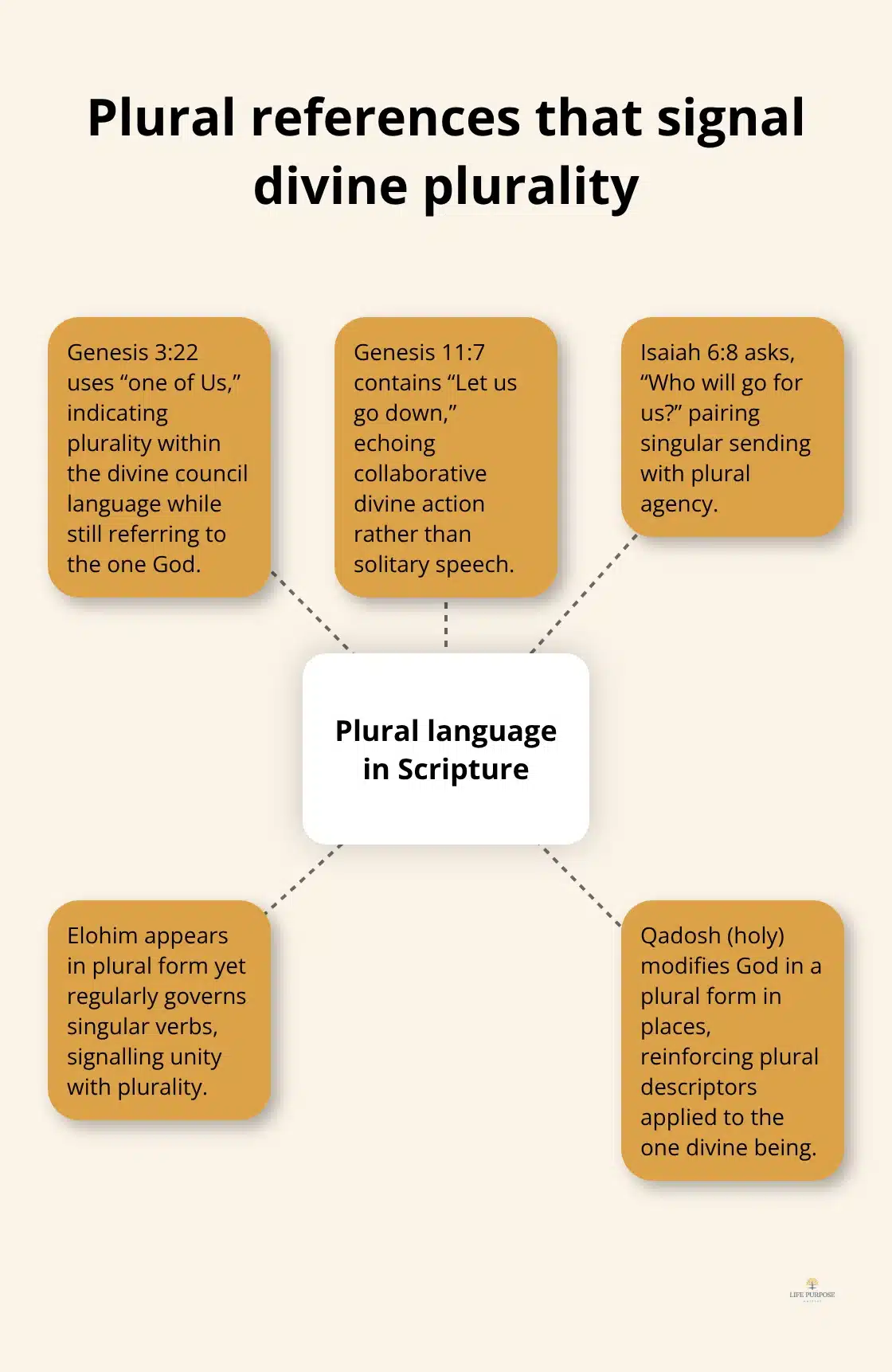
The adjective qadosh (holy) even modifies God in plural form, reflecting a Hebrew plural adjective paired with the divine noun.
Distinguishing Divine Plurality from Royal Majesty
What makes this evidence particularly strong is how it contradicts the common objection that plural language was merely a stylistic device of majesty. Other ancient texts show that when rulers spoke in plural about themselves, they employed different grammatical patterns than what appears in Scripture. In 2 Samuel 16:20 and Ezra 4:16-19, human rulers speaking in the plural about their own actions maintained different linguistic markers than the Hebrew writers used for God. The distinction matters because it shows the biblical writers made intentional choices about how they described the divine nature.
Unity and Plurality Coexisting in One God
When Isaiah 45 uses Elohim alongside the divine name YHWH to describe the sole Creator, the text doesn’t contradict the plural language elsewhere. Instead, it demonstrates that plurality and singularity coexist in God’s nature. Isaiah 45:12 reinforces this with the declaration “I, even I,” establishing one Creator while earlier verses employed plural forms. This linguistic tension between plural and singular references to the same divine being wasn’t a problem the Hebrew writers were trying to solve. They were describing reality as they understood it, and the early interpreters who came after them recognised this pattern as foundational evidence for understanding God’s nature as unified yet plural.
These linguistic clues set the stage for what comes next: the mysterious figures and events scattered throughout the Old Testament that foreshadow a fuller revelation of God’s nature.
Old Testament Encounters That Reveal God’s Multi-Person Nature
The Angel of the Lord: A Divine Presence in Human Form
The Angel of the Lord appears throughout the Old Testament in ways that defy simple explanation. Genesis 16:10 records the angel promising Hagar a son, yet the text shifts seamlessly between the angel speaking and God speaking, as though they were the same person. Genesis 22:12 shows the angel of the Lord stopping Abraham from sacrificing Isaac and swearing by himself, claiming divine authority that only God possesses. Exodus 3:2 presents the angel of the Lord in the burning bush, but verse 6 identifies this figure as the God of Abraham, Isaac, and Jacob.
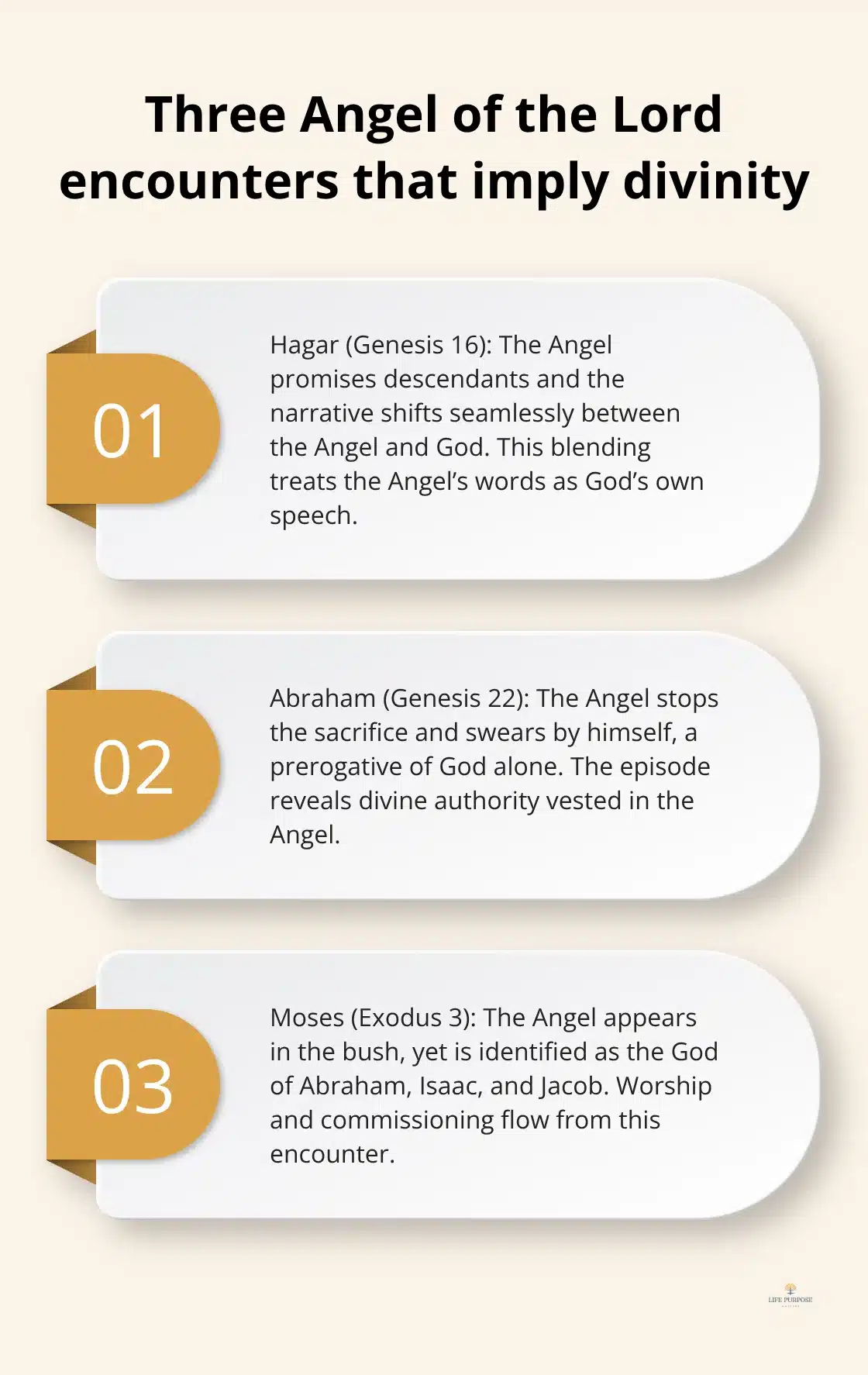
These passages treat the angel and God as one divine presence operating in distinct ways.
Joshua 5:13-15 follows the same pattern across centuries of Hebrew history. Joshua encounters the commander of the Lord’s army, removes his sandals in worship, and receives instructions that reshape Israel’s military strategy. The consistency across these passages spanning different eras suggests something more intentional than coincidental language overlap. Early Christian interpreters recognised these encounters as the Angel of the Lord as pre-incarnate appearances of Christ, though modern readers often miss the implications because they expect explicit theological labels rather than narrative demonstration.
The Spirit of God: A Distinct Divine Actor
The Spirit of God operates with equal distinctiveness throughout Old Testament narratives. Genesis 1:2 shows the Spirit hovering over creation before any other divine action occurs, suggesting agency and presence apart from the Father’s creative word. Nehemiah 9:20 and 9:30 describe the Spirit being sent and the Spirit speaking, language that distinguishes the Spirit as a separate actor within God’s unified nature.
The Spirit empowered specific leaders with concrete transformations. Judges 3:10 records the Spirit coming upon Othniel, granting him military power to defeat Cushan-rishathaim and judge Israel. Judges 6:34 shows the Spirit clothing Gideon with power, a phrase suggesting active empowerment rather than passive inspiration. First Samuel 10:9-10 demonstrates the Spirit transforming Saul into a different person, granting prophetic ability that marked him as chosen for kingship. Yet First Samuel 16:14 reveals the Spirit departing from Saul due to disobedience, indicating that divine empowerment operated conditionally based on covenant faithfulness.
Messianic Promise and the Spirit’s Role
Isaiah 11:2 presents the Messiah clothed with the Spirit of the Lord, wisdom, understanding, counsel, might, knowledge, and the fear of the Lord, detailing specific capacities the Spirit would grant. These were not abstract blessings but concrete transformations that enabled leaders to accomplish God’s purposes. The pattern shows the Spirit functioning as a distinct divine person whose presence could come, go, empower, instruct, and convict, operating alongside the Father in ways that suggest unified purpose but separate agency.
These encounters and empowerments throughout the Old Testament establish a foundation for understanding how God’s nature operated before the New Testament made explicit what the Hebrew writers had already demonstrated through narrative and experience. The next section examines how wisdom literature and divine personification further illuminate this multi-person understanding of God’s nature.
How Old Testament Prophecy Points to the Trinity
Isaiah’s Messianic Vision and the Spirit’s Role
Isaiah 61:1-2 contains a prophecy where the speaker claims the Spirit of the Lord rests upon him, anointing him to preach good news to the poor, heal the brokenhearted, and proclaim freedom to prisoners. When Jesus stood in the synagogue at Nazareth in Luke 4:18-19, he read this exact passage and declared it fulfilled in himself that very day. The connection matters because it reveals Jesus identifying himself as the one upon whom the Spirit rested, positioning himself within the Messiah’s role while simultaneously remaining distinct from the Spirit empowering him. This wasn’t Jesus claiming to be the Spirit; it was Jesus claiming to be the one the Spirit would anoint. The prophecy assumes what the Old Testament demonstrated through narrative: that God operates as multiple persons unified in purpose.
Ezekiel’s Vision of the Eternal Shepherd
Ezekiel 34:23-24 prophesies that God will set up a shepherd named David who will feed the people and serve as their prince forever, yet the passage immediately follows with God declaring, “I, the Lord, will be their God.” This creates theological tension that only makes sense through a trinitarian lens. The Messiah functions as God’s servant and representative, yet God remains the ultimate authority and object of worship.
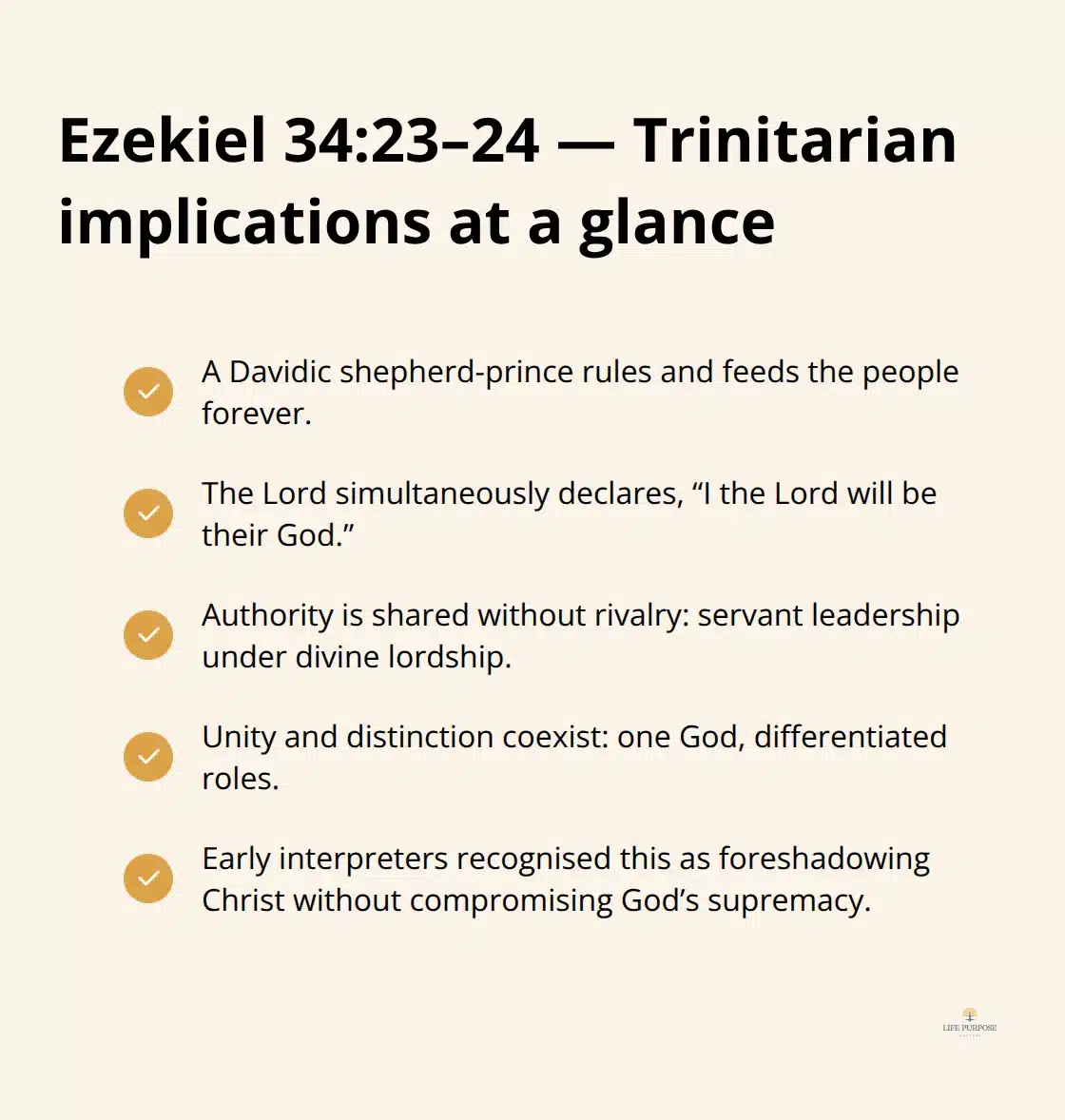
The prophecy doesn’t present a rival to God’s lordship but rather a servant operating within God’s unified nature. Early interpreters like Origen understood this passage as foreshadowing Christ’s role without compromising God’s singular supremacy.
The Spirit’s Transformative Work Across History
The Spirit’s activity throughout Old Testament narratives reinforces this pattern consistently. The Spirit convicts sinners in Genesis 6:3, empowers judges like Samson and Gideon with military prowess, inspires prophecy in God’s messengers, and, according to Ezekiel 36:27, will eventually transform believers’ hearts from within. Each operation demonstrates the Spirit as a distinct agent with specific functions, yet always working toward the Father’s purposes. This progressive revelation didn’t suddenly introduce new information in the New Testament; it clarified what the Old Testament writers had already embedded within their language, narratives, and prophecies about how God actually operates.
Final Thoughts
The evidence for the Trinity in the Old Testament emerges from consistent patterns woven throughout Hebrew Scripture rather than isolated verses. The grammatical plurality of Elohim, the repeated appearances of the Angel of the Lord as a distinct divine presence, and the Spirit operating with independent agency all point toward a God whose nature encompasses unity and plurality simultaneously. Early Christian interpreters recognised these patterns immediately because the text itself invited that recognition.
This understanding transforms how you read the Old Testament and shapes your grasp of God’s actual nature. When you encounter God speaking in plural pronouns or the Spirit empowering judges with concrete transformations, you witness the foundational revelation of God’s multi-person nature operating throughout history. The New Testament clarified what the Old Testament had already demonstrated through centuries of divine encounters and prophetic witness.
Understanding the Trinity in the Old Testament anchors your Christian experience in Scripture’s deepest foundations and shows that God’s nature has always been relational. Visit Life Purpose Matters to access resources that help you integrate these truths into your daily spiritual life and deepen your connection with God’s revealed nature.