

I once sat in a church service where the pastor asked the congregation to explain the Trinity in one sentence. The room went silent. Most of us grew up hearing about Father, Son, and Holy Spirit, yet few could articulate why these three are actually one God.
At Life Purpose Matters, we believe understanding the origin of the Trinity transforms how you read Scripture and practise your faith. This concept shaped Christianity for nearly 2,000 years, yet its roots run deeper than most realise.
Where Scripture First Hints at God’s Threefold Nature
Old Testament Whispers of Plurality
The Trinity didn’t suddenly appear in the fourth century. Scripture planted its seeds centuries earlier, though early readers often missed them because they looked for explicit statements rather than patterns. The Old Testament contains moments where God speaks in ways that suggest internal plurality. Genesis 1:26 records God saying, “Let us make mankind in our image, in our likeness“-odd phrasing if God stands completely alone. Isaiah 48:16 shows the speaker saying “the Lord has sent me, and his Spirit,” which creates a distinction between the sender and the sent one. These passages don’t spell out trinitarian theology, but they establish something vital: God’s nature involves more than simple singularity.
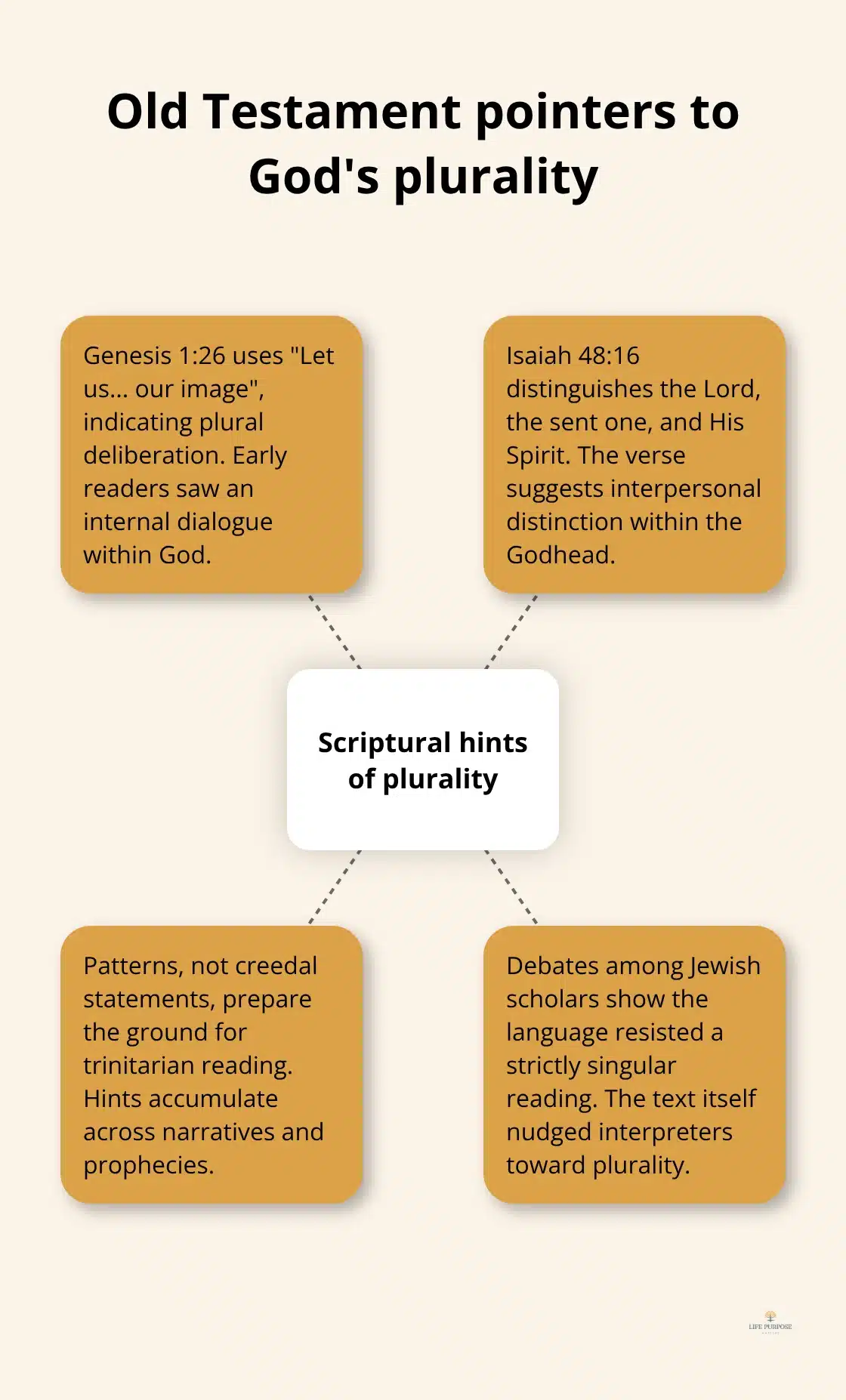
Jewish scholars debated these texts for centuries without settling on a trinitarian framework, yet the language itself resisted purely monotheistic readings.
New Testament Formulas That Changed Everything
The New Testament shifts dramatically. Matthew 28:19 records Jesus instructing disciples to baptise in the name of the Father and of the Son and of the Holy Spirit, which established a threefold formula for Christian initiation that became standard practise across the early church. Second Corinthians 13:14 opens with “the grace of the Lord Jesus Christ, and the love of God, and the fellowship of the Holy Spirit,” presenting all three as distinct agents of divine action in salvation. First Peter 1:2 arranges the same three in sequence, describing believers as “chosen according to the foreknowledge of God the Father, through the sanctifying work of the Spirit, for obedience to Jesus Christ.”
How Early Christians Lived the Trinity
These passages don’t argue for the Trinity; they assume it and use it functionally in worship and blessing. Scholars across traditions acknowledge that early Christians operated with a threefold understanding long before councils formalised the doctrine. What stands out is that this wasn’t imposed from above but emerged from how Christians actually prayed, baptised, and experienced God’s work in their lives. This functional trinitarian practise created the foundation upon which later theological councils would build their formal definitions, a reality that makes the historical development of trinitarian doctrine far less abstract than many assume.
How the Trinity Took Shape in History
Arius and the Crisis That Forced Clarity
Around 320 AD, a priest named Arius in Alexandria began teaching that the Son was created by the Father and therefore subordinate to him, not truly divine in the same way. This wasn’t a fringe position-it gained serious traction across the Mediterranean world. Arius argued from Scripture that the Son had a beginning, citing passages where Jesus submitted to the Father’s will. His bishop, Alexander, opposed him vigorously, but the dispute spread so rapidly that Emperor Constantine realised the church’s internal conflict threatened imperial stability. The controversy forced the church to articulate what it had always believed but never formally defined.
The Council of Nicaea and Homoousios
Constantine convened roughly 300 bishops at Nicaea in 325 AD to settle the matter. The council didn’t invent trinitarian doctrine; it formalised what Christians had already been practising liturgically. The bishops rejected Arianism decisively and produced the Nicene Creed, declaring the Son was of the same substance as the Father using the Greek term homoousios. This single word became the theological linchpin. It meant the Son shares the Father’s divine nature completely, not as a created being but as eternally begotten. Constantine enforced the decision with exile for dissenters, which reveals an uncomfortable truth: doctrine got established partly through political power, not purely through theological argument.
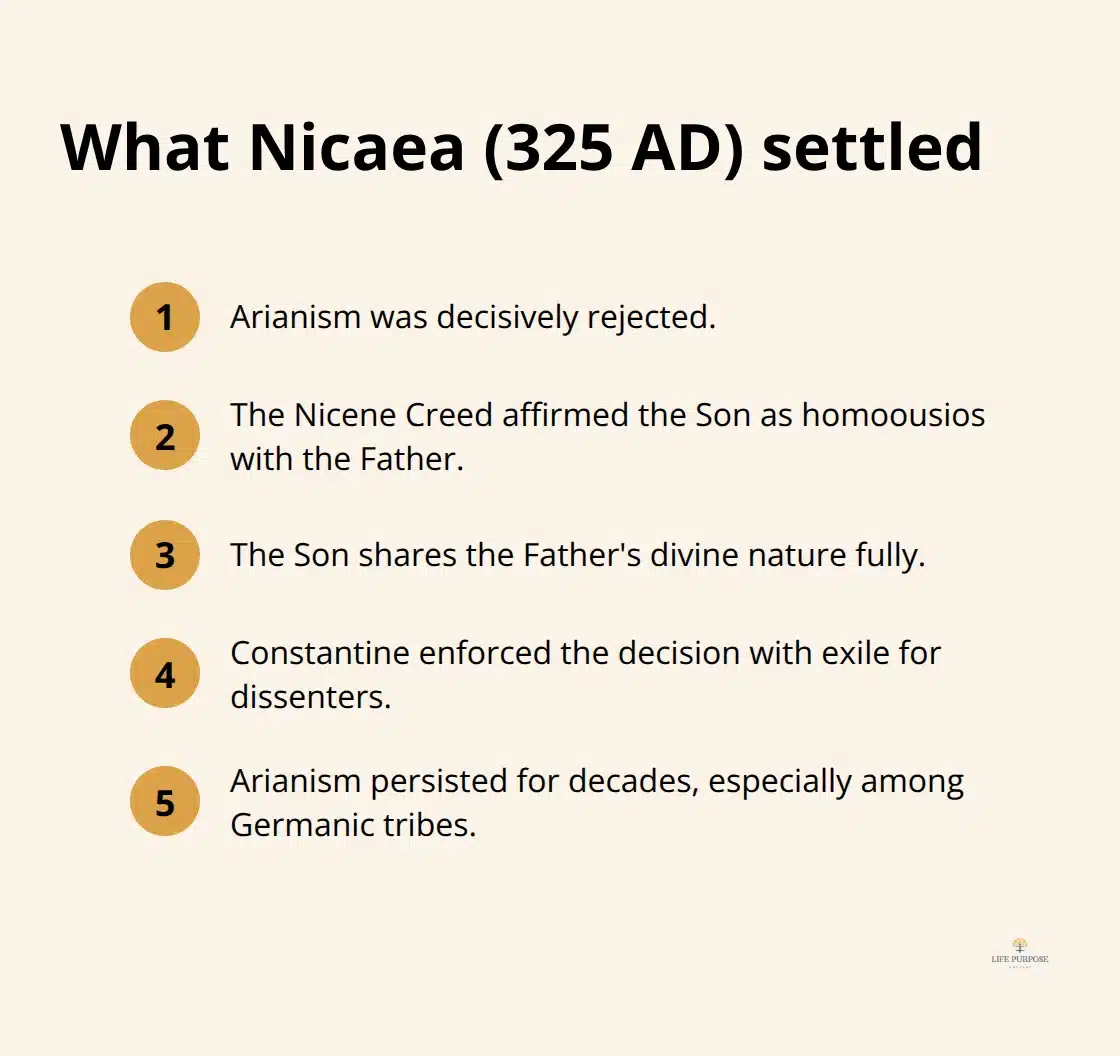
Arianism didn’t disappear after Nicaea; it actually remained influential for decades, spreading especially among Germanic tribes on the empire’s borders.
The Cappadocian Fathers Refined the Framework
The real theological breakthrough came later through the Cappadocian Fathers-Basil the Great, Gregory of Nyssa, and Gregory of Nazianzus-who refined the language in the mid-fourth century. They distinguished between ousia, meaning the shared divine essence, and hypostasis, meaning the individual persons. This terminology solved a vital problem: how can three distinct persons exist within one God without creating three gods or collapsing into modalism, where God merely wears different masks? Gregory of Nyssa argued that the divine operations or actions flow from a single divine will and power, yet the three persons retain real personal distinctions. The First Council of Constantinople in 381 AD affirmed the Holy Spirit’s full divinity, completing the standard trinitarian framework.
Augustine and the Athanasian Creed
Augustine, in the Western church, developed psychological analogies comparing the Trinity to memory, intellect, and will within a single human mind, though he was careful to note these analogies broke down under scrutiny. The Athanasian Creed, likely composed in the fifth or sixth century, crystallised the orthodox position: one God in three persons, three persons in one substance, with emphasis on coequality and coeternity. The doctrine emerged from real debate among serious thinkers wrestling with Scripture, not from abstract philosophy imposed downward. Understanding this history helps you grasp why Christians across denominations hold trinitarian belief so firmly-it represents nearly 1,700 years of theological consensus built on interpreting biblical texts about God’s nature and Christ’s identity. This foundation of careful theological work now leads us to examine what the Trinity actually means for how we understand God’s character and our relationship with each Father, Son, and Spirit.
What Each Person of the Trinity Actually Does
God the Father: Source and Sustainer
The Nicene framework gave us the language to describe the Trinity, but knowing the definition differs vastly from understanding how Father, Son, and Holy Spirit actually function in your spiritual life. God the Father operates as the source and sustainer of all existence. Scripture presents him as the one who initiates creation, establishes covenants, and maintains the universe through his will. In practical terms, the Father represents authority grounded in love rather than dominance. When you pray to the Father, you address the person of God who provides guidance and direction.
Jesus Christ: God’s Radical Love Made Flesh
Jesus Christ enters human history as God the Son, and his work fundamentally reshapes how you understand God’s character. The incarnation wasn’t symbolic or temporary; Christ became fully human while remaining fully divine, living under the same physical limitations you face, experiencing hunger, fatigue, and genuine temptation. His crucifixion and resurrection accomplished what no other being could accomplish: bridging the separation between humanity and God’s holiness. This means when you struggle with shame or feel distant from God, Christ’s resurrection proves that no barrier is permanent.
The Holy Spirit: God’s Active Presence Now
The Holy Spirit functions as God’s active presence in your life right now, not as an abstract concept but as a relational force that guides, comforts, and empowers. According to Acts 5:3-4, lying to the Holy Spirit equals lying to God, indicating the Spirit possesses genuine personal agency and deserves the same respect you’d offer the Father or Son. The Spirit’s work in your daily experience becomes visible when you recognise conviction about sin, comfort in suffering, and strength to live the Christian life.
How the Trinity Works Together in Your Life
The Father establishes your identity and worth; you matter because he created you intentionally. Christ demonstrates radical love and provides the mechanism for forgiveness; his work means your past failures don’t define your future. The Spirit equips you for daily obedience and reveals truth as you read Scripture. Rather than viewing the Trinity as a theological puzzle, recognise it as three distinct persons working in perfect coordination toward your redemption and transformation (when you experience conviction about sin, that’s the Spirit’s work; when you encounter grace in a moment of failure, that reflects Christ’s finished work; when you sense purpose and direction, the Father is leading).
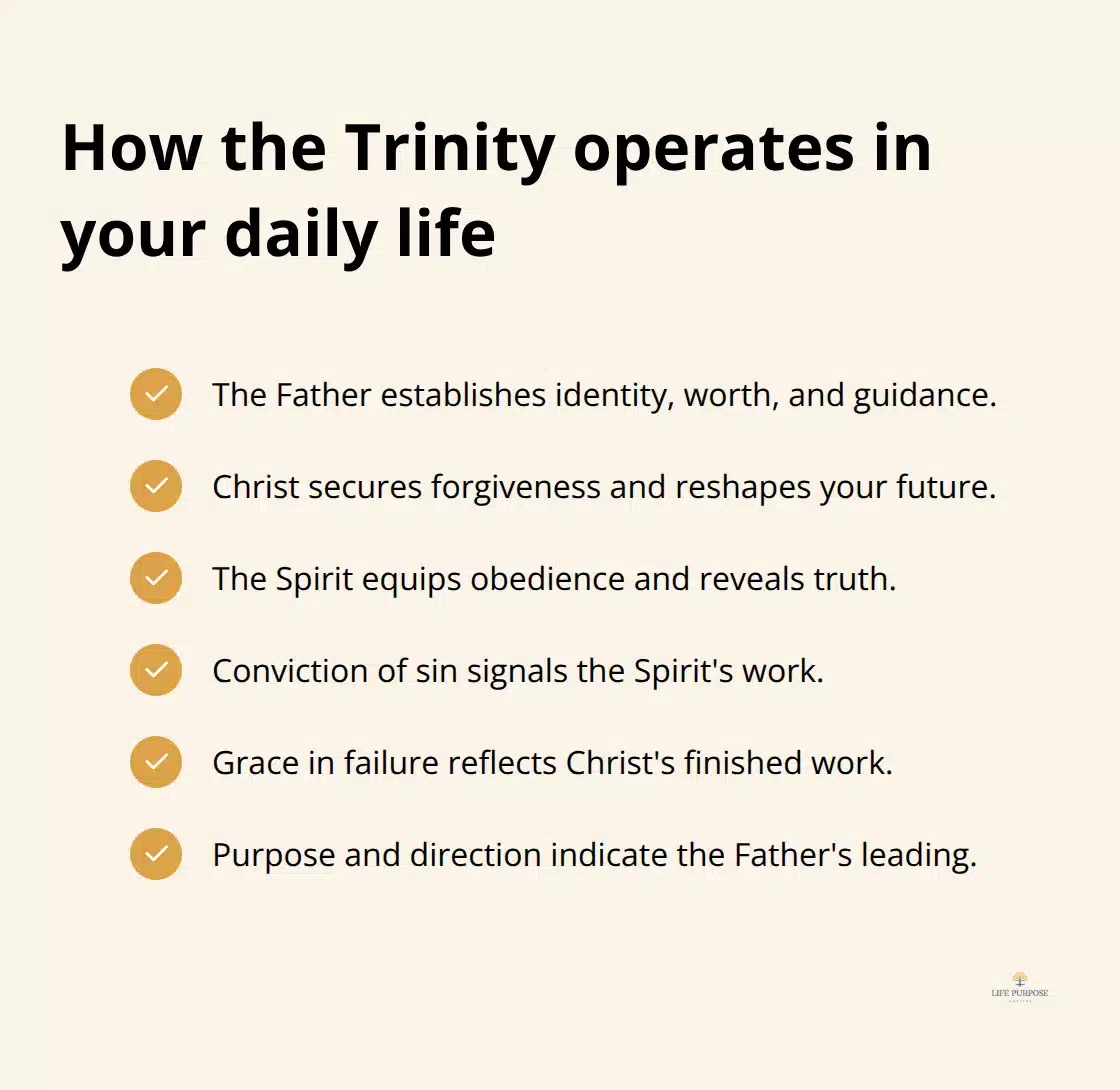
The Trinity isn’t primarily about abstract metaphysics; it’s about how God relates to you across all dimensions of your existence.
Final Thoughts
The origin of the Trinity emerges from Scripture itself and the lived experience of early Christians who encountered God as Father, Son, and Holy Spirit. From Genesis’s hints of plurality to Matthew’s baptismal formula to the Cappadocian Fathers’ careful theological language, the doctrine developed organically across centuries. What began as functional practise in worship became formal doctrine at Nicaea, then refined through centuries of theological reflection.
The Trinity fundamentally shapes how you understand God’s character and your relationship with him. It means God isn’t distant or impersonal but actively present through three distinct persons working toward your redemption. The Father establishes your worth and purpose, Christ demonstrates that God entered human suffering and conquered death itself, and the Spirit empowers you daily to live out your faith.
Understanding the Trinity moves you beyond abstract theology into relational reality, where prayer becomes conversation with the living God rather than recitation to an unknown force. Scripture opens up with new meaning as you recognise how each person of the Trinity operates throughout biblical history, and your struggles gain context within God’s larger redemptive plan. Explore how foundational Christian truths integrate into your daily life at Life Purpose Matters, where we provide resources to support your spiritual journey and help you live out your faith with greater clarity.