
I once knew someone who read the same Bible passage every morning for years without it changing anything about how she lived. Then she started actually sitting with the text, asking questions, and writing down her thoughts. Within weeks, her faith felt alive in a completely different way.
That’s the power of scripture reflection routines. At Life Purpose Matters, we’ve seen how intentional engagement with God’s Word transforms not just your understanding, but your entire spiritual life. The difference isn’t about reading more-it’s about reading with purpose.
Why Scripture Reflection Actually Changes You
The Retention Problem Nobody Talks About
Most people treat scripture like they treat their gym membership in January-they start strong, then life gets busy, and suddenly months pass without meaningful engagement. The real issue isn’t laziness. It’s that surface-level reading doesn’t stick because your brain isn’t actually processing what you’re reading. When you simply read a passage and move on, you retain almost nothing. Research on reading comprehension shows that passive consumption of text results in about 10% retention. But when you actively reflect on what you’re reading, annotate it, and connect it to your life, retention jumps to 65% or higher. That’s not a small difference.
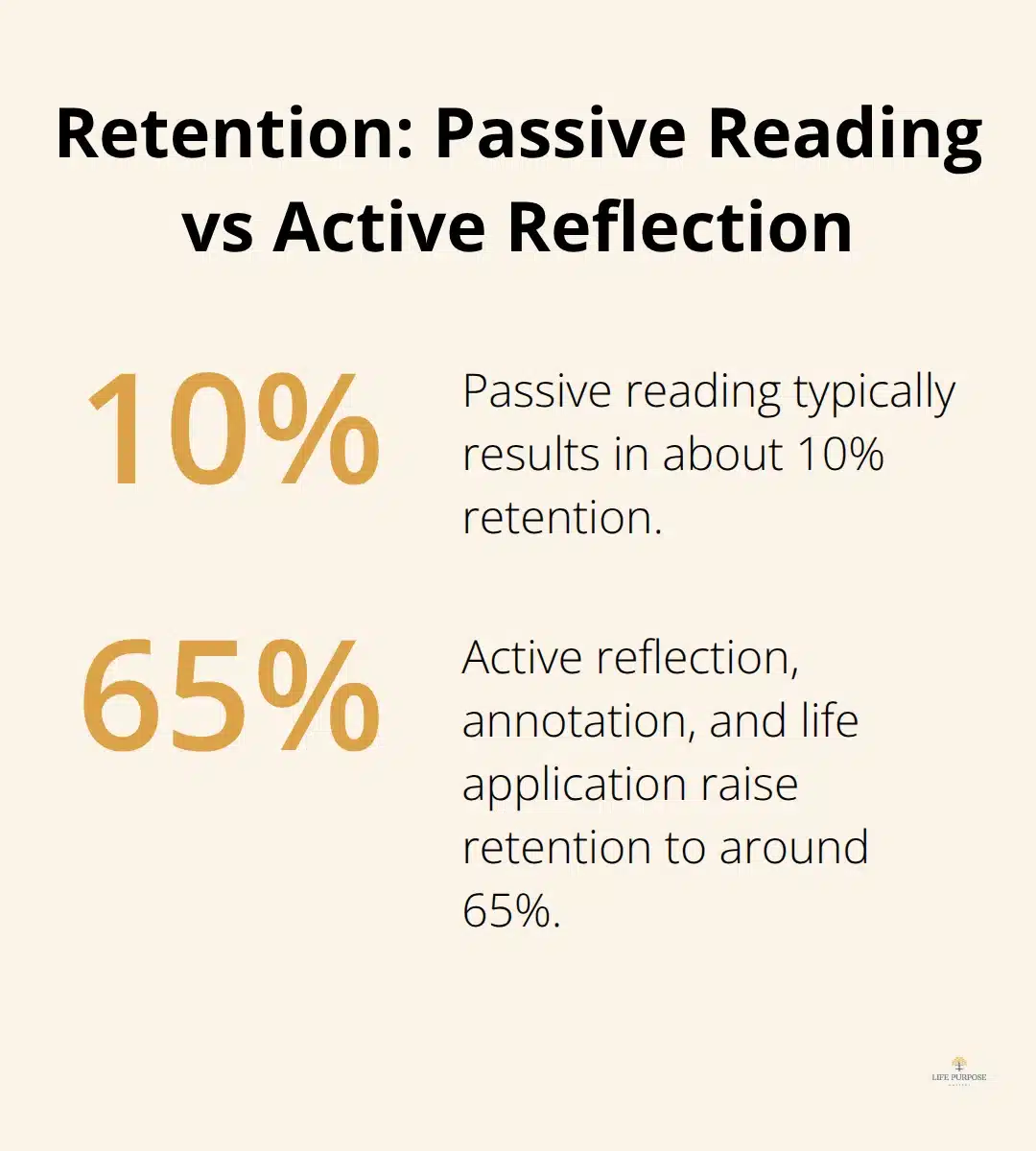
That’s the gap between a faith that feels distant and a faith that genuinely shapes how you live.
How Reflection Transforms Passive Reading Into Conversation
Scripture reflection forces you to slow down and actually think about what God’s Word means for you specifically, not just for some generic Christian audience. When you sit with a passage and ask yourself real questions about it-what does this mean, how does it apply to my struggle with anxiety, what am I avoiding about this truth-something shifts. Your brain stops treating the Bible like an instruction manual you’re supposed to memorise and starts treating it like a conversation with God. That shift changes everything.
Building Discipline Through Structure, Not Willpower
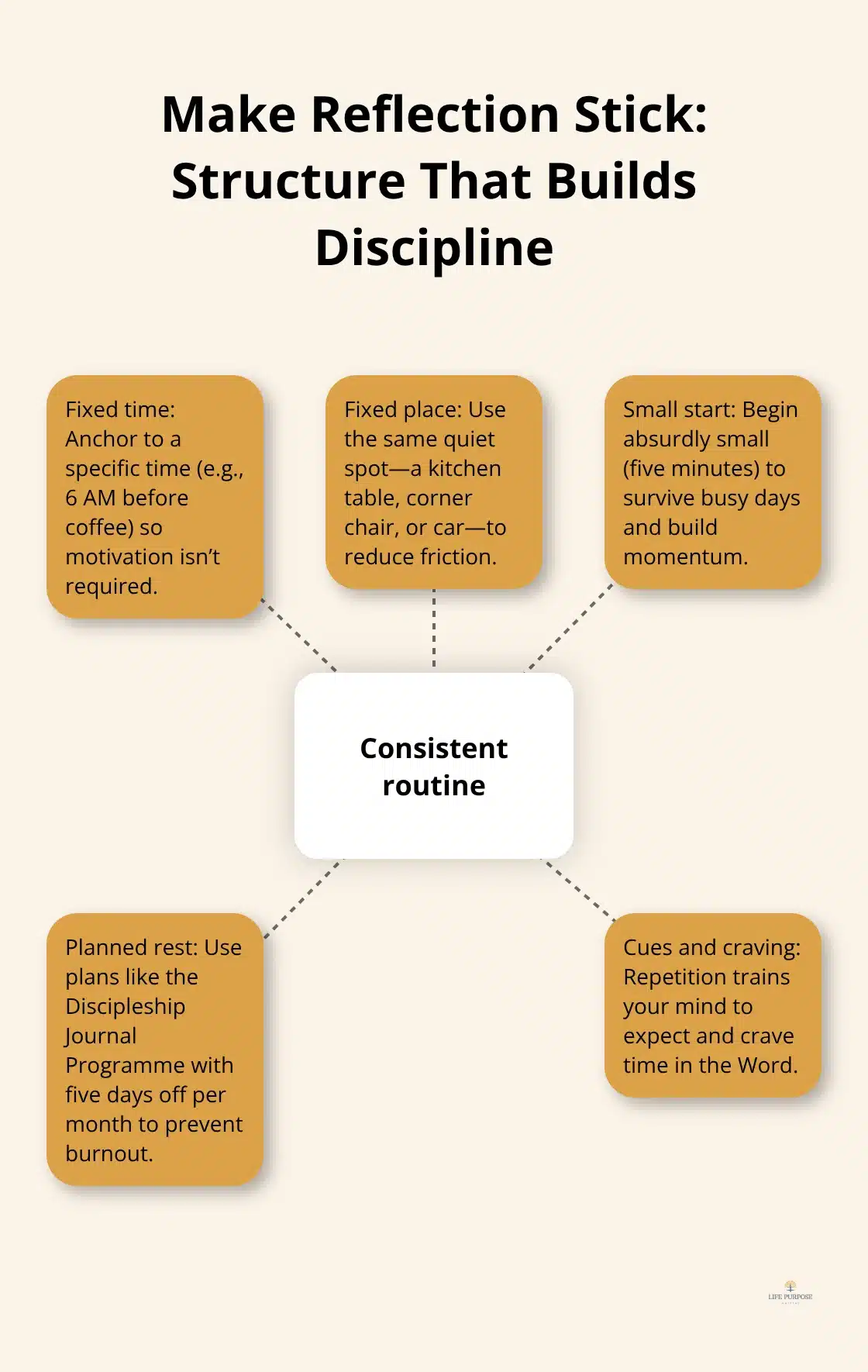
This is why consistent scripture reflection builds spiritual discipline in a way that casual Bible reading never does. Discipline isn’t about white-knuckling your way through a daily habit. It’s about creating a structure that makes reflection so natural that skipping it feels wrong. When you assign a specific time-say, 6 AM before your coffee-and a specific place-maybe the kitchen table or a corner chair-your brain stops requiring motivation. You just show up. The Discipleship Journal Bible Reading Programme from the Navigators actually builds this in by offering five days off per month for rest or catch-up, which prevents burnout while maintaining momentum. Over time, this consistency trains your mind to expect and crave that time with God’s Word.
When Scripture Moves From Knowledge to Life Change
You’ll notice yourself thinking about passages throughout the day, recognising how they apply to conversations you’re having or decisions you’re facing. That’s not coincidence. That’s your brain working on what you’ve planted through reflection. A passage about forgiveness stops being an abstract principle and becomes a specific challenge about forgiving your coworker. A verse about anxiety becomes your anchor when you’re lying awake at 3 AM. Scripture reflection turns God’s Word from something you know about into something you know, something that shapes your choices, your responses, and ultimately who you become.
Now that you understand why reflection matters, the question becomes: how do you actually build a routine that sticks?
Building Your Reflection Routine From Scratch
Start Absurdly Small
The biggest mistake people make when starting a scripture reflection routine is trying to be perfect from day one. They set an ambitious 6 AM wake-up time, commit to thirty minutes of study, and plan to journal three pages daily. Life happens-a sick kid, a work crisis, a late night-and the whole routine collapses within two weeks. Instead, start absurdly small. Choose one specific time that already exists in your day. Not a time you wish existed. Not a time that requires waking up earlier or sacrificing something else. If you drink coffee every morning, sit with your Bible for five minutes during that coffee. If you have a lunch break at work, use ten minutes of it. The Navigators’ Discipleship Journal Bible Reading Programme understands this reality. It builds in five days off per month, which tells you something important: consistency matters infinitely more than intensity. A five-minute daily habit beats a sixty-minute habit you abandon after three weeks.
Claim Your Space
Find your existing anchor point in the day and attach your routine to it. Then find your space. This doesn’t need to be a dedicated prayer room or a special chair. It needs to be a place where you can actually think without interruption. Your bedroom works. Your car before work starts works. A coffee shop corner works. What doesn’t work is wherever you usually multitask. Your routine will fail if you also watch your phone or half-listen to background noise. Claim fifteen minutes of actual quiet, even if it means closing a door, putting your phone in another room, or arriving at work ten minutes early.
Read Passages Repeatedly
Once your time and space are locked in, select a single passage and read it multiple times over several days rather than racing through new material. Pick something short-a paragraph, a few verses, maybe one chapter. Read it once without writing anything down. Read it again the next day and notice what stands out. On day three, read it a third time and ask yourself what you actually notice about the words, the context, the meaning. This repetition forces your brain to engage at a deeper level than a single read-through ever could. Biblical meditation involves slow, deep reflection on Scripture’s meaning, allowing yourself to move beyond surface-level reading.
Write Without Perfection
Then move to journaling, which isn’t about writing beautifully or theologically correctly. Write like you’re texting a friend. What does this passage make you think about? Where does it connect to something happening in your life right now? What question does it raise? What feels uncomfortable or challenging about it? The act of writing slows your thinking down enough to actually process what you’re reading. You’ll notice patterns in your own thoughts when you write them down. You’ll catch yourself avoiding certain truths or getting stuck on specific questions. That’s the work happening.
Ask the Same Reflective Questions
Finally, develop three or four reflective questions you ask about every passage. Something like: What is God saying here? How does this challenge me today? What would change if I actually believed this? What’s one small action could I take based on this passage? Ask the same questions repeatedly. Your brain will start automatically looking for answers to these questions when you read, which means you’re no longer passively consuming scripture-you’re actively interrogating it. This consistency in your questioning approach creates a framework that transforms how you engage with God’s Word. Once you’ve built this foundation, you’re ready to explore specific methods that deepen your reflection even further.
Four Methods That Actually Work
The routine you’ve built provides structure, but structure alone doesn’t guarantee depth. You need a method that guides your thinking so you’re not just sitting with a passage wondering what to do next.
The SOAP Method: Systematic and Straightforward
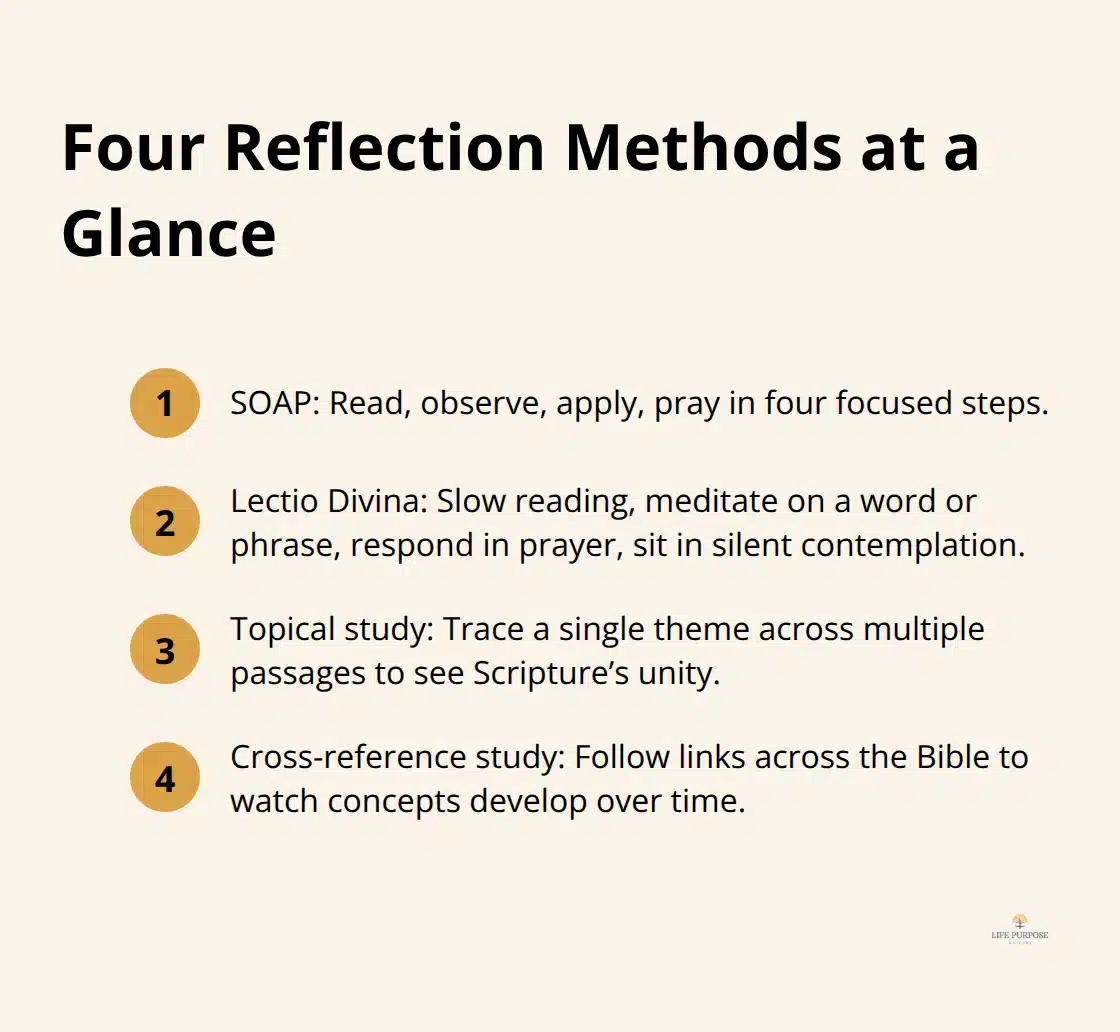
The SOAP method works exceptionally well for people who think systematically. You read the Scripture passage first, then write down your observations about what actually stands out in the text itself-the repeated words, the context, who’s speaking, what seems surprising. Next, you identify one specific application to your life right now, not someday, not theoretically. Finally, you pray about what you’ve learned. The beauty of SOAP is its simplicity. You’re not wrestling with theological complexity. You’re just moving through four concrete steps that force your brain to engage differently with each pass through the text. Many people who use SOAP report that after a few weeks, they naturally start asking these questions without writing them down, which means the method has trained your thinking.
Lectio Divina: Embracing Slowness and Listening
Lectio Divina takes the opposite approach. Instead of a structured formula, it’s an ancient four-step practice that emphasises slowness and listening. You read the passage slowly, then meditate on it by letting a specific word or phrase occupy your mind. You respond through prayer, speaking directly to God about what the passage stirred in you. Finally, you contemplate in silence, sitting with what God might be saying without trying to force understanding. This method works best for people who find SOAP too rigid or who struggle with the pressure of coming up with applications. Lectio Divina gives you permission to simply listen and embrace the slower pace of spiritual formation.
Topical Study: Tracing Themes Across Scripture
Topical study takes you in a different direction entirely. Instead of working deeply with one passage, you pick a theme-forgiveness, anxiety, trust, identity-and trace it across multiple passages throughout Scripture. You might spend a week on forgiveness, reading what Jesus said about it in Matthew, what Paul wrote about it in Colossians, what the Psalms reveal about it. This method reveals how God’s Word circles back to the same truths from different angles. It’s particularly powerful when you’re wrestling with something specific in your life because you see how Scripture addresses that issue from multiple perspectives.
Cross-Reference Study: Following the Connections
Cross-reference study works similarly but more systematically. When you encounter a passage that references another passage, you follow those connections. Most Bibles include cross-references in the margins or footnotes. Tools like Blue Letter Bible make this even easier by showing you every passage that connects to the one you’re reading. Following these connections transforms your understanding because you see how a single concept builds throughout Scripture (one word might appear in Genesis, reappear in the Psalms, and take on new meaning in the New Testament).
Choosing Your Method and Committing to It
Try one method and commit to it for at least two weeks before switching. Your brain needs time to settle into the rhythm. Most people discover that one method resonates more deeply than the others, and that becomes their primary approach. Some people even combine methods-using SOAP for weekday study and Lectio Divina on weekends, or alternating topical study with cross-reference work depending on what Scripture passage they’re exploring.
Final Thoughts
Your faith transforms when you commit to scripture reflection routines that anchor you in God’s Word. The passages you read on Monday morning become the anchor you grab on Wednesday when anxiety hits, and the verse you journal about becomes the lens through which you see a conflict with a friend. This practice reshapes how you think, how you respond, and ultimately who you become-not through perfection, but through consistent, intentional engagement with Scripture.
Starting today requires nothing more than one time, one place, and one passage. Spend five minutes with it tomorrow morning, write three sentences about what it makes you think, and ask yourself one reflective question. That simple act plants the seed, and the discipline builds naturally from there as you show up day after day in that same quiet space. The transformation follows not because you white-knuckle your way through a routine, but because you’ve created a structure that makes reflection feel like the most natural part of your day.
Visit Life Purpose Matters to explore resources and encouragement for your spiritual growth journey. We exist to support exactly this kind of deeper engagement with your faith and your God-given purpose.