

Last night, you stared at the ceiling for two hours, your mind spinning with tomorrow’s worries while your body refused to cooperate. Sound familiar? At Life Purpose Matters, we’ve found that countless people struggle with sleep, not because they lack a comfortable bed, but because they lack peace. That’s where restful sleep scripture comes in. The Bible offers profound wisdom about rest that goes far deeper than counting sheep or adjusting your pillow.
Why Scripture Reframes How You Sleep
God Built Rest Into Your Design
The Bible doesn’t treat sleep as a luxury or a sign of laziness-it frames rest as a divine design. God built sleep into human biology as an act of restoration, not a waste of time. Genesis 2:3 shows God rested on the seventh day, establishing the pattern that rest holds sacred value. When you struggle to sleep, you’re not just fighting fatigue; you’re fighting against God’s intentional design for your body and mind. Ecclesiastes 5:12 states that the sleep of a labourer is sweet, meaning your rest directly fuels your capacity to function the next day. This isn’t theoretical: Sleep deprivation costs the American economy roughly $411 billion annually in lost productivity, according to research published by the RAND Corporation. When you neglect sleep, you’re not being more productive; you’re sabotaging your physical health, mental clarity, and spiritual resilience. Psalm 127:2 declares that God gives sleep to those He loves. This means your nighttime rest isn’t something you earn through willpower-it’s a gift meant to be received.
Sleep as Divine Protection, Not Just Physical Recovery
Throughout Scripture, sleep appears alongside God’s protection and guidance. Psalm 4:8 promises that you will lie down and your sleep will be sweet because God alone makes you dwell in safety. This isn’t poetic language divorced from reality; it addresses the actual anxiety that keeps people awake. Studies from the American Academy of Sleep Medicine show that anxiety disorders affect roughly 40 million American adults. When you apply Psalm 4:8 before bed-visualising yourself in God’s protection-you redirect your nervous system away from threat detection and toward calm. Psalm 91:5 promises that you will not fear the terror of night, directly addressing the specific fear that grips people in darkness. The practical application here is straightforward: when nighttime anxiety surfaces, recite this verse aloud or write it on a notecard beside your bed. This grounds your mind in truth rather than allowing it to spiral into what-ifs.
Trust Transforms Your Nighttime Experience
Biblical examples reinforce this pattern powerfully. In Matthew 8:24, Jesus sleeps through a violent storm while His disciples panic, demonstrating that genuine rest flows from trust, not from circumstances being perfect. His calm in chaos reveals a fundamental truth: your sleep quality depends far more on your faith than on your environment. When you internalise this reality, you stop waiting for perfect conditions and start cultivating the inner peace that actually produces rest. The verses we’ve explored so far point toward a deeper shift-one that moves you from anxiety-driven nights to faith-anchored sleep.
This transformation happens not through willpower alone, but through specific Scripture passages and practices that rewire how you approach bedtime itself.
Powerful Scripture Passages for Better Sleep
Transform Worry Into Prayer
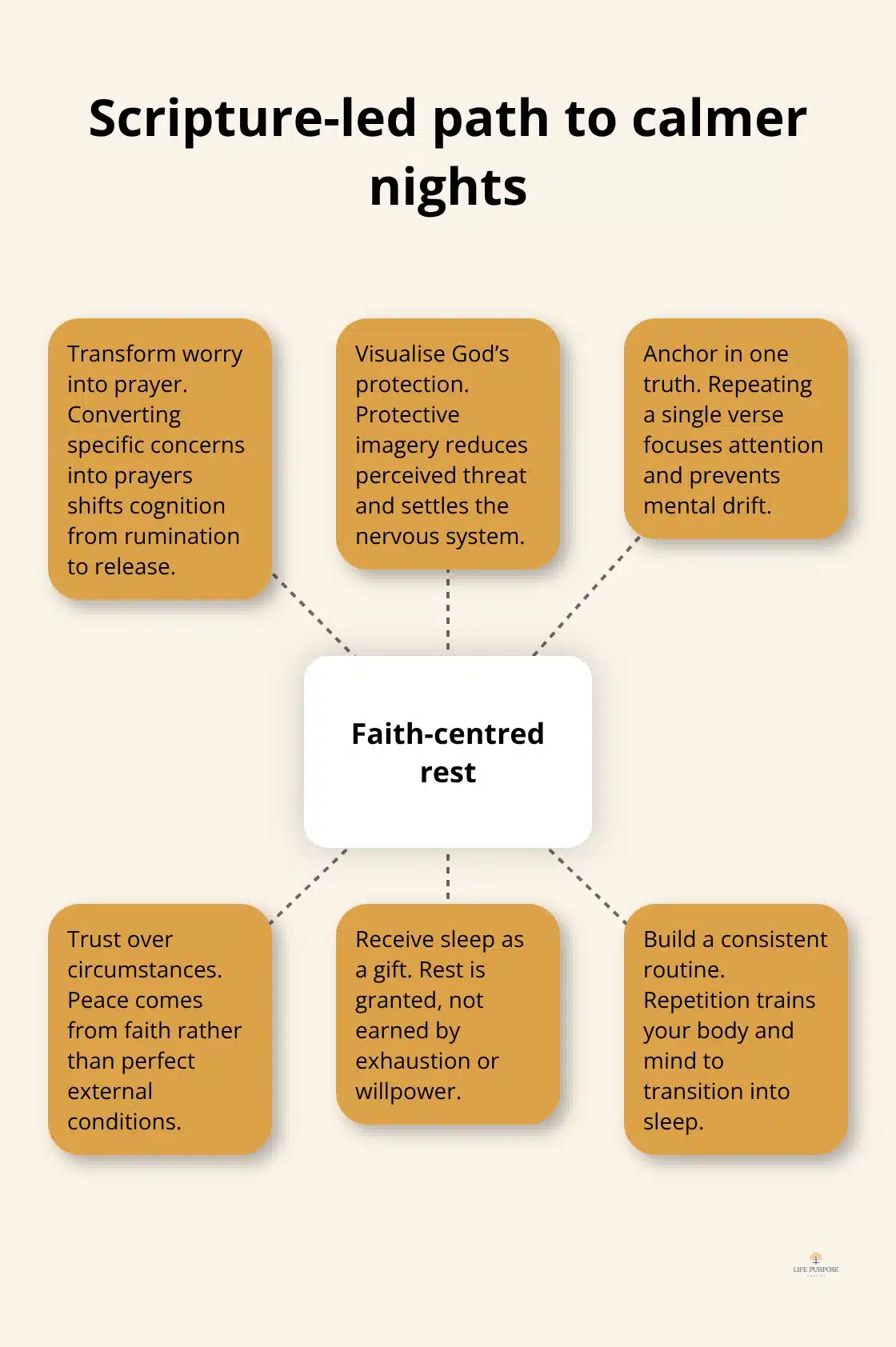
Philippians 4:6-7 stands out as the most actionable passage for bedtime anxiety because it offers a direct mechanism for change. The verse instructs you to transform worry into prayer, then promises that God’s peace will guard your heart and mind. This isn’t passive comfort-it’s a two-minute practice you can implement tonight. When anxiety surfaces at 2 a.m., write down what’s troubling you, then spend two minutes converting each worry into a specific prayer. Research from the Journal of Clinical Psychology shows that cognitive restructuring reduces nighttime wakefulness by an average of 19 minutes per night.
Psalm 56:3 reinforces this directly: when fear arises, you can trust in God’s word. The practical application is memorising one verse that addresses your specific bedtime fear. If you worry about the future, Matthew 6:34 states that each day has enough trouble of its own. If you fear abandonment, Psalm 27:10 promises that though your mother and father forsake you, the Lord will receive you. Write your chosen verse on a card and place it on your nightstand where you’ll see it during anxious moments.
Visualise God’s Protection
Psalm 91 and Psalm 4:8 address nighttime protection specifically, which matters because fear of darkness and vulnerability peak at night. Psalm 91:1-2 describes dwelling in God’s shelter, and sleep apps that feature Bible-based content use this passage in their sleep stories to help users visualise protective imagery before drifting off. The visualisation technique works because your brain cannot simultaneously generate vivid protective imagery and anxious thoughts. As you lie in bed, mentally construct a fortress or shelter around yourself, filling in sensory details: the texture of stone walls, the warmth of safety, the absence of threat.
Psalm 4:8 adds a vital element by connecting safety to peaceful sleep-you will lie down, and your sleep will be sweet. This verse directly counters the belief that sleep is something you must earn through exhaustion. Instead, it frames rest as something granted when you feel secure.
Anchor Your Mind in One Truth
Isaiah 26:3 promises perfect peace for minds kept steadfast on God, which means your pre-sleep routine should anchor your thoughts in one truth rather than allowing them to wander across multiple worries. Spend your final five minutes before sleep repeating a single verse aloud or silently, letting it become the last conscious thought before you close your eyes. This focused approach prevents your mind from cycling through the day’s stressors and instead plants a seed of faith that grows as you drift toward sleep. The specificity matters-one verse works far better than rotating through several passages, as your brain needs consistency to shift out of alert mode.
These passages form the foundation for practical application, and the next section reveals exactly how to weave them into your nightly routine, so they actually produce results.
Making Scripture Your Nightly Anchor
Select Three Verses That Match Your Struggles
The gap between knowing a verse and actually using it at 2 a.m. is where most people fail. You need a system, not just good intentions. Start by selecting exactly three verses that address your specific sleep barriers. If worry dominates your nights, choose Philippians 4:6-7. If fear of the dark surfaces, pick Psalm 91:1-2. If you wake with racing thoughts about tomorrow, memorise Isaiah 26:3. Write these three verses on separate notecards and place one on your nightstand, one in your bathroom mirror, and one on your phone’s lock screen. This repetition forces your brain to internalise the passage rather than simply reading it once and forgetting it by bedtime.
Build Your 30-Minute Pre-Sleep Routine
Research from the Sleep Foundation shows that people who establish a consistent pre-sleep routine fall asleep faster on average than those without structure. Your routine should start 30 minutes before bed, not at the moment your head hits the pillow. Spend the first 10 minutes reading your selected verse slowly, then the next 10 minutes converting any surface-level worries into specific prayers using the Philippians 4:6-7 framework. Write down what troubles you, then write how you’re entrusting it to God.
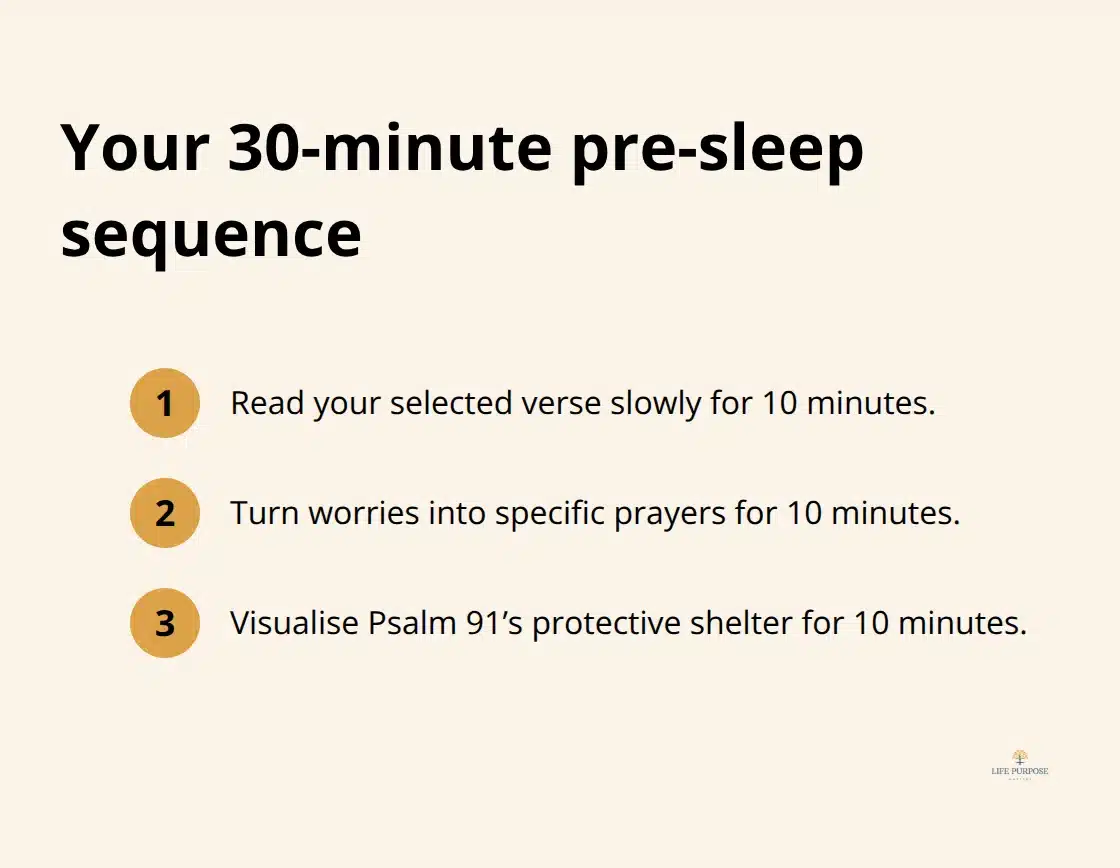
The final 10 minutes should involve visualisation-close your eyes and mentally construct the protective shelter described in Psalm 91, filling in sensory details until your nervous system genuinely feels safer. This three-step sequence rewires your brain’s transition from wakefulness to sleep by giving it a clear, repeatable path forward.
The Abide app offers Bible-based sleep stories that integrate these exact verses into guided narratives, giving you an alternative if sitting in silence with your thoughts feels overwhelming.
Commit to Consistency Over Intensity
Consistency matters far more than intensity. A 20-minute routine executed five nights per week produces better results than a 60-minute marathon session once a month. Track your routine for two weeks using a simple calendar where you mark each night you complete it. Research from the British Journal of General Practice found that habits solidify after approximately 66 days of consistent practice, so expect your routine to feel natural around mid-March if you start in January.
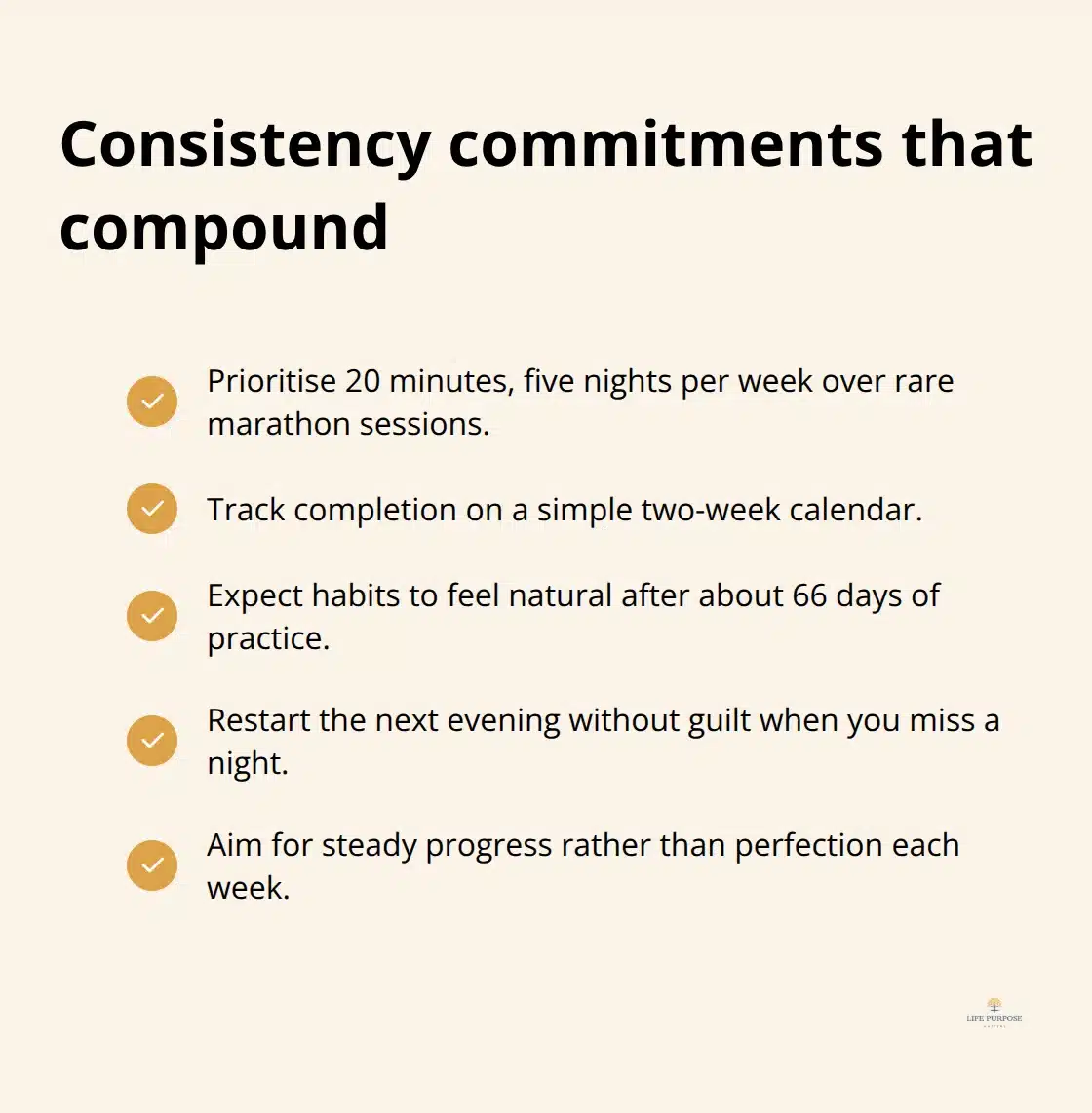
When you miss a night, restart the next evening without guilt or self-criticism-the goal is establishing a sustainable pattern, not achieving perfection.
Many people sabotage their progress by abandoning the routine after one missed night, treating it as failure rather than a temporary interruption. Instead, view sleep scripture practice as a skill that improves with repetition. Your first week will feel awkward and mechanical. Your second week will feel slightly more natural. Your fourth week will feel genuinely calming. The transformation happens gradually, which is why people who expect instant results often quit too early.
Eliminate Screen Interference Before Sleep
One final practical element: eliminate your phone from the bedroom entirely 30 minutes before sleep, or at a minimum switch it to aeroplane mode. The blue light from screens suppresses melatonin production according to research from Harvard Medical School, directly undermining the calming effect of your scripture practice. Your bedside notecards and a physical Bible or printed verses should be your only reading materials during this wind-down period. This removes the temptation to check emails or news and keeps your mind focused on the specific verses designed to anchor your sleep.
Final Thoughts
The shift from sleepless nights to restful mornings happens when you stop forcing sleep and start receiving it as God’s gift. Restful sleep scripture rewires your brain by anchoring your thoughts in truth rather than anxiety, and your nervous system responds when you lie down with Psalm 4:8 on your mind instead of tomorrow’s deadlines. Within three to four weeks of consistent practice, you’ll fall asleep faster, wake fewer times during the night, and experience genuinely restorative rest.
Select three verses that address your specific sleep barriers and place them where you’ll see them during anxious moments. Build a 30-minute pre-sleep routine that combines reading, prayer, and visualisation, then commit to consistency rather than perfection-missed nights don’t erase your progress. The verses you choose become your personal anchor, the practice becomes your reliable refuge, and sleep becomes what it was always meant to be: a time of restoration and divine care.
We at Life Purpose Matters believe that integrating faith into every area of your life, including sleep, deepens your spiritual journey and strengthens your connection with God. Visit Life Purpose Matters to explore tools designed to support your spiritual growth and help you live out your faith daily. Your better nights and brighter days are waiting.