

Last Tuesday, a parent told me they felt completely lost when their eight-year-old asked why God allows bad things to happen. They wanted to raise spiritually minded kids, but didn’t know where to start at home.
In Christian parenting, raising “spiritually minded” kids is essential for cultivating a lasting relationship with God, developing a biblical worldview in a secular culture, and fostering emotional resilience. It focuses on nurturing a child’s eternal soul and developing character, rather than just behaviour management, passing on a transforming faith.
It is about shifting the focus from merely managing outward behaviour to nurturing a child’s internal connection with God. It is a way to prepare children for their eternal purpose rather than just immediate social success.
We at Life Purpose Matters hear this concern often. The truth is, building a faith-centred household doesn’t require perfection or complicated strategies-it requires intentional, everyday choices that show your children what faith actually looks like in real life.
Building Daily Faith Into Your Home
Faith Happens in Ordinary Moments, Not Perfect Ones
Your faith won’t stick in your kids’ minds through lectures or Sunday-only religion. Research shows that parental religiosity and faith practices are linked to higher resilience and lower parental stress, with direct positive effects on parenting satisfaction and marital harmony. The real work happens in the ordinary moments at your kitchen table, in the car, and before bed. Most families struggle because they wait for the perfect moment to talk about faith, but perfect moments rarely arrive. Instead, weave short prayer moments into existing routines. Before meals, pause and pray together. Before bed, ask your kids what made them feel happy that day and connect it to God’s goodness. Before leaving for school, offer a quick blessing. These micro-moments compound over time and become the spiritual foundation your children internalise without resistance.
Start With a Simple Nightly Gratitude Practice
A nightly gratitude practice where each family member shares one thing they’re thankful for takes five minutes and costs nothing, yet it trains your children to notice God’s presence throughout their day. This single habit shifts how kids perceive their world-they start looking for reasons to be grateful rather than focusing on what’s missing. The practice also normalises talking about faith as a regular part of family life, not something reserved for church or formal settings.
Make Scripture Feel Natural, Not Formal
Scripture doesn’t have to feel formal or heavy. When your child asks why they should share their toys, connect it to a simple Bible story like the Good Samaritan rather than lecturing about generosity. Take nature walks and point out details-spider webs, changing leaves, bird songs-and ask your kids what these reveal about God’s creativity. Keep a prayer jar in your kitchen where family members write prayer requests or thank-yous, then read a few each day. Make story time a gateway to faith by reading tales with positive moral themes from various spiritual traditions, which broadens your child’s worldview while keeping conversations age-appropriate.
Answer Questions With Openness, Not Preaching
When your kids ask tough questions about suffering or doubt, answer with openness and curiosity instead of preaching. Research shows that religious norms emphasising family time foster high-quality interactions and stronger parent-child attachment. Your children absorb your actions and attitudes far more than your words, so model genuine, mindful, values-driven living rather than aiming for perfection. Attend church together regularly, not as a box to check but as a chance to belong to a community that reinforces what you’re teaching at home. This community connection matters because it shows your kids that faith extends beyond your four walls.
What Does Faith Actually Look Like in Action
Kids don’t learn faith from what you tell them to believe-they learn it from watching how you handle conflict, money, disappointment, and other people. When your child sees you lose your temper in traffic and then apologise, they witness what repentance looks like. When they watch you give to someone in need, even though your budget is tight, they see generosity in real time. Research shows that religious parenting leads to more responsive, affectionate parent-child interactions and higher child well-being, meaning kids thrive when faith shapes how parents behave. The gap between what you preach and what you practise is the first thing children notice. If you talk about forgiveness on Sunday but hold grudges on Monday, your kids will absorb the hypocrisy faster than they absorb the lesson. Start examining your own decisions through a faith lens before you expect your children to do the same. When you face a choice, ask yourself what your faith teaches about it, then let your kids see that process. Talk out loud about why you chose honesty over convenience, or generosity over self-protection. This doesn’t mean performing perfection-it means showing your kids that faith actually shapes how you live, even when it’s difficult.
Real Situations Teach Values Better Than Lectures
The moment your child lies about breaking a cup or excludes another kid at school is your real classroom. These ordinary situations teach biblical values far better than any formal lesson. Instead of saying kids should be honest because the Bible says so, address the broken cup situation and connect it to why honesty matters to God and to your family. Ask your child how they would feel if someone lied to them, then link that to the Golden Rule. When your child struggles with jealousy toward a sibling’s new toy, use it as a chance to talk about contentment and gratitude. Research on family faith activities shows that when families participate in group religious rituals together, adolescents report higher psychological well-being and lower substance use, which suggests that faith-based conversations during real moments create lasting change. Establish a practise where you share highs and lows from your day at dinner and connect them to your faith. Ask what situations challenged them and how their faith could guide their choices. This turns daily life into spiritual formation.
Service Transforms Faith From Abstract to Real
Kids who only talk about faith but never live it out through service will eventually see faith as irrelevant to real life. Commit your family to concrete acts of service, not someday, but this month. Bake for nursing home residents, create care kits for unhoused people in your community, or write encouraging notes to teachers. Make the service meaningful (have your kids help plan it and discuss afterwards why Jesus emphasised serving others). When children serve alongside their parents, they internalise that faith compels action. They also develop compassion because they interact directly with people different from themselves. The Fruits of the Spirit-love, joy, peace, patience, kindness, goodness, faithfulness, gentleness, and self-control-aren’t abstract virtues to memorise; they’re qualities that develop through practise. When your child shows kindness to someone, acknowledge it and connect it explicitly to the Spirit’s work in their life. This reinforces that faith produces visible, measurable change in how they treat others. As your children watch faith shape your decisions and see it lived out through your family’s service, they begin to understand that faith isn’t something you believe-it’s something you do, which prepares them to navigate the doubts and difficult questions that inevitably arise.
When Kids Ask the Hard Questions
Your ten-year-old watches the news and asks why God lets people suffer. Your six-year-old wonders why their friend’s family doesn’t believe in Jesus. Your teenager scrolls through social media and encounters arguments against faith she’s never considered. These moments terrify many parents because they assume doubt means failure, but doubt is actually where real faith develops. Honest conversations about faith create stronger believers than comfortable silence ever could.
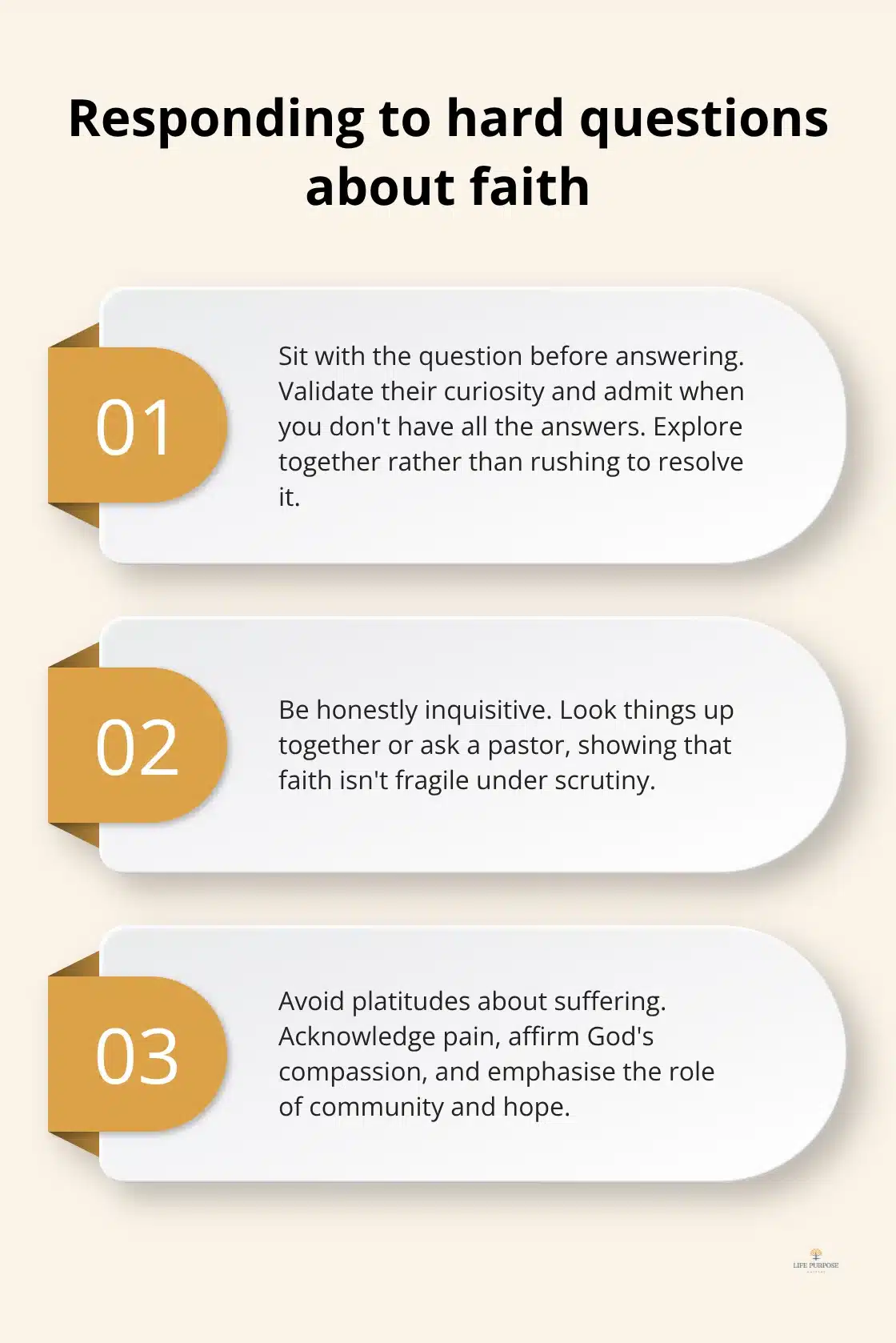
Research shows that when parents address questions with openness and curiosity rather than defensive answers, children develop resilience and deeper conviction.
Sit With Questions Instead of Rushing to Answer
Start by shifting your mindset. Doubt isn’t the enemy of faith-avoidance is. When your child asks a tough question, resist the urge to immediately provide the perfect theological answer. Instead, sit with the question. Say things like: “I don’t have all the answers, but let’s think about this together” or “That’s a really important question, and I’m glad you asked me.” This approach teaches your child that faith survives scrutiny and that you value their thinking more than blind agreement.
If you don’t know the answer, say so. Look it up together, call your pastor, or discuss it over the next few days. This models intellectual honesty and shows your child that faith isn’t fragile. When addressing suffering specifically, avoid platitudes. Don’t say everything happens for a reason or God needed another angel. Instead, acknowledge that suffering is real and painful, that God grieves with us, and that faith doesn’t eliminate hardship but gives us community and hope within it. Teenagers especially need this honesty because they can spot shallow answers immediately.
Expose Your Child to Different Perspectives in Safe Settings
Protecting your child’s faith doesn’t mean isolation-it means engagement. The instinct to shield kids from opposing viewpoints often backfires because they eventually encounter those ideas anyway, unprepared. Instead, expose your child to different perspectives in safe settings where you can discuss them together. Watch a documentary about world religions as a family and talk about what you observe. Read age-appropriate books that raise spiritual questions.
When your child encounters an atheist argument online or a friend challenges their beliefs at school, they won’t panic because you’ve already normalised these conversations at home. Set clear boundaries about screen time and content, but do it transparently. Explain why you’re concerned about certain influences and what you’re protecting them from, rather than simply forbidding things. A teenager who is told no is far more likely to seek out forbidden content than one who understands the reasoning.
Build Community Around Your Child’s Faith Journey
Find a church community that welcomes questions and employs trained staff to work with children and teenagers. Some churches offer youth groups specifically designed to address doubts, peer pressure, and real-world faith challenges. Ask your pastor whether your church provides resources for teens navigating secular environments. If your current church doesn’t offer this, consider whether another congregation in your area does.
Community matters enormously here-your child needs to see peers their age living out faith authentically, not just hearing about it from you. Connect with other families who share your values. These relationships become anchors when your child feels isolated for their beliefs at school. Practical steps include joining a church small group focused on parenting, attending family events at your faith community, and intentionally building friendships with families who prioritise faith conversations. Your child will feel less alone when they know other kids navigate the same questions and challenges. The goal isn’t to eliminate doubt or shield your child from the world-it’s to equip them with honest answers, trusted adults to ask, and a community that supports their journey toward owned faith rather than inherited faith.
Final Thoughts
Raising spiritually minded kids doesn’t require perfection or rigid formulas-it demands consistent presence, honest answers, and faith that shapes how you actually live. The practises throughout this post work together to create an environment where faith becomes natural rather than forced, and your children develop their own conviction rather than simply inheriting yours. Research shows that when parents prioritise their spiritual lives and involve their families in faith practises, kids develop stronger resilience, better emotional health, and clearer values that extend well into adulthood.
The most important step you can take right now isn’t adding more activities to your schedule-it’s committing to your own spiritual growth. Your children absorb your authenticity far more than your perfection, and if you struggle with your own faith, that becomes your starting point, not your disqualification. Examine your relationship with God, address your own doubts, and let your kids witness you wrestling with faith honestly, which models that faith is a living journey rather than a destination.
Start small this week by choosing one practice: a nightly gratitude moment, a prayer before meals, or a conversation about what faith means to your family. Life Purpose Matters offers resources designed to support your spiritual journey as a parent and help you integrate faith more fully into your daily rhythms. One prayer, one honest conversation, and one family moment at a time, you shape not just your child’s beliefs but their entire approach to living with purpose and meaning.