

I still remember a while back when my friend Zainab asked me about my faith at a coffee shop. My stomach dropped. I froze. All I could think was: what if I say the wrong thing? What if she thinks I’m weird?
Gospel sharing without fear or awkwardness involves building genuine relationships, listening well, and sharing personal stories of faith rather than treating it as a high-pressure sales pitch. Focus on being a “good news bearer” by highlighting how God has impacted your life, relying on the Holy Spirit for boldness, and engaging in natural conversations.
Sharing the gospel doesn’t have to feel like walking a tightrope. At Life Purpose Matters, we’ve found that most people’s anxiety comes from overthinking the moment rather than from any real barrier between you and a genuine conversation about what matters most.
Understanding Your Fear of Gospel Sharing
Why Your Fear Feels So Real
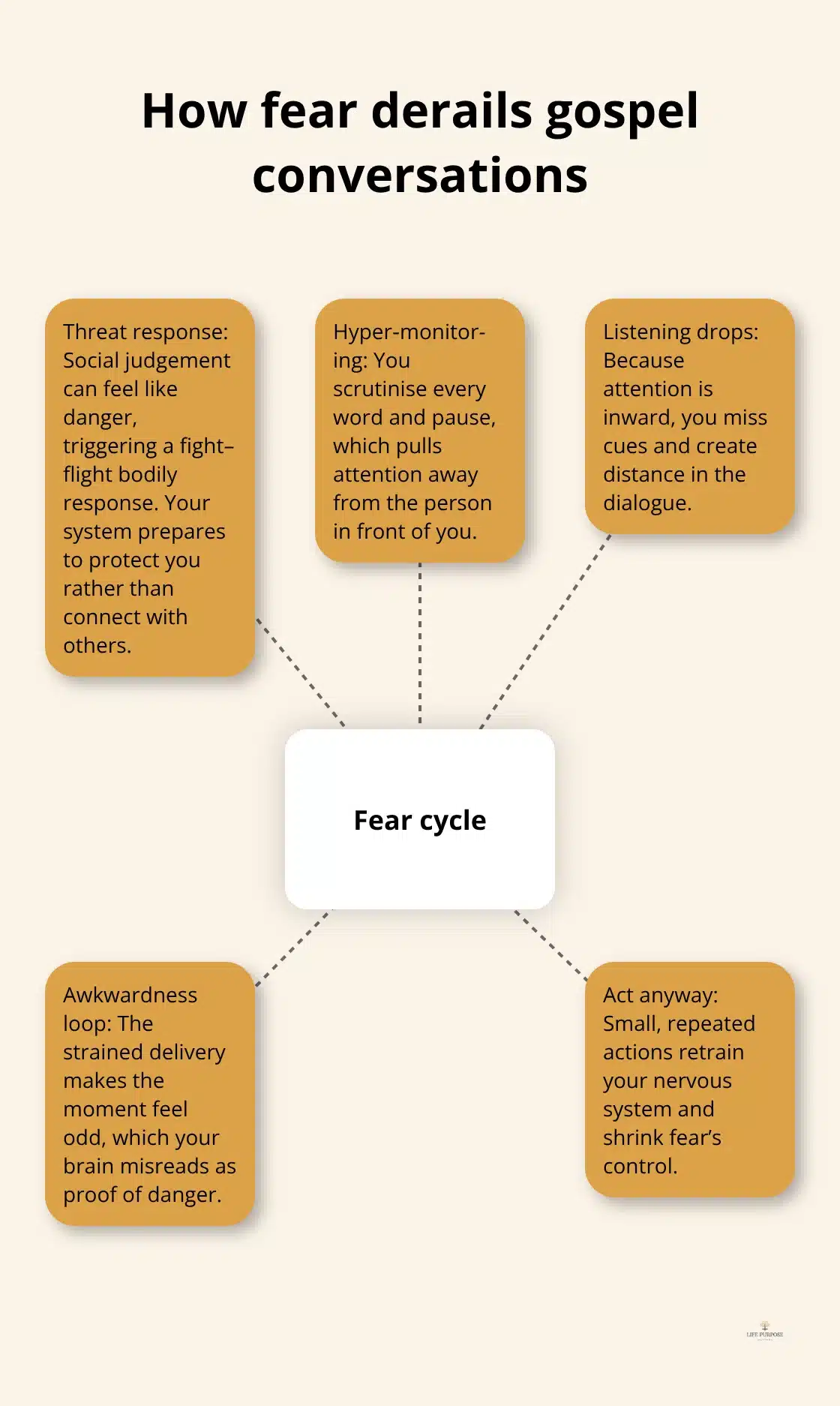
The anxiety you feel before sharing your faith isn’t imaginary, and it’s definitely not a character flaw. Research on social anxiety shows that fear of judgement activates the same neural pathways as physical danger, which explains why your chest tightens when you consider bringing up Jesus with someone. Your brain isn’t overreacting-it’s doing exactly what it was designed to do. The problem is that this protective mechanism, while useful for avoiding actual threats, sabotages conversations that could genuinely help someone.
When you’re afraid, you become hyperaware of every word choice, every pause, every facial expression. You start monitoring yourself instead of listening to the other person. This self-consciousness creates the very awkwardness you’re trying to avoid. The irony is brutal: your attempt to prevent discomfort actually produces it.
What Fear Really Steals From You
Fear doesn’t just make conversations uncomfortable for you-it prevents the other person from hearing something that might change their life. When you stay silent about your faith, you make a decision for someone else about what they’re ready to hear. You assume they’ll judge you when most people are actually curious about what makes someone tick spiritually.
Personal evangelism shows that people who hear the gospel message often report being surprised by how natural the conversation felt, yet the person sharing was terrified beforehand. Your fear rests on a worst-case scenario that rarely happens. Meanwhile, your silence guarantees that this particular moment of connection won’t happen at all. That’s the real loss.
Fear Is a Spiritual Problem, Not a Social One
The Bible doesn’t treat fear of sharing faith as a personality quirk that shy people naturally have. It treats it as something to actively resist. Paul wrote to Timothy about how God didn’t give us a spirit of fear, but of power and love and self-discipline. That’s not motivational poster language-that’s Paul directly addressing the specific anxiety you’re experiencing right now.
When you hesitate to share your faith, you step into agreement with a lie that says your comfort matters more than someone’s eternity. That sounds harsh, but it’s true. The good news is that this fear responds to action. People who regularly share their faith report that the fear doesn’t disappear-it just stops controlling their decisions. They speak up anyway. Each conversation makes the next one slightly easier because reality replaces the catastrophic predictions your anxious brain keeps making.
How Action Breaks the Fear Cycle
The path forward isn’t complicated. You don’t need a perfect theology degree or a rehearsed speech. You need to act despite the fear. Every time you choose to speak up, you gather evidence that contradicts what anxiety told you would happen. Your nervous system learns that gospel conversations don’t result in rejection or humiliation. Instead, you find that people respond with curiosity, openness, or at worst, polite disagreement. None of these outcomes match the catastrophe your fear predicted.
This is where genuine relationships become your greatest asset. When you’ve invested time in someone’s life and shown authentic care for them, the conversation about faith flows naturally from that foundation. They already know you’re not trying to manipulate them-you’ve demonstrated genuine interest in their wellbeing. That trust transforms how they receive what you share.
How to Actually Start a Gospel Conversation
Listen First, Talk Second
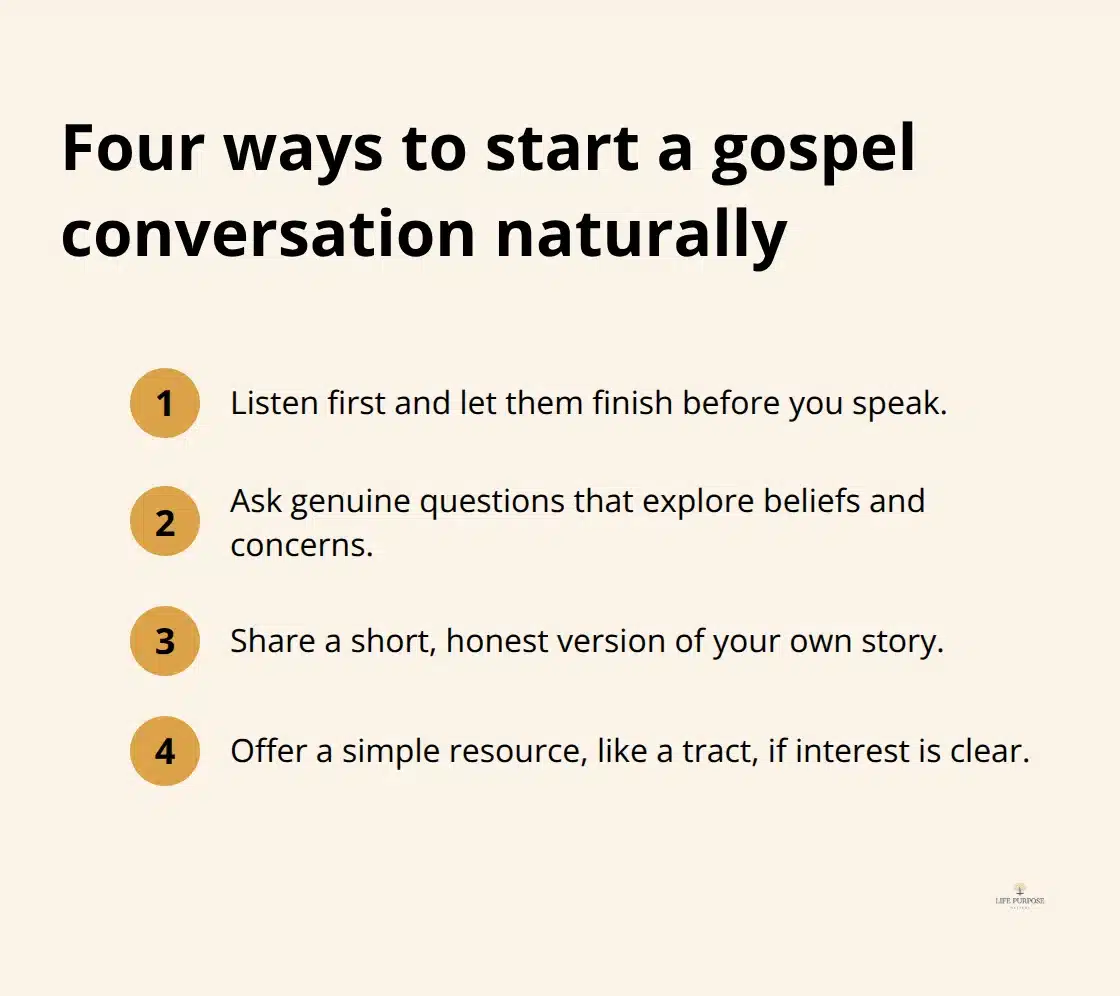
The fear you felt in the last chapter comes partly from imagining what you’ll say. Stop imagining. Start listening instead. Most people who struggle with gospel sharing talk too much and listen too little. They rehearse their pitch, wait for a pause, then launch into their prepared statement. The other person feels like they’re receiving a monologue rather than having a conversation. Flip this completely. Ask genuine questions about what someone believes, what they’re struggling with, or what they think about God. Questions accomplish two critical things: they keep the other person engaged, and they give you information about where they actually are spiritually. When someone tells you they don’t believe in God, you now know you’re not starting from scratch explaining who Jesus is. When they mention their kid is sick, you’ve found a natural entry point to talk about prayer and faith. The best gospel conversations feel like normal dialogue because you respond to what the other person actually cares about, not what you prepared ahead of time.
Lifeway Research found that people who regularly share their faith do so through natural conversation rather than formal presentations. They ask questions, listen to answers, and then weave faith into the response. This approach works because it honours the other person’s actual thoughts and concerns.
Tell Your Real Story, Not a Script
Your personal story matters far more than theological perfection. If someone asks what your faith means to you, don’t recite doctrine. Tell them what changed in your life when you started following Jesus. Did you find peace? Purpose? A reason to get out of bed on hard mornings? That’s your story. Write down three versions: a 30-second version for casual moments, a two-minute version for deeper conversations, and a five-minute version if someone wants more detail. Practice these out loud, not in your head. When you speak them aloud, you hear what sounds natural versus what sounds like a script. Your real story is powerful because it’s specific to you. Someone might not care about abstract theology, but they’ll listen when you explain how faith changed your actual life.
Recognise the doorways already around you
The everyday moments are already there. You don’t need to manufacture opportunities. A coworker mentions they’re stressed about their marriage. A barista asks how your day is going. Someone at the gym mentions they feel lost. These aren’t random moments-they’re doorways. You can say, “That reminds me of something I’ve found helpful,” or “I’ve been thinking about that exact thing.” Then share what your faith teaches about marriage, purpose, or peace. You’re not forcing religion into the conversation. You’re connecting something they brought up to what you actually believe. Most people won’t think you’re weird for mentioning faith when it fits naturally into what they’re already discussing. They’ll think you’re weird if you randomly bring up Jesus when the conversation is about coffee or sports. Keep it relevant.
Use a Practical Tool to Ease the Moment
One practical tool many people use is carrying a tract-a small printed card explaining the gospel. You don’t hand it over mid-conversation like you’re distributing flyers. You mention something relevant to what someone shared, and if they seem interested, you say, “I have something you might like to read,” and you hand it to them. It gives them something to think about later without putting them on the spot. The point isn’t to ambush anyone. The point is to take the fear out of the moment by having something concrete to offer if the conversation opens that direction.
As you build these skills, something shifts. The conversations start to feel less like performances and more like genuine exchanges. This foundation of natural dialogue sets the stage for something even more powerful: the relationships that make people actually want to hear what you have to say.
Relationships Come Before Rhetoric
Care Matters More Than Credentials
People don’t care how much you know until they know how much you care. Your willingness to show up in someone’s life matters infinitely more than your ability to articulate theology. When you invest genuine time in people, gospel conversations stop feeling like ambushes and start feeling like natural extensions of real friendship. This means showing up when it’s inconvenient. This means remembering what someone told you three weeks ago and asking about it. This means helping move boxes, listening to problems that have nothing to do with faith, and proving through your actions that you’re not just collecting people for a conversion quota.
Lifeway Research found that personal relationships are the primary pathway through which people hear the gospel and ultimately decide to follow Christ. Not campaigns. Not billboards. Not perfectly crafted arguments. Relationships. When someone knows you genuinely care about their wellbeing-not just their soul-they become open to what you actually believe.
Start Small With Specific People
Pick one or two people in your life right now and decide you will invest differently in those relationships. Text them about something they mentioned in passing. Invite them to do something they actually enjoy, not something you think will lead to a gospel moment. Buy coffee for the coworker who’s been stressed. Help the neighbour with their yard work without expecting anything in return.
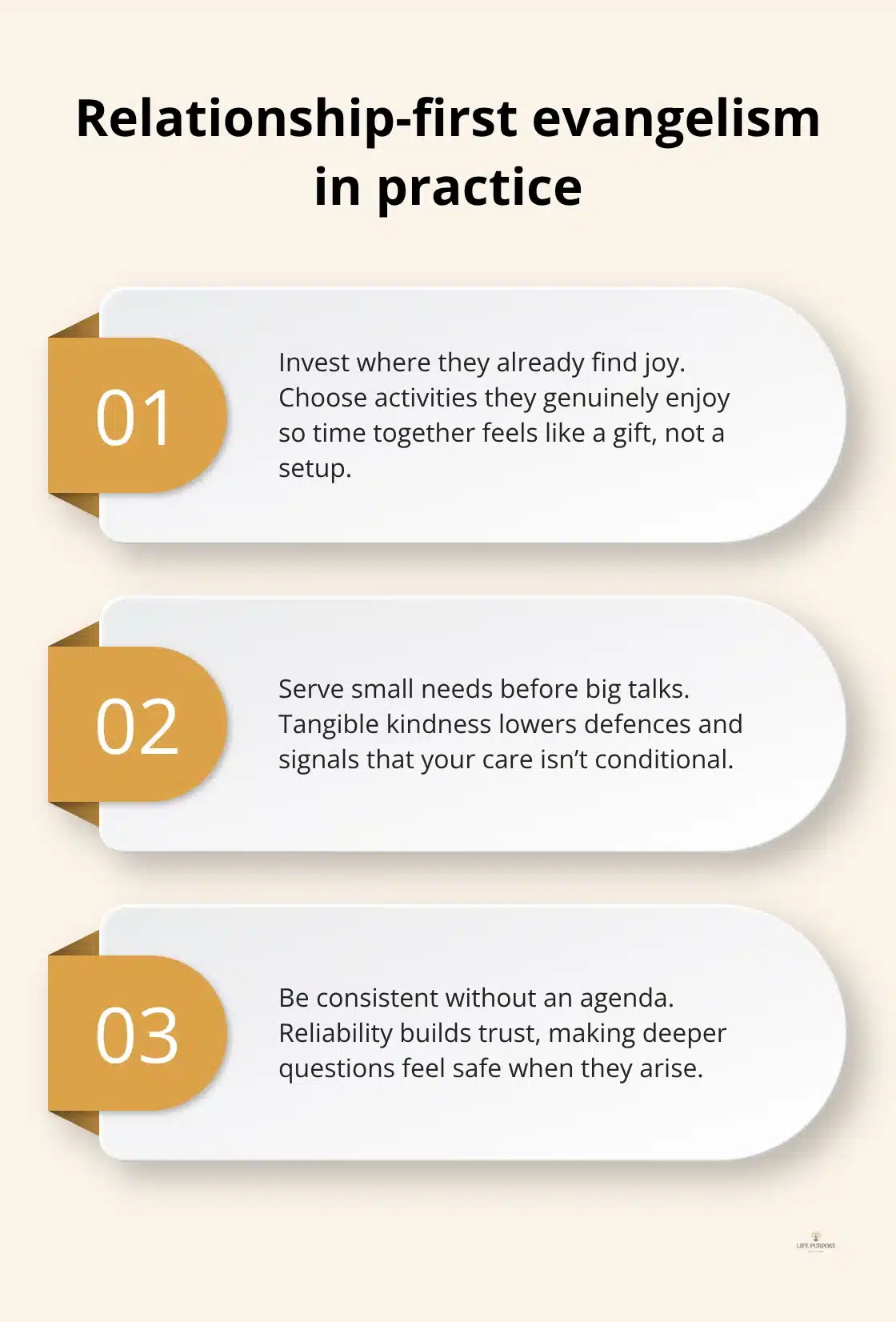
Notice what happens: they start trusting you. They start opening up about real struggles. They mention doubts, fears, and questions about meaning. These conversations emerge naturally because you created space for honesty. Your consistent presence and genuine interest become a magnet for deeper dialogue.
Let Your Actions Speak First
When people see that your faith produces kindness, patience, and real care for their welfare, they stop viewing Christianity as a threat and start viewing it as something that might actually be worth exploring. The gospel becomes credible not because you explained it well, but because they watched it change how you treat them. Your life becomes the first sermon they hear (and often the most persuasive one). Actions carry weight that words alone cannot match. Someone notices you remain calm when everything falls apart. Someone sees you forgive when you had every right to hold a grudge. Someone watches you serve without seeking recognition. These moments plant seeds far more effectively than any prepared speech ever could.
Final Thoughts
Gospel sharing doesn’t require perfection, a theology degree, or an extroverted personality. You need three things: the willingness to act despite fear, the ability to listen to people and respond to their actual concerns, and genuine investment in relationships before spiritual conversations happen. These aren’t complicated strategies-they’re simple practices that work because they honour both the person you’re talking to and the message you’re sharing.
Start with one person this week. Text them about something they mentioned before. Show up in their life without an agenda, and notice how the conversation naturally shifts when someone knows you genuinely care about them. That’s where gospel sharing becomes effortless, not because you’ve overcome all nervousness, but because you’ve built enough trust that the conversation flows from real connection rather than fear-driven performance.
Each conversation you have teaches your nervous system that people aren’t rejecting you when faith comes up. Each relationship you invest in creates space for deeper dialogue. Each time you choose to speak despite anxiety, you gather evidence that contradicts what fear predicted. We at Life Purpose Matters believe that your unique story and genuine care for others are exactly what people need to hear-explore our resources to strengthen your faith and deepen your spiritual journey as you start today.