

I still remember a moment of profound realisation: following the burial of my parents, I was sitting alone, watching a small child chase dandelion seeds. His laughter was pure, but a minute later, he fell, and a scraped knee led to floods of tears. As quickly as his mother comforted him, he smiled again through his tears. That moment cemented a truth: happiness is fleeting. It depends on the outside world. But joy? Joy can live and even thrive within the ache – God’s blueprint for happiness.
Every human being, across all cultures and eras, shares a fundamental goal: the pursuit of a “good life.” In the modern age, this pursuit often looks like a frantic race, a relentless effort to secure the perfect job, the ideal partner, or the highest social status. The underlying belief is straightforward: happiness is the reward for successful effort. However, against this backdrop of temporary satisfaction stands a revolutionary, counter-cultural declaration delivered two millennia ago: The Beatitudes (Matthew 5:1-12). Spoken by Jesus during the Sermon on the Mount, these statements are not platitudes; they are God’s radical blueprint for a life of true and lasting blessedness.
This article will explore the profound contrast between the world’s conditional happiness and God’s unconditional blessedness. By examining the paradoxical wisdom of the Beatitudes, we will uncover how this ancient teaching provides the enduring formula for satisfaction, demonstrating why this spiritual state is properly understood not as fleeting happiness but as permanent joy.
The World’s Definition of Happiness: External and Fleeting
The world’s definition of happiness is overwhelmingly external and materialistic. It is a temporary feeling associated with favourable happenings. We are told that satisfaction is a direct result of wealth, comfort, pleasure, and the affirmation of others.
The problem with this blueprint is its foundation:
- The Metric of Materialism: Success is measured by possessions and status. This happiness is conditional; it depends on keeping things that can be lost.
- The Pursuit of Pleasure: The cultural focus on immediate gratification is temporary and often leads to an addictive cycle of seeking the next high.
Yet, countless stories prove that people who achieve everything the world promises can still feel profoundly empty. This reliance on external validation highlights a flawed blueprint, one that consistently ends in a cul-de-sac of fleeting satisfaction.
God’s Blueprint for Blessedness: The Beatitudes (Matthew 5:1-12)
When Jesus began His famous Sermon on the Mount, He didn’t offer a formula for earthly success; He offered a radical path to blessedness – God’s blueprint for happiness . The term He used makarioi, which in Greek signifies a state of deep, inner satisfaction and spiritual well-being, independent of circumstance. It is the opposite of the world’s success metric.
-
The Beatitudes: A Spiritual Dependency Test
The first four Beatitudes define the internal posture required to receive God’s blessing—those who recognize their deep, spiritual need.

-
The Beatitudes: A Call to Righteous Action and Perseverance
The remaining Beatitudes define the outward actions and relationships that flow from this humility, even when it results in rejection.

The Crucial Distinction: Happiness vs. Joy
The language we use to describe our inner state matters deeply. To truly appreciate the Beatitudes, we must understand the difference between happiness and joy.
1. The Nature of Happiness
The English word “happiness” is rooted in the Old Norse word “happ,” which means “chance,” “fortune,” or “luck.”
- External and Conditional: Happiness is an emotion derived from favorable happenings or circumstances.
- Fleeting and Fragile: Because it depends on external events, happiness is inherently temporary. If circumstances change (the weather turns foul, your status drops), the feeling often disappears.
2. The Nature of Joy (Biblical Chara)
In contrast, the “blessedness” promised in the Beatitudes leads to enduring joy. The Greek word often translated as joy is “chara, and it has a fundamentally different source:
- Internal and Unconditional: Joy is a deep-seated spiritual state or an internal assurance that comes from a secure relationship with God. It is a fruit of the Spirit (Galatians 5:22).
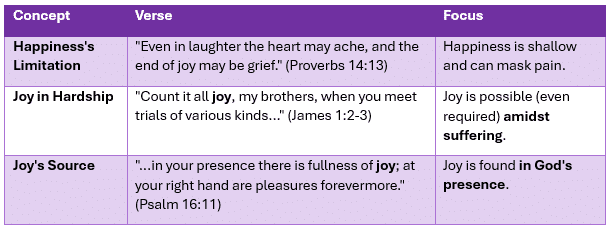
- Constant and Secure: Joy remains even when “happenings” are terrible. A person can mourn (Matthew 5:4) and still possess joy, because their ultimate hope and security are fixed in God.

Analogy: Happiness is like the weather, it changes hourly, dependent on the atmosphere. Joy is like the climate, it is the stable, underlying reality that remains even during a storm. The sun (Joy) is still there, even if clouds (Unhappiness/Mourning) temporarily block it.
The Beatitudes make absolutely no sense if Jesus is promising happiness; they make profound sense because He is promising this deep, unbreakable joy.
Conclusion: Embracing the Blueprint
We began with the universal quest for happiness and found two wildly different paths. The world’s path is built on acquiring and maintaining external conditions, leading to conditional, temporary happiness. God’s path, articulated in the Beatitudes, is built on cultivating internal character, leading to unconditional, eternal blessedness, or Joy.
The crucial distinction lies here: Happiness is the weather of the soul; Joy is the climate of the soul, a deep, constant assurance rooted in a relationship with God. When we are poor in spirit or persecuted, happiness flees, but the joy promised to those who follow the Beatitudes remains secure. This is the kind of joy that cannot be stolen, because it is not built on sand, but on the Rock. To pursue God’s blueprint for happiness is to choose a radical life, a life of purposeful humility, passionate hunger for righteousness, and courageous peacemaking. This is the only path that promises the full reward: the kingdom of heaven, eternal comfort, and the vision of God Himself.
If you’ve been chasing happiness and finding it hollow, perhaps it’s time to come home to joy, the kind that doesn’t depend on your bank account, your relationship status, or your to-do list. The kind that whispers, “You are blessed, even here.” Stop chasing the fleeting happenings of the world, and start cultivating the profound, unshakeable joy that Jesus promises to those who embrace His definition of “blessed.” Let the Beatitudes be your compass. Let Jesus redefine what it means to be truly happy.