

Last Tuesday, I sat in my living room around 6 AM, phone buzzing with notifications, mind already racing through my to-do list before my coffee got cold. I realised I was physically present but spiritually absent, even during my prayer time. That’s when Christian mindfulness exercises changed everything for me.
Christian mindfulness exercises blend traditional meditation techniques with biblical reflection to foster a closer connection with God, reduce stress, and promote spiritual growth. Key practices include breath prayers (inhaling peace, exhaling fear), scripture meditation (focusing on verses like Psalm 46:10), centring prayer, and mindful awareness of God’s presence in daily activities
At Life Purpose Matters, we’ve found that thousands of people struggle with the same disconnect. You can pray the right words while your heart stays miles away. The good news? Learning to quiet your mind and truly show up in God’s presence isn’t complicated-it’s actually something you can start practising today.
Why Christian Mindfulness Works When Other Methods Fall Short
The Problem We All Face
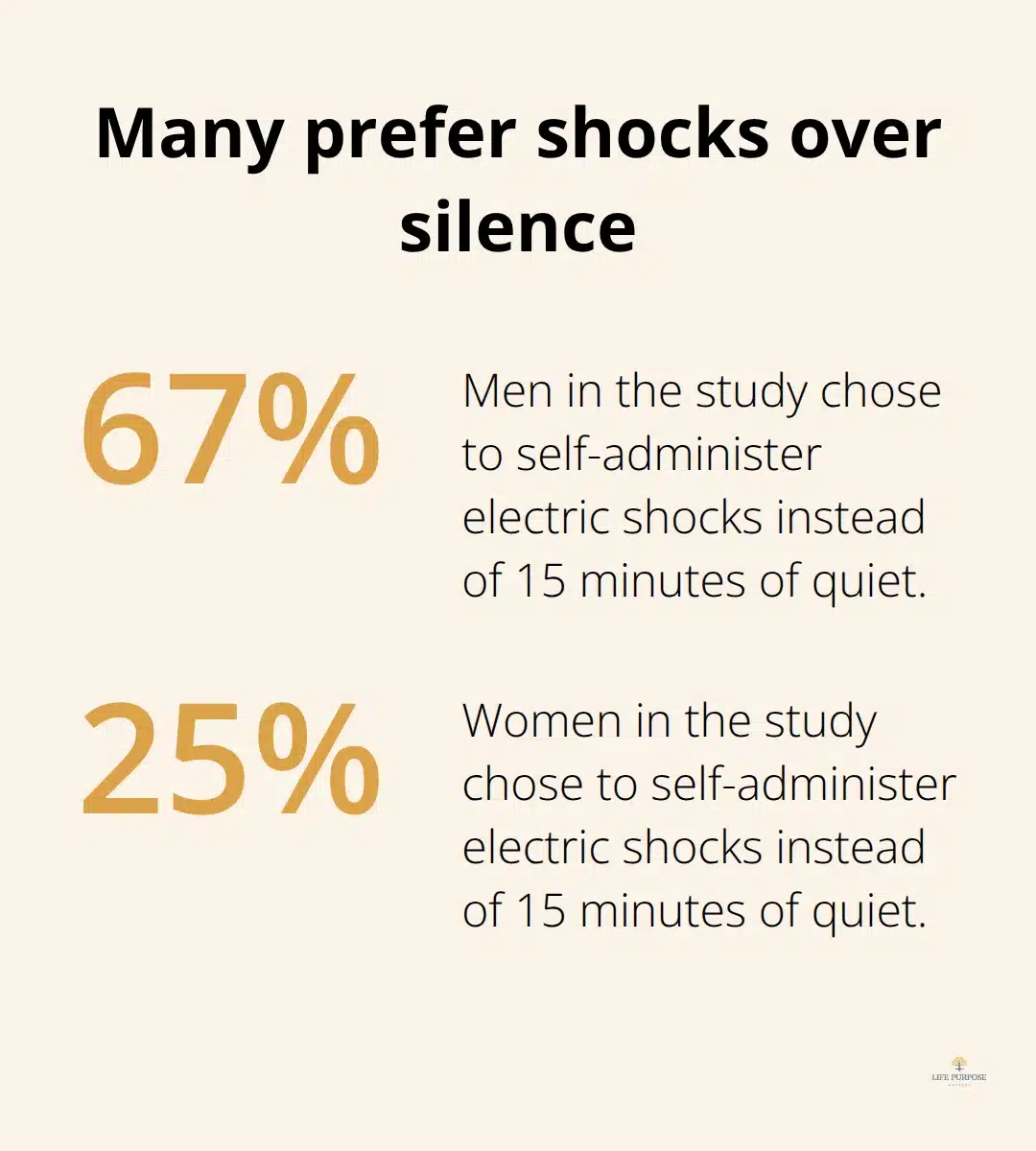
The disconnect you felt that Tuesday morning isn’t a personal failing-it’s a widespread problem. A 2014 University of Virginia study found that 67% of men and 25% of women chose to shock themselves rather than sit quietly with their thoughts for 15 minutes. We’re wired to avoid silence, yet silence is where God actually speaks. Christian mindfulness directly addresses this by anchoring your attention not inward but toward God’s presence.
When you practise breath prayer using Scripture like Mark 10:47- “Lord Jesus Christ, Son of God, have mercy on me”-you’re not trying to empty your mind or achieve some detached calm. You’re actively inviting God into your awareness. This changes everything because you’re not relying on willpower or mental discipline alone. Instead, you’re building a habit that strengthens your spiritual connection with each session.
How Neuroscience Supports Christian Practice
The neuroscience backs this up. Mindfulness-Based Stress Reduction, developed by Dr Jon Kabat-Zinn in the 1970s, has been integrated into medical therapies to help treat depression, drug addiction, and binge eating. But here’s where Christian mindfulness diverges: secular mindfulness treats your thoughts as clouds passing in the sky, asking you to observe without judgment. Biblical meditation invites something radically different. Isaiah 55:8-11 reminds us that God’s thoughts are higher than our thoughts. When you centre your practise on Scripture rather than your own mental patterns, you literally rewire what you think about. Romans 8:1 promises there is no condemnation for those in Christ Jesus. That’s not a thought to suppress-it’s a truth to dwell on, to let transform your inner experience from the ground up.
The Practical Difference That Matters
Secular mindfulness teaches you to notice tension in your body and observe it without reaction. Christian mindfulness does something more: it connects that physical awareness to God’s presence. Psalm 37:7-9 invites you to be still before the Lord and to wait patiently, which counters anxiety by trusting in God’s timing rather than through detachment techniques. This matters because transformation happens when your heart’s allegiance shifts toward God, not when you simply manage your emotions better. A quiet heart yields humility and wisdom, according to Proverbs 10:14 and Hebrews 12:11, which emphasise that quiet learning and disciplined growth produce lasting peace. You start noticing that your racing thoughts often reflect divided loyalty-part of you seeking God’s approval, another part seeking human validation or control. Christian mindfulness exposes this and gives you a way to realign.
Active Partnership With the Spirit
The biblical foundation for present awareness runs through the entire New Testament. John 14:26 promises that the Holy Spirit will teach you all things and bring to remembrance all that Jesus has said. This isn’t passive meditation-it’s an active partnership with the Spirit. When you sit down to practise, you’re not trying harder to concentrate. You’re creating space where God can work. That’s why consistent practise transforms your spiritual life. You begin recognising God’s presence throughout your day, not just during dedicated prayer time. This recognition opens the door to the specific exercises that actually work-the ones we’ll walk through next.
Three Exercises That Actually Work
Breath Prayer: The Simplest Path to God’s Presence
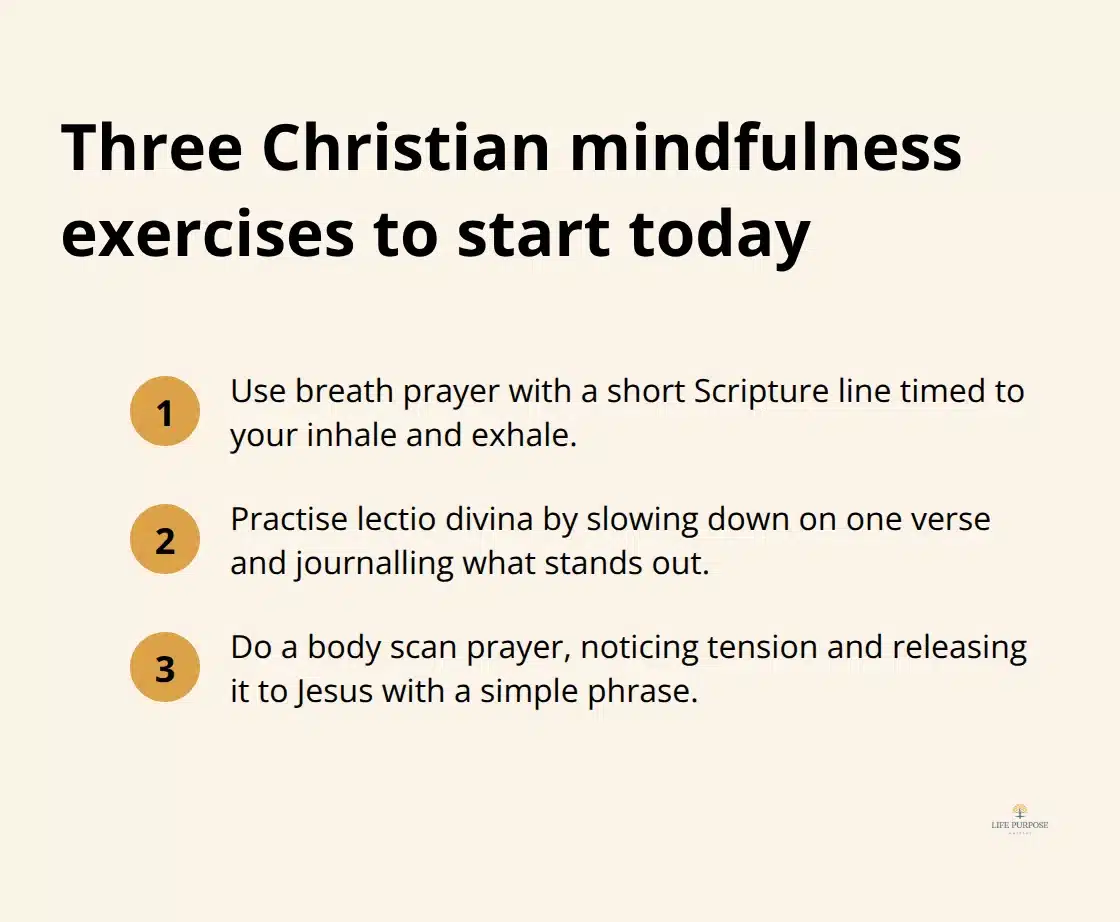
The bridge between understanding Christian mindfulness and living it daily requires specific techniques you can execute immediately. Breath prayer stands as the most accessible entry point because it requires nothing but your lungs and a Scripture verse. The Orthodox Christian tradition has used this method for centuries, and it works through anchoring your attention to God’s Word via your breathing rhythm.
Choose a short line from Scripture: Mark 10:47 offers a powerful example: Lord Jesus Christ, Son of God, have mercy on me. Inhale slowly on the first half, exhale on the second half. Most people find four to five seconds per breath creates a sustainable pace without forcing. Start with five minutes daily rather than attempting thirty-minute sessions that feel overwhelming. The power lies in consistency, not duration.
When your mind wanders to your email inbox or that awkward conversation from yesterday, simply return to the breath and the words. You’re not fighting distraction; you’re gently redirecting your attention toward God’s presence each time your focus drifts.
Lectio Divina: Transforming How You Read Scripture
Lectio Divina represents the second proven method, and it transforms how you read Scripture through slowing your pace dramatically. Most people scan Bible passages like they’re checking off a task. Lectio Divina asks you to read a single verse, perhaps Romans 8:1, about no condemnation in Christ, then pause and notice what word or phrase catches your attention. Write that word down.
Then read the verse again and ask yourself how this truth applies to your actual life today (not theoretically, but specifically). What situation are you facing where you need to remember there is no condemnation? Spend three to five minutes journaling your honest answer. This method works because it moves Scripture from your head into your lived experience.
Body Scan Prayer: Connecting Sensation to Spiritual Truth
The final technique, body scan prayer, connects physical sensation directly to God’s presence. Sit quietly and mentally scan from your head down to your toes, noticing tension without judgment. When you find tightness, perhaps in your shoulders from stress, pause, ask God what that tension represents. Often, you’ll discover you’re carrying anxiety about control or outcomes.
Inhale into that area while silently praying a phrase like Jesus, I release this to you. This practise typically takes ten to fifteen minutes and trains your nervous system to recognise where you hold spiritual disconnection in your physical body (making it easier to address throughout your day). These three techniques work because they anchor your mind to God rather than to your own mental patterns. Each one requires nothing more than your willingness to show up consistently. The real transformation happens when you move from understanding these exercises to actually practising them, which means establishing the daily rhythm that sustains them.
Making Your Practice Stick When Life Gets Chaotic
Start Absurdly Small
The truth about Christian mindfulness is that knowing the three exercises means nothing if you abandon them after two weeks. People feel inspired, start strong, then life interrupts, and the practise vanishes. The problem isn’t weakness or lack of faith-it’s that you’re trying to build a new habit without removing the friction that kills it. You need a system, not motivation.
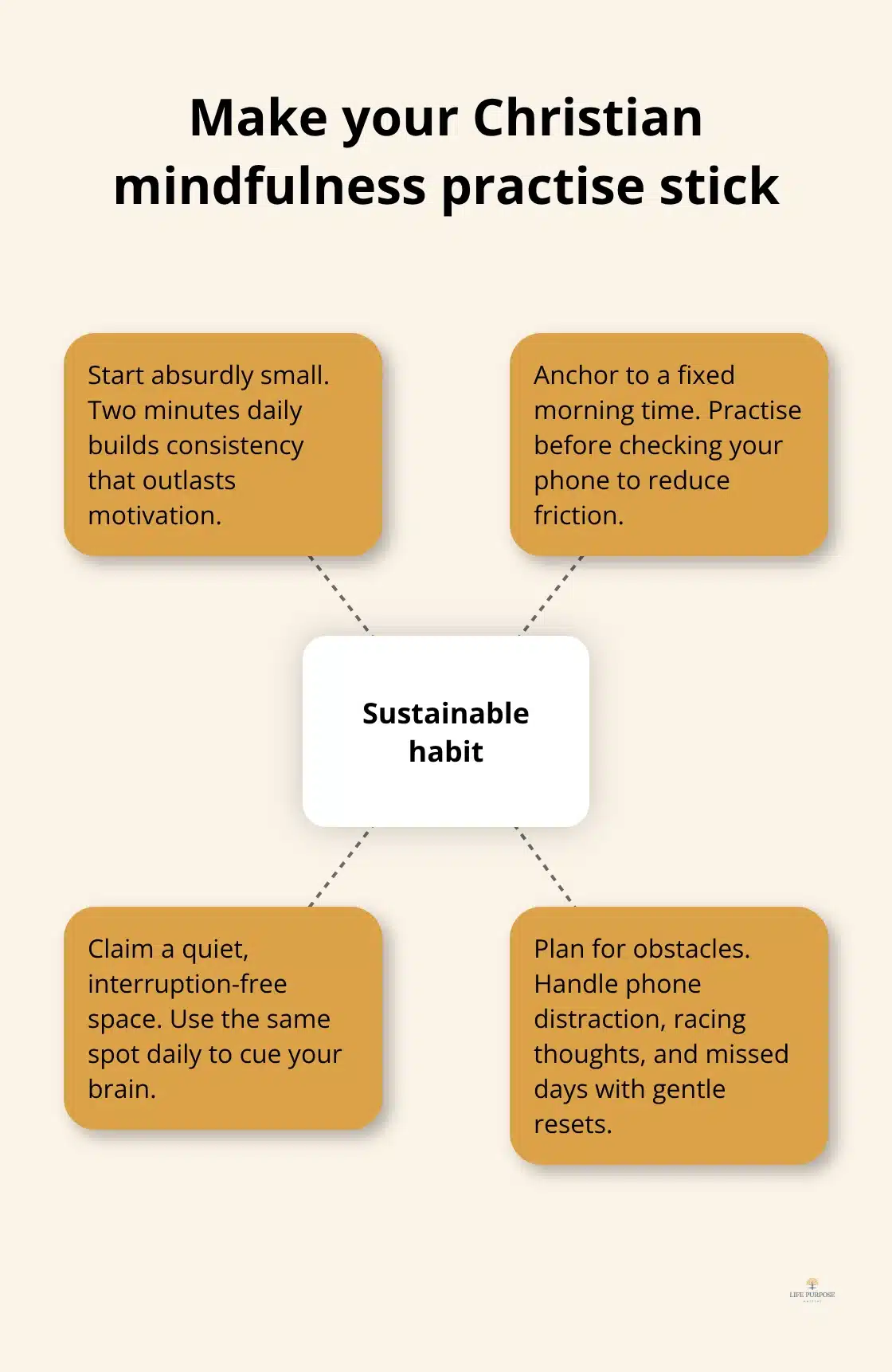
Two minutes of breath prayer daily beats five minutes attempted once. One verse with one sentence of reflection beats a full lectio divina session you never complete. Making your practise stick when life gets chaotic shows that consistency matters far more than duration. Your brain needs proof that this practise is non-negotiable, like brushing your teeth.
Anchor Your Practice to a Specific Time
Pick one specific time, not whenever you feel like it. Morning works best because evening gets swallowed by fatigue and unexpected demands. Set your alarm two minutes earlier and practise before checking your phone. That’s it. No elaborate ritual, no perfect quiet space required initially. The goal is to prove to yourself that you can show up consistently before you add complexity.
Your brain learns through repetition at the same time. This consistency trains your nervous system to shift into contemplative awareness automatically. The practise becomes as routine as your morning coffee, not something you negotiate with yourself about each day.
Claim Your Quiet Space
Finding actual quiet space separates people who maintain practise from those who quit. You don’t need a dedicated prayer room; you need somewhere your family knows not to interrupt for ten minutes. Tell them explicitly: I’m unavailable from 6:05 to 6:15 AM. This boundary matters because your brain can’t shift into contemplative mode if you’re half-expecting a child to burst through the door.
Even a bathroom works-it’s the one room most people respect as temporarily off-limits. The physical location should stay the same daily because your nervous system learns to transition into spiritual awareness through environmental cues. Your kitchen table at 6 AM becomes associated with God’s presence; your brain begins shifting into that state before you even sit down.
Navigate the Obstacles That Will Come
Obstacles will come regardless of your setup, and they fall into predictable categories. Distraction from your phone is the obvious one-put it in another room, not just face-down beside you. Distraction from racing thoughts is trickier; when your mind sprints through your schedule, that’s not failure. Your job is to notice it happened and redirect attention back to your breath or Scripture without frustration. Expect your mind to wander. Plan for it.
The third obstacle is guilt when you miss a day. You will miss days. You’ll have a sick child, travel, or a genuine crisis. Missing one day doesn’t erase your practise. The habit survives if you simply resume the next day without self-condemnation. Romans 8:1 says there is no condemnation for those in Christ-apply that directly to your own inconsistency. What kills practises permanently is missing one day, feeling guilty, then missing three more days while you’re mad at yourself. Instead, miss your practise, acknowledge it without drama, and sit down the next morning. This approach actually works because you’re building a sustainable rhythm rather than chasing perfection.
Final Thoughts
After weeks of practising Christian mindfulness exercises, something shifts in how you experience your day. You stop noticing God’s presence only during your designated prayer time and start recognising it throughout your waking hours. That moment when frustration rises and you catch yourself, pause, and breathe a quiet prayer instead of reacting-that’s transformation happening in real time. Your nervous system learns that God is present, trustworthy, and closer than your anxiety.
This transformation unfolds gradually, almost invisibly at first. You don’t wake up one day suddenly enlightened; instead, you notice you responded to your child’s meltdown with patience instead of irritation. You caught yourself spiralling about a work situation and redirected your thoughts toward Scripture. You felt genuine peace during a difficult conversation instead of the usual tension. These small shifts compound over months, and your baseline emotional state actually changes. The constant low-level anxiety that felt normal becomes noticeably lighter.
Biblical promises of peace become your lived experience when you practise consistently. Philippians 4:6-7 says that when you bring your requests to God with thanksgiving, His peace that surpasses understanding will guard your heart and mind, and you experience this directly. When you practise breath prayer during anxiety, your nervous system calms. When you sit with Scripture through lectio divina, your perspective shifts. When you scan your body and release tension to Jesus, you feel the difference physically. The peace you build isn’t the absence of problems but the presence of God within them, and we at Life Purpose Matters exist to support this journey as your unique purpose unfolds through deepening your connection with God.