

I once sat in a church service where the pastor spent twenty minutes explaining the Trinity, and I left more confused than when I arrived. Most of us feel that way; the concept seems abstract, almost untouchable. Like me, then, most Christians struggle to understand the Trinity because it is a complex, paradoxical doctrine that defies human logic (1+1+1=1), often described as a mystery rather than an intellectual puzzle to be solved.
At Life Programme Matters, we believe the Triune God isn’t meant to stay locked in theology textbooks. Understanding how Father, Son, and Holy Spirit work together actually changes how you pray, serve, and find meaning in your faith.
Where Does the Trinity Actually Show Up in Scripture?
The Trinity in Creation and the Old Testament
The Trinity isn’t hidden in Scripture. It runs through the entire biblical narrative, starting in Genesis and building through the Old Testament. Genesis 1:26 reveals something striking: God says, “Let us make man in our image.” That plural language matters. God isn’t speaking to angels or addressing a heavenly council.
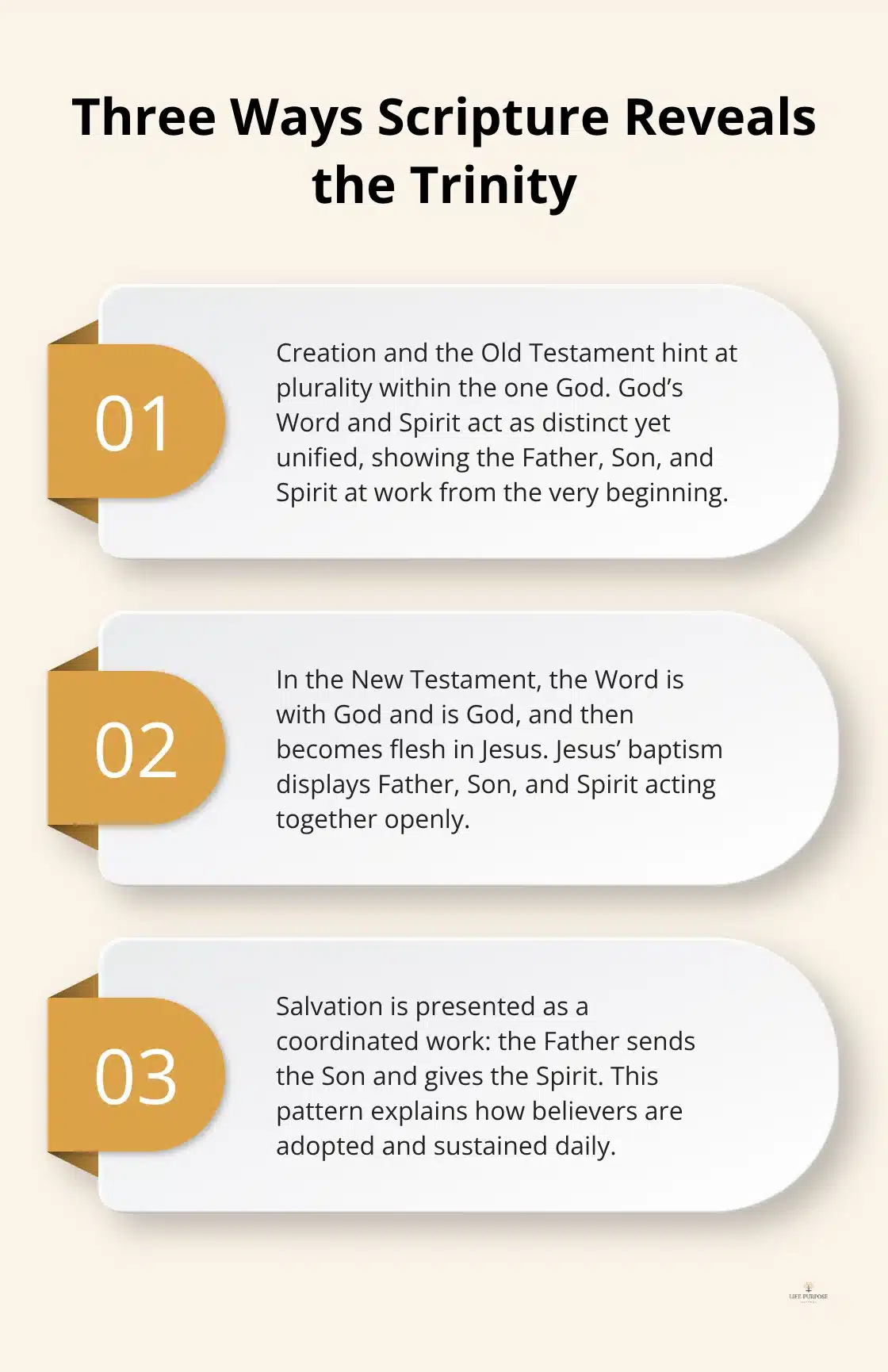
The Father, Son, and Spirit work together in creation itself. Throughout the Old Testament, God’s Word and God’s Spirit operate as distinct yet unified expressions of the divine. Isaiah 55:11 shows that God’s Word accomplishes what God sends it to do, revealing how it functions as something real and active. Proverbs 8:22-31 personifies Wisdom in ways that early Christians understood as pointing to the Son. These aren’t abstract theological puzzles. They describe how God actually operates in history and creation.
The New Testament Makes the Pattern Clear
The New Testament makes this pattern undeniable. John 1:1-3 declares that the Word was with God and was God, and all things came into existence through the Word. Then John 1:14 tells us this Word became flesh in Jesus. That’s not poetry or metaphor. That’s God entering human history as a person. When Jesus was baptised, Matthew 3:16-17 shows all three persons present and active: the Spirit descends like a dove, the Father’s voice affirms the Son, and the Son stands in the water. Jesus Himself commanded His disciples to baptise people in the name of the Father, Son, and Holy Spirit (Matthew 28:19).
Salvation as a Trinitarian Act
Paul’s letters consistently reinforce this pattern. Galatians 4:4-6 explains how the Father sent the Son, and believers receive the Spirit, crying out “Abba! Father!” Salvation as a Trinitarian act means the Holy Spirit gives Christ and all the redemptive blessings to the people of God and applies to the church what Christ has accomplished. This framework isn’t theology for its own sake. It explains how God actually saves you, adopts you, and sustains you in faith every single day. Once you see this pattern woven through Scripture, you start recognising how the Trinity shapes everything about your relationship with God, which makes the next question impossible to ignore: how does this ancient doctrine actually change the way you live right now?
How the Trinity Reshapes Your Worship and Relationships
The moment you understand that salvation isn’t a solo transaction between you and God but a coordinated act of Father, Son, and Spirit, everything shifts. The Father doesn’t just forgive you from a distance. The Son doesn’t just die for you as a historical event. The Spirit doesn’t just show up occasionally when you feel inspired. All three actively work together right now to sustain your faith, transform your character, and draw you deeper into a relationship with the living God. This isn’t abstract theology. It’s the reason your prayers work differently once you understand who you’re actually talking to.
Prayer Becomes a Conversation, Not a Monologue
When you pray, you’re not addressing a distant deity. You’re speaking to a God who is Father above you, Son alongside you, and Spirit within you. That changes everything about how you approach prayer.
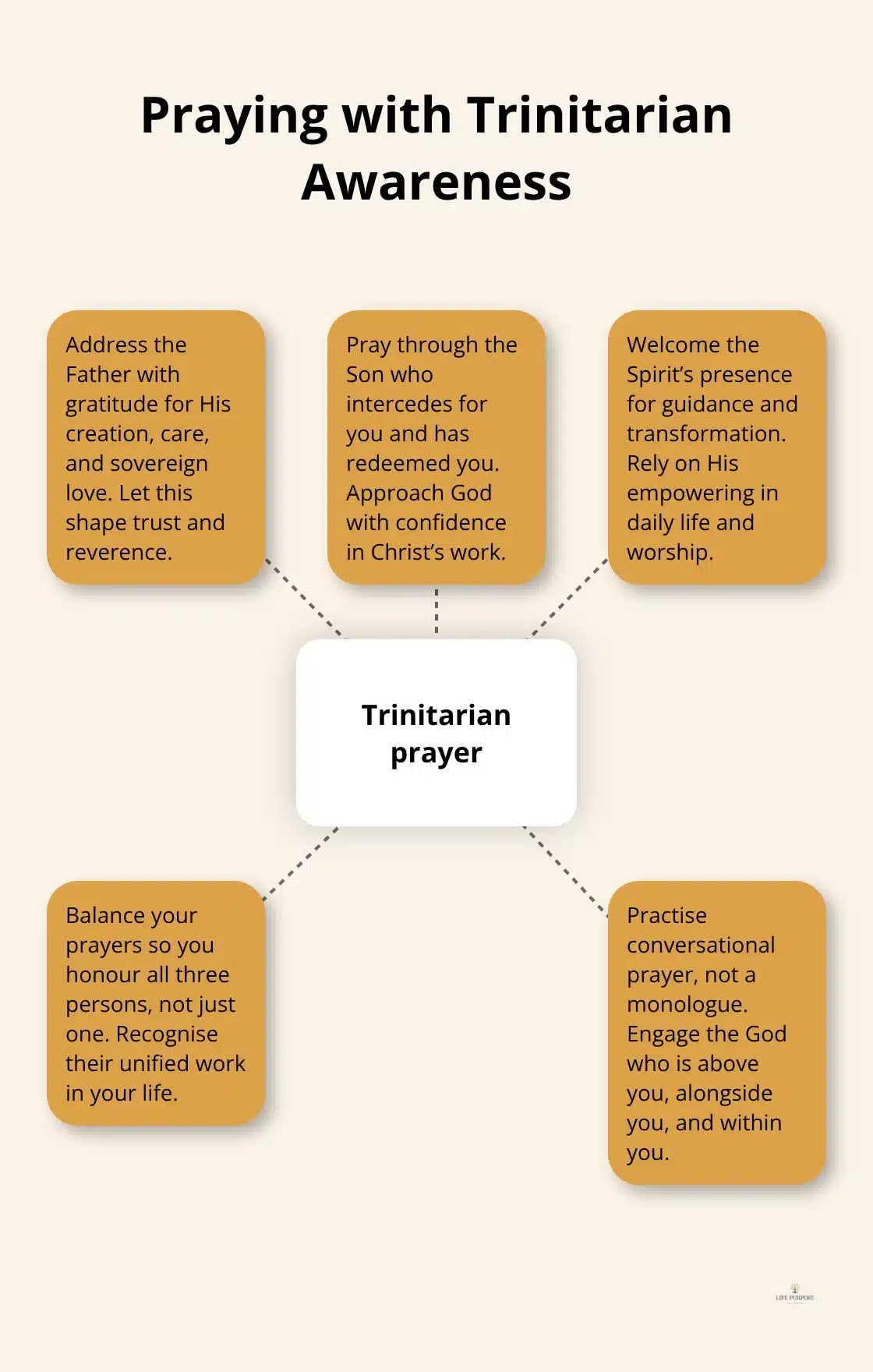
Instead of hoping your words reach some far-off throne room, you participate in a conversation with a God who is intimately present in three distinct ways. Research on contemplative prayer practices shows that people who understand God’s relational nature report deeper spiritual experiences and greater consistency in their prayer lives. The Trinity reframes your entire approach to worship because you’re no longer performing for an audience of one. You’re joining the eternal fellowship of Father, Son, and Spirit in their communion of love.
Worship That Reflects the Whole God
When you worship with Trinitarian awareness, you stop shortchanging God with incomplete prayers. Many Christians unconsciously pray only to Jesus or focus entirely on the Father, while neglecting the Spirit’s active role. But the three persons deserve equal honour and recognition in your spiritual life. This means your worship should explicitly acknowledge all three. If you attend a church where sermons mention only Jesus without connecting His work to the Father’s sending or the Spirit’s empowering presence, you’re receiving an incomplete gospel. Push back gently. Ask your pastor to preach the fullness of God. The liturgical churches have long understood this through the Trinitarian structure of the Nicene Creed, which confesses the Father, then the Son, then the Holy Spirit in one unified statement. You don’t need to attend a liturgical service to benefit from this pattern. In your personal prayers, practice acknowledging the work of all three persons. Thank the Father for creation and sovereignty. Honour the Son for redemption and intercession. Ask the Spirit for transformation and guidance. This isn’t adding extra steps to your prayer life. It’s actually removing the gaps where you’ve been leaving God partially out of the conversation. Your spiritual growth accelerates when you address the complete God rather than a reduced version.
Community Built on Trinitarian Love
The Trinity’s relational structure directly shapes how Christian community should function. The Father, Son, and Spirit exist in perfect unity while remaining distinct persons. That means a healthy Christian community doesn’t demand conformity or homogenisation. It celebrates diversity within unity. If your church or small group treats everyone like they need to think and act identically, you’re missing the Trinitarian model. The Spirit deliberately distributes different gifts to different believers. Some lead, some serve, some teach, some encourage. These gifts aren’t ranked hierarchically in God’s economy. They’re all essential expressions of the one Spirit working through many members. When churches operate from Trinitarian conviction, they naturally resist both authoritarian leadership that crushes individuality and hyper-individualism that fractures the Christian community. Instead, they cultivate what theologian Fred Sanders calls the relational reality of God Himself. This means your church should be a place where people with different backgrounds, perspectives, and experiences genuinely belong together, not as a diversity checkbox but as a reflection of how the Trinity functions.
Leadership That Mirrors the Trinity
The practical implication is significant. If you’re in a church where certain voices are systematically silenced or where leadership makes unilateral decisions without listening to the broader body, that’s a sign the community has drifted from Trinitarian practice. The Trinity models collaborative decision-making, mutual submission, and shared authority among equals. When your faith community operates that way, people experience genuine belonging instead of mere attendance. This relational approach to leadership and community life extends beyond Sunday services. It shapes how you interact with family, friends, and colleagues throughout the week. A Trinitarian worldview teaches you that relationships matter because God Himself exists in eternal relationship. You’re not just an isolated individual trying to maximise your own benefit. You’re part of a web of connections where your choices affect others, and their flourishing contributes to yours. As you begin to see how the Trinity transforms the way you worship and relate to others, you’ll start noticing something else: certain misconceptions about God’s nature have been quietly shaping your faith in ways you never realised.
Common Misconceptions About the Trinity
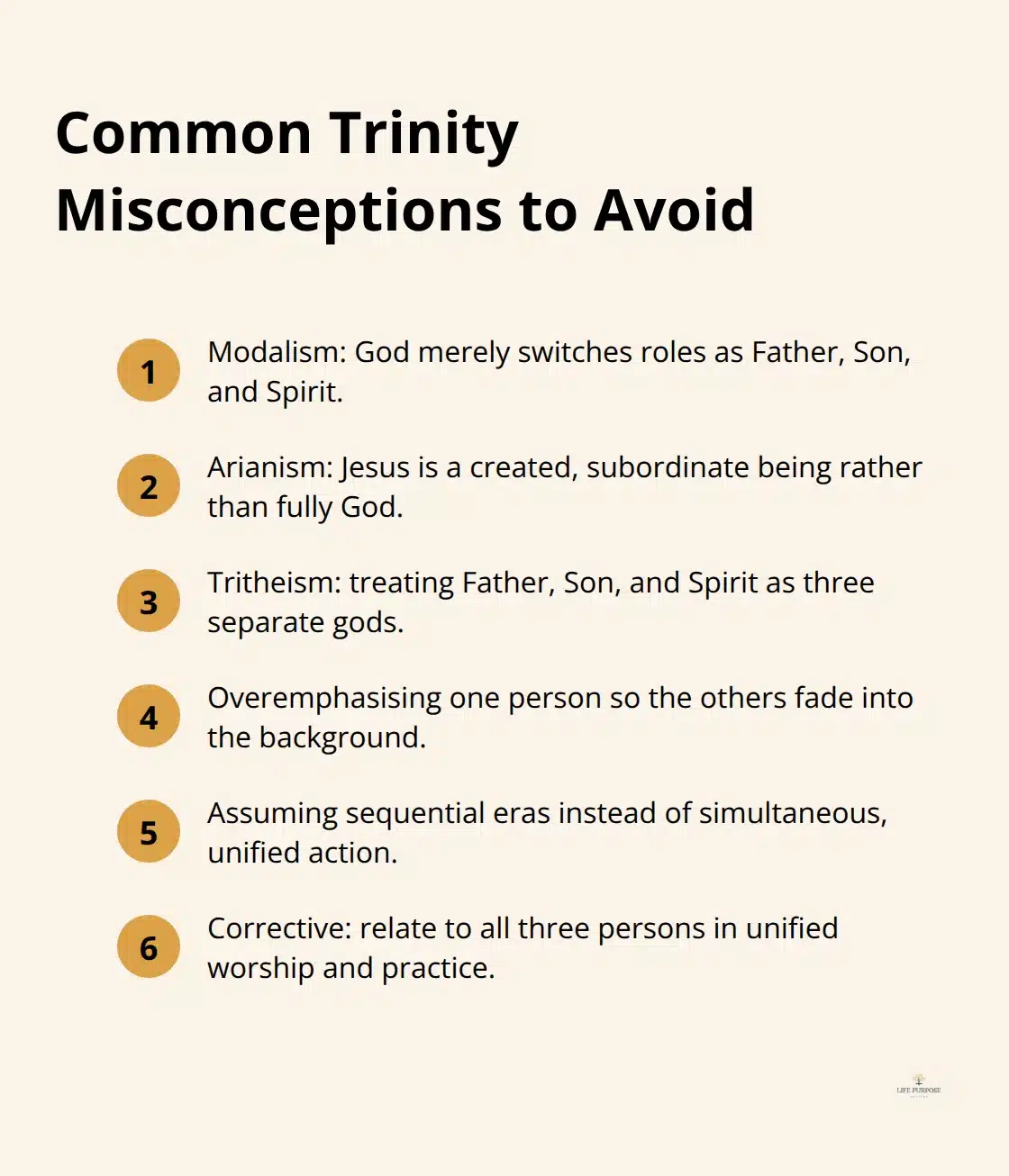
Many people hold distorted versions of the Trinity without realising it, and these misconceptions quietly undermine their entire spiritual life. The most common distortion is modalism, which treats Father, Son, and Holy Spirit as three different roles God plays at different times, like an actor switching costumes. Under this view, God was the Father in the Old Testament, became the Son during Jesus’s earthly ministry, and now operates as the Spirit. This sounds convenient because it preserves monotheism without the complexity, but it destroys the gospel itself.
Why Modalism Collapses the Gospel
If Jesus was just God wearing a human mask temporarily, then the incarnation becomes theatre rather than the actual entering of God into history. More critically, modalism makes salvation impossible in its biblical form. Paul tells us in Galatians 4:4-6 that the Father sends the Son while simultaneously sending the Spirit into believers’ hearts. If these are just sequential roles rather than distinct persons acting together, then nobody actually receives the Spirit’s indwelling power right now. You are left with a God who acts alone in each era, instead of a God who coordinates redemption across all three persons simultaneously.
This matters practically because modalism leaves you with an impersonal God who changes strategies rather than a relational God who sustains you through the continuous work of Father, Son, and Spirit. Your spiritual life depends on experiencing God as actively present through all three persons, not as a single being rotating through different functions.
Arianism: The Danger of Reducing Christ’s Divinity
Another ancient distortion called Arianism claims that Jesus, while divine, is subordinate to the Father and was created at some point. This sounds almost reasonable until you realise what it costs. If Christ is a created being, then He cannot save you because only God can bridge the infinite gap between humanity and divinity. Arianism essentially reduces Jesus to a very powerful creature rather than the eternal God.
The councils of Nicaea and Constantinople rejected Arianism precisely because they saw it gutted the gospel’s power. When you pray to Jesus, when you trust Him with your deepest needs, you implicitly confess His full divinity. Arianism makes that prayer theologically incoherent. Your confidence in Christ’s ability to redeem you rests entirely on His status as fully God, not merely as a superior creature.
The Fragmentation of Treating God as Three Separate Gods
A third misconception treats the Trinity as three separate gods competing for attention, which contradicts the core Christian claim that there is one God. This error sometimes emerges in churches that overemphasise one person of the Trinity at the expense of the others. Some communities focus so intensely on Jesus that the Father and Spirit fade into the background. Others emphasise the Spirit’s power so heavily that Christ’s centrality gets blurred.
These are not minor theological quibbles. They shape whether you experience God as unified and coherent or fragmented and confusing. The solution is not finding the perfect theological formula. Scripture consistently presents Father, Son, and Holy Spirit as distinct persons unified in purpose and power, and your spiritual life depends on relating to all three actively rather than treating one as central while the others remain peripheral.
Final Thoughts
Understanding the Triune God transforms how you relate to God, serve others, and live out your purpose. When you grasp that the Father, Son, and Holy Spirit actively work together in your salvation and sustain you daily, your entire spiritual life shifts from abstract belief to lived reality. You stop praying to a distant deity and start conversing with a God who is simultaneously above you, alongside you, and within you. This understanding moves you from knowing about God to knowing God personally, where the Father’s love, the Son’s redemption, and the Spirit’s presence all engage in your transformation right now.
Trinitarian understanding reshapes your daily choices because how you treat others reflects whether you truly believe God exists in an eternal relationship. How you lead, serve, and build community either mirrors or contradicts the triune God’s relational model, and how you spend your time and resources reveals whether you’re living for yourself alone or participating in God’s redemptive work in the world. These aren’t separate spiritual disciplines-they’re natural expressions of grasping who God actually is.
Your God-given purpose becomes clearer when you understand the Triune God’s nature, as you’re invited into the eternal fellowship of Father, Son, and Spirit, participating in their work of love, redemption, and restoration. This reframes everything: your career, relationships, creative gifts, and influence all become expressions of serving God’s purposes. We at Life Programme Matters help you discover and live out your purpose within a Christian framework, where the Trinity reshapes how you worship, relate, and serve.