

I still remember the conversation that changed everything. My friend Sandra called me in tears because a disagreement with her husband had spiralled into weeks of silence. She’s a devoted Christian, he is too, yet they couldn’t figure out how to talk through their hurt without things getting worse.
That’s when I realised how many people face Christian conflict in relationships but don’t know where to start with healing. Here at Life Purpose Matters, we’ve seen how faith can be the bridge that brings people back together, but only when you know how to use it.
What Jesus Actually Taught About Fixing Broken Relationships
Jesus didn’t speak in abstract theories about reconciliation. He spoke directly about what matters: your relationship with the person across from you right now. In Matthew 5:23-24, He makes this painfully clear. If you’re about to offer a gift at the altar and you remember your brother or sister has something against you, leave your gift and go make it right first. This isn’t optional advice for the spiritually advanced. It’s a command that puts reconciliation above religious practice itself. Jesus prioritised healing the breach over maintaining the appearance of devotion, which means your conflict with your spouse, friend, or family member isn’t a distraction from your faith-it’s central to living it out.
How You Talk About Faith Shapes Your Conflict
The reason this matters so much is that Jesus understood something about human nature: we default to protecting ourselves. We rationalise our hurt, rehearse our grievances, and build cases for why we’re right. But Matthew 18:21-35 tells the story of an unforgiving servant who was forgiven an enormous debt, then turned around and refused to forgive someone who owed him far less. Jesus’s point was brutal. If God has forgiven you infinitely, your refusal to forgive others becomes an act of profound ingratitude.
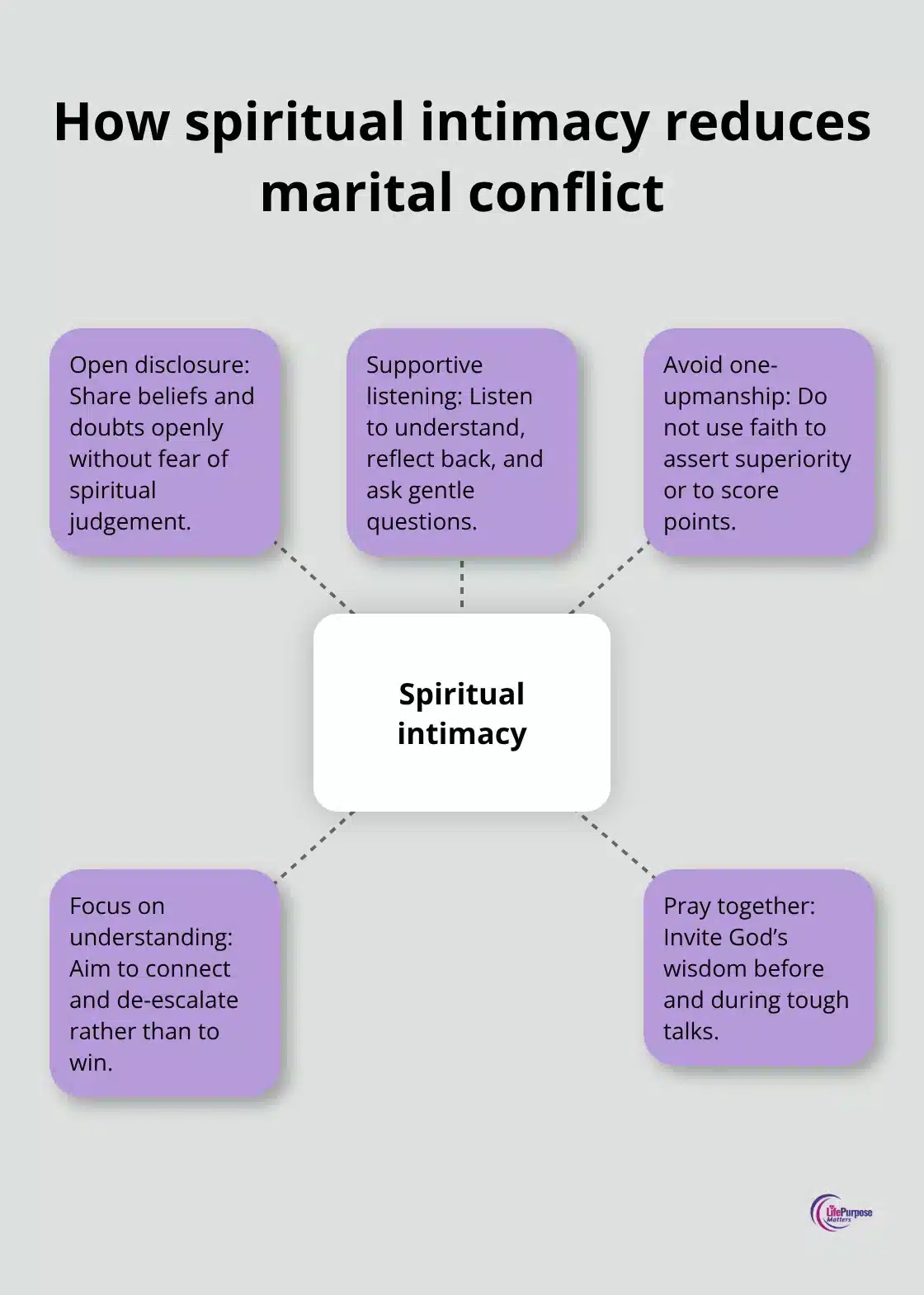
Research from Mahoney and colleagues studying married couples across the transition to parenthood found something practical: when both spouses practised spiritual intimacy, open disclosure and supportive listening about their beliefs, they experienced significantly less frequent marital conflict. The couples who instead used spiritual beliefs to assert superiority in arguments, what researchers called spiritual one-upmanship, showed increased verbal hostility and stalemate patterns. This tells us that how you talk about faith with your partner matters more than how religious you both are.
Where Your Conflict Actually Starts
James 4:1-3 cuts to the root issue in every conflict you’ve ever had. Your fights come from passions warring within you, from desires you have but can’t satisfy. You want something; respect, control, comfort, validation-and when you don’t get it, you fight for it. The problem isn’t the other person. It’s that you’re trying to fill a void they can never fill.
This is why two Christians can still clash bitterly. Both of you might pursue legitimate desires in illegitimate ways. One partner wants security and pursues it through control. The other wants freedom and pursues it through withdrawal. Neither is wrong to want these things, but the way you go after them creates the collision. The fix starts with honest self-examination. What are you actually fighting for in this conflict? Is it really about the issue at hand, or is it about something deeper you feel you’ve lost or never had?
What Forgiveness Actually Changes
Forgiveness is misunderstood as weakness or enabling. It’s neither. Colossians 3:13 tells you to forgive as the Lord forgave you, which means you model Christ’s own action toward you. But here’s what forgiveness doesn’t mean: it doesn’t mean you forget what happened, pretend it was okay, or restore trust immediately. It means you stop using the offence as a weapon or a wall. You release your right to punish.
This shift is practical and measurable. When you forgive, you stop rehearsing the hurt in your mind. You stop bringing it up in new arguments. You stop treating the person as permanently defined by their worst moment. That’s not naive kindness. That’s freedom. You free them from your judgement, and more importantly, you free yourself from carrying bitterness. The couples who succeeded in rebuilding after conflict were those who moved past blame and toward understanding. They asked why the other person acted that way, not just condemned that they did.
Moving From Understanding to Action
Yet understanding the root of conflict and knowing forgiveness matters intellectually doesn’t automatically heal the breach. You need to know how to actually sit down with the person, speak truth without weaponising it, and listen when they speak back. The gap between knowing what Jesus taught and living it out is where most people get stuck. That’s where the practical steps come in-the concrete moves you make when you’re sitting across from someone you love and the air between you feels heavy with unresolved hurt.
How to Actually Talk Through the Hard Stuff
Start With Your Own Heart First
The moment you decide to address a conflict, most people freeze. They know they need to say something, but the fear of making it worse often wins. What separates couples who heal from those who drift further apart is simple: one group talks directly, and the other doesn’t. When you sit down to resolve conflict, you must first get your own emotions in check.
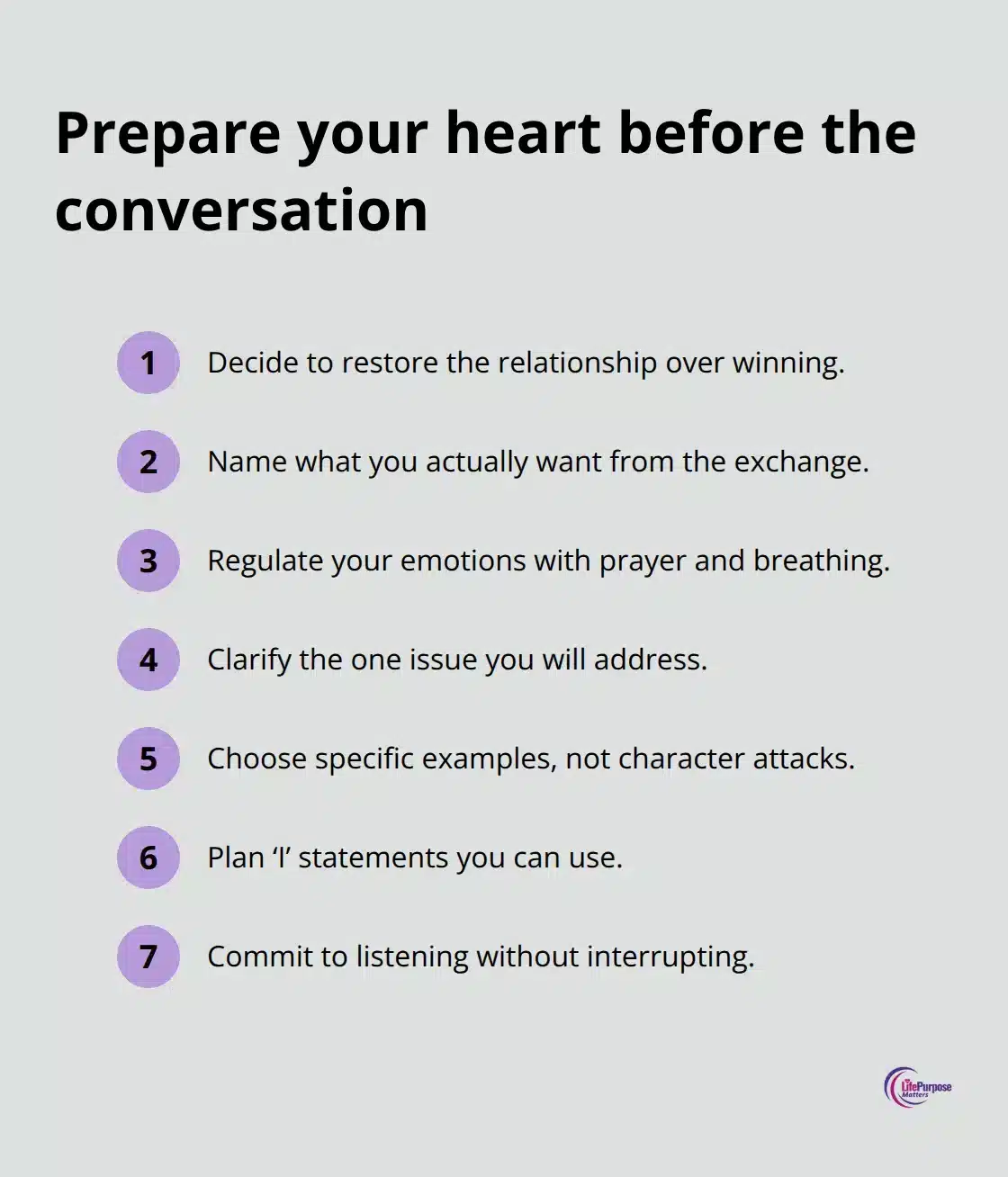
Pause before the conversation and ask yourself what you actually want from this exchange. Do you want to win, or do you want to restore the relationship?
Research on couples navigating the transition to parenthood showed that spiritual intimacy-open disclosure and supportive listening about beliefs-predicted significantly less frequent marital conflict. The couples who succeeded did not use the conversation as an opportunity to prove they were right spiritually or morally. They listened. They asked clarifying questions. They treated their partner’s perspective as worth understanding, not defeating.
Speak Your Truth Without Attacking Theirs
When you sit across from someone, your job is not to convince them you are correct. Your job is to understand why they see things differently and let them understand you. This means you use specific language about your own experience rather than attacking their character. Instead of saying “you always shut down when things get hard,” try saying “I felt unheard when you interrupted me three times, and I didn’t know how to respond without getting defensive.” The difference is massive. One statement invites dialogue; the other invites defensiveness.
Your words carry immense power in these moments. The tongue can set a course of destruction or blessing (James 3:6-8). You choose which one you release into the conversation. When you speak from your own experience rather than your partner’s failures, you create space for them to actually hear you instead of preparing their defence.
Invite God Into the Conversation
The second critical move is to ask God for wisdom before, during, and after the conversation. James 1:5 promises that God gives wisdom generously to those who ask. This is not mystical-it is practical. When you pause and pray, you slow your brain down enough to access the part of you that thinks clearly instead of reacting from hurt. Many people skip this step because it feels too slow or too spiritual. But the couples who report successful conflict resolution consistently mention prayer as the moment things shifted. They stopped trying to win and started trying to understand.
Find What You Both Actually Want
Finally, you search for genuine common ground, not compromise that leaves both people resentful. Common ground means you identify what you both actually want beneath the surface disagreement. You might disagree about how to spend money, but you both want financial security. You might disagree about how often to see extended family, but you both value connection. When you find that shared desire, the conversation moves from adversarial to collaborative. You are not opponents anymore-you are teammates solving a problem together.
This is where faith becomes practical. You are not just believing in reconciliation; you are actively building it through honest speech, genuine listening, and the willingness to see your partner as someone God loves as much as He loves you. When you strengthen your relationship with faith and love at the forefront, you move past hurt and rebuild trust. The real test comes when you actually have to move past the hurt and rebuild trust, which means you need to know what obstacles will try to pull you back into old patterns.
What Actually Blocks Reconciliation
The moment you decide to have the difficult conversation, something shifts inside you. Your heart rate increases, your mind floods with worst-case scenarios, and suddenly you remember every way the other person has hurt you before. This is where most Christian conflict resolution attempts stall. You know what Jesus taught. You understand forgiveness intellectually. You want reconciliation. But then reality hits, and old patterns take over. Pride whispers that you should protect yourself by winning the argument instead of understanding the other person. Unresolved hurt from past conflicts makes you interpret their words through a lens of suspicion. Poor communication habits mean you say something that lands wrong, they react defensively, and suddenly you are further apart than when you started. These obstacles are not theoretical problems that only affect difficult people. They are the actual reasons your conversations stall, why you find yourself having the same fight repeatedly, and why weeks of silence follow instead of healing.
Pride Masquerades as Strength
The first obstacle masquerades as strength but destroys reconciliation from the inside. Pride tells you that admitting fault means you lose, that listening to your partner’s perspective means accepting blame, that humility is weakness. Research on spiritual one-upmanship in marriages shows couples who used spiritual beliefs to assert superiority experienced greater negativity and stalemate patterns. They were trying to win spiritually, which meant their partner had to lose spiritually. The antidote is brutally simple: before the conversation, decide whether you want to be right or whether you want the relationship to heal. You cannot have both. When you sit down angry and determined to prove your point, your brain literally cannot access the parts that enable genuine listening. Your nervous system enters defence mode. The couples who successfully resolved conflict made one critical choice first: they chose the relationship over being right. They walked into the conversation willing to discover they had misunderstood something, willing to admit their part, willing to change. This does not mean you pretend the other person did nothing wrong. It means you stop making their wrongness the centre of the conversation.
Past Wounds Create Invisible Barriers
Unresolved hurt from previous conflicts creates another invisible barrier. When your partner says something ambiguous, you interpret it through the lens of how they hurt you last month or last year. They say they need space, and you hear abandonment because they withdrew during an earlier conflict. They express frustration, and you assume they are blaming you because that is what happened before. You are not actually responding to what is happening now; you are responding to what happened then. This pattern repeats until both people feel chronically misunderstood. The only way forward is to address the past wound directly before you try to resolve the current conflict. Ask your partner what they need to feel safe bringing up the old hurt again. Sometimes this means a separate conversation entirely, where you revisit what happened, acknowledge the damage, and agree on how you will handle similar situations differently going forward.
Communication Habits You Can Fix Today
Poor communication habits are the third major blocker, and this one you can fix immediately. Most people never learned how to say hard things without attacking or how to listen without preparing their defence. You interrupt because you are anxious.
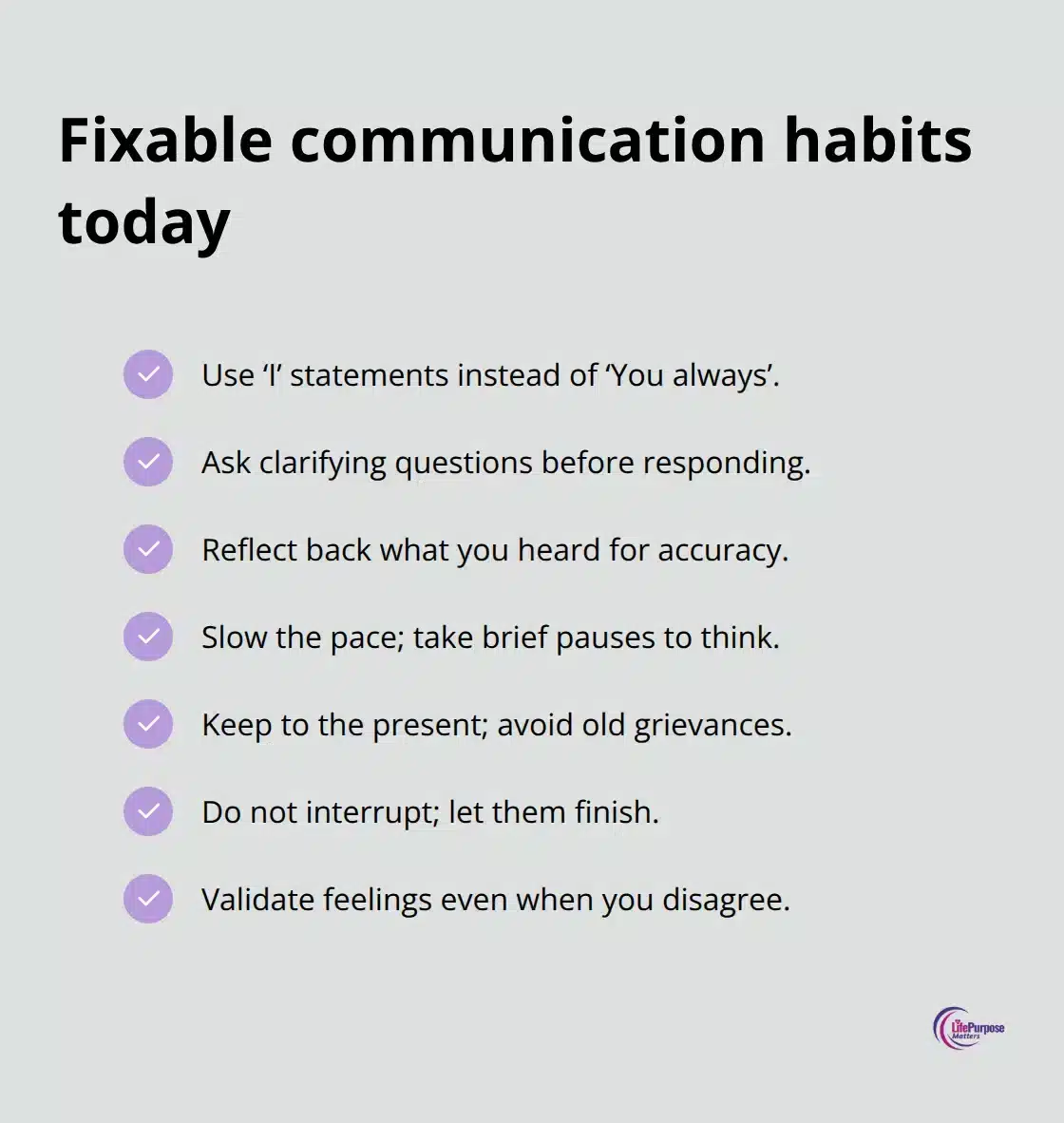
You minimise their feelings because you feel blamed. You bring up old grievances because you are trying to prove your point. Each of these habits is learned, which means you can unlearn them. Start with one change: when your partner speaks, your job is to understand what they actually mean, not to formulate your response while they are talking. Ask clarifying questions. Say back what you heard to confirm you understood correctly. This slows everything down, which sounds inefficient but is actually the most efficient path to resolution because you stop having the same conversation over and over.
The Power of Choosing Relationship Over Self-Protection
The obstacles to reconciliation are real and they are powerful, but they are not permanent. They lose their grip the moment you decide the relationship matters more than protecting yourself. Pride releases its hold when you value connection more than victory. Past hurt loses its power to distort the present when you address it directly. Communication habits shift when you commit to understanding instead of defending. Each obstacle that blocks reconciliation also points toward the solution: you must prioritise the other person and the relationship itself over your need to be right, your fear of being hurt again, or your comfort with familiar patterns.
Final Thoughts
The work of resolving Christian conflict in relationships continues long after the conversation ends, as you rebuild trust and establish new patterns where grace becomes your default response. The couples who report the deepest connection after working through disagreement treat reconciliation as an ongoing practice, not a one-time event, they check in regularly about how they feel, notice when old patterns creep back, and address them early. This consistency transforms how you relate to each other and creates an environment where both people know they matter more than winning an argument.
Creating a culture of grace in your relationships means you stop expecting perfection from each other and start expecting growth. Grace means you extend the same forgiveness to your partner that Christ extended to you, which is complete and unearned, so you assume good intent when possible and speak gently about each other’s struggles. When grace becomes your baseline, Christian conflict becomes an opportunity for deeper understanding rather than a threat to the relationship.
Trusting God’s plan for healing requires you to release your grip on the timeline and outcome, show up consistently, speak truthfully, and listen carefully. God works through your willingness to do the hard work of reconciliation, and He meets you in the humility and honest conversations that follow. If you want more resources on living out your faith in relationships, visit Life Purpose Matters to discover tools designed to help you integrate your faith more fully into every area of your life.