

My grandmother used to say that eternal life was something you earned through perfect church attendance and eating all your vegetables, especially on Sundays! 😂 She meant well, but, like many believers, she had confused biblical truth with tradition. Feel free to share your grandparents’ stories in the comment box below. The Bible actually presents a much clearer picture of eternal life than most people realise. In the Bible, eternal life (Greek: zōē aiōnios) is not just an endless duration of time; it is primarily described as a qualitative relationship with God that begins the moment a person believes. Therefore, it is safe to say that eternal life is a gift from God through faith in Jesus Christ, not earned by works. Jesus provides a direct definition in John 17:3: “Now this is eternal life: that they know you, the only true God, and Jesus Christ, whom you have sent.” At Life Purpose Matters, we believe that understanding these truths can transform your perspective on your relationship with God and your spiritual future.
Biblical Foundations of Eternal Life
Old Testament Introduces Everlasting Life
The Old Testament introduces eternal life through Daniel 12:2, which states that many who sleep in the dust shall awake, some to everlasting life and others to shame and everlasting contempt. This passage represents the only reference in the Old Testament to “everlasting life” and describes the resurrection of both wicked and righteous persons occurring simultaneously.
The Hebrew word olam appears 439 times in the Old Testament. Translators often render it as everlasting or eternal, which establishes the foundation for New Testament teachings about life beyond death.
Jesus Makes Eternal Life Central to His Message
Jesus transforms the conversation about eternal life in the Gospels. He mentions it 17 times across the four books. In John 17:3, he defines eternal life specifically as knowledge of the only true God and Jesus Christ whom he sent.
John 3:16 remains the most quoted verse about eternal life, with over 3.9 billion Google search results. Jesus consistently presents eternal life as both a present reality for believers and a future hope.

In John 5:24, he states that whoever hears his word and believes has eternal life and will not face condemnation. Matthew 25:46 presents the stark contrast between eternal punishment and eternal life (Jesus never taught universal salvation).
Paul Reinforces Grace-Based Eternal Life
Paul’s letters contain 25 references to eternal life. He emphasises it as God’s gift rather than an earned reward. Romans 6:23 declares that while the wages of sin are death, the gift of God is eternal life in Christ Jesus.
Paul writes in Ephesians 2:8-9 that salvation comes through grace by faith, not by works, so no one can boast. His letter to Titus 1:2 reveals that God promised eternal life before the world began.
Romans 10:13 provides the simple path: everyone who calls on the name of the Lord will be saved. Paul consistently teaches that eternal life flows from faith in Christ, not human effort or religious performance.
These biblical foundations raise an important question: What specific steps does Scripture outline for receiving this eternal life?
How Do You Actually Receive Eternal Life?
Faith in Christ Opens the Door
Scripture provides a clear path to eternal life that starts with faith in Jesus Christ. John 14:6 records Jesus as he declares himself the way, the truth, and the life, with no one who comes to the Father except through him. This exclusive claim eliminates all other religious paths or personal efforts as viable routes to eternal life.
Romans 10:9 gives the specific requirement: confess with your mouth that Jesus is Lord and believe in your heart that God raised him from the dead, and you will be saved. The Pew Research Centre found that 65% of American adults identify as Christian, yet many struggle with what genuine faith actually means.
Biblical faith involves complete trust in Christ’s finished work on the cross rather than religious activities or moral behaviour. Faith requires action, not just intellectual agreement with biblical facts.
Repentance Changes Everything
Acts 2:38 connects repentance to eternal life when Peter tells the crowd to repent and be baptised for the forgiveness of sins. Repentance means you change your mind about sin and turn toward God. The Greek word metanoia indicates a fundamental change in direction.
True repentance produces visible changes in behaviour and priorities. You cannot continue in deliberate sin while claiming to have repented. The tax collector Zacchaeus demonstrated genuine repentance when he promised to give half his possessions to the poor and repay those he had cheated four times over.
Baptism Declares Your Decision
Romans 6:4 explains that baptism represents death to your old life and resurrection to new life in Christ. Baptism serves as the public declaration of your faith decision, not a requirement for salvation itself.
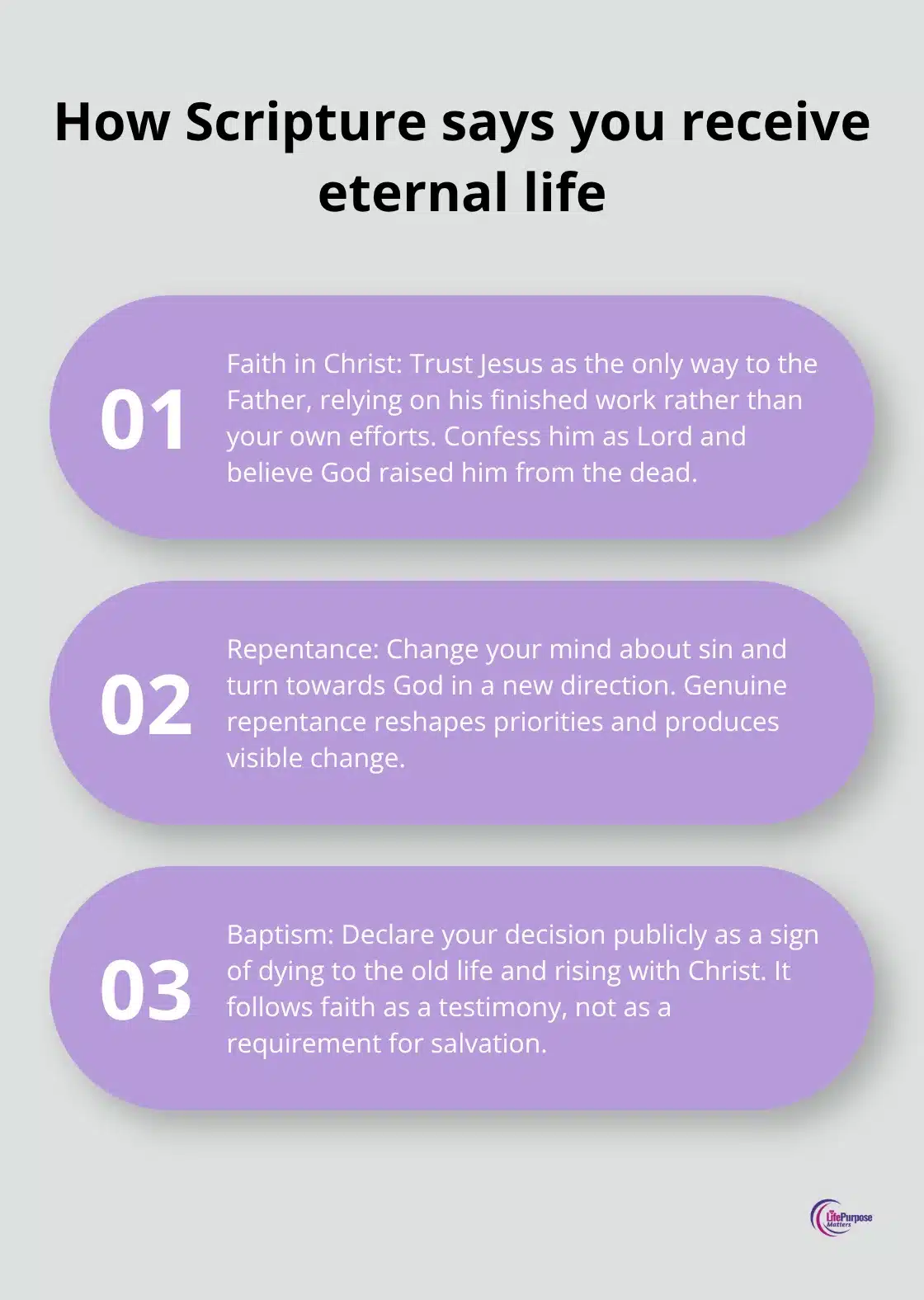
The Ethiopian eunuch in Acts 8:36-39 demonstrates immediate baptism after faith, with no delay between belief and public commitment. Modern church statistics show that 68% of Protestant churches practise baptism by immersion, which follows the New Testament pattern of full submersion that symbolises complete transformation.
Grace Defeats Works-Based Religion
Ephesians 2:8-9 settles the debate about earning eternal life through good works. Salvation comes through grace by faith, not by works, so no one can boast. This passage directly contradicts religious systems that require specific deeds, charitable giving, or ritual observance for salvation.
Titus 3:5 reinforces this truth when it declares that God saved us not because of the righteous things we had done, but because of his mercy. The Reformation emphasised this grace-based salvation, with Martin Luther’s challenge to the Catholic Church’s sale of indulgences in 1517.
Good works flow from salvation rather than creating it. James 2:17 explains that faith without works is dead, which means genuine faith naturally produces good actions as evidence of internal transformation.
These biblical requirements seem straightforward, yet many people still hold misconceptions about what the Bible actually teaches about eternal life.
Common Misconceptions About Eternal Life
Universal Salvation Contradicts Scripture
Many modern churches teach that all people eventually reach heaven regardless of their beliefs, but Jesus directly refutes this popular idea. Matthew 7:14 states that the gate is narrow and the way is hard that leads to life, and those who find it are few. The Pew Research Centre found that 70% of Americans believe people of many religions can attain eternal life, yet this contradicts Jesus’ exclusive claim in John 14:6.
Universal salvation sounds compassionate, but it ignores biblical warnings about judgment and the reality of hell. Jesus spoke more about hell than heaven in his teachings, preaching on hell as a place of endless suffering far more than he talked about heaven. Scripture presents two distinct eternal destinations, not universal redemption.
Good Deeds Never Purchase Heaven
The most dangerous misconception involves earning eternal life through charitable works, church attendance, or moral behaviour. Gallup polling shows that 77% of Americans believe good people go to heaven regardless of their religious beliefs, but Romans 3:23 declares that all have sinned and fall short of God’s glory.

Isaiah 64:6 compares our righteous acts to filthy rags before God’s perfect standard. Mother Teresa dedicated her life to serving the poor in Calcutta, yet she struggled with spiritual darkness and doubts about her salvation, according to her private letters published posthumously. Good works flow from salvation but never create it.
Eternal Life Begins Now, Not Later
Christians often postpone eternal life until after death and miss the present reality Jesus offers. John 5:24 teaches that believers have eternal life right now, not just future hope. The Greek word aionios means both eternal in duration and divine in quality, which indicates that eternal life transforms your current existence.
First John 5:13 was written so believers might know they have eternal life and provides present assurance rather than future uncertainty. This misconception causes believers to live defeated lives instead of experiencing the abundant life Jesus promised in John 10:10.
Final Thoughts
The Bible presents eternal life as God’s gift through faith in Jesus Christ, not something you earn through religious performance or good deeds. Scripture consistently teaches that salvation comes by grace through faith, with repentance and baptism as responses to God’s gift rather than requirements for it. Your spiritual transformation begins when you accept this truth and trust in Christ’s finished work on the cross.
Your spiritual journey starts with faith in Jesus as Lord and Saviour, which transforms both your present reality and future destiny. Eternal life begins the moment you believe, not after death. The narrow path Jesus described requires genuine faith and repentance, which rejects popular misconceptions about universal salvation or works-based righteousness (Romans 6:23 makes this distinction clear).
We at Life Purpose Matters help you live out your God-given purpose through faith-based encouragement. Your relationship with Christ provides the foundation for understanding your unique calling and experiencing the abundant life he promised. Take the step of faith today, knowing that God’s promise of eternal life is available to everyone who calls on the name of the Lord.